

VoiceDDB
Politics • Culture • News
oDDBall analysis of conservative politics with a libertarian economic conservative twist. Small government, big freedom.
Interested? Want to learn more about the community?
September 01, 2021
Thu 2nd Sep history

The intervention into the top end of Australia following the horrific revelation that over 90% of children in some communities had venereal disease was limited by the ALP (left wing in Aus politics). ALP had sought to end it legally. Press lined up behind ALP.

ALP were so confident in their judgement they considered the conservative (named Liberal) party would have to roll their leader after the election. History shows the Libs rolled Malcolm Turnbull before the election, and so Liberal Party won. Because woke politics espoused by Turnbull and the ALP are not popular policies.

To illustrate how bad the issue was for children in the top end of Australia before the intervention, there was the case of a seven year old girl who had had sex with several boys while watching tv when her parents were not home. Brought before a judge on charges, the boys were excused by a judge who 'sternly' warned them not to have sex with children.

The girl was placed in foster care with a loving family who took time off to tend to her emotional needs. But, they weren't Aboriginal. So the then 9 year old girl was taken away from her foster family and placed in the care of family, and began having sex with boys and young men.

So Queensland authorities placed the girl in the care of a team of psychiarists and psychologists and the child was denied contact with children her own age.

https://conservativeweasel.blogspot.com/2021/09/thu-2nd-september-2021-current-affairs.html

Interested? Want to learn more about the community?
What else you may like…
Videos
Posts
Articles
00:01:07
November 27, 2022
Jingle Bell Rock

Jingle bell, jingle bell, jingle bell rock
Jingle bells swing and jingle bells ring
Snowin' and blowin' up bushels of fun
Now the jingle hop has begun

Jingle bell, jingle bell, jingle bell rock
Jingle bells chime in jingle bell time
Dancin' and prancin' in Jingle Bell Square
In the frosty air

What a bright time, it's the right time
To rock the night away
Jingle bell time is a swell time
To go glidin' in a one-horse sleigh

Giddy-up jingle horse, pick up your feet
Jingle around the clock
Mix and a-mingle in the jinglin' feet
That's the jingle bell rock

Jingle bell, jingle bell, jingle bell rock
Jingle bell chime in jingle bell time
Dancin' and prancin' in Jingle Bell Square
In the frosty air

What a bright time, it's the right time
To rock the night away
Jingle bell time is a swell time
To go glidin' in a one-horse sleigh

Giddy-up jingle horse, pick up your feet
Jingle around the clock
Mix and a-mingle in the jinglin' feet
That's the jingle bell
That's the jingle...

00:02:04
September 01, 2021
Intro to Locals for the Conservative Voice

David Daniel Ball calls himself the Conservative Voice.

I'm a teacher with three decades experience teaching math to high school kids.I also work with first graders and kids in between first grade and high school. I know the legends of why Hypatia's dad is remembered through his contribution to Math theory. And I know the legend of why followers of Godel had thought he had disproved God's existence.

I'm not a preacher, but I am a Christian who has written over 28 books all of which include some reference to my faith. Twelve blog books on world history and current affairs, detailing world events , births and marriages on each day of the year, organised by month. Twelve books on the background to and history of Bible Quotes. One Bible quote per day for a year. An intro to a science fiction series I'm planning, post apocalyptic cyber punk. An autobiography with short story collections.

I'm known in Australia for my failure as a whistleblower over the negligence death of a school boy. ...

00:01:50
September 04, 2026
Should violent criminals be made fat? Grok says 'no'

No. Transferring gut bacteria from an obese person into a violent criminal is not a reliable, ethical, or effective way to make them “fat, sedentary, and less of a physical threat.”

The science does not deliver the outcome you want

Mouse studies in germ-free animals showed that microbiota from obese donors can increase energy harvest and adiposity compared with lean-donor microbiota. That is the origin of the idea. Human evidence is far weaker.

Randomized trials of fecal microbiota transplant (FMT) from lean donors into people with obesity have generally failed to produce meaningful, sustained weight loss. Microbiome composition can change; body weight and metabolic markers often do not, or the effects are small and inconsistent. Diet and the existing gut environment usually dominate. A 2025 Nature paper found diet outperformed microbial transplant for microbiome recovery. Human guts are already colonized, not sterile like lab mice, so engraftment is variable and effects unpredictable.

It is not a ...

post photo preview
August 28, 2026
Pfizer struggles to answer

Some in Australia are brilliant. Malcolm Roberts Investigates Pfizer over Covid vaccine.

Holiday break is over back to work tonight

Tonight I'll start double posting until I've caught up.

post photo preview
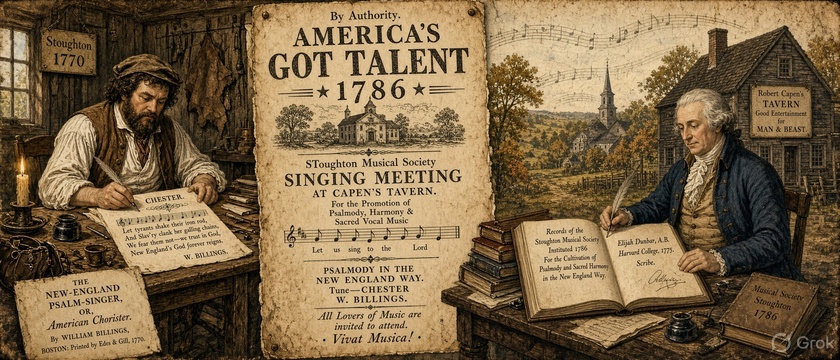
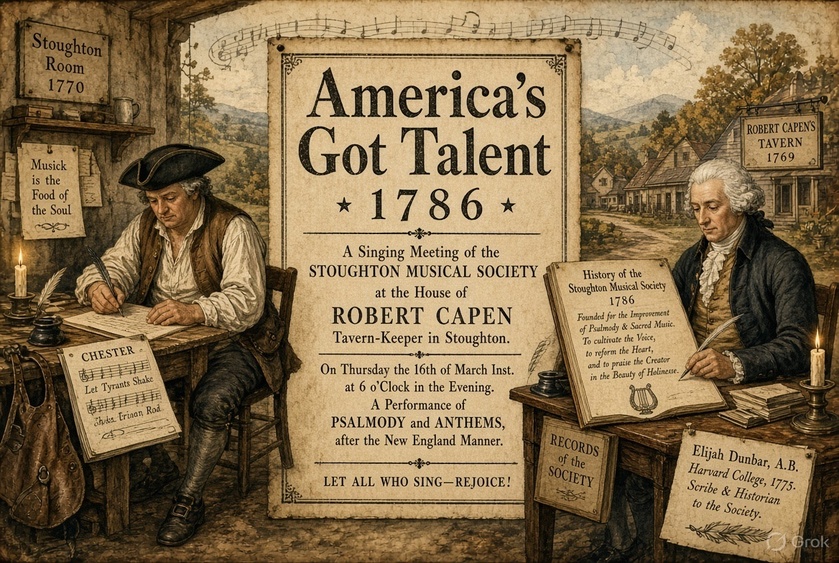
Stoughton Music Society America’s Got Talent 1786
November 7th

Stoughton Music Society America’s Got Talent 1786

Stoughton Musical Society (later Old Stoughton Musical Society), founded 7 November 1786 in Stoughton, Massachusetts, is the oldest continuously active musical organization in the United States. It grew out of local singing traditions and a pivotal 1774 singing school taught by William Billings, and it later played a key role in preserving early American (New England) psalmody after that style largely fell out of fashion in churches.

Before 1786: Local singing tradition and Billings’ influence

Singing meetings (informal “sings”) existed in the Stoughton area as early as 1762. Elijah Dunbar’s journals record about 30 such meetings in 1762–63; these were one-off events in houses or taverns, not a formal organization. Music was mostly English psalm tunes. Some later claims (especially by a rival group founded in 1802) incorrectly treated the 1762 activity as the start of a continuous society; contemporary records do not support an institutional founding that early.

In January 1774, Boston composer William Billings (1746–1800)—often called America’s first notable choral composer and a self-taught tanner by trade—taught a singing school at the tavern/house of Robert Capen in Stoughton. It is the first such school for which a complete pupil list survives (49 students). One tenor, Jacob French, later became a notable composer. Billings’ energetic, homegrown style (including fuguing tunes and patriotic pieces like “Chester”) made a lasting impression. The Revolutionary War interrupted regular musical activity, but the enthusiasm from Billings’ school persisted.

The 1786 founding and early years

On 7 November 1786, 25 men formally organized the Stoughton Musical Society at Robert Capen’s house—the same place Billings had taught. The founding members included:

  • Elijah Dunbar (1740–1814) of Canton — first president and conductor (served ~22 years); Harvard graduate, accomplished singer, and journal-keeper who documented the earlier sings.
  • Capt. Samuel Talbot — first vice president.
  • Joseph Smith, 4th — first treasurer.
  • Andrew Capen — second treasurer.
  • Others listed in the membership journal: George Wadsworth, Enoch Leonard, Elijah Crane, Samuel Capen (2nd), James Capen, Nathan Crane, Uriah Leonard, Thomas Crane, Samuel Dunbar, Jonathan Capen, Isaac Morton, David Wadsworth, Thomas Capen, Peter Crane, Samuel Tolman, Lemuel Fisher, Joseph Richards Jr., Jonathan Billings, John D. Dunbar, Jesse Billings, Atherton Wales, and more.

They purchased The Worcester Collection of Sacred Harmony (compiled by Isaiah Thomas, 1786), which contained the first American printing of Handel’s “Hallelujah Chorus.” In 1787 the society adopted its own constitution—the first known constitution of any American musical organization, written shortly after the U.S. Constitution. Early rules emphasized orderly singing (e.g., only the president beat time openly).

Around 1790 the society took part in what is regarded as America’s first documented singing contest. Challenged by the mixed-voice choir of First Parish Church in Dorchester (accompanied by a bass viol), 20 selected male voices from Stoughton, led by “Squire” Elijah Dunbar and singing unaccompanied from memory, performed Jacob French’s anthem “The Heavenly Vision” and then Handel’s “Hallelujah Chorus.” Contemporary accounts describe unbounded applause and a Stoughton victory.

Significant figures

  • William Billings — inspirational teacher and stylistic model; never a member but “gave birth” to the society through his 1774 school. Signature works associated with the group include “Chester” and “Majesty.”
  • Elijah Dunbar — founding president, conductor, and chronicler of the local tradition.
  • Jacob French (1754–1817) — pupil of the 1774 school and composer whose “The Heavenly Vision” was a highlight of the 1790 contest.
  • Later associated composers and members from the region included Supply Belcher, Samuel Capen, Edward French, and (in the 19th century) Edwin Arthur Jones and others. Musicologist Roger Lee Hall has been a major modern chronicler and advocate, helping document the society’s claims (including Guinness recognition in the 1980s as the oldest U.S. choral society).

After 1786: Preservation amid changing tastes

In the early-to-mid 19th century, reformers such as Lowell Mason promoted European classical styles and pushed the older, more vigorous New England psalmody (Billings and contemporaries) out of many churches. The Stoughton society continued to sing and collect this music when it was unfashionable elsewhere, becoming an important repository of the tradition. They published collections (e.g., the 1878 Stoughton Collection of Church Music / Centennial Collection) that kept 18th-century American tunes alive.

The society was incorporated in 1908 under Massachusetts law and renamed the Old Stoughton Musical Society. It has given at least one performance most years since 1786, maintained a broad American repertoire with a special focus on early New England composers, and performed at events such as the 1893 World’s Columbian Exposition in Chicago. A second, more restrictive group (The Musical Society in Stoughton, founded 1802 and limited to town residents) existed in parallel for many decades and disbanded in 1982; the 1786 society is the continuous one.

Today the Old Stoughton Musical Society remains active as a 501(c)(3) organization dedicated to preserving, promoting, and performing American choral music, especially early New England works. Its longevity and role in safeguarding a distinctly American sacred music style make the 1786 founding a landmark in U.S. musical history.

The story is one of continuity: informal local sings → Billings’ energetic school → formal society in the early republic → stubborn preservation of a native style against later Europeanizing trends.

= November 7th

These events are commonly listed for 7 November (not 5 November) in standard historical calendars. November 5 is better known for the Gunpowder Plot (Guy Fawkes, 1605). The battle in 1426 spanned roughly 5–7 November. Here is context for each:

335 – Athanasius banished to Trier
Athanasius of Alexandria (c. 296/298–373), bishop and leading defender of Nicene orthodoxy against Arianism, was deposed by a synod at Tyre (influenced by pro-Arian bishops) and then banished by Emperor Constantine I. The decisive charge was that he had (or would) block the vital Egyptian grain fleet to Constantinople—an accusation of near-treason that touched the empire’s food supply. He was sent to Trier (Treveri/Augusta Treverorum), then a western imperial residence. This was his first of five exiles; he returned after Constantine’s death in 337. Athanasius is remembered as a key Church Father and defender of the Trinity.

680 – Sixth Ecumenical Council begins in Constantinople
The Third Council of Constantinople (Sixth Ecumenical Council, 680–681) opened under Emperor Constantine IV. It addressed Monothelitism (the claim that Christ had two natures but only one will). The council affirmed two wills and two operations in Christ, consistent with the Chalcedonian definition of two natures. It met in the Trullo hall of the imperial palace; roughly 170–300 bishops participated (with papal and other patriarchal representation). Sessions continued into 681.

921 – Treaty of Bonn
Frankish kings Charles the Simple (West Franks / West Francia) and Henry the Fowler (East Franks / East Francia) signed a “pact of friendship” (amicitia) recognizing their mutual legitimacy and the Rhine as the approximate border. The ceremony took place on a ship in the middle of the Rhine near Bonn so neither entered the other’s territory. It confirmed the division of the former Carolingian realm but proved short-lived; by the mid-920s Henry had annexed Lotharingia and Charles was overthrown.

1426 – Battle of Tốt Động – Chúc Động (Lam Sơn uprising)
In the Red River Delta near Đông Quan (modern Hanoi area), Vietnamese Lam Sơn rebels under commanders such as Lý Triện, Đinh Lễ and others ambushed and routed a much larger Ming Chinese army under Wang Tong. The fighting (roughly 5–7 November) was a turning point in the 14-year uprising led by Lê Lợi. Heavy Ming losses (tens of thousands by Vietnamese accounts) forced the Chinese to abandon major offensives; Vietnamese independence was secured by 1428. Hand cannons and ambush tactics were key.

1492 – Ensisheim meteorite
The oldest well-documented European stony meteorite fall with surviving material struck a wheat field outside Ensisheim (then Alsace, now France) around noon on 7 November. It was an LL6 ordinary chondrite weighing about 127 kg; it created a roughly 1 m deep crater and was seen as a fireball from a distance. King Maximilian I later treated it as a favourable omen, and pieces were removed while the main mass was secured (and later chained) in a church to prevent further damage or “wandering.” Most of the original mass was gradually chipped away over centuries; the remainder is displayed in Ensisheim.

1619 – Elizabeth Stuart crowned Queen of Bohemia
Elizabeth Stuart (daughter of James VI/I of Scotland/England) was crowned at St Vitus Cathedral in Prague on 7 November, three days after her husband Frederick V of the Palatinate was crowned king. Bohemian Protestant nobles had offered him the throne amid the crisis that opened the Thirty Years’ War. Their reign was brief (“Winter King and Queen”); they were defeated at White Mountain in 1620 and went into exile. Their children included Prince Rupert of the Rhine.

1665 – London Gazette first published
The official journal of record (initially the Oxford Gazette) appeared on 7 November while Charles II’s court was in Oxford to escape the Great Plague in London. It was “Published by Authority,” carried official news, shipping and court information, and was posted to subscribers. It moved with the court and became the London Gazette in early 1666; it remains the oldest continuously published newspaper in the United Kingdom and the UK government’s official gazette.

1775 – Lord Dunmore’s Proclamation
John Murray, 4th Earl of Dunmore and royal governor of Virginia, issued the proclamation from aboard ship off Norfolk. It declared martial law and offered freedom to indentured servants, enslaved people (“Negroes”), or others belonging to rebels who would join British forces. It was the first large-scale emancipation offer of its kind in the North American colonies, recruited Black Loyalists (including into the Ethiopian Regiment), and heightened colonial fears of slave insurrection, accelerating support for independence among many slaveholders.

1786 – Stoughton Musical Society founded
Twenty-five men in Stoughton, Massachusetts, formally organized the society on 7 November, inspired by a 1774 singing school taught by composer William Billings. It is the oldest continuously active musical organization in the United States (later incorporated as the Old Stoughton Musical Society). Early activities included purchasing American sacred music collections and participating in what is regarded as the first documented singing contest in America (c. 1790). It helped preserve early New England psalmody.

These episodes span church politics, imperial diplomacy, anti-colonial warfare, celestial events, royal ambition, official journalism, Revolutionary-era emancipation offers, and early American cultural institutions. Dates can vary slightly by source or calendar convention; the 7 November association is the one most frequently used for this cluster.
Read full Article
post photo preview
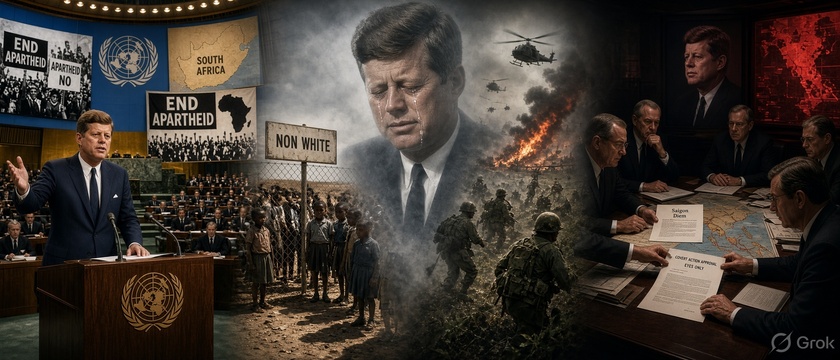
JFK tried
November 6th

JFK tried

These two events both occurred on (or were dated to) 6 November in successive years.

1962 – UN General Assembly Resolution 1761 condemning apartheid

On 6 November 1962 the UN General Assembly adopted Resolution 1761 (XVII), “The policies of apartheid of the Government of the Republic of South Africa.”

The resolution:

  • Deplored South Africa’s refusal to abandon its racial policies and its disregard of the UN Charter.
  • Declared that the continuance of apartheid seriously endangered international peace and security.
  • Called on member states, separately or collectively, to take measures including breaking diplomatic relations (or not establishing them), closing ports to vessels flying the South African flag, prohibiting their own ships from entering South African ports, boycotting South African goods, and suspending landing rights for South African aircraft.
  • Established a Special Committee on the Policies of Apartheid to keep the situation under review.

It passed by 67 votes to 16, with 23 abstentions. South Africa itself, along with several Western states (including the United Kingdom, the United States, Australia, Belgium, Canada, and Portugal), voted against or abstained. The resolution was non-binding.

Context and significance. Apartheid had been formalised after the 1948 election victory of the National Party. International condemnation intensified after the 1960 Sharpeville massacre, in which police killed 69 unarmed Black protesters. Resolution 1761 was one of the strongest early UN calls for diplomatic, economic, and military isolation. Western powers and South Africa’s main trading partners largely resisted full sanctions at the time, but the resolution marked a clear shift toward treating apartheid as an international issue. Later UN measures, including an arms embargo and the eventual designation of apartheid as a crime against humanity, built on this foundation. South Africa was suspended from the General Assembly in 1974; apartheid formally ended in the early 1990s.

1963 – General Dương Văn Minh assumes leadership of South Vietnam

On 1–2 November 1963 a group of South Vietnamese generals staged a coup against President Ngô Đình Diệm. Diệm and his influential brother Ngô Đình Nhu were captured and killed (officially reported as suicide, but widely understood to have been executed). In the following days the coup leaders consolidated power; by 6 November, General Dương Văn Minh (“Big Minh”) was recognised as the head of the new Military Revolutionary Committee and effectively the leader of South Vietnam.

Key figures.

  • Dương Văn Minh (1916–2001): Senior army officer, popular with many officers and the Americans. He chaired the Military Revolutionary Committee. Real power rested with the military junta rather than any civilian figurehead.
  • Ngô Đình Diệm: President since 1955; increasingly authoritarian, especially in the suppression of Buddhist protests in 1963. His removal had the tacit awareness (and, according to some accounts, encouragement) of the U.S. Embassy under Ambassador Henry Cabot Lodge.
  • Other junta members included Generals Trần Văn Đôn and Tôn Thất Đính. A civilian, Nguyễn Ngọc Thơ, was named premier, but the military committee held ultimate authority. The constitution was suspended, the National Assembly dissolved, and martial law declared.

Aftermath. Minh’s government was short-lived and ineffective. He was ousted in a bloodless coup led by General Nguyễn Khánh on 30 January 1964. South Vietnam then entered a period of rapid political instability with successive coups and juntas. Minh later served briefly as the last president of South Vietnam in April 1975 and oversaw the formal surrender to North Vietnamese forces.

The 1963 coup is widely regarded as a turning point: it removed a leader the United States had supported for years, deepened U.S. involvement, and contributed to the political chaos that characterised South Vietnam until its collapse in 1975. President Kennedy was reportedly shocked by the assassinations of Diệm and Nhu.

Both events reflected the intensifying Cold War and decolonisation pressures of the early 1960s—one through multilateral diplomatic condemnation of racial policies, the other through a U.S.-influenced military takeover that accelerated the Vietnam War.

= 6th November

These events all took place on 6 November in their respective years. Here is a concise overview of each:

355 – Elevation of Julian to Caesar

Roman Emperor Constantius II promoted his cousin Julian (later known as Julian the Apostate) to the rank of Caesar at Mediolanum (modern Milan). Julian, then about 23–24 and a scholarly, inexperienced figure who had spent much of his life under supervision studying Greek philosophy and Neoplatonism, was given responsibility for the Prefecture of the Gauls (the Western provinces).

The appointment came after Constantius had executed Julian’s half-brother Gallus and faced ongoing Germanic threats and a recent revolt in Gaul. Julian was married to Constantius’s sister Helena and sent west with limited forces and oversight. He proved unexpectedly successful as a military and administrative leader, defeating Alemanni and Franks and restoring order. In 360 his troops proclaimed him Augustus; after Constantius’s death in 361, Julian became sole emperor (361–363).

963 – Synod of Rome and deposition of Pope John XII

Emperor Otto I convened a synod in St. Peter’s Basilica in Rome beginning on 6 November. Pope John XII (who had crowned Otto emperor in 962) faced charges including simony, perjury, murder, adultery, incest, and breaking his oath of loyalty by plotting against Otto. John refused to appear, excommunicated the participants from afar, and fled. The synod deposed him (formally on 4 December) and elected the layman Leo (as Leo VIII) in his place.

This was a significant assertion of imperial authority over the papacy. After Otto left, John returned, overturned the acts, and the situation remained contested until later events.

1217 – Charter of the Forest

The Charter of the Forest was sealed at Old St Paul’s Cathedral in London by the young King Henry III (acting under the regency of William Marshal, 1st Earl of Pembroke). Issued as a companion to the reissued Magna Carta, it restored rights of access for free men to the royal forests that had been heavily restricted and expanded by William the Conqueror and his successors.

Key provisions limited the extent of royal forest, reduced harsh forest-law punishments, and allowed free men to use wood, pasture, and other resources on forest land under certain conditions. It remained influential for centuries (some elements lasted until the 20th century) and is regarded as an important early statement of common rights over land and resources.

1528 – Cabeza de Vaca reaches Texas

Shipwrecked Spanish conquistador Álvar Núñez Cabeza de Vaca (of the failed Narváez expedition) and surviving companions washed ashore on or near what is now Galveston Island (or a nearby Texas barrier island) on 6 November. This is widely regarded as the first known European landing in the area that became Texas.

The expedition had collapsed after landing in Florida; survivors built crude rafts and tried to reach Mexico. Storms separated them; only a handful eventually survived years of hardship, captivity, and travel among Indigenous peoples across the Gulf Coast and interior before reaching Spanish settlements in northern Mexico in 1536. Cabeza de Vaca’s later account is a major early source on the peoples and geography of the region.

1789 – Appointment of the first U.S. Catholic bishop

Pope Pius VI appointed Father John Carroll as the first Catholic bishop in the United States (Bishop of Baltimore, with jurisdiction over the entire country) on 6 November. Carroll, a Maryland Jesuit from a prominent family, had previously served as prefect apostolic and was recommended by the American clergy.

He was consecrated the following year (15 August 1790) in England. As the first American bishop he organised the Church in the new republic, founded institutions including Georgetown College (later University), and worked to establish a native clergy and seminaries while navigating relations with both Rome and the U.S. government.

1792 – Battle of Jemappes

In the French Revolutionary Wars (War of the First Coalition), French forces under General Charles-François Dumouriez defeated an Austrian army commanded by Duke Albert of Saxe-Teschen near Jemappes (in the Austrian Netherlands, modern Belgium) on 6 November. The French, with a large force of volunteers, outnumbered the Austrians and carried a prepared position on a ridge after hard fighting.

It was one of the first major offensive victories for the armies of the young French Republic. The French quickly overran the Austrian Netherlands (including Brussels), though they later lost the territory at the Battle of Neerwinden. The battle demonstrated the effectiveness of the new revolutionary armies against professional European forces.

These events span late antiquity, the medieval period, the Age of Exploration, the American founding era, and the French Revolution, illustrating a range of political, religious, legal, and military developments on the same calendar date.

Read full Article
November 04, 2026
post photo preview
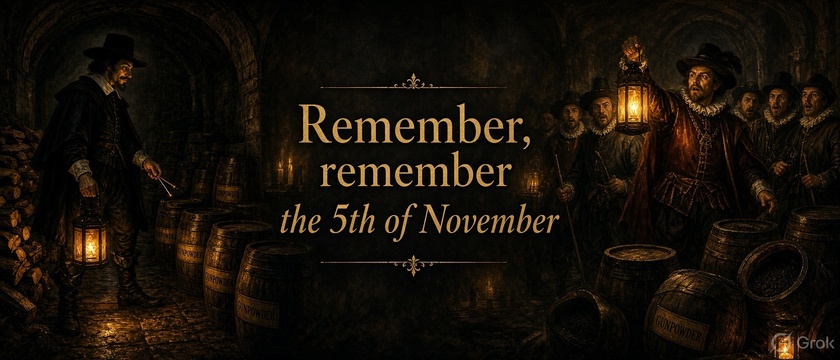
Remember remember
The 5th November

Remember Remember

The Gunpowder Plot of 1605 was a failed attempt by a group of English Catholics to assassinate King James I and the Protestant political leadership by blowing up the House of Lords during the State Opening of Parliament on 5 November. It is the origin of the annual British tradition of Guy Fawkes Night (Bonfire Night).

Context before 1605

Under Elizabeth I (r. 1558–1603), English Catholics faced severe restrictions: recusancy fines for non-attendance at Church of England services, execution of missionary priests as traitors, and the after-effects of the 1570 papal bull excommunicating Elizabeth. Many Catholics hoped for relief when James VI of Scotland (son of the Catholic Mary, Queen of Scots) became James I of England in 1603. James initially signalled moderation and privately suggested he would not harshly persecute those who gave outward obedience. However, hopes faded quickly. In February 1604 he ordered Catholic priests to leave the country and reimposed recusancy fines. The 1604 Treaty of London ended the long war with Spain without securing any religious concessions for English Catholics. By late 1604–1605, persecution had intensified again, creating deep disappointment among some Catholic gentry.

Significant figures

The plot was driven by a small circle of mostly Midlands Catholic gentlemen linked by kinship and shared frustration. The original inner group of five (sworn to secrecy in May 1604 at the Duck and Drake inn in the Strand) were:

  • Robert Catesby (c. 1572–1605): The charismatic leader and originator of the scheme. A tall, athletic Northamptonshire gentleman of old Catholic stock whose father had been imprisoned for recusancy. He had previously been involved in the Earl of Essex’s 1601 rebellion. He conceived the plan to destroy Parliament and the king in one blow.
  • Thomas Wintour (or Winter; c. 1571–1606): Catesby’s cousin; acted as a diplomat and recruiter. He travelled to the Spanish Netherlands seeking support (unsuccessfully) and brought Guy Fawkes into the plot.
  • John (Jack) Wright (c. 1568–1605): A skilled swordsman and long-time associate; brother-in-law of Thomas Percy.
  • Thomas Percy (c. 1560–1605): A kinsman and agent of the Earl of Northumberland. He rented the property near the House of Lords and provided a respectable front. He was also tasked with seizing the young Prince Charles after the explosion.
  • Guy (Guido) Fawkes (1570–1606): A Yorkshire-born soldier who had fought for the Spanish in the Low Countries and had practical experience with mining and explosives. Recruited for his military skills and relative anonymity in England. He used the alias John Johnson while guarding the gunpowder. He was the man found and arrested in the cellar.

Later recruits (bringing the total to 13 main conspirators) included Christopher (Kit) Wright (John’s brother), Robert Wintour (Thomas’s brother), Robert Keyes, Thomas Bates (Catesby’s servant), John Grant, Ambrose Rookwood (who provided money and horses), Sir Everard Digby (who was to organise a Midlands rising and seize Princess Elizabeth), and Francis Tresham (who is widely suspected of sending the anonymous warning letter to Lord Monteagle, his brother-in-law). Jesuit priest Henry Garnet was later implicated for knowledge of the plot (he claimed he was bound by the seal of confession) and was executed.

The plan was to kill James, his eldest son Henry, and the leading ministers, then proclaim the nine-year-old Princess Elizabeth as a puppet queen who could be married to a Catholic prince. A rising in the Midlands was intended to support the coup. They first tried to dig a tunnel under the House of Lords; when that proved impractical they rented a cellar directly beneath it and stocked it with 36 barrels of gunpowder.

The night of 4–5 November 1605 and immediate aftermath

An anonymous letter warning Lord Monteagle not to attend the opening of Parliament was shown to the authorities. After a delay, a search on the night of 4–5 November discovered Fawkes (with matches and fuses) and the gunpowder. He was arrested, taken to the Tower of London, and tortured (on James’s explicit orders, using the rack). He eventually confessed and named his co-conspirators.

Most of the others fled north. On 8 November they made a last stand at Holbeach House in Staffordshire. Catesby, Percy, and both Wright brothers were killed in the fighting; others were wounded and captured. Eight surviving conspirators were tried for high treason in January 1606 and sentenced to be hanged, drawn, and quartered. Executions took place on 30–31 January 1606 (some in St Paul’s Churchyard, Fawkes and others in Old Palace Yard at Westminster). Fawkes famously jumped from the gallows, breaking his neck and dying before the full mutilation. Francis Tresham died in the Tower (possibly of illness); Henry Garnet was also executed.

After 1605

The plot’s failure led to stricter anti-Catholic measures, including the 1606 Popish Recusants Act, which required Catholics to take an Oath of Allegiance denying the Pope’s power to depose monarchs. It reinforced Protestant fears and propaganda that Catholics (especially Jesuits) were disloyal and dangerous. Parliament quickly established 5 November as a day of public thanksgiving. This evolved into Guy Fawkes Night / Bonfire Night, traditionally marked by bonfires, fireworks, and the burning of effigies (“guys”). The custom continues in Britain today, though its original religious edge has largely faded into a more general autumn celebration.

In short, the Gunpowder Plot was born of the gap between Catholic hopes raised by James’s accession and the continued reality of persecution. Its dramatic failure permanently associated Guy Fawkes’s name with the date and cemented anti-Catholic legislation and sentiment for generations.

= The 5th November

These are notable events that occurred on 5 November in various years. Here is a concise overview of each:

1138 – Lý Anh Tông enthroned as emperor of Vietnam

Lý Anh Tông (born Lý Thiên Tộ in 1136) became the sixth emperor of the Lý dynasty of Đại Việt at about two years old after the death of his father, Lý Thần Tông. He reigned until 1175 (roughly 37 years). His mother and court officials (including regents such as Đỗ Anh Vũ) governed during his minority. His reign is generally seen as the last relatively stable period of the Lý dynasty before later turbulence.

1499 – Publication of the Catholicon

Jehan Lagadeuc of Tréguier (Brittany) wrote this trilingual (Breton–French–Latin) dictionary in 1464. Printed in 1499 (often associated with Tréguier or nearby), it is the first printed Breton dictionary and an important early French lexicographical work. It contains roughly 6,000 entries focused on everyday and scholarly vocabulary and was intended to help Breton speakers learn French and Latin. It is regarded as the foundational printed dictionary for Breton.

1605 – Gunpowder Plot: Guy Fawkes is arrested

In the early hours of 5 November 1605, Guy Fawkes (also known as John Johnson) was discovered and arrested in a cellar beneath the House of Lords. He was guarding about 36 barrels of gunpowder intended to blow up King James I and Parliament during the opening of the session. The plot, organised by Robert Catesby and other English Catholics, aimed to kill the Protestant king and leadership and install a Catholic regime (with James’s daughter Elizabeth as a puppet). A warning letter to Lord Monteagle had prompted the search. Fawkes and the other conspirators were later executed; the failure of the plot is still commemorated in Britain as Guy Fawkes Night / Bonfire Night with fireworks and bonfires.

1688 – William III of England lands with a Dutch fleet at Brixham

William of Orange (later William III) landed at Brixham in Torbay, Devon, on 5 November 1688 with a Dutch fleet and roughly 14,000 troops. This was the start of the Glorious Revolution. Invited by English Protestants opposed to the Catholic James II, William’s largely unopposed landing led to James’s flight and William and Mary’s joint accession. It is remembered as a key moment in the establishment of parliamentary sovereignty and the Protestant succession.

1757 – Battle of Rossbach (Seven Years’ War)

Frederick the Great of Prussia, with about 22,000 men, decisively defeated a larger allied force of roughly 41,000 French and Holy Roman Empire (Imperial) troops under the Prince de Soubise and Prince Joseph of Saxe-Hildburghausen near Rossbach in Saxony. The battle lasted about 90 minutes and was a striking example of Prussian tactical superiority (especially cavalry and rapid manoeuvre). Prussian losses were light (around 550); allied losses were heavy (thousands killed, wounded, or captured). The victory restored Frederick’s reputation after earlier setbacks, encouraged British subsidies, and is regarded as a turning point in the war.

1768 – Treaty of Fort Stanwix

Signed on 5 November 1768 at Fort Stanwix (near present-day Rome, New York) between Sir William Johnson (for Britain) and the Haudenosaunee (Iroquois Six Nations), with colonial representatives present. It adjusted the boundary established by the 1763 Royal Proclamation, ceding large areas (including much of what became Kentucky and parts of present-day West Virginia and Pennsylvania) to the Crown. The Haudenosaunee received substantial payments. The treaty opened vast tracts west of the Appalachians to colonial settlement and speculation but was controversial, as some of the land lay outside strict Iroquois control and later contributed to frontier conflicts.

1780 – Defeat of French-American forces under Colonel LaBalme by Miami Chief Little Turtle

In early November 1780 (commonly dated 5 or 6 November), a force of French and Canadien irregulars under Colonel Augustin de La Balme, operating in support of the American side during the Revolutionary War, was ambushed and destroyed near the Eel River (in present-day Indiana) by Miami warriors led by Chief Little Turtle (Mishikinakwa). La Balme had sacked the Miami town of Kekionga (near modern Fort Wayne) while marching toward British-held Detroit. Little Turtle’s victory was decisive, established his reputation as a military leader, and effectively ended the expedition. It foreshadowed his later successes in the Northwest Indian War.

These events span medieval Vietnamese history, early modern European printing and politics, the Seven Years’ War, colonial North American land treaties, and the American Revolutionary frontier. The best-known in the English-speaking world is the Gunpowder Plot and the subsequent Guy Fawkes Night tradition.

Read full Article
See More
Available on mobile and TV devices
google store google store app store app store
google store google store app tv store app tv store amazon store amazon store roku store roku store
Powered by Locals