



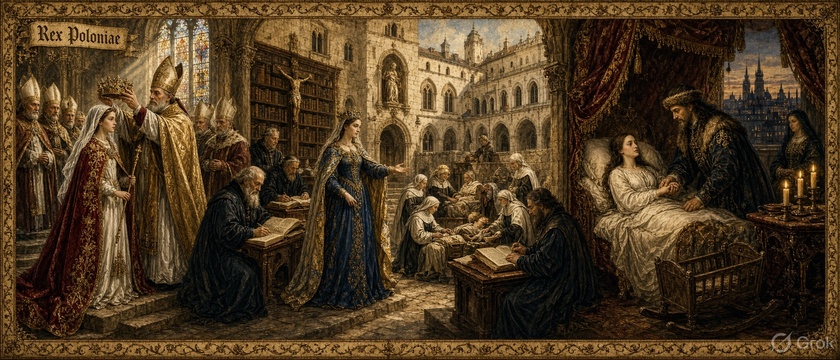
Jadwiga crowned King of Poland
Jadwiga (Hedwig/Hedvig; born between October 1373 and February 1374 in Buda, died 17 July 1399 in Kraków) was the youngest of the three daughters of Louis I the Great (King of Hungary 1342–1382 and King of Poland 1370–1382) and Elizabeth of Bosnia. Louis had no sons. Through his mother, Elizabeth of Poland (daughter of Władysław I Łokietek), he had a Piast claim to Poland and succeeded his childless maternal uncle Casimir III the Great in 1370 under earlier agreements.
In the Privilege of Koszyce (Košice) of 1374, Louis secured noble recognition of his daughters’ succession rights in exchange for significant privileges (reduced taxes, military obligations limited largely to defending the kingdom). He initially designated his eldest daughter Catherine for Poland and Jadwiga for Hungary. Catherine died in 1378. Mary (engaged to Sigismund of Luxembourg) was then intended for Poland, with Jadwiga for Hungary. Jadwiga was provisionally betrothed in 1375/1378 (ceremony at Hainburg) to William of Habsburg (Duke of Austria); she spent time in Vienna. The match was never fully consummated.
Louis died on the night of 10/11 September 1382. Within days the Hungarian elites crowned the elder daughter Mary as king of Hungary under her mother Elizabeth’s influence, ending the personal union. Polish nobles (especially the powerful lords of Lesser Poland) refused to accept Mary and Sigismund or continued absentee rule from Hungary. They insisted on a resident daughter of Louis. After roughly two years of negotiations, civil unrest (including in Greater Poland), and pressure (including threats of electing someone else), Elizabeth of Bosnia sent the approximately 10-year-old Jadwiga to Poland. She arrived in Kraków around 12–13 October 1384.
Rival candidates had included Siemowit IV of Masovia (a Piast) and Sigismund. Archbishop Bodzanta of Gniezno had at times leaned toward Siemowit.
The Coronation (16 October 1384)
On Sunday, 16 October 1384, in Wawel Cathedral, Kraków, Archbishop Bodzanta of Gniezno crowned Jadwiga. Contemporary and near-contemporary sources (including Jan Długosz) and the traditional scholarly consensus describe her as crowned rex (“king”) rather than regina (“queen”)—in regem Poloniae coronata. This emphasized that she was a sovereign monarch in her own right, not a consort. Polish custom and law treated the ruler as “king”; there was no established form for a queen regnant, and the masculine title helped preserve the crown’s full authority and prevent any future husband from automatically taking the title without noble consent.
A large gathering of clergy, nobles, and burghers welcomed her. No formal regent was appointed; the lords of Lesser Poland (in contact with Elizabeth) effectively guided government while she was a minor. Her main early advisers included Archbishop Bodzanta, Bishop Jan Radlica of Kraków, Bishop Dobrogost of Poznań, and figures such as Duke Władysław of Opole. Her formal style included “Hedvigis Dei gratia rex/regina Poloniae...” along with titles over specific Polish lands.
Significant Figures and Immediate Aftermath
- Elizabeth of Bosnia: Mother and key negotiator; later involved in Hungarian politics and was murdered in 1387 amid civil strife.
- Mary of Hungary and Sigismund of Luxembourg: Elder sister and her fiancé/husband; the Polish rejection of them ended the Angevin dual monarchy.
- William of Habsburg: Childhood betrothed. In 1385 he came to Kraków hoping to consummate and validate the match. Polish nobles expelled him. Jadwiga publicly renounced the childhood betrothal (sources vary on her personal feelings and any attempts to join him). The Church accepted it as unconsummated.
- Jogaila (Jogaila/Jagiello), Grand Duke of Lithuania: The preferred political match. On 14 August 1385 at Krewo (Kreva), he issued the Act of Krewo promising: baptism of himself, his family, and subjects into Roman Catholicism; marriage to Jadwiga; compensation (traditionally cited around 200,000 florins) to William; recovery of certain Polish lands; and association of Lithuania and its Ruthenian territories with the Polish Crown.
- He was baptized in Kraków on 15 February 1386 as Władysław, married Jadwiga on 18 February 1386 in Wawel Cathedral, and crowned King of Poland jure uxoris by Bodzanta on 4 March 1386. They ruled jointly while she lived; she remained a leading figure.
- Other notables: Lesser Poland magnates who drove the policy; later Vytautas the Great (Jogaila’s cousin) in Lithuania; Teutonic Knights as a major external threat that the union helped counter.
Results and Longer-Term Consequences
The marriage and Act of Krewo created a personal union between Poland and Lithuania that lasted, in evolving forms, until the Union of Lublin (1569) and the Polish-Lithuanian Commonwealth. It Christianized the last major pagan realm in Europe (the Lithuanian core), shifted the regional balance of power (especially against the Teutonic Order), and integrated large Orthodox Ruthenian territories. Poland gained a powerful partner and ended the short Angevin personal union with Hungary.
Jadwiga and Jogaila had one child, a daughter Elizabeth Bonifacia (born 22 June 1399). The infant died after about three weeks (c. 13 July); Jadwiga died of postpartum complications on 17 July 1399, aged about 25. They were buried together in Wawel Cathedral. With no surviving heir, she was Poland’s last hereditary ruler; subsequent kings (starting with her husband and the Jagiellonian dynasty) were elective.
While she lived she was an active co-ruler and patron of religion, charity, and learning. She supported the restoration and expansion of the University of Kraków (later the Jagiellonian University), founded or aided hospitals, churches, and a Lithuanian college in Prague, and promoted the Christianization and cultural ties of the united lands. Her early death left succession and governance more fully in Jogaila’s hands (he later married Anna of Cilli as she advised).
She was venerated soon after death, beatified in 1979, and canonized by Pope John Paul II on 8 June 1997 (feast day 17 July or 28 February in some calendars). She remains a major figure in Polish history as the child sovereign whose coronation and marriage launched the Polish-Lithuanian union and the Jagiellonian era.
Primary narrative sources include Jan Długosz’s 15th-century Annales; documentary evidence includes the Privilege of Koszyce, the Act of Krewo, and cathedral calendars. Some details (exact feelings about William, precise legal force of “attachment” of Lithuania, minor date variants) remain debated among historians.
= October 16th
456 – Ricimer defeats Emperor Avitus at Piacenza
Flavius Ricimer (a Germanic general of Suebic/Visigothic descent serving as magister militum) and the comes domesticorum Majorian rebelled against the short-reigning Western Roman Emperor Eparchius Avitus (r. 455–456). After killing Avitus’s magister militum Remistus near Ravenna in September, they faced Avitus’s remaining forces near Placentia (modern Piacenza) in northern Italy. Contemporary and near-contemporary sources place the battle on 17 or 18 October (some later accounts say the 16th). Avitus was defeated, his army shattered, and his commander Messianus killed. Ricimer spared Avitus’s life but forced him to abdicate and become Bishop of Piacenza. Avitus died soon afterward (accounts vary between starvation, execution, or natural causes while fleeing). Ricimer emerged as the dominant power in the West, effectively the “maker of emperors” for the next 16 years, installing a series of short-lived puppet rulers while the Western Empire continued to fragment.
690 – Wu Zetian ascends the throne
Wu Zhao (Wu Zetian), already the de facto ruler of Tang China for decades (first as empress consort to Gaozong, then as empress dowager controlling her sons), formally took the throne. On 16 October 690 she proclaimed the Zhou dynasty (named after the ancient Zhou, from which she claimed descent), changed the imperial surname, and ruled as huangdi (emperor) under titles such as “Sacred and Divine Emperor.” She is the only woman in Chinese imperial history to rule in her own name and right. Her formal enthronement or related ceremonies are sometimes dated a few days later (around 19 October), but 16 October is the conventional date for the proclamation of the dynasty and her accession. She ruled until a palace coup forced her abdication in 705.
955 – Battle on the Raxa (Recknitz)
King Otto I of Germany (later Holy Roman Emperor) defeated a coalition of Slavic tribes, primarily the Obotrites under Nako and his brother Stoigniew (Stoinef/Stoignew), near the Raxa river (most often identified with the Recknitz in present-day Mecklenburg-Vorpommern). The battle followed Otto’s decisive victory over the Magyars at the Lechfeld in August. Otto’s forces (drawn from across the German kingdom, with Bohemian allies) used a feint and secretly built bridges to cross the river, routing the Slavs. Stoigniew was killed (his head displayed the next day), and roughly 700 captives were executed. The victory consolidated Otto’s control of the Billung March and was a high point of his reign.
1384 – Jadwiga crowned King of Poland
Jadwiga (Hedwig) of Anjou, roughly 10–11 years old and the youngest daughter of Louis I of Hungary and Poland, was crowned rex (“king”) rather than regina (“queen”) in Wawel Cathedral, Kraków. The masculine title underscored that she was a sovereign in her own right, not a consort; Polish law had no formal provision for a queen regnant. She reigned until her death in 1399. Her later marriage to the pagan Grand Duke Jogaila of Lithuania (who converted and became Władysław II Jagiełło) created the Polish-Lithuanian union that shaped East-Central European history for centuries. She was later canonized.
1590 – Carlo Gesualdo murders his wife and her lover
Carlo Gesualdo, Prince of Venosa and Count of Conza (and later a renowned composer of chromatic madrigals), caught his wife Donna Maria d’Avalos in bed with her lover Fabrizio Carafa, Duke of Andria, at the Palazzo San Severo in Naples. Accompanied by armed retainers, he murdered both (accounts describe multiple stab wounds, gunshots, and extreme violence; Maria’s throat was cut). The killing was treated as an “honour” crime under contemporary Neapolitan aristocratic norms; Gesualdo faced little legal consequence and retreated to his estates. The episode became inseparable from his later reputation as a tormented, innovative composer.
1780 – Royalton and Tunbridge raids
British Lieutenant Richard Houghton, with about 300 Mohawk (and some Abenaki) warriors from Kahnawake, raided settlements along Vermont’s White River Valley. On 16 October they attacked and burned Royalton, Sharon, and Tunbridge, killing a few settlers, taking roughly 26 prisoners (later marched to Canada), and destroying homes and livestock. Local Vermont militia pursued them but broke off after threats to the captives. It was the last major British-led Indigenous raid in New England during the Revolutionary War.
1793 – Execution of Marie Antoinette and the Battle of Wattignies
- Marie Antoinette: The former queen of France (widow of Louis XVI, executed in January) was tried by the Revolutionary Tribunal on charges including treason and conspiracy with foreign powers. Found guilty in the early hours of 16 October, she was guillotined that afternoon at the Place de la Révolution (now Place de la Concorde) in Paris, at the height of the Reign of Terror. She was about 37–38 years old.
- Battle of Wattignies: Fought 15–16 October near Maubeuge during the War of the First Coalition. French forces under Jean-Baptiste Jourdan (with Lazare Carnot of the Committee of Public Safety present) defeated a Coalition (mainly Austrian) covering force under Prince Josias of Saxe-Coburg and Count Clerfayt. The victory raised the siege of Maubeuge and temporarily checked the Allied advance into northern France. The same day as Marie Antoinette’s execution.
These events illustrate the date’s range: late Roman power struggles, the sole female Chinese emperor, medieval German-Slavic warfare, a female sovereign in Poland, a notorious Renaissance murder, the closing phase of the American Revolution in New England, and the radical peak of the French Revolution. Sources sometimes differ by a day or two on the precise dating of the 456 battle and the exact ceremonial timing of Wu Zetian’s proclamation, but 16 October is the conventional anniversary for all of them.