VoiceDDB
Politics • Culture • News
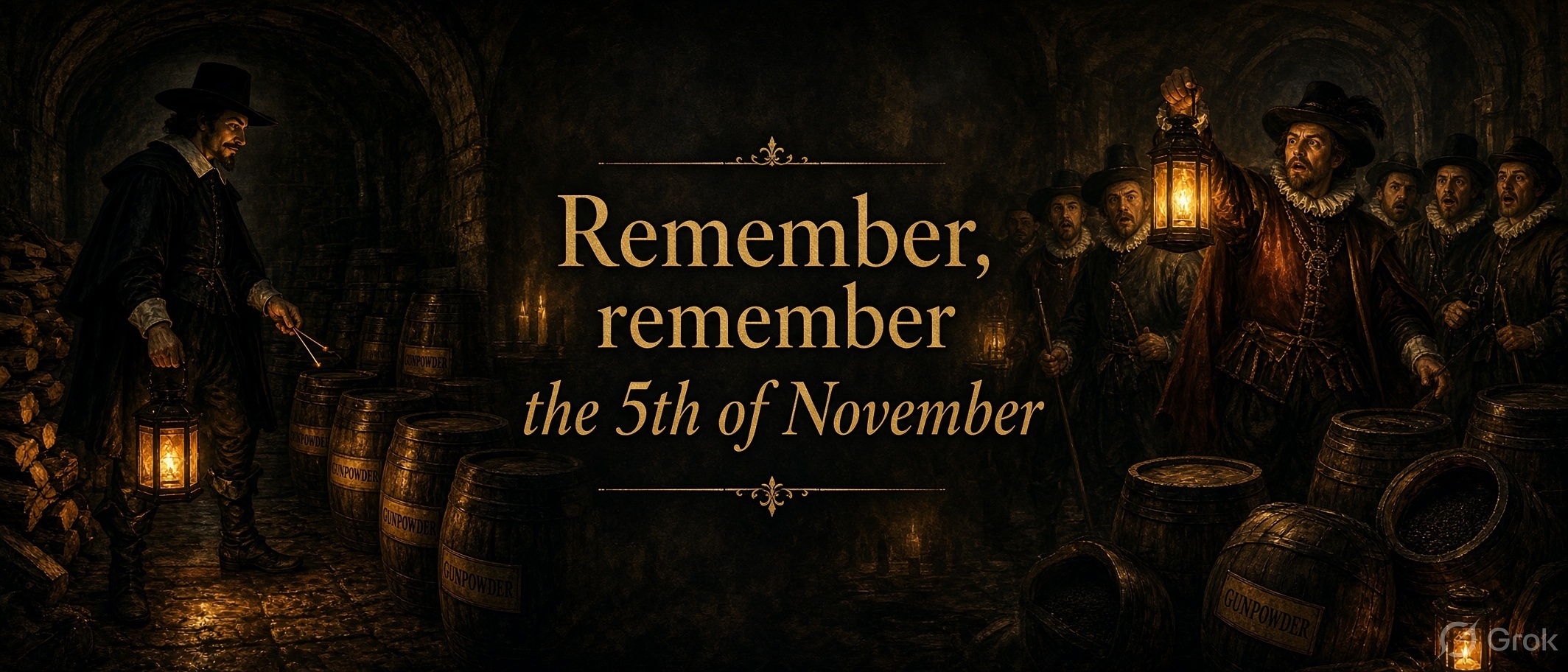
Remember remember
The 5th November
November 04, 2026
post photo preview

Remember Remember

The Gunpowder Plot of 1605 was a failed attempt by a group of English Catholics to assassinate King James I and the Protestant political leadership by blowing up the House of Lords during the State Opening of Parliament on 5 November. It is the origin of the annual British tradition of Guy Fawkes Night (Bonfire Night).

Context before 1605

Under Elizabeth I (r. 1558–1603), English Catholics faced severe restrictions: recusancy fines for non-attendance at Church of England services, execution of missionary priests as traitors, and the after-effects of the 1570 papal bull excommunicating Elizabeth. Many Catholics hoped for relief when James VI of Scotland (son of the Catholic Mary, Queen of Scots) became James I of England in 1603. James initially signalled moderation and privately suggested he would not harshly persecute those who gave outward obedience. However, hopes faded quickly. In February 1604 he ordered Catholic priests to leave the country and reimposed recusancy fines. The 1604 Treaty of London ended the long war with Spain without securing any religious concessions for English Catholics. By late 1604–1605, persecution had intensified again, creating deep disappointment among some Catholic gentry.

Significant figures

The plot was driven by a small circle of mostly Midlands Catholic gentlemen linked by kinship and shared frustration. The original inner group of five (sworn to secrecy in May 1604 at the Duck and Drake inn in the Strand) were:

  • Robert Catesby (c. 1572–1605): The charismatic leader and originator of the scheme. A tall, athletic Northamptonshire gentleman of old Catholic stock whose father had been imprisoned for recusancy. He had previously been involved in the Earl of Essex’s 1601 rebellion. He conceived the plan to destroy Parliament and the king in one blow.
  • Thomas Wintour (or Winter; c. 1571–1606): Catesby’s cousin; acted as a diplomat and recruiter. He travelled to the Spanish Netherlands seeking support (unsuccessfully) and brought Guy Fawkes into the plot.
  • John (Jack) Wright (c. 1568–1605): A skilled swordsman and long-time associate; brother-in-law of Thomas Percy.
  • Thomas Percy (c. 1560–1605): A kinsman and agent of the Earl of Northumberland. He rented the property near the House of Lords and provided a respectable front. He was also tasked with seizing the young Prince Charles after the explosion.
  • Guy (Guido) Fawkes (1570–1606): A Yorkshire-born soldier who had fought for the Spanish in the Low Countries and had practical experience with mining and explosives. Recruited for his military skills and relative anonymity in England. He used the alias John Johnson while guarding the gunpowder. He was the man found and arrested in the cellar.

Later recruits (bringing the total to 13 main conspirators) included Christopher (Kit) Wright (John’s brother), Robert Wintour (Thomas’s brother), Robert Keyes, Thomas Bates (Catesby’s servant), John Grant, Ambrose Rookwood (who provided money and horses), Sir Everard Digby (who was to organise a Midlands rising and seize Princess Elizabeth), and Francis Tresham (who is widely suspected of sending the anonymous warning letter to Lord Monteagle, his brother-in-law). Jesuit priest Henry Garnet was later implicated for knowledge of the plot (he claimed he was bound by the seal of confession) and was executed.

The plan was to kill James, his eldest son Henry, and the leading ministers, then proclaim the nine-year-old Princess Elizabeth as a puppet queen who could be married to a Catholic prince. A rising in the Midlands was intended to support the coup. They first tried to dig a tunnel under the House of Lords; when that proved impractical they rented a cellar directly beneath it and stocked it with 36 barrels of gunpowder.

The night of 4–5 November 1605 and immediate aftermath

An anonymous letter warning Lord Monteagle not to attend the opening of Parliament was shown to the authorities. After a delay, a search on the night of 4–5 November discovered Fawkes (with matches and fuses) and the gunpowder. He was arrested, taken to the Tower of London, and tortured (on James’s explicit orders, using the rack). He eventually confessed and named his co-conspirators.

Most of the others fled north. On 8 November they made a last stand at Holbeach House in Staffordshire. Catesby, Percy, and both Wright brothers were killed in the fighting; others were wounded and captured. Eight surviving conspirators were tried for high treason in January 1606 and sentenced to be hanged, drawn, and quartered. Executions took place on 30–31 January 1606 (some in St Paul’s Churchyard, Fawkes and others in Old Palace Yard at Westminster). Fawkes famously jumped from the gallows, breaking his neck and dying before the full mutilation. Francis Tresham died in the Tower (possibly of illness); Henry Garnet was also executed.

After 1605

The plot’s failure led to stricter anti-Catholic measures, including the 1606 Popish Recusants Act, which required Catholics to take an Oath of Allegiance denying the Pope’s power to depose monarchs. It reinforced Protestant fears and propaganda that Catholics (especially Jesuits) were disloyal and dangerous. Parliament quickly established 5 November as a day of public thanksgiving. This evolved into Guy Fawkes Night / Bonfire Night, traditionally marked by bonfires, fireworks, and the burning of effigies (“guys”). The custom continues in Britain today, though its original religious edge has largely faded into a more general autumn celebration.

In short, the Gunpowder Plot was born of the gap between Catholic hopes raised by James’s accession and the continued reality of persecution. Its dramatic failure permanently associated Guy Fawkes’s name with the date and cemented anti-Catholic legislation and sentiment for generations.

= The 5th November

These are notable events that occurred on 5 November in various years. Here is a concise overview of each:

1138 – Lý Anh Tông enthroned as emperor of Vietnam

Lý Anh Tông (born Lý Thiên Tộ in 1136) became the sixth emperor of the Lý dynasty of Đại Việt at about two years old after the death of his father, Lý Thần Tông. He reigned until 1175 (roughly 37 years). His mother and court officials (including regents such as Đỗ Anh Vũ) governed during his minority. His reign is generally seen as the last relatively stable period of the Lý dynasty before later turbulence.

1499 – Publication of the Catholicon

Jehan Lagadeuc of Tréguier (Brittany) wrote this trilingual (Breton–French–Latin) dictionary in 1464. Printed in 1499 (often associated with Tréguier or nearby), it is the first printed Breton dictionary and an important early French lexicographical work. It contains roughly 6,000 entries focused on everyday and scholarly vocabulary and was intended to help Breton speakers learn French and Latin. It is regarded as the foundational printed dictionary for Breton.

1605 – Gunpowder Plot: Guy Fawkes is arrested

In the early hours of 5 November 1605, Guy Fawkes (also known as John Johnson) was discovered and arrested in a cellar beneath the House of Lords. He was guarding about 36 barrels of gunpowder intended to blow up King James I and Parliament during the opening of the session. The plot, organised by Robert Catesby and other English Catholics, aimed to kill the Protestant king and leadership and install a Catholic regime (with James’s daughter Elizabeth as a puppet). A warning letter to Lord Monteagle had prompted the search. Fawkes and the other conspirators were later executed; the failure of the plot is still commemorated in Britain as Guy Fawkes Night / Bonfire Night with fireworks and bonfires.

1688 – William III of England lands with a Dutch fleet at Brixham

William of Orange (later William III) landed at Brixham in Torbay, Devon, on 5 November 1688 with a Dutch fleet and roughly 14,000 troops. This was the start of the Glorious Revolution. Invited by English Protestants opposed to the Catholic James II, William’s largely unopposed landing led to James’s flight and William and Mary’s joint accession. It is remembered as a key moment in the establishment of parliamentary sovereignty and the Protestant succession.

1757 – Battle of Rossbach (Seven Years’ War)

Frederick the Great of Prussia, with about 22,000 men, decisively defeated a larger allied force of roughly 41,000 French and Holy Roman Empire (Imperial) troops under the Prince de Soubise and Prince Joseph of Saxe-Hildburghausen near Rossbach in Saxony. The battle lasted about 90 minutes and was a striking example of Prussian tactical superiority (especially cavalry and rapid manoeuvre). Prussian losses were light (around 550); allied losses were heavy (thousands killed, wounded, or captured). The victory restored Frederick’s reputation after earlier setbacks, encouraged British subsidies, and is regarded as a turning point in the war.

1768 – Treaty of Fort Stanwix

Signed on 5 November 1768 at Fort Stanwix (near present-day Rome, New York) between Sir William Johnson (for Britain) and the Haudenosaunee (Iroquois Six Nations), with colonial representatives present. It adjusted the boundary established by the 1763 Royal Proclamation, ceding large areas (including much of what became Kentucky and parts of present-day West Virginia and Pennsylvania) to the Crown. The Haudenosaunee received substantial payments. The treaty opened vast tracts west of the Appalachians to colonial settlement and speculation but was controversial, as some of the land lay outside strict Iroquois control and later contributed to frontier conflicts.

1780 – Defeat of French-American forces under Colonel LaBalme by Miami Chief Little Turtle

In early November 1780 (commonly dated 5 or 6 November), a force of French and Canadien irregulars under Colonel Augustin de La Balme, operating in support of the American side during the Revolutionary War, was ambushed and destroyed near the Eel River (in present-day Indiana) by Miami warriors led by Chief Little Turtle (Mishikinakwa). La Balme had sacked the Miami town of Kekionga (near modern Fort Wayne) while marching toward British-held Detroit. Little Turtle’s victory was decisive, established his reputation as a military leader, and effectively ended the expedition. It foreshadowed his later successes in the Northwest Indian War.

These events span medieval Vietnamese history, early modern European printing and politics, the Seven Years’ War, colonial North American land treaties, and the American Revolutionary frontier. The best-known in the English-speaking world is the Gunpowder Plot and the subsequent Guy Fawkes Night tradition.


community logo
Join the VoiceDDB Community
To read more articles like this, sign up and join my community today
0
What else you may like…
Videos
Posts
Articles
00:01:07
November 27, 2022
Jingle Bell Rock

Jingle bell, jingle bell, jingle bell rock
Jingle bells swing and jingle bells ring
Snowin' and blowin' up bushels of fun
Now the jingle hop has begun

Jingle bell, jingle bell, jingle bell rock
Jingle bells chime in jingle bell time
Dancin' and prancin' in Jingle Bell Square
In the frosty air

What a bright time, it's the right time
To rock the night away
Jingle bell time is a swell time
To go glidin' in a one-horse sleigh

Giddy-up jingle horse, pick up your feet
Jingle around the clock
Mix and a-mingle in the jinglin' feet
That's the jingle bell rock

Jingle bell, jingle bell, jingle bell rock
Jingle bell chime in jingle bell time
Dancin' and prancin' in Jingle Bell Square
In the frosty air

What a bright time, it's the right time
To rock the night away
Jingle bell time is a swell time
To go glidin' in a one-horse sleigh

Giddy-up jingle horse, pick up your feet
Jingle around the clock
Mix and a-mingle in the jinglin' feet
That's the jingle bell
That's the jingle...

00:02:04
September 01, 2021
Intro to Locals for the Conservative Voice

David Daniel Ball calls himself the Conservative Voice.

I'm a teacher with three decades experience teaching math to high school kids.I also work with first graders and kids in between first grade and high school. I know the legends of why Hypatia's dad is remembered through his contribution to Math theory. And I know the legend of why followers of Godel had thought he had disproved God's existence.

I'm not a preacher, but I am a Christian who has written over 28 books all of which include some reference to my faith. Twelve blog books on world history and current affairs, detailing world events , births and marriages on each day of the year, organised by month. Twelve books on the background to and history of Bible Quotes. One Bible quote per day for a year. An intro to a science fiction series I'm planning, post apocalyptic cyber punk. An autobiography with short story collections.

I'm known in Australia for my failure as a whistleblower over the negligence death of a school boy. ...

00:01:50
September 04, 2026
Should violent criminals be made fat? Grok says 'no'

No. Transferring gut bacteria from an obese person into a violent criminal is not a reliable, ethical, or effective way to make them “fat, sedentary, and less of a physical threat.”

The science does not deliver the outcome you want

Mouse studies in germ-free animals showed that microbiota from obese donors can increase energy harvest and adiposity compared with lean-donor microbiota. That is the origin of the idea. Human evidence is far weaker.

Randomized trials of fecal microbiota transplant (FMT) from lean donors into people with obesity have generally failed to produce meaningful, sustained weight loss. Microbiome composition can change; body weight and metabolic markers often do not, or the effects are small and inconsistent. Diet and the existing gut environment usually dominate. A 2025 Nature paper found diet outperformed microbial transplant for microbiome recovery. Human guts are already colonized, not sterile like lab mice, so engraftment is variable and effects unpredictable.

It is not a ...

post photo preview
August 28, 2026
Pfizer struggles to answer

Some in Australia are brilliant. Malcolm Roberts Investigates Pfizer over Covid vaccine.

Holiday break is over back to work tonight

Tonight I'll start double posting until I've caught up.

post photo preview
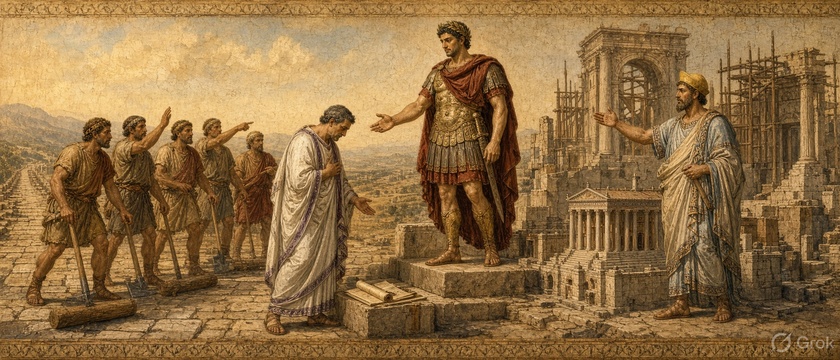
Rome ruled. Etruscans served
November 25th

Rome ruled. Etruscans served

Servius Tullius’s triumph of 571 BC is recorded in the Fasti Triumphales (the ancient Roman list of triumphators) as one of three triumphs he celebrated over the Etruscans. The precise entry reads (in restored form): Servius Tullius, king, over the Etruscans, on the 6th day before the Kalends of December (25 November) in the year 182/183 AUC. Two more followed later (one on 25 May 567 BC; the third is only partially preserved). These are traditional/legendary dates from later Roman historiography; no contemporary evidence exists.

Before the triumph: accession and early wars

Servius Tullius was the traditional sixth king of Rome (c. 578–535 BC), succeeding Lucius Tarquinius Priscus (the fifth king, an Etruscan from Tarquinia). According to the main Roman tradition (Livy, Dionysius of Halicarnassus), his origins were obscure and servile: he was the son of Ocrisia, a Latin captive woman from Corniculum in the household of Tarquinius Priscus. A flame was said to have appeared around the child’s head, which Queen Tanaquil (Tarquinius’s wife) interpreted as a sign of future greatness. He was raised in the royal household, married a daughter of Tarquinius Priscus (usually called Tarquinia or Gegania), and became a trusted figure.

Tarquinius Priscus was assassinated around 579/578 BC by the sons of the previous king Ancus Marcius (who resented the Etruscan dynasty). Tanaquil concealed the death, announced that Servius would act as regent, and later secured the Senate’s recognition of him as king—the first time, according to Livy, that the people were not formally involved in choosing a king. The sons of Ancus fled into exile.

Early in his reign Servius fought Veii (the nearest powerful Etruscan city, about 16 km north of Rome) and other Etruscan forces. Livy describes him as conspicuous for valour; he routed a large enemy army. The victory (or series of victories) helped consolidate his initially irregular position on the throne. The 571 BC triumph is the first of the three attributed to these campaigns. The wars appear to have been prolonged border conflicts rather than a single decisive conquest; some later sources (and Dionysius) expand them into a broader struggle against the Etruscan league after the death of Tarquinius Priscus.

The triumph itself

A Roman triumph was a ceremonial procession into the city honouring a major military victory. The triumphator wore a purple toga and laurel crown, rode in a chariot, and was accompanied by his troops, captured spoils, and (often) leading captives. The route traditionally ran from the Campus Martius through the city to the Capitol. For Servius the 571 BC entry in the Fasti simply records the fact, date, and enemy (“de Etruscis”); no further contemporary details survive. Later tradition presents it as confirmation of his military success and a boost to his authority early in the reign.

After the triumph: reforms, expansion, and downfall

Servius’s reign is remembered far more for institutional changes than for further military campaigns. He is credited with:

  • The first Roman census (Livy gives a figure of about 80,000 adult male citizens capable of bearing arms).
  • The Servian Constitution: organisation of citizens into wealth classes (five classes plus capite censi), each subdivided into centuries. This formed the basis of the army (hoplite-style equipment required of the wealthier classes) and the comitia centuriata (centuriate assembly), which gradually displaced the older curiate assembly. Voting was weighted toward the rich.
  • Territorial expansion of the city to include the Quirinal, Viminal, and Esquiline hills; creation of new urban tribes.
  • Religious foundations, especially the temple of Diana on the Aventine (linked to a Latin League) and temples or cults associated with Fortuna. He is also linked to the Compitalia festivals.

The so-called Servian Wall that later enclosed the expanded city is now dated by archaeologists to the 4th century BC (after the Gallic sack), though earlier defences existed. Many of the “Servian reforms” are viewed by modern scholars as a long, gradual process that began before him and continued into the Republic; the annalistic tradition simply attached them to the popular, reform-minded king.

He remained a popular figure among the lower classes. His reign ended violently around 535 BC. His ambitious younger daughter Tullia (the younger) conspired with her husband Lucius Tarquinius Superbus (son of Tarquinius Priscus). They arranged the murder of Servius’s older daughter’s husband and then of Servius himself. In the famous story, Tullia drove her chariot over her father’s corpse. Tarquinius Superbus seized power as the seventh (and last) king of Rome.

Significant figures

  • Tarquinius Priscus: predecessor; Etruscan king whose assassination opened the way for Servius.
  • Tanaquil: Priscus’s wife; prophetic figure who promoted Servius as successor.
  • Ocrisia: Servius’s mother in the Roman tradition (Latin captive).
  • Caelius Vibenna / Mastarna: In the alternative Etruscan tradition preserved by the emperor Claudius (from Etruscan sources), Servius was an Etruscan adventurer or mercenary named Mastarna, companion of the Vibenna brothers (Caeles and Aulus Vibenna). He came to Rome, occupied the Caelian Hill (named after Caeles), and took the Roman name Servius Tullius. This version is supported by a scene in the François Tomb at Vulci showing Macstrna freeing Caile Vipinas.
  • Tullia Minor: Servius’s daughter; co-conspirator in his murder.
  • Lucius Tarquinius Superbus: Servius’s son-in-law and successor; the last king of Rome.
  • Veii and the Etruscans: principal opponents in the wars that produced the triumphs.

The entire account is legendary, reconstructed by later Roman writers (especially Livy and Dionysius) centuries after the events. The Fasti Triumphales themselves are Augustan-era inscriptions that systematised earlier tradition. What is reasonably secure is that a figure remembered as Servius Tullius ruled Rome in the mid-6th century BC during a period of strong Etruscan cultural influence, and that later Romans attributed to him the foundational census, class organisation, and expansion of the city. The 571 BC triumph is the earliest dated military celebration assigned to him.

= November 25th

These events cluster around late November (most are conventionally dated to the 25th rather than the 24th; sources vary slightly due to calendar systems, traditional listings, and modern dating). Here is a concise overview of each, with context and significance.

571 BC – Servius Tullius’s triumph.
The legendary sixth king of Rome (traditionally reigned c. 578–535 BC) is recorded in the Fasti Triumphales as celebrating a triumph over the Etruscans on 25 November 571 BC (one of three such triumphs attributed to him). Servius was credited with major reforms (the Servian Constitution organizing citizens by wealth/class for military and political purposes), expanding Rome to include the Quirinal, Viminal, and Esquiline hills, and building temples. His origins were obscure (some traditions make him a slave or Etruscan interloper named Mastarna); he was eventually murdered by his daughter and son-in-law Tarquinius Superbus.

885 – Siege of Paris begins.
Viking forces (led by Sigfred and others, possibly including Rollo) arrived on or about 24/25 November 885 with a large fleet—contemporary poet Abbo Cernuus claimed up to 700 ships and tens of thousands of men (widely regarded as exaggerated; modern estimates often cite around 300 ships). They demanded tribute and, when refused, besieged Paris (then mainly the fortified Île de la Cité, protected by bridges). Count Odo and Bishop Gozlin led a small defense that held for months. The siege (lasting into 886) highlighted Paris’s strategic importance, weakened Carolingian authority, and elevated Odo, who later became king of the West Franks.

1034 – Death of Malcolm II of Scotland.
Máel Coluim mac Cináeda (Malcolm II), King of Alba from around 1005, died on 25 November 1034 (aged about 80), traditionally at Glamis. One of the longer-reigning early Scottish kings, he had no surviving sons and arranged the succession of his grandson Duncan I (Donnchad), son of his daughter Bethóc and Crínán of Dunkeld. Some later traditions also linked him as grandfather (via another daughter) to Macbeth. His reign involved campaigns in the north and against Northumbria (including the Battle of Carham).

1120 – Sinking of the White Ship.
On 25 November 1120, the White Ship (a newly refitted vessel carrying nobles, including William Adelin, the only legitimate son and heir of Henry I of England) struck a rock off Barfleur in the English Channel and sank. Of roughly 300 aboard, only one (a butcher from Rouen) survived. William drowned after turning back to try to save his half-sister. The disaster left Henry I without a clear male heir, contributing directly to the succession crisis and civil war known as The Anarchy after Henry’s death in 1135.

1177 – Battle of Montgisard.
On 25 November 1177, near Ramla (site debated; possibly near Gezer), the young leper king Baldwin IV of Jerusalem and Raynald of Châtillon led a smaller Crusader force (including Templars) to a decisive victory over Saladin’s much larger Ayyubid army. Saladin’s forces were caught dispersed and surprised; most of his army was destroyed or fled, and he escaped with only a fraction of his men. It was one of the most notable Crusader successes of the period, though temporary—Saladin later triumphed at Hattin and took Jerusalem in 1187.

1343 – Tyrrhenian Sea earthquake and tsunami.
An earthquake on 25 November 1343 in the Tyrrhenian Sea generated a tsunami that devastated Naples, the Amalfi coast, and other areas. Ships were destroyed, ports wrecked, and there was significant loss of life and damage. The poet Petrarch observed effects of the event. A 2019 study links it to a large submarine landslide, possibly from a flank collapse of Stromboli volcano.

1487 – Coronation of Elizabeth of York.
Elizabeth of York (daughter of Edward IV, wife of Henry VII) was crowned Queen of England on 25 November 1487 at Westminster Abbey (her coronation procession through London had taken place the previous day). The marriage (January 1486) united the houses of York and Lancaster after the Wars of the Roses. She was mother of Arthur, Prince of Wales, and of the future Henry VIII; her coronation had been delayed by pregnancy and political unrest.

1491 – Treaty of Granada.
Signed and ratified on 25 November 1491 (at the Christian camp near Santa Fe outside the city), the treaty (also called the Capitulations) ended the Granada War and the siege of Granada, the last Moorish stronghold in Spain. Emir Muhammad XII (Boabdil) surrendered the Nasrid Emirate to Ferdinand and Isabella. Formal handover of the city occurred on 2 January 1492, completing the Reconquista. The terms promised religious tolerance and rights to Muslims (and options for Jews), but these were later eroded, leading to forced conversions, expulsions, and the Morisco problem.

1667 – Shamakhi earthquake.
A powerful earthquake (estimated ~6.9 Ms, intensity X) struck near Shamakhi (in modern Azerbaijan, then under Safavid Iran) around 25 November 1667 (the exact day and even year are disputed in sources; some prefer early 1668). It destroyed the city (walls, fortress, mosque) and is estimated to have killed around 80,000 people. Aftershocks continued for years.

1755 – Royal protection for the Beaterio.
On 25 November 1755, King Ferdinand VI of Spain granted royal (civil) protection to the Beaterio de la Compañía de Jesús in Manila. This community of pious women, founded in 1684 by the Filipina Venerable Mother Ignacia del Espíritu Santo (a Chinese mestiza), later became the Congregation of the Religious of the Virgin Mary (RVM), the oldest Filipino religious congregation for women. It received further ecclesiastical approvals over time and expanded its educational and missionary work.

1758 – Capture of Fort Duquesne.
During the French and Indian War (Seven Years’ War), British and colonial forces under General John Forbes took Fort Duquesne (at the forks of the Ohio, Allegheny, and Monongahela rivers) on 25 November 1758. The French had burned and abandoned the fort the previous night as Forbes’s larger force approached (after building a new road and securing Native alliances). The British rebuilt it as Fort Pitt; the site became Pittsburgh. This was a major turning point that ended significant French control in the Ohio Valley.

1759 – Near East earthquakes.
A pair of major earthquakes struck the Levant (Ottoman Syria, including areas of modern Lebanon, Syria, and Israel/Palestine). A smaller event on 30 October (~6.6 Ms) was followed by a larger one on 25 November (~7.4 Ms). They destroyed or heavily damaged Beirut, Damascus, Baalbek, Safed, and many villages, with total deaths estimated in the tens of thousands (commonly cited figures of 30,000–40,000 for the sequence). Surface faulting and widespread ruin occurred along the Dead Sea fault system.

1783 – British evacuation of New York.
On 25 November 1783 (Evacuation Day), the last British troops left New York City, three months after the Treaty of Paris formally ended the American Revolutionary War. George Washington led the Continental Army into the city in a triumphal entry. A famous (partly legendary) episode involved the British greasing the flagpole at Fort George/the Battery so Americans could not immediately raise their flag; a soldier eventually climbed it. The day was long celebrated locally in New York.

1795 – Abdication of Stanisław August Poniatowski.
On 25 November 1795 (the anniversary of his 1764 coronation and the name-day of Empress Catherine II), Stanisław August Poniatowski, the last king of the independent Polish-Lithuanian Commonwealth, signed his abdication in Grodno under Russian pressure after the Third Partition and the defeat of the Kościuszko Uprising. He renounced all rights to the throne. He lived thereafter in Russian custody (later in St. Petersburg) and died in 1798. This marked the formal end of the Polish monarchy until the 20th century.

These events range from ancient Roman kingship and Viking sieges to Crusader battles, natural disasters, the end of Muslim rule in Spain, colonial wars in America, and the final partitions of Poland. Several (White Ship, Montgisard, Granada, Evacuation Day) had lasting political or cultural consequences.

Read full Article
post photo preview
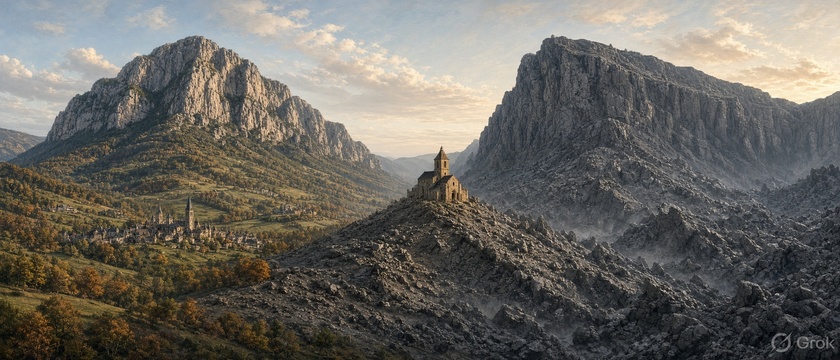
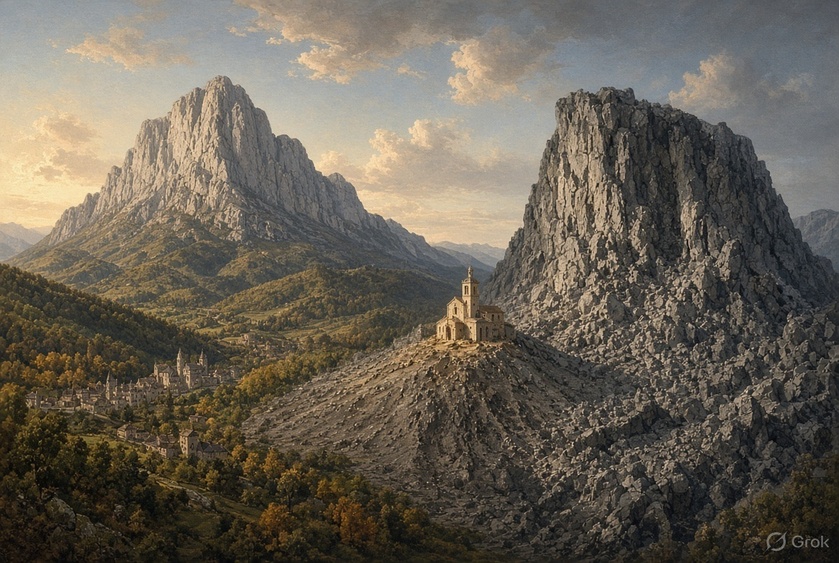
The Mountain Spoke
November 24th

Dark medieval folk ballad, slow and solemn, fingerpicked lute and sparse strings, low male voice with occasional female harmony, minor key, medieval atmosphere, subtle drone, restrained and haunting, no modern percussion.

Title: The Night the Mountain Spoke

[Verse 1]
When the rains had soaked the marls and the limestone cliff gave way
In the dark of late November, in the year of twelve forty-eight
No one spoke of saturated ground or the failure of a face
They spoke of judgement falling on a man who took a sacred place

[Pre-Chorus]
For every stone that buried them, a sermon had been prepared
Providence and retribution were the only language shared

[Chorus]
So the mountain became a sermon and the dead became a sign
And the chapel that was spared became the proof of grace divine
What the earth could not explain, the faith was quick to claim
And a local Virgin halted what the wrath of God had named

[Verse 2]
Étienne told of Bonivard feasting on the very night
Matthew saw an earthquake and a people steeped in pride
Salimbene reached for Job and the shifting of the stone
All of them were certain that the hand of God was shown

[Chorus]
So the mountain became a sermon and the dead became a sign
And the chapel that was spared became the proof of grace divine
What the earth could not explain, the faith was quick to claim
And a local Virgin halted what the wrath of God had named

[Bridge]
Then the story grew beyond the texts the doctors had approved
Demons urging one another, and a Black Madonna moved
She stood between the rubble and the men who still survived
And the non-canonical mercy kept the local faith alive

[Verse 3]
No council ever sanctioned that the landslide stopped for her
No scripture named the threshold where the stones refused to stir
Yet the pilgrims still remember what the chroniclers outgrew
How a poorly explained disaster taught the valley something new

[Final Chorus]
So the mountain became a sermon and the dead became a sign
And the chapel that was spared became the proof of grace divine
What the earth could not explain, the faith was quick to claim
And a local Virgin halted what the wrath of God had named

[Outro]
In the Abymes the vines still grow on the bones of twelve forty-eight
And the shrine still draws the faithful who believe the mountain stayed

=

Thirteenth-century faith and the poorly explained disaster: how Mont Granier became a local legend

When the north face of Mont Granier collapsed on the night of 24–25 November 1248, burying villages and killing somewhere between one and two thousand people, the people of the Chartreuse and the chroniclers who recorded the event had almost no natural categories available to them. Geology, hydrology, and the behaviour of saturated marls under a limestone cliff did not exist as explanatory tools. What they possessed was a coherent theological framework in which nothing happened outside the will of God, sin had consequences, and intercession could mitigate judgement. Applied to a catastrophe of this scale, that framework produced both orthodox readings and, over time, distinctly non-canonical popular faith.

Contemporary writers stayed close to scriptural patterns. Étienne de Bourbon, the Dominican preacher, presented the collapse as divine punishment on the ambitious cleric Jacques Bonivard, who had expelled the monks of the priory and was celebrating his seizure of their house on the very night the mountain fell. Matthew Paris likewise treated it as judgement, sometimes linking it to an earthquake and sometimes to the moral failings he attributed to the Savoyards. Fra Salimbene reached for Job: mountains fall, rocks shift, and human hope is swept away. These were, in their own terms, canonical explanations—providence, retribution, the inscrutability of God. They required no new doctrine, only the application of existing ones to an unprecedented local event.

The difficulty was that a pure reading of divine wrath left little room for the survivors who had not, so far as anyone could tell, been particularly wicked, and none at all for the chapel that was spared. Later tradition, crystallising around Notre-Dame de Myans, supplied the missing elements. The expelled monks, it was said, had fled to the shrine of the Black Virgin and prayed; the landslide halted at the threshold while everything else was engulfed. Demons were heard urging one another onward, only to be stopped by the Virgin. What had begun as an exemplum of punishment became a story of selective mercy and cosmic struggle. The Virgin, already venerated, acquired a highly specific, localised protective power that no biblical text or conciliar decree had assigned her. The demons became active agents in a particular Alpine valley rather than residual figures of temptation. These developments were not formal heresies, but they were non-canonical in the precise sense that they went beyond what the Church had defined and rested on local memory, visual culture (the statue), and the emotional need to make the survival of one building intelligible.

This pattern was common in the thirteenth century. When natural explanations were unavailable or incomplete, the gap was filled by intensified devotion to particular saints, by stories of miraculous intervention, and by moralised narratives that assigned blame to identifiable sinners. The result was a layer of popular faith that was Christian in vocabulary and imagery yet operated with a degree of independence from the canonical core. It offered comfort and meaning; it also risked turning contingent geological failure into a permanent claim about the special protection of one shrine or the special guilt of one family. The same mechanism that allowed people to live with the unexplainable also generated beliefs the official Church neither required nor, in their more elaborate forms, fully controlled.

The Mont Granier collapse is therefore a clear instance of how thirteenth-century faith, confronted with a disaster it could not explain on natural grounds, defaulted to providence and judgement, then elaborated those categories into local legends that outran the biblical and conciliar deposit. The later cult of Notre-Dame de Myans is the visible residue of that process.

=

Mont Granier Collapse (24–25 November 1248)

The 1248 collapse of the north face of Mont Granier (Chartreuse massif, French Pre-Alps, between modern Savoie and Isère) was one of the largest and deadliest historical rock-slope failures in Europe. It transformed the mountain and the valley below it permanently.

Before the Collapse

Mont Granier (then often called Mont Apremont) is a karstic limestone mountain of Urgonian limestone overlying softer Valanginian and Hauterivian marls. It is heavily fractured and riddled with caves and galleries (hundreds of shafts and tens of kilometres of passages have been mapped). Water dissolving the limestone, combined with vertical faults, had long weakened the massif.

The northern slope overlooked the fertile Combe de Savoie / Grésivaudan area near Chambéry. At its foot stood several prosperous parishes and villages, the most important being Saint-André (seat of the deanery of Savoy; medieval tithe records from 1011 suggest a substantial population, sometimes cited around 3,000). Other settlements included Cognin, Vourey, Granier, Saint-Pérange (Saint-Péran), and parts of Myans and Les Murs (Les Marches). The land was cultivated; vineyards and mixed farming supported a dense rural population by medieval alpine standards.

Heavy autumn rains in 1248 saturated the marls beneath the limestone cliff. The exact trigger is still debated, but the most widely accepted mechanism (Goguel & Pachoud, 1972, and later refinements) is that a section of the limestone cornice failed, struck the waterlogged marls, and triggered a large translational slide. Friction vaporised interstitial water, accelerating the movement into a massive rock avalanche and debris flow.

The Event (Night of 24–25 November 1248)

A huge volume of material—commonly estimated at around 500 million m³ (with modern reconstructions often in the range of several hundred million cubic metres for the overall landslide complex)—broke away. The limestone from the cliff itself formed only a small fraction; most of the volume was the underlying marls and the material it mobilised. Debris travelled more than 8 km northeast, covering roughly 23–32 km² in a layer that in places reached 10–40 m thick. Large limestone blocks (some of hundreds of cubic metres, including the famous “Pierre Hachée” of about 1,000 m³) were carried several kilometres.

Five parishes were wholly buried or destroyed: Cognin, Vourey, Saint-André, Granier, and Saint-Pérange. Myans and Les Murs were partly destroyed. The roar was reportedly heard as far as Chambéry. Contemporary estimates of the death toll ranged from about 1,000 (Annales of Erfurt) to 4,000–5,000 or even 10,000 (Matthew Paris and others). Modern historians, considering realistic medieval population densities, generally settle on roughly 1,000–2,000 deaths—still one of the highest for any alpine landslide in the historical record.

The collapse created the dramatic sheer north face still visible today (roughly 700–900 m high and one of the highest limestone cliffs in France). The mountain was subsequently renamed Mont Granier after one of the buried villages; the village of Apremont was later rebuilt on the debris and took the mountain’s old name.

After the Collapse

The landscape was permanently altered. The debris field (the “Abymes de Myans”) formed a hummocky terrain of conical hills and depressions. New lakes appeared, most notably Lake Saint-André (near the site of the buried town of the same name). Drainage patterns changed and wetlands formed.

Vegetation recolonised relatively quickly with pioneer species. From the 14th century onward the debris slopes were planted with vines; the Apremont and Abymes AOCs today grow on this 13th-century landslide deposit. The area remains geologically active—smaller rockfalls have occurred in the 20th and 21st centuries (notably 1953 and a notable sequence in 2016)—but none approaches the scale of 1248.

Significant Figures and Contemporary Accounts

No single eyewitness account by a named local survivor has survived, but the disaster was reported widely across Europe within months. Key chroniclers (writing 1250–1283) include:

  • Étienne de Bourbon (Dominican, Lyon): In his Traité des diverses matières à prêcher he framed the collapse as divine punishment of the ambitious cleric Jacques Bonivard (or Benevais), a counsellor of the Count of Savoy, who had obtained the priory of Saint-Benoît / Granier, expelled the monks, and was celebrating with friends the very night the mountain fell.
  • Matthew Paris (Benedictine, St Albans): Gave several versions, including one attributing the event to an earthquake and casting it as punishment on the Savoyards (he disliked the influence of Savoyard relatives of Eleanor of Provence at the English court).
  • Fra Salimbene (Franciscan): Reported roughly 4,000 dead and seven parishes buried.
  • Martin of Opava (“Martin the Pole”), the anonymous Erfurt Dominican annals, and Géraud de Frachet: Provided varying casualty figures and descriptions that circulated widely.

Later legend (emerging by the 16th century) focused on the Sanctuary of Notre-Dame de Myans. According to the story, monks expelled by Bonivard fled to the chapel of the Black Virgin at Myans and prayed; the landslide stopped short of the building while the rest of the plateau was buried. Demons were said to have been halted by the Virgin. The chapel (and its golden statue) became a major pilgrimage site and is still visited by more than 100,000 people a year. The medieval texts themselves emphasise divine punishment more than the later Virgin-versus-demons narrative.

The 1248 Mont Granier collapse remains the defining event in the mountain’s history and one of the classic case studies of large alpine rock-slope failure.

= November 24th

Here is a concise overview of the six events you listed. Note that most primary sources date them to 24 November (or the night of 23–24 / 24–25), which is common in historical calendars; some “on this day” lists place them a day or two earlier.

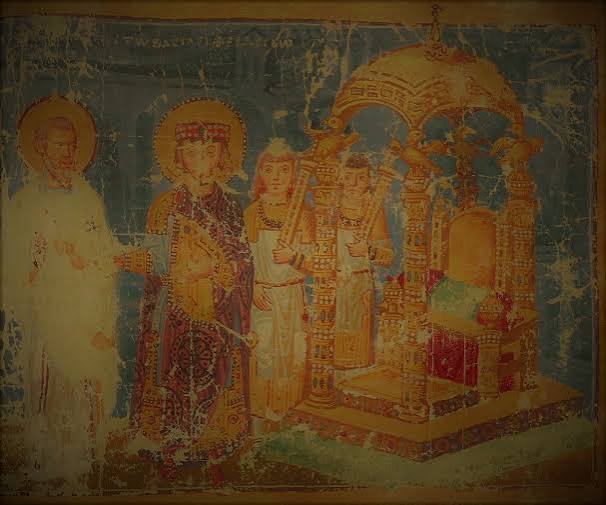
380 – Theodosius I’s formal entry (adventus) into Constantinople

After the catastrophic Roman defeat at Adrianople (378) and the death of Emperor Valens, Gratian appointed the Spanish general Theodosius as Augustus for the East (19 January 379). Theodosius spent 379–80 campaigning against the Goths from Thessalonica. In autumn 380 he fell seriously ill, was baptised by the Nicene bishop Acholius, and issued the Edict of Thessalonica (27 February 380) declaring Nicene Christianity the official religion of the empire and branding other beliefs heretical.

In late November (commonly given as 24 November) he made his ceremonial adventus into Constantinople. This was the first time he had entered the capital; the city prefect and orators (including Themistius) received him outside and inside the walls. He immediately acted against Arianism: the Homoian bishop Demophilus was deposed and the churches handed to the Nicene party under Gregory of Nazianzus. Theodosius thereafter spent most of his reign in or near Constantinople, setting the pattern for later Byzantine emperors. The following year he convened the First Council of Constantinople (381), which confirmed Nicene orthodoxy.

1227 – Assassination of Leszek the White at Gąsawa

On the night of 23–24 November 1227, during a congress of Piast dukes near Gąsawa (Kuyavia, Poland), High Duke Leszek the White (“Leszek Biały”) was attacked while bathing. He escaped the bathhouse, fled on horseback, but was overtaken a few kilometres away near Marcinkowo and killed. Duke Henry the Bearded of Silesia was gravely wounded (saved by a knight who shielded him). The event is also called the “Gąsawa bloodbath.”

Responsibility is generally ascribed to Świętopełk II of Gdańsk Pomerania, who sought to free his duchy from Piast overlordship; some historians also implicate Władysław Odonic of Greater Poland. The murder deepened Poland’s feudal fragmentation: the authority of the “High Duke” weakened, Kraków became just another contested territory, and full reunification of the Polish lands was delayed until the late 13th / early 14th century.

1248 – Collapse of Mont Granier

During the night of 24–25 November 1248 a huge mass of limestone resting on marls on the north face of Mont Granier (Chartreuse massif, French Pre-Alps) suddenly failed. Estimates of the volume vary, but it was one of the largest historical rock-slope failures in Europe (hundreds of millions of cubic metres in some reconstructions). The debris flow and rock avalanche travelled several kilometres, destroying or burying villages including Cognin, Vourey, Saint-André, Granier and Saint-Pérange (and partially Myans and Les Marches). Contemporary chroniclers put the death toll at around 1,000 or more. The event created the dramatic sheer cliff face still visible today.

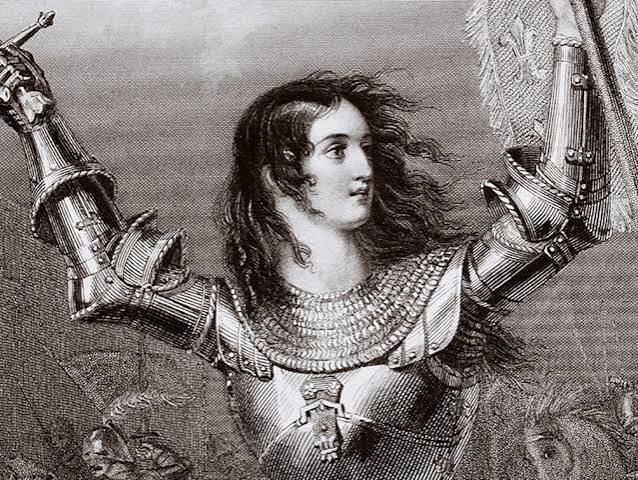
1429 – Joan of Arc’s unsuccessful siege of La Charité

After the coronation of Charles VII at Reims and the failed attack on Paris (September 1429), Joan was sent against the fortified town of La Charité-sur-Loire, held by the Burgundian mercenary captain Perrinet Gressart. The siege began around 24 November 1429. Joan’s force was poorly equipped with artillery; despite requests for supplies from nearby towns and some reinforcements from Bourges and Orléans, the town was well provisioned. After roughly a month of winter fighting the siege was abandoned; the attackers left much of their artillery behind. The failure further reduced Joan’s standing at court. The town was only recovered by Charles VII years later (1435) by ransom.

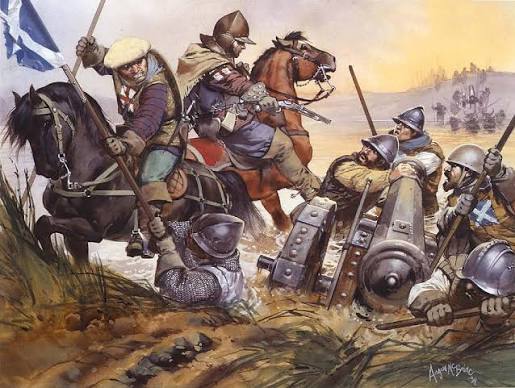
1542 – Battle of Solway Moss

On 24 November 1542 a Scottish army of roughly 15,000–18,000 men, raised in retaliation for an English raid into the Borders, crossed into England near the River Esk (Solway Moss / Arthuret area, Cumberland). It was poorly led and organised. An English force of only about 3,000 under Thomas, Lord Wharton, met and routed it. The Scots were pinned between the river, the peat moss and the English; hundreds drowned trying to recross the Esk, and about 1,200 were captured (including several earls and lords). English losses were minimal (around seven killed). News of the humiliation is said to have hastened the death of the already ill James V of Scotland a few weeks later; he left the infant Mary, Queen of Scots, as his heir.

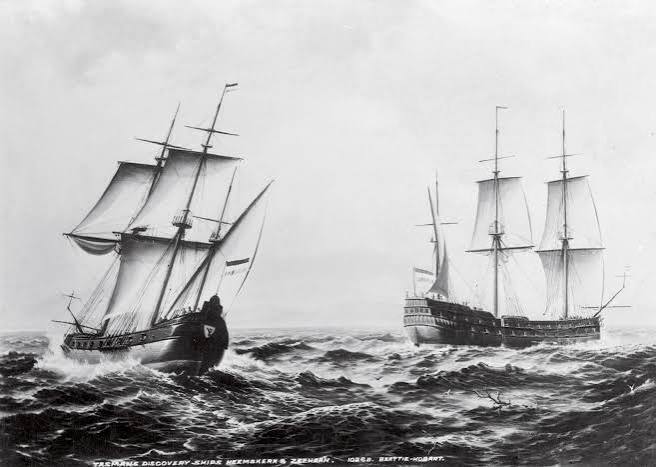
1642 – Abel Tasman sights Van Diemen’s Land (Tasmania)

On 24 November 1642 the Dutch navigator Abel Janszoon Tasman, commanding the VOC ships Heemskerck and Zeehaen, sighted the west coast of a previously unknown island at about 42°20′ S. He named it Van Diemen’s Land after Anthony van Diemen, Governor-General of the Dutch East Indies who had commissioned the voyage. (Earlier Dutch explorers had charted parts of the Australian mainland, but this was the first European sighting of the island.) Tasman’s party noted smoke and heard voices but made no direct contact with the Aboriginal inhabitants. He later continued east and became the first European to sight New Zealand. The island was renamed Tasmania in 1856.

These events span the late Roman world, medieval Central Europe, the Hundred Years’ War, Anglo-Scottish border warfare, and the age of Dutch exploration in the southern oceans. Let me know if you want more detail on any of them.

Read full Article
November 21, 2026
post photo preview
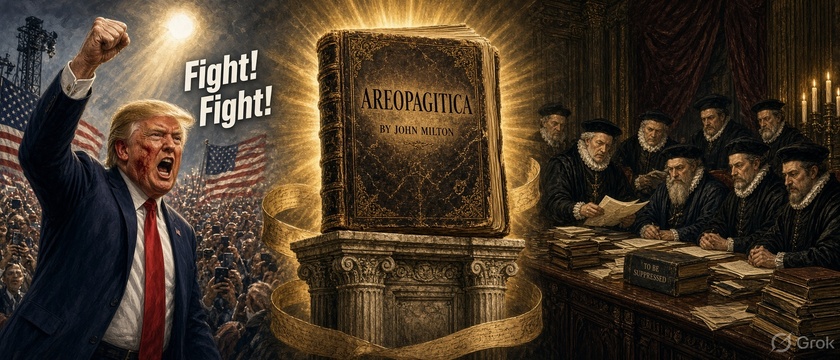
“AREOPAGITICA” by John Milton
November 23rd

“AREOPAGITICA” by John Milton

Areopagitica (full title: Areopagitica; A Speech of Mr. John Milton for the Liberty of Unlicenc’d Printing, to the Parlament of England) is one of the most important early modern arguments against pre-publication censorship. Published on 23 November 1644 as a pamphlet (itself unlicensed), it was addressed to the English Parliament during the First English Civil War. It did not immediately succeed, but it became a foundational text for later ideas about free speech and a free press.

Before: Context and the Licensing Order of 1643

Press control in England had a long history. Henry VIII introduced licensing of books; later monarchs and the Star Chamber (a royal prerogative court) enforced it. The system aimed to suppress heresy, sedition, and criticism of Church or Crown.

In 1641, during the lead-up to and early stages of the English Civil War (1642–1651), the Long Parliament abolished the Star Chamber. This removed the main instrument of pre-publication censorship and triggered an explosion of pamphlets, newsbooks, and political/religious tracts—from a few dozen per year to nearly 2,000 in 1642 alone. Parliament had earlier opposed royal censorship, but once in power it faced royalist propaganda, radical religious writing, and disorder in the book trade.

On 14 June 1643, Parliament issued the Ordinance for the Regulating of Printing (the Licensing Order of 1643). It required that no book, pamphlet, or paper be printed or sold unless first approved and licensed by persons appointed by Parliament, entered in the Stationers’ Company register, and (in most cases) bearing the author’s name. Unlicensed presses could be searched and seized; authors, printers, and sellers could be punished. The stated goals were to suppress “false, forged, scandalous, seditious, libellous, and unlicensed” works and to protect the Stationers’ Company’s commercial privileges.

Milton had personal reasons to object. In 1643–44 he published controversial tracts arguing for the right to divorce on grounds of incompatibility (after a short and troubled marriage to Mary Powell). These were censored or met with hostility; one clergyman reportedly said they deserved to be burnt. Milton had earlier supported the Parliamentary side and the attack on royal censorship, so the Order felt like a betrayal of the liberties he expected from the new regime. He also referenced the harsh treatment of figures such as John Lilburne (flogged and pilloried in 1638 for importing unlicensed books).

The title alludes to Isocrates’ Areopagiticus (4th century BC), a speech addressed to the Athenian Areopagus council. Milton, not a member of Parliament, wrote in the form of a speech to the “High Court of Parliament,” deliberately circulating it without a licence.

Significant Figures

  • John Milton (1608–1674): The author—poet, scholar, and polemicist, deeply versed in classical, biblical, and contemporary learning. At this stage he was a supporter of Parliament (initially leaning Presbyterian) who later served the Commonwealth as Latin Secretary (Secretary for Foreign Tongues). He is best known today for the epic Paradise Lost (1667). Areopagitica is his finest prose work. Later, under the Commonwealth, he himself licensed material for the official newsbook Mercurius Politicus (edited by Marchamont Nedham) and other texts—an apparent practical contradiction of his earlier principles that scholars note when assessing the consistency of his free-speech stance.
  • The Long Parliament: The body that issued the 1643 Order. Milton addresses it directly, praising its anti-royalist stance while criticising the new censorship.
  • Stationers’ Company: The London guild of printers and booksellers that enforced licensing and held monopolies. The Order protected its commercial interests as well as political control.
  • Later influencers and readers: John Locke (who helped argue against renewal of licensing in the 1690s), John Stuart Mill (On Liberty, 1859), and American figures such as Thomas Jefferson (who quoted or engaged with the ideas). The French revolutionary Mirabeau’s translation circulated in the late 1780s–early 1790s.

After: Immediate Failure and Longer-Term Legacy

Areopagitica did not persuade Parliament to repeal the licensing requirement. The Order remained in force through the Commonwealth period. After the Restoration of the monarchy (1660), tighter controls returned under the Licensing of the Press Act 1662 (and renewals). Pre-publication licensing finally ended in England in 1695 when Parliament allowed the Licensing Act to lapse (John Locke played a notable role in the opposition, citing both commercial monopolies and the principle that a man should be free to print what he is free to speak, and answerable afterward).

Milton’s pamphlet had little immediate political effect—partly because his radical views on divorce had already marked him as extreme to many Presbyterians. Its real influence came later. It helped shape Enlightenment and liberal arguments for free expression. Key elements that endured include:

  • Opposition to prior restraint (pre-publication licensing) while accepting that authors could still be punished after publication for libel, sedition, or other offences.
  • The idea that truth is strengthened by open contest with error (“Let her and Falsehood grapple; who ever knew Truth put to the worse, in a free and open encounter?”).
  • The value of reading widely, including “bad” or erroneous books, for developing judgment and virtue (“I cannot praise a fugitive and cloistered virtue”).
  • Books as living things that embody reason: “as good almost kill a man as kill a good book… who destroys a good book, kills reason itself.”
  • The famous plea: “Give me the liberty to know, to utter, and to argue freely according to conscience, above all liberties.”

These ideas fed into the Anglo-American free-speech tradition. They influenced arguments against prior restraint in English and American law, the “marketplace of ideas” concept associated with Mill and later free-speech theory, and the intellectual climate that produced the U.S. First Amendment. Note, however, that Milton did not advocate absolute free speech. He explicitly excluded Roman Catholicism (“popery”) and certain “superstitious” or “evil” writings from protection, and he was prepared to support post-publication sanctions. Modern readers often highlight both the power of his arguments and these limitations.

Influence Today

Areopagitica remains a foundational text in the history of free expression. It is regularly cited in discussions of press freedom, prior restraint (e.g., in U.S. Supreme Court cases opposing government pre-approval of speech), academic freedom, and the dangers of state or institutional gatekeeping of ideas. The core claim—that open debate is more likely to advance truth than pre-emptive censorship, and that individuals need exposure to conflicting ideas to develop sound judgment—still underpins liberal free-speech principles.

In the digital age it is invoked in debates over content moderation, social-media platforms, “disinformation,” campus speech codes, and government attempts to regulate online expression. Critics note that Milton’s own exceptions and later role as a licenser show the perennial tension between free expression and the desire to suppress ideas one regards as dangerous. Supporters emphasize that the pamphlet’s lasting value lies in its insistence that the risks of free exchange are preferable to the risks of empowering censors.

In short: written in the heat of civil war against a Parliament that had just reimposed the censorship it once opposed, Areopagitica failed in its immediate goal but supplied enduring arguments that helped dismantle licensing systems and shaped the modern ideal of a free press. Its influence is visible wherever free societies still debate the proper limits of prior restraint and the value of open argument.

= November 23rd

These events are traditionally associated with 23 November in historical calendars (including Wikipedia’s “On this day” listings). Here is a concise overview of each:

534 BC – Thespis of Icaria becomes the first recorded actor

Thespis (from the deme of Icaria/Icarius near Athens) is credited by Aristotle and later tradition as the first person to step out of the chorus and portray an individual character on stage, rather than merely narrating or singing in the third person. He used masks (often of linen) to distinguish roles and is regarded as the inventor or pioneer of tragedy. In 534 BC, under the tyrant Peisistratus, formal tragic competitions began at the City Dionysia festival in Athens; Thespis is said to have won the first one. His name is the root of the word “thespian.” He is also associated with early theatrical touring, carrying props and costumes in a wagon.

1174 – Saladin enters Damascus

After the death of Nur al-Din in 1174, Saladin (Ṣalāḥ ad-Dīn Yūsuf ibn Ayyūb), already dominant in Egypt (where he had abolished the Fatimid caliphate in 1171 and restored Sunni rule under the Abbasids), moved on Damascus. He entered the city relatively peacefully and added it to his domains. This was a crucial step in uniting Egypt and Syria under Ayyubid rule, enabling the later campaigns that culminated in the Battle of Hattin (1187) and the recapture of Jerusalem from the Crusaders.

1248 – Conquest of Seville by Ferdinand III of Castile

Ferdinand III of Castile completed a roughly 16-month siege of Seville (one of the major remaining Muslim cities in al-Andalus). Castilian forces isolated the city by land and sea; Ramón de Bonifaz’s fleet broke the chain across the Guadalquivir that linked Seville to Triana. The city surrendered on 23 November 1248. Large numbers of Muslim inhabitants were allowed or compelled to leave; the great mosque was converted into a cathedral (later rebuilt as the Gothic Seville Cathedral, with the Giralda minaret surviving as the bell tower). This was a major milestone in the Reconquista.

1499 – Execution of Perkin Warbeck

Perkin Warbeck (born Pierrechon de Werbecque in Tournai, Flanders) was a pretender who claimed to be Richard of Shrewsbury, Duke of York—one of the Princes in the Tower, the younger son of Edward IV. He gained support from various European courts, invaded England in 1497 with Cornish rebels, and was captured. After a later escape attempt from the Tower of London (linked to a plot involving the Earl of Warwick), he was tried for treason and hanged at Tyburn on 23 November 1499, after reading a confession. His elimination, along with Warwick’s execution days later, helped secure the Tudor dynasty under Henry VII.

1510 – Ottoman campaign against Imereti

This was the first major Ottoman campaign against the Kingdom of Imereti in western Georgia. Ottoman forces sacked the capital Kutaisi and burned the Gelati Monastery (a major 12th-century cultural and religious centre founded by King David IV “the Builder,” later a UNESCO site). The campaign reflected growing Ottoman pressure on the Caucasus as the unified Kingdom of Georgia had fragmented. Georgian sources vary slightly on the exact year (1509–1512 range), but the sack of Kutaisi and damage to Gelati are consistently recorded.

1531 – Second War of Kappel

The Second War of Kappel (October–November 1531) was a conflict between the Catholic and Protestant cantons of the Old Swiss Confederacy during the Swiss Reformation. The five Catholic cantons attacked Zürich; at the Battle of Kappel on 11 October, the Protestant forces were defeated and the reformer Huldrych Zwingli (serving as a military chaplain) was killed. The Second Peace of Kappel (late November 1531) largely upheld Catholic positions in contested areas and limited further Protestant expansion within the Confederacy.

1644 – John Milton publishes Areopagitica

On 23 November 1644, during the English Civil War, John Milton published the pamphlet Areopagitica; A Speech of Mr. John Milton for the Liberty of Unlicenc’d Printing, to the Parlament of England. It argued against the Licensing Order of 1643, which reimposed pre-publication censorship. Milton defended the free exchange of ideas as essential to truth-seeking (“Give me the liberty to know, to utter, and to argue freely according to conscience, above all liberties”). It remains one of the foundational texts in the history of free speech and freedom of the press, influencing later Enlightenment and constitutional thinking, though it did not immediately end licensing in England.

1733 – Start of the slave insurrection on St. John

On 23 November 1733, approximately 150 enslaved Akwamu people (from the Gold Coast, modern Ghana) launched a revolt on the Danish island of St. Jan (Sankt Jan, now St. John in the U.S. Virgin Islands). They seized the fort at Coral Bay (using concealed cane knives during a wood delivery), killed most of the garrison, and took control of much of the island for months, aiming to eliminate European planters and resume production under their own authority. Leaders included figures such as Breffu. The uprising was suppressed by mid-1734 with the help of French troops from Martinique. It was one of the earliest and longest slave revolts in the Americas.

These events span ancient Greek drama, the Crusades and Reconquista, Tudor England, the Caucasus, the Swiss Reformation, early modern free speech debates, and Caribbean slave resistance. Let me know if you want more detail on any of them.

Read full Article
See More
Available on mobile and TV devices
google store google store app store app store
google store google store app tv store app tv store amazon store amazon store roku store roku store
Powered by Locals