VoiceDDB
Politics • Culture • News
Sitting Court found support for ending slavery was a threat to the revolution
November 3rd
November 01, 2026
post photo preview

Sitting Court found support for ending slavery was a threat to the revolution

The first sitting of a U.S. District Court under the Constitution occurred on 3 November 1789, when the District Court for the District of New York convened under the Judiciary Act of 1789. It was the first federal trial court to sit under the new Constitution, several months before the Supreme Court’s first session.

Before 1789: Creating the Federal Judiciary

Article III of the Constitution (ratified 1788) vested the judicial power in “one supreme Court, and in such inferior Courts as the Congress may from time to time ordain and establish.” It left the details to Congress. The First Congress, meeting in New York (then the temporary capital), passed the Judiciary Act of 1789 (signed by President George Washington on 24 September 1789). Primarily drafted by Senator Oliver Ellsworth of Connecticut (later Chief Justice), with contributions from William Paterson and others, the Act created:

  • A Supreme Court of six justices.
  • Thirteen district courts (generally one per state, with Virginia and Massachusetts each split).
  • Three circuit courts (staffed by two Supreme Court justices “riding circuit” plus the local district judge).

District courts handled admiralty and maritime cases, minor federal crimes, and certain civil suits involving the United States. The Act scheduled the first sessions: New York and New Jersey on the first Tuesday of November (3 November), with others staggered later. President Washington quickly nominated judges, attorneys, and marshals. James Duane was nominated and confirmed for New York on 25 September 1789 (commission dated 26 September), the same day John Jay received his commission as the first Chief Justice.

The 3 November 1789 Sitting

Judge James Duane (then about 56) opened the court in the Exchange Building (also called the Royal or Merchants Exchange) near the foot of Broad Street in lower Manhattan. His commission was read. Approximately 30 attorneys were admitted to the bar of the new court and entered on a parchment roll. No cases were pending, so the court immediately adjourned. Contemporary accounts noted the brief session and the absence of business.

The New Jersey district court was scheduled for the same day but was delayed until December because of illness of its judge, David Brearley (who died the following summer). Thus New York became the first federal district court to sit. The court is sometimes called the “Mother Court” for this chronological priority. (The modern Southern District of New York traces its lineage to this court.)

Significant Figures

  • James Duane (1733–1797): Born in New York City, he studied law and was admitted to the bar in 1754. He served as attorney general of colonial New York (1767), a delegate to the Continental Congress (1774–1783), a signer of the Articles of Confederation, first post-British mayor of New York City (1784–1789), and a New York state senator. He supported ratification of the Constitution at New York’s convention. Appointed by Washington, he served until resigning in March 1794 due to ill health. He died in 1797 and is buried at Christ Church in Duanesburg (named for him), New York.
  • Aaron Burr (1756–1836): Among the attorneys admitted that day. A Revolutionary War veteran, lawyer, and New York attorney general (1789–1791), he later became U.S. senator, vice president (1801–1805), and is best known for killing Alexander Hamilton in a duel in 1804.
  • Other notables admitted included Richard Varick (then mayor of New York), John Laurance (later a federal judge and U.S. senator), Robert Troup (first clerk of the court and later its third judge; Hamilton’s college roommate), Egbert Benson (later first chief judge of the Second Circuit), and Brockholst Livingston (later a Supreme Court justice). Richard Harrison served as the first U.S. attorney for the district.
  • George Washington: Appointed Duane and the initial Supreme Court justices (John Jay as Chief Justice, plus John Rutledge, William Cushing, Robert H. Harrison—who declined—James Wilson, and John Blair).
  • John Jay: First Chief Justice; his Supreme Court commission was signed the same day as Duane’s.

After 1789

The court initially had little work. Its first case was filed in April 1790 (United States v. Three Boxes of Ironmongery, Etc.), an admiralty/customs matter; most early cases involved seizures and maritime disputes. Duane resigned in 1794 for health reasons and was succeeded by John Laurance. The district later split (Southern and Northern Districts of New York in 1814, with further divisions later).

The Supreme Court held its first session on 1 February 1790 in the same Exchange Building. Lacking a quorum that day, it formally opened on 2 February with Chief Justice Jay and three associate justices present. It admitted attorneys, handled organizational matters, and heard no cases in its first term. The capital soon moved to Philadelphia, then Washington.

The 1789 system (district courts + circuit-riding Supreme Court justices) endured for decades, with major reforms in the 19th century (including the creation of separate circuit judges in 1869 and the Courts of Appeals in 1891). The Southern District of New York has since handled many high-profile cases and remains one of the busiest federal trial courts.

=

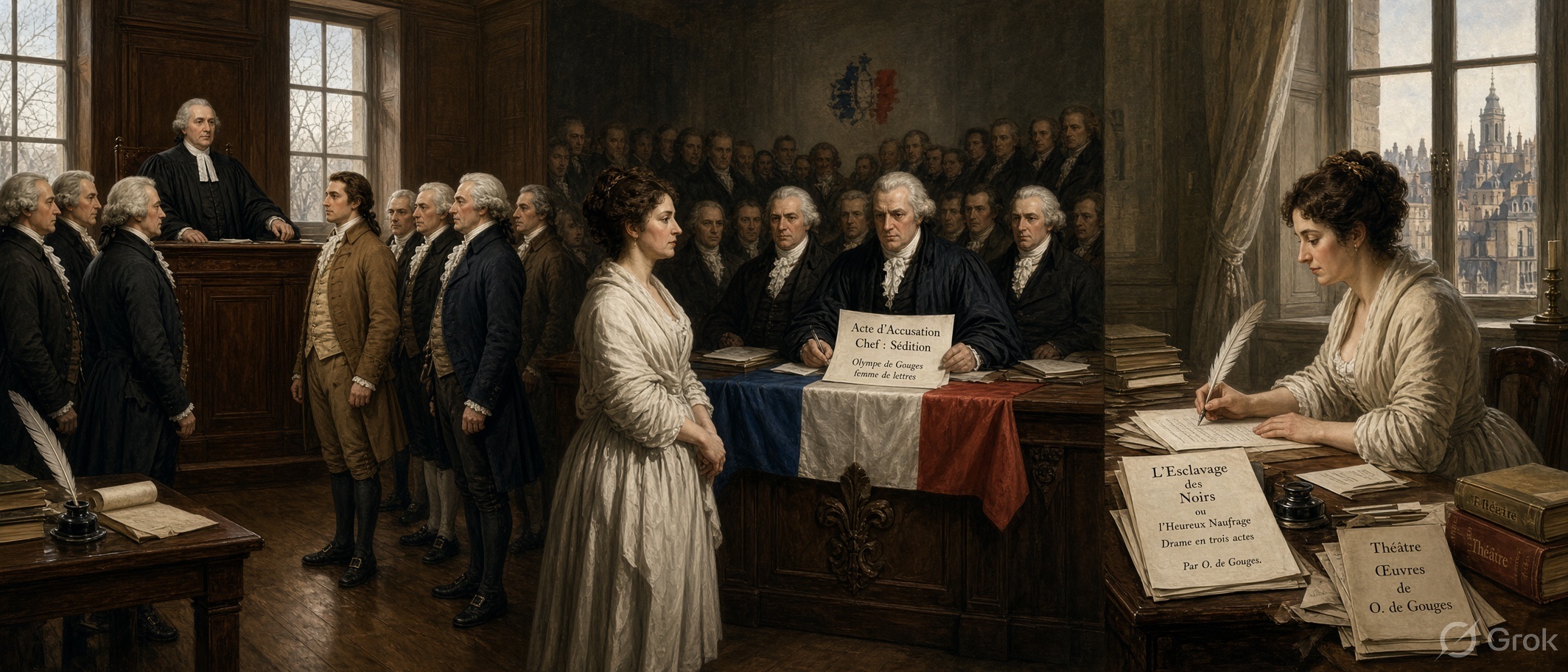
Olympe de Gouges (born Marie Gouze, 7 May 1748 – 3 November 1793) was a French playwright, journalist, abolitionist, and political activist. Her execution on 3 November 1793 in the Place de la Révolution (today’s Place de la Concorde) came at a pivotal moment in the French Revolution, during the opening phase of the Reign of Terror.

Before 1793: Writings, Politics, and Rising Conflict

De Gouges came from Montauban in southwestern France. After an unhappy marriage to Louis Aubry (who died soon after the birth of their son), she moved to Paris, adopted the more aristocratic-sounding name Olympe de Gouges, and supported herself as a writer. She produced dozens of plays and pamphlets on social issues, including opposition to slavery (her play L’Esclavage des Noirs attacked the colonial slave trade) and the rights of illegitimate children.

In September 1791 she published the Déclaration des droits de la femme et de la citoyenne (“Declaration of the Rights of Woman and of the Female Citizen”) as a direct reply to the 1789 Declaration of the Rights of Man and of the Citizen. Addressed in part to Queen Marie Antoinette, it asserted that women are born free and equal in rights and demanded political participation, equal inheritance, and the right to divorce. Its most famous line appears in Article 10: “If a woman has the right to mount the scaffold, she must equally have the right to mount the speaker’s rostrum.”

Politically she aligned with the moderate Girondins (the more federalist, less radical faction in the National Convention) against the increasingly dominant Montagnards (the radical Jacobin group led by figures such as Maximilien Robespierre). She opposed the execution of Louis XVI (carried out 21 January 1793) and criticised the September Massacres of 1792 and the growing violence of the revolutionary government. In summer 1793 she published the placard Les Trois Urnes (“The Three Urns”), which proposed a popular referendum on three options: a unitary republic, a federal republic, or a constitutional monarchy. This was treated as sedition and an attack on the sovereignty of the people.

Key preceding events in 1793:

  • 2 June: Montagnards purge the Girondin deputies from the Convention.
  • 13 July: Jean-Paul Marat is assassinated by Charlotte Corday (a Girondin sympathiser).
  • 27 July: Robespierre joins the Committee of Public Safety.
  • 5 September: The Convention declares “Terror the order of the day.”
  • 16 October: Marie Antoinette is executed.
  • 31 October: Twenty-one leading Girondins (including Jacques-Pierre Brissot and Pierre Vergniaud) are guillotined.

The Arrest, Trial, and Execution

De Gouges was arrested on 20 July 1793 and held in the Conciergerie. On 2 November she faced the Revolutionary Tribunal (public prosecutor Antoine Quentin Fouquier-Tinville). She was charged with composing writings that tended to re-establish royalty or any power attacking the sovereignty of the people. She defended herself vigorously, declared she was pregnant (a claim that would have delayed execution), and was examined by the Tribunal’s doctors, who found the claim false. The Tribunal sentenced her to death the same day; she was guillotined the following afternoon, 3 November, at about 4 p.m. Her last reported words were “Children of the Fatherland, you will avenge my death.” Her body was buried in the Madeleine Cemetery.

Significant figures around the event:

  • Maximilien Robespierre – Dominant figure on the Committee of Public Safety; de Gouges had publicly attacked him as ambitious and bloodthirsty.
  • Antoine Quentin Fouquier-Tinville – Public prosecutor of the Revolutionary Tribunal who pressed the case.
  • Girondin leaders (Brissot, Vergniaud, and others) – Executed three days earlier; de Gouges shared their moderate republican stance.
  • Pierre Gaspard Chaumette – Radical of the Paris Commune who later used her death as a warning against women participating in politics.

After 1793: Intensification of the Terror and Legacy

Her execution occurred early in the Reign of Terror (roughly September 1793–July 1794), when the Committee of Public Safety under Robespierre, Saint-Just, and others used emergency powers, the Law of Suspects, and the Revolutionary Tribunal to eliminate perceived enemies. Roughly 16,000 people were formally executed and many more died in prison or mass killings. Notable subsequent events include:

  • 10 November 1793: Festival of Reason (Notre-Dame rededicated).
  • December 1793: Law of 14 Frimaire further centralises power.
  • March–April 1794: Execution of Hébertists and Dantonists.
  • June 1794: Law of 22 Prairial accelerates the “Great Terror.”
  • 27–28 July 1794 (9–10 Thermidor): Fall and execution of Robespierre; the Terror ends.

De Gouges’s death was cited by some revolutionaries (notably Chaumette) as a warning to women who left the domestic sphere. Women’s political clubs were closed around the same period. In the longer term she became a foundational figure in French feminism; her Declaration is now widely studied as an early systematic demand for gender equality. French women gained the vote only in 1944.

= November 3rd

These events cluster tightly around early November (mostly 3 November), not strictly 1 November. Here is a corrected, contextual account of each.

361 – Death of Constantius II
Constantius II (Flavius Julius Constantius), son of Constantine the Great, died of fever on 3 November 361 at Mopsuestia (Mopsucrene) in Cilicia while marching west against his cousin Julian, whom the army in Gaul had proclaimed Augustus. On his deathbed he was baptised by the Semi-Arian bishop Euzoius of Antioch and is said to have named Julian his successor. His death ended the last phase of Constantinian dynastic civil war and opened the brief pagan restoration under Julian the Apostate. He had ruled as Caesar from 324 and Augustus from 337, spending much of his reign fighting the Sasanian Empire and Germanic peoples while promoting Arian Christianity and restricting pagan cults.

644 – Assassination of Umar ibn al-Khattab
Umar, the second Rashidun caliph (r. 634–644), was stabbed while leading dawn prayer in the mosque of Medina by the Persian slave Abu Lu’lu’a Firuz. The attack occurred around 26 Dhu al-Hijja 23 AH. Sources place the death on or about 3 November 644 (Julian; some Gregorian conversions give 6 November), with burial a few days later. Umar’s decade saw the major conquests of the Levant, Egypt, and Iran and the establishment of the diwan and Hijri calendar. The succession council he appointed chose Uthman.

1333 – Flood of the Arno at Florence
Heavy rains from about 1 November culminated in the catastrophic overflow of the Arno on 4 November 1333. The Florentine chronicler Giovanni Villani recorded that the waters reached the altar of the Baptistery, destroyed or damaged every bridge except Rubaconte (Ponte alle Grazie), swept away the Ponte Vecchio (except its two central piers), and killed hundreds (later estimates range from ~300 to over 1,000). The event was widely interpreted as divine judgment. Marks from this flood still survive in the city; the same date saw the even more destructive 1966 flood.

1468 – Sack of Liège
After the third Liège revolt against Burgundian rule, Charles the Bold (Charles I of Burgundy), accompanied by a captive Louis XI of France, captured the city at the end of October. On 30 October the “Six Hundred Franchimontois” failed in a night raid aimed at killing the duke and king. The following day the city was sacked; hundreds were killed or drowned in the Meuse. From about 3 November Charles ordered the systematic burning of the city (sparing churches), which is said to have burned for weeks. The destruction was intended to end Liégeois resistance permanently.

1492 – Peace of Étaples
Signed at Étaples on 2 or 3 November 1492 between Henry VII of England and Charles VIII of France. It ended a brief English expedition that had landed at Calais and besieged Boulogne in response to French support for the Yorkist pretender Perkin Warbeck. France agreed to expel Warbeck and pay a substantial indemnity (often cited as £159,000 or 742,000 crowns); Henry recognised French control of Brittany. The treaty was ratified in December and was later renewed. It strengthened Henry’s finances and removed a dynastic threat while allowing Charles to turn toward Italy.

1493 – Columbus sights Dominica
On the second voyage, Columbus’s fleet of 17 ships sighted a rugged island in the Lesser Antilles on Sunday, 3 November 1493, and named it Dominica (Sunday Island). The same day or the next they reached Marie-Galante. This marked the start of European exploration of the eastern Caribbean on the return voyage after the first contact of 1492.

1534 – First Act of Supremacy
The English Parliament passed the Act of Supremacy (26 Hen. VIII c. 1) in early November 1534; it took effect from 3 November 1534 and received royal assent on 18 December. It declared Henry VIII “the only supreme head in earth of the Church of England,” confirming the break with Rome that had begun with the Act in Restraint of Appeals (1533). The measure was framed as recognising an existing right rather than creating a new one. It was repealed under Mary I and replaced under Elizabeth I by the milder title of Supreme Governor.

1592 – Founding of San Luis Potosí
The legal foundation of the settlement (then called Pueblo de San Luis de Mezquitique or San Luis Minas del Potosí) was recorded on 3 November 1592. Acting under commission from Viceroy Luis de Velasco, Miguel Caldera and Juan de Oñate established the town in the valley near the newly discovered silver and gold deposits of Cerro de San Pedro, which lacked adequate water. The name honoured Louis IX of France and the rich mines of Potosí in Bolivia. It quickly became a major mining and administrative centre in New Spain.

1783 – Disbandment of the Continental Army
Congress had ordered that troops on furlough be discharged on 3 November 1783 following the Treaty of Paris. Most of the Continental Army was disbanded around that date (at New Windsor and elsewhere). A small residual force remained at West Point and frontier posts until the final discharge orders of June 1784, after which the United States Army was authorised as a successor force. The step reflected the republican distrust of standing armies in peacetime.

1789 – First sitting of a U.S. District Court under the Constitution
Under the Judiciary Act of 1789, the District Court for the District of New York (Judge James Duane) convened on the first Tuesday of November—3 November 1789—at the Exchange Building in New York City. No cases were heard; the court immediately adjourned after admitting attorneys (including Aaron Burr). It was the first federal district court to sit under the new Constitution, preceding the Supreme Court’s first session by several months. (New Jersey was scheduled for the same day but was delayed by the judge’s illness.)

1793 – Execution of Olympe de Gouges
The French playwright, journalist, and author of the Declaration of the Rights of Woman and of the Female Citizen (1791) was guillotined on 3 November 1793 in the Place de la Révolution. Arrested in July for her Girondin-leaning writings (especially Les Trois Urnes, which called for a referendum on the form of government), she was tried by the Revolutionary Tribunal on 2 November and executed the next day for sedition. She had earlier attacked slavery, defended the rights of women, and opposed the excesses of the Montagnards. Her death occurred during the intensifying Terror.

These dates form a striking early-November cluster of imperial transitions, natural disasters, treaties, colonial foundations, military demobilisation, and revolutionary executions.

community logo
Join the VoiceDDB Community
To read more articles like this, sign up and join my community today
0
What else you may like…
Videos
Posts
Articles
00:01:07
November 27, 2022
Jingle Bell Rock

Jingle bell, jingle bell, jingle bell rock
Jingle bells swing and jingle bells ring
Snowin' and blowin' up bushels of fun
Now the jingle hop has begun

Jingle bell, jingle bell, jingle bell rock
Jingle bells chime in jingle bell time
Dancin' and prancin' in Jingle Bell Square
In the frosty air

What a bright time, it's the right time
To rock the night away
Jingle bell time is a swell time
To go glidin' in a one-horse sleigh

Giddy-up jingle horse, pick up your feet
Jingle around the clock
Mix and a-mingle in the jinglin' feet
That's the jingle bell rock

Jingle bell, jingle bell, jingle bell rock
Jingle bell chime in jingle bell time
Dancin' and prancin' in Jingle Bell Square
In the frosty air

What a bright time, it's the right time
To rock the night away
Jingle bell time is a swell time
To go glidin' in a one-horse sleigh

Giddy-up jingle horse, pick up your feet
Jingle around the clock
Mix and a-mingle in the jinglin' feet
That's the jingle bell
That's the jingle...

00:02:04
September 01, 2021
Intro to Locals for the Conservative Voice

David Daniel Ball calls himself the Conservative Voice.

I'm a teacher with three decades experience teaching math to high school kids.I also work with first graders and kids in between first grade and high school. I know the legends of why Hypatia's dad is remembered through his contribution to Math theory. And I know the legend of why followers of Godel had thought he had disproved God's existence.

I'm not a preacher, but I am a Christian who has written over 28 books all of which include some reference to my faith. Twelve blog books on world history and current affairs, detailing world events , births and marriages on each day of the year, organised by month. Twelve books on the background to and history of Bible Quotes. One Bible quote per day for a year. An intro to a science fiction series I'm planning, post apocalyptic cyber punk. An autobiography with short story collections.

I'm known in Australia for my failure as a whistleblower over the negligence death of a school boy. ...

00:01:50
September 04, 2026
Should violent criminals be made fat? Grok says 'no'

No. Transferring gut bacteria from an obese person into a violent criminal is not a reliable, ethical, or effective way to make them “fat, sedentary, and less of a physical threat.”

The science does not deliver the outcome you want

Mouse studies in germ-free animals showed that microbiota from obese donors can increase energy harvest and adiposity compared with lean-donor microbiota. That is the origin of the idea. Human evidence is far weaker.

Randomized trials of fecal microbiota transplant (FMT) from lean donors into people with obesity have generally failed to produce meaningful, sustained weight loss. Microbiome composition can change; body weight and metabolic markers often do not, or the effects are small and inconsistent. Diet and the existing gut environment usually dominate. A 2025 Nature paper found diet outperformed microbial transplant for microbiome recovery. Human guts are already colonized, not sterile like lab mice, so engraftment is variable and effects unpredictable.

It is not a ...

post photo preview
August 28, 2026
Pfizer struggles to answer

Some in Australia are brilliant. Malcolm Roberts Investigates Pfizer over Covid vaccine.

Holiday break is over back to work tonight

Tonight I'll start double posting until I've caught up.

November 20, 2026
post photo preview
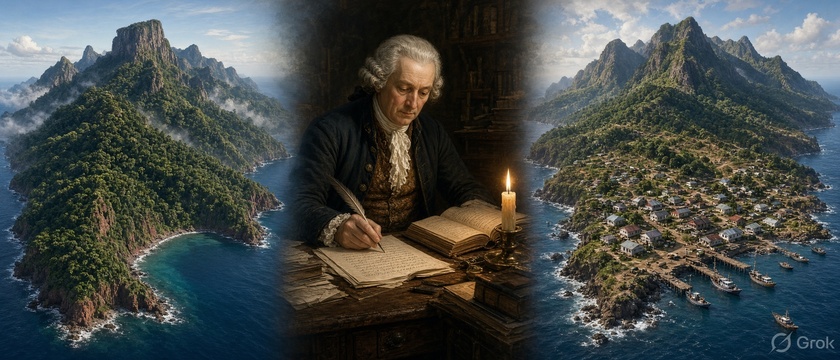
Robinson Crusoe Island
November 22nd

Robinson Crusoe Island

1574 discovery of the Juan Fernández Islands: context, the event, and what followed

The islands (now Chilean territory, ~670 km west of Valparaíso) were uninhabited volcanic islands with no indigenous population when Europeans first recorded them. They sit in the southeastern Pacific, formed by the Juan Fernández hotspot as the Nazca Plate moved over it.

Before the discovery

Spanish navigation between the Viceroyalty of Peru (Callao/Lima) and Chile (Valparaíso) followed the coast. The northward-flowing Humboldt Current and prevailing winds made the southbound voyage slow—often three months or more. Juan Fernández (c. 1536–c. 1604), a Spanish navigator born in Cartagena and active on the Peru–Chile run by around 1550, theorized that sailing farther offshore (west of the current) would let ships catch better winds and currents for a much faster passage.

There is some debate about earlier sightings. Magellan’s expedition may have glimpsed the islands, but Fernández’s 1574 voyage is the one that established them navigationally and gave them lasting significance.

The discovery (22 November 1574)

On a voyage from Callao to Valparaíso, Fernández deliberately steered west. He completed the trip in roughly 30 days—an extraordinary improvement. In the process he sighted the archipelago on 22 November 1574. The main islands later became known as Más a Tierra (“Nearer Land,” now Robinson Crusoe Island), Más Afuera (“Farther Out,” now Alejandro Selkirk Island), and the small Santa Clara (or Goat) Island.

He also discovered the Desventuradas Islands (San Félix and San Ambrosio) the same year. The dramatic speed of his Callao–Chile run led to him being brought before the Inquisition in Peru on suspicion of sorcery; he was cleared and thereafter nicknamed el brujo del Pacífico (“the witch/wizard of the Pacific”).

Immediate aftermath and Fernández’s later life

Fernández received a grant to colonize the islands. He introduced goats and pigs (whose descendants later fed castaways) and spent time there, but permanent settlement failed. He returned to navigation, was recognized in 1589 as “chief pilot of the South Sea,” and later retired to an estate in Chile.

There were further early Spanish attempts at settlement (including one around 1591–1596 and another starting in 1599), but none lasted long. The islands remained essentially unoccupied by Spain for decades.

The pirate and privateer era (17th–mid-18th centuries)

The islands became a valuable stopover for ships rounding Cape Horn or the Strait of Magellan—places to take on water, wood, fresh meat (from the introduced goats), and rest after long, scurvy-ridden voyages. Dutch, English, and French privateers and pirates used them as bases or refuges while raiding Spanish shipping and coastal towns. Notable visitors included Willem Schouten (1616), Jacques L’Hermite, William Dampier, and later George Anson (who spent months there in 1741 repairing ships).

Alexander Selkirk and the Robinson Crusoe connection

The most famous episode occurred in 1704. Scottish privateer Alexander Selkirk (1676–1721), sailing with the Cinque Ports under Thomas Stradling (part of a larger expedition involving William Dampier), judged the ship unseaworthy while stopped at Más a Tierra. He asked to be left behind. Stradling obliged, putting him ashore with a musket, hatchet, knife, cooking pot, Bible, some supplies, and clothing.

Selkirk lived alone for four years and four months (until 2 February 1709). He hunted goats, built huts, and adapted to isolation; rats chewed his feet at night until he began feeding the feral cats that had also been introduced. He was rescued by the privateering ships Duke and Duchess under Woodes Rogers, with Dampier aboard. Rogers later published an account (A Cruising Voyage Round the World, 1712). Daniel Defoe’s 1719 novel Robinson Crusoe drew heavily on Selkirk’s story (and other castaway accounts), even though the fictional island is set elsewhere.

In 1966 Chile renamed Más a Tierra Robinson Crusoe Island and Más Afuera Alejandro Selkirk Island.

Spanish permanent settlement and later history

Alarmed by foreign use of the islands, Spain established a permanent colony in 1750. Under orders from the Crown, Governor Juan Navarro Santaella led an expedition with soldiers, settlers (around 171 people), and convicts. They founded San Juan Bautista at Cumberland Bay on Más a Tierra, built Fort Santa Bárbara, and used the island as a penal settlement. This occupation was intended to deny the islands to British and other rivals.

During the Chilean wars of independence the island again served as a place of exile for patriots. After independence it remained Chilean. A more lasting civilian settlement developed later in the 19th century (notably involving the Swiss colonizer Alfred von Rodt from 1877). Today the main population lives in San Juan Bautista on Robinson Crusoe Island, supported by lobster fishing and tourism. The archipelago is a national park known for high endemism in flora and fauna (including the Juan Fernández firecrown hummingbird and the Juan Fernández fur seal).

Key figures

  • Juan Fernández — Discoverer and improver of the Callao–Chile route; introduced livestock.
  • Alexander Selkirk — Real-life castaway whose survival inspired Robinson Crusoe.
  • Woodes Rogers — Privateer who rescued Selkirk and published the account.
  • William Dampier — Experienced privateer and navigator connected to both the marooning expedition and the rescue.
  • Juan Navarro Santaella — First governor of the 1750 Spanish colony.
  • Daniel Defoe — Author of the novel that immortalized the islands in popular culture.

The 1574 discovery transformed an isolated volcanic group into a strategic waypoint in Pacific navigation, a privateering haunt, the setting of one of literature’s most famous survival stories, and eventually a Chilean territory valued for its unique ecology.

= November 22nd

November 22 features several notable historical events spanning papal politics, Breton independence, the suppression of the Knights Templar, exploration, colonial conflict, and piracy. Here is more context on each:

498 – Dual papal elections and the start of the Laurentian Schism

After the death of Pope Anastasius II, a disputed election occurred in Rome. Symmachus was elected by one faction in the Lateran Palace, while Laurentius was elected by another in the Basilica of Santa Maria Maggiore. This began the Laurentian Schism (roughly 498–506).

Symmachus had the support of the Roman clergy and the Gothic king Theodoric the Great (who later confirmed him), while Laurentius was backed by a group of senators and Byzantine interests. The rivalry involved accusations of simony, violence, and competing claims to legitimacy. Theodoric eventually intervened decisively in favor of Symmachus. The episode highlighted the growing tension between papal authority, Roman senatorial power, and the Ostrogothic kingdom in Italy after the fall of the Western Roman Empire.

845 – Battle of Ballon and Breton resistance

Nominoë, the first Duke/King of Brittany (often called the “Father of Brittany”), defeated the Frankish forces of Charles the Bald near Redon at the Battle of Ballon. Nominoë had been appointed by Charlemagne’s successors but later asserted Breton autonomy.

The victory marked a significant step toward Breton independence from Carolingian control. Nominoë went on to expand Breton territory, challenge Frankish authority more broadly, and is credited with laying foundations for a distinct Breton political identity. Charles the Bald’s defeat illustrated the difficulty the West Frankish kings had in holding peripheral regions during a period of Viking raids and internal fragmentation.

1307 – Pastoralis Praeeminentiae and the fall of the Templars

Pope Clement V issued the bull Pastoralis Praeeminentiae, ordering Christian monarchs across Europe to arrest members of the Knights Templar and seize their assets. This followed the dramatic arrests in France ordered by King Philip IV on 13 October 1307 (the famous “Friday the 13th” arrests).

Clement V, under heavy pressure from Philip IV (who was in debt to the Templars and coveted their wealth), authorized the widespread suppression. The order was accused of heresy, blasphemy, and other charges (many extracted under torture). The process culminated in the formal dissolution of the Templars at the Council of Vienne (1312) and the execution of leaders such as Jacques de Molay. The bull effectively internationalized the French campaign and led to the transfer of much Templar property to the Hospitallers or secular rulers.

1574 – Discovery of the Juan Fernández Islands

Spanish navigator Juan Fernández sighted the islands that now bear his name, located in the southeastern Pacific off the coast of Chile. The main island (Isla Robinson Crusoe / Más a Tierra) and its smaller companions later became famous as the setting associated with the real-life castaway Alexander Selkirk, whose story helped inspire Daniel Defoe’s Robinson Crusoe.

The islands served as a stopover for ships rounding Cape Horn and as a base for privateers and pirates. They remained Spanish (later Chilean) territory and are notable for their unique endemic flora and fauna.

1635 – Dutch pacification campaign on Formosa (Taiwan)

Dutch colonial forces based at Fort Zeelandia launched a military campaign against indigenous Taiwanese (Formosan) villages. The Dutch East India Company (VOC) sought to extend control over the central and southern parts of the island, secure trade, and suppress resistance.

The campaign involved alliances with some indigenous groups against others, the establishment of additional forts and settlements, and the gradual imposition of Dutch administrative and missionary influence. It was part of the broader Dutch presence on Taiwan (1624–1662), which ended when Koxinga (Zheng Chenggong) expelled the Dutch.

1718 – Death of Blackbeard

Off the coast of North Carolina (near Ocracoke Inlet), the pirate Edward Teach (Blackbeard) was killed in a fierce boarding action by a force led by Royal Navy Lieutenant Robert Maynard. Blackbeard’s ship, the Queen Anne’s Revenge, had been abandoned earlier; he was operating with a smaller sloop.

Maynard’s men lured Blackbeard into an ambush. After a brutal hand-to-hand fight, Blackbeard was shot and stabbed multiple times; his head was later displayed as a warning. The episode marked a high-profile success in the British campaign against piracy in the Caribbean and along the North American coast during the Golden Age of Piracy. Blackbeard’s fearsome reputation (enhanced by his appearance and use of slow-burning fuses in his beard) made his death widely reported.

These events reflect different themes: contested religious authority in late antiquity, regional resistance in medieval Europe, the centralization of monarchical and papal power in the late Middle Ages, European exploration, colonial expansion in East Asia, and the suppression of piracy in the early modern Atlantic world.

Read full Article
November 19, 2026
post photo preview
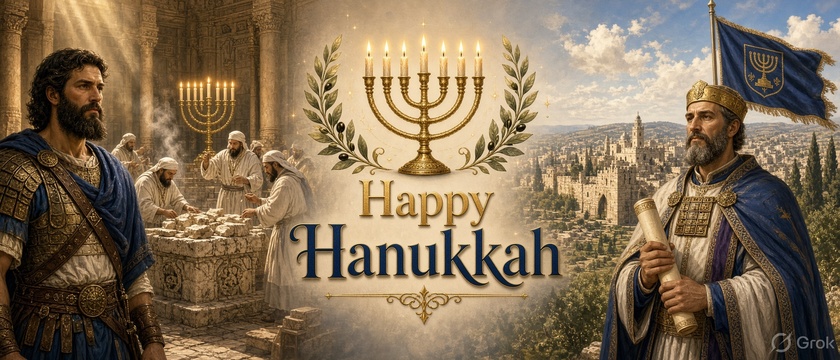
The Hammer who saved the world
November 21st

The Hammer who saved the world

164 BC: Judas Maccabeus restores and rededicates the Temple in Jerusalem (origin of Hanukkah)

This event marked a turning point in the Maccabean Revolt (167–141 BCE). Judas Maccabeus (Judah Maccabee) and his followers recaptured Jerusalem, cleansed the desecrated Second Temple, and rededicated it on 25 Kislev (corresponding to roughly mid-December 164 BCE in modern calendars; some historical lists associate it with 21 November). The eight-day festival of Hanukkah (“Dedication”) commemorates this.

Before: Context and Outbreak of the Revolt

Judea had been under Hellenistic rule since Alexander the Great’s conquests and the subsequent Wars of the Diadochi. By the 2nd century BCE it was part of the Seleucid Empire. Many upper-class Jews had adopted aspects of Greek culture, but traditional practice continued under relative tolerance.

Tensions rose under Antiochus IV Epiphanes (reigned 175–164 BCE). He sold the high priesthood to the highest bidder (first Jason, then Menelaus). Internal Jewish factional conflict, combined with Antiochus’s campaigns in Egypt and Roman pressure forcing him to withdraw, led him to treat unrest in Jerusalem as rebellion. In 167 BCE he issued decrees banning key Jewish practices (circumcision, Sabbath observance, possession of the Torah, dietary laws) on pain of death. A pagan altar (the “abomination of desolation,” associated with Zeus Olympios) was erected in the Temple, and traditional sacrifices ceased. A Seleucid garrison and citadel (the Acra) were established in Jerusalem. The Temple was plundered earlier as well.

In Modein (Modi’in), the priest Mattathias (Mattathias ben Johanan of the Hasmonean family) refused to perform a pagan sacrifice. He killed a Jewish man who stepped forward to do so, along with the Seleucid official, and fled with his five sons to the hills. He called for those “zealous for the law” to join him. This launched a guerrilla campaign. Mattathias died around 166 BCE after about a year, appointing his son Judas Maccabeus (“the Hammer”) as military leader.

Judas and the Maccabees (supported especially by the Hasidim/pious traditionalists) used mobile guerrilla tactics. They defeated smaller Seleucid forces (e.g., under Apollonius and Seron at Beth Horon) and won major victories at Emmaus (against Nicanor and Gorgias) and Beth Zur. Antiochus IV left for the east; his regent Lysias was preoccupied. News of Antiochus’s death in Persia (late 164 BCE) further weakened Seleucid efforts. The Maccabees entered Jerusalem in triumph, though the Acra garrison remained.

The Restoration and Rededication

Upon entering the Temple Mount, the Maccabees found the sanctuary desolate, the altar profaned, and the courts overgrown. According to 1 Maccabees, they tore down the defiled altar of burnt offering and stored its stones, then built a new altar of unhewn stones as required by Jewish law. They restored or remade the lampstand, table for showbread, altar of incense, and vessels; hung curtains; and purified the courts.

On the morning of 25 Kislev in the 148th year of the Seleucid era (164 BCE), they offered sacrifice on the new altar—the anniversary of the earlier desecration. They celebrated for eight days with songs, music, and joy. Judas and the assembly decreed that this rededication should be observed annually for eight days beginning on 25 Kislev. The Books of Maccabees (especially 1 Maccabees 4 and 2 Maccabees 10) are the primary early accounts; the later Talmudic story of a single sealed jar of pure oil miraculously lasting eight days (long enough to prepare new oil) is the best-known popular legend associated with the “Festival of Lights.”

After: Continued Struggle and Hasmonean Independence

The rededication was a major symbolic and practical victory, and Lysias later agreed to revoke the ban on Jewish practices. Many moderate/Hellenized Jews were satisfied once religious freedom was restored. The more radical Maccabees continued fighting for fuller political independence.

Judas campaigned to aid Jewish communities in Galilee and Transjordan, then besieged the Acra. Seleucid forces under Lysias and the young Antiochus V Eupator counterattacked, winning at Beth Zechariah and besieging Jerusalem (a sabbatical year complicated supplies). Political turmoil in Syria forced their withdrawal; a settlement restored Jewish religious freedom.

Judas later defeated Nicanor at Adasa (13 Adar, 161 BCE) and made a treaty with Rome. He was killed at the Battle of Elasa in 160 BCE against Bacchides. Leadership passed to his brothers Jonathan Apphus and then Simon Thassi. Internal Seleucid divisions and external problems allowed the Maccabees to expel the Acra garrison in 141 BCE. Simon was recognized as high priest and ethnarch, founding the independent Hasmonean dynasty (which ruled Judea until the Roman period). The Hasmoneans expanded territory but later faced internal conflicts and Hellenizing pressures of their own.

Significant Figures

  • Mattathias: Priest from Modein who sparked the revolt by refusing pagan sacrifice and killing the enforcers; father of the five brothers; died c. 166 BCE.
  • Judas Maccabeus (Judah Maccabee): Military genius and primary leader 166–160 BCE; won key early battles, rededicated the Temple; killed at Elasa.
  • His brothers: Jonathan Apphus (succeeded Judas; later high priest), Simon Thassi (secured independence and founded the dynasty), Eleazar Avaran and John Gaddi (both died in the fighting).
  • Antiochus IV Epiphanes: Seleucid king whose policies of forced Hellenization and Temple desecration provoked the revolt; died 164 BCE.
  • Lysias: Seleucid regent who led campaigns against the Maccabees and later negotiated religious concessions.
  • Other Seleucid commanders: Gorgias, Nicanor, Bacchides.
  • Internal figures: Hellenizing high priests such as Jason and Menelaus (the latter’s actions contributed to tensions); later Alcimus.

Primary sources are 1 and 2 Maccabees (deuterocanonical), Josephus (Antiquities and Jewish War), and later rabbinic traditions. Dates and exact details vary slightly across sources, but the core narrative of revolt, Temple restoration, and the establishment of Hanukkah is consistent.

= November 21st

These are notable historical events traditionally associated with November 21 (New Style calendar; some earlier dates use the Old Style calendar, which was about 10 days behind at the time).

164 BC – Judas Maccabeus restores the Temple in Jerusalem (origin of Hanukkah)

Judas Maccabeus (“the Hammer”), son of the priest Mattathias of the Hasmonean family, led the Jewish Maccabean Revolt against the Seleucid Empire under Antiochus IV Epiphanes. Antiochus had banned Jewish practices and desecrated the Second Temple in Jerusalem (including sacrificing a pig). After victories at battles such as Emmaus and Beth Zur, Judas recaptured Jerusalem in 164 BC. He and his followers cleansed the Temple, removed the defiled altar, built a new one of unhewn stones, restored the sacred vessels, and rededicated it with sacrifices on 25 Kislev (traditionally linked to November 21 in some reckonings). This eight-day celebration of purification and rededication is the origin of the Jewish festival of Hanukkah (the Festival of Lights). A later legend describes a miracle in which a small amount of oil burned for eight days.

235 – Pope Anterus succeeds Pontian

Anterus (also Anteros or Antheros; possibly of Greek origin) became the 19th Bishop of Rome (pope) on November 21, 235, after Pope Pontian abdicated following his deportation to the Sardinian mines under Emperor Maximinus Thrax’s persecution of Christians. Anterus’s pontificate was very short (about 40–43 days), ending with his death on January 3, 236. Tradition (from the Liber Pontificalis) holds that he ordered the collection of the acts of the martyrs and was himself martyred for this, though some modern scholars question the martyrdom details and suggest he may have died of other causes amid the persecution. He was the first pope buried in the papal crypt of the Catacomb of Callixtus.

1009 – Lý Công Uẩn enthroned, founding the Lý dynasty

Lý Công Uẩn (974–1028), later known by the temple name Lý Thái Tổ, was enthroned as emperor of Đại Cồ Việt (early Vietnam) on or around November 21, 1009, after the death of the last Early Lê dynasty ruler, Lê Long Đĩnh (Lê Ngọa Triều). A former palace commander with strong support from the Buddhist establishment (including the monk Vạn Hạnh) and officials like Đào Cam Mộc, he rose peacefully to power. He established the Lý dynasty (which lasted until 1225), took the era name Thuận Thiên (“Accordance with Heaven”), and later moved the capital from Hoa Lư to Đại La (renamed Thăng Long, the site of modern Hanoi). This marked a long period of relative stability and cultural development in Vietnamese history.

1386 – Timur captures and sacks Tbilisi

The Turco-Mongol conqueror Timur (Tamerlane) of Samarkand, during the first of several invasions of the Kingdom of Georgia (framed by his chroniclers as a jihad), besieged and captured the Georgian capital of Tbilisi in late November 1386 (sources vary slightly between November 21 and 22). King Bagrat V and members of his family were taken captive. The city was sacked. Bagrat later feigned conversion to Islam to secure his release, then escaped with the help of his son George VII after an ambush of the accompanying Timurid forces. This was the start of repeated devastating Timurid campaigns against Georgia that lasted until the early 1400s.

1620 – Signing of the Mayflower Compact

While the Mayflower was anchored in what is now Provincetown Harbor (Cape Cod), 41 of the male passengers signed the Mayflower Compact on November 11, 1620 (Old Style), which corresponds to November 21 New Style. The group (Separatist “Pilgrims” and others) had landed outside the territory covered by their patent. The short document was a covenant creating a “civil body politic” to enact just and equal laws for the colony’s ordering and preservation, with submission and obedience promised. It served as an early basis for self-government in the Plymouth Colony. The original has been lost; the text is known from William Bradford’s writings.

1676 – Ole Rømer presents the first quantitative measurement of the speed of light

Danish astronomer Ole (Olaus) Rømer, working at the Paris Observatory, demonstrated that light travels at a finite (measurable) speed rather than instantaneously. By carefully timing the eclipses of Jupiter’s moon Io, he observed that the intervals appeared longer when Earth was moving farther from Jupiter and shorter when closer. He predicted a delay of about 10 minutes for a November 9 eclipse (which was confirmed) and estimated that light takes roughly 22 minutes to cross the diameter of Earth’s orbit. This implied a speed on the order of ~220,000 km/s (about 25–30% low by modern standards, due to imprecise knowledge of the astronomical unit at the time). He presented his findings around this period; a summary appeared in the Journal des sçavans in December 1676. This was the first quantitative estimate of the speed of light.

1783 – First untethered hot-air balloon flight

In Paris, Jean-François Pilâtre de Rozier and François Laurent, Marquis d’Arlandes, made the first free (untethered) human flight in a hot-air balloon designed by the Montgolfier brothers (Joseph-Michel and Jacques-Étienne). Launching from the grounds of the Château de la Muette (Bois de Boulogne) on November 21, they flew for about 25 minutes, covering roughly 5–5.5 miles (about 9 km) over the city before landing safely near the Butte-aux-Cailles. This followed earlier unmanned and tethered tests (including one with animals). It marked the beginning of human aviation. Pilâtre de Rozier later died in a 1785 Channel-crossing attempt with a hybrid balloon.

1789 – North Carolina ratifies the U.S. Constitution

North Carolina’s second ratification convention, meeting in Fayetteville, approved the United States Constitution on November 21, 1789, by a vote of roughly 194–77, making it the 12th state. A previous convention in Hillsborough (1788) had neither ratified nor rejected it, primarily due to the lack of a Bill of Rights. Assurances that a Bill of Rights would be added (it was proposed by Congress in September 1789), plus Federalist political efforts, shifted the outcome. North Carolina was the second-to-last of the original 13 states to ratify (Rhode Island followed in 1790).

These events span religion, politics, science, exploration, and technology, illustrating the range of human activity recorded on this date across more than two millennia.

Read full Article
November 19, 2026
post photo preview
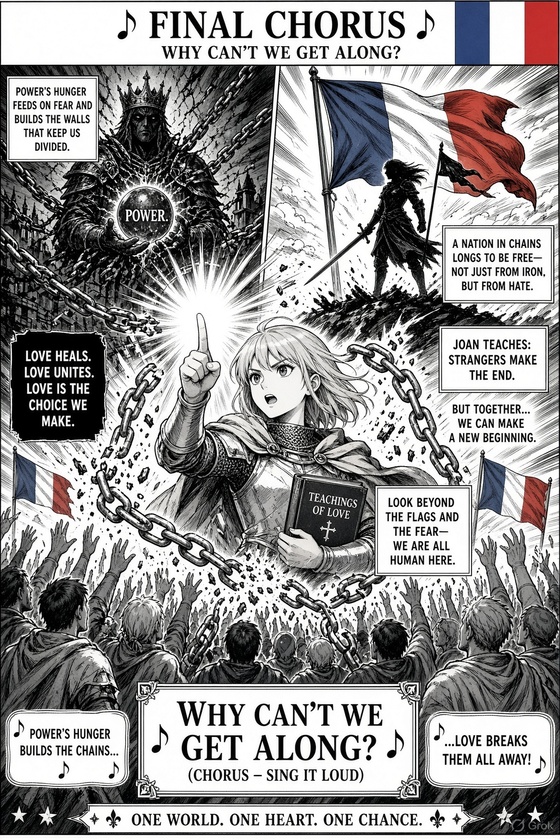
Why Can't we get along? Truce between Burgundy and Orléans
November 20th

Why Can't we get along? Truce between Burgundy and Orléans

18–20 November 1407 (reconciliation) and 23 November 1407 (assassination)

This episode was the flashpoint that turned a bitter family and political rivalry into the Armagnac–Burgundian Civil War, which tore France apart for nearly three decades and left the kingdom catastrophically weak during the later stages of the Hundred Years’ War.

The Background (roughly 1392–1407)

King Charles VI of France had suffered intermittent but severe mental illness since the early 1390s. During his “absences,” power was contested by the great princes of the blood.

The two main rivals were:

  • Louis I, Duke of Orléans (1372–1407) — the king’s younger brother. Handsome, spendthrift, and ambitious, he dominated the court for periods, controlled large amounts of royal revenue, and pursued an expansionist policy in the east (including the purchase of Luxembourg). He was widely rumoured to be the lover of Queen Isabeau of Bavaria.
  • John the Fearless (Jean sans Peur, 1371–1419), Duke of Burgundy from 1404. Son of Philip the Bold, he inherited the vast Burgundian domains (Burgundy, Flanders, Artois, etc.). Flanders’ cloth industry depended on English wool, so John preferred peace or accommodation with England. He was a tough, unscrupulous politician who resented the decline in Burgundian influence and royal pensions after his father’s death.

Tensions had been rising for years over money, territory, control of the royal council, and foreign policy. Their uncle John, Duke of Berry, repeatedly tried to mediate. By late 1407 the two cousins were making open threats.

The Truce

On 20 November 1407 (some popular accounts say the 18th; contemporary sources point to the 20th), John of Berry secured a solemn public reconciliation. Louis and John the Fearless exchanged vows of perpetual friendship, attended Mass together, and received communion from the same priest. The appearance of peace was carefully staged.

The Assassination (23 November 1407)

Three days later, the truce was shattered. That evening Louis visited Queen Isabeau at the Hôtel Barbette on the Rue Vieille-du-Temple in Paris. A royal valet (who was part of the plot) delivered a false message that King Charles VI urgently required him at the Hôtel Saint-Paul.

As Louis rode back through the dark street with a small escort, he was ambushed by about fifteen masked men led by Raoul d’Anquetonville, a Norman knight in John the Fearless’s service. They cut off one of Louis’s hands, split his skull with an axe, and hacked him to death. His Flemish esquire Jacob was killed trying to shield him. Contemporary accounts describe the attackers beating the body “as if they were beating a mattress.”

John the Fearless did not deny the crime. Within days he admitted to his uncles that the murder had been done on his orders (“the Devil took possession of me”), then fled Paris. Later he had the Sorbonne theologian Jean Petit deliver a public justification framing the killing as legitimate tyrannicide — the removal of a tyrant who had allegedly plotted against the king and committed other crimes.

Aftermath and the Civil War

The murder ignited the Armagnac–Burgundian Civil War (c. 1407–1435).

  • The Orléanist side was led first by Louis’s young son Charles, Duke of Orléans, and then increasingly by his powerful father-in-law Bernard VII, Count of Armagnac — hence the name “Armagnacs.”
  • The Burgundians, led by John the Fearless, initially enjoyed strong support in Paris and among many urban groups.

The conflict was vicious and prolonged. It fatally weakened France just as Henry V of England renewed the Hundred Years’ War. French defeat at Agincourt (1415) and the subsequent English conquest of northern France were made possible in large part by this internal division. Paris changed hands more than once; both sides committed atrocities.

The cycle of revenge closed in 1419, when John the Fearless himself was assassinated on the bridge at Montereau during a meeting with the Dauphin (the future Charles VII). John’s son Philip the Good then allied Burgundy with England, prolonging the war until the Treaty of Arras (1435).

Key Figures

FigureRole
John the FearlessOrdered the murder; leader of the Burgundians; later assassinated at Montereau (1419)
Louis I of OrléansVictim; king’s brother and main rival for power
Charles VIMentally ill king whose incapacity created the power vacuum
Isabeau of BavariaQueen; often associated with the Orléans faction; rumoured lover of Louis
John, Duke of BerryUncle and mediator who arranged the short-lived truce
Charles of OrléansLouis’s son; poet and long-time English prisoner; early leader of the Orléanists
Bernard VII of ArmagnacMilitary leader who gave the anti-Burgundian faction its lasting name
Raoul d’AnquetonvilleThe knight who led the actual ambush
 

The 1407 assassination is one of the classic examples of how a single act of political murder can escalate a feud into a full-scale civil war with consequences far beyond the original protagonists.

= November 20th

These events all occurred on 18 November across different centuries. Here’s a concise overview of each, with the key context that makes them notable:

284 – Diocletian becomes Roman emperor

After the death of Emperor Numerian, the army at Nicomedia proclaimed the general Diocletian (born Diocles) as emperor. He would rule until 305 and is best known for ending the Crisis of the Third Century, reforming the empire’s administration and military, instituting the Tetrarchy (rule by four emperors), and launching the last major persecution of Christians.

762 – Tang forces recapture Luoyang

During the An Lushan Rebellion (755–763), one of the most destructive civil wars in Chinese history, Tang dynasty troops aided by Uyghur (Huihe) cavalry retook the eastern capital Luoyang from the rebel Yan dynasty. The rebellion ultimately killed millions and permanently weakened the Tang.

1194 – Henry VI takes Palermo

Henry VI, Holy Roman Emperor and King of Germany, captured Palermo, the capital of the Norman Kingdom of Sicily. This completed his conquest of southern Italy and Sicily, which he claimed through his wife Constance, the last legitimate Norman heir.

1407 – Truce between Burgundy and Orléans (broken days later)

A temporary truce was arranged between John the Fearless, Duke of Burgundy, and Louis, Duke of Orléans, under the mediation of their uncle John, Duke of Berry. Three days later (21 November), Burgundian agents assassinated Orléans in Paris, igniting the French civil war between the Armagnacs and Burgundians that lasted for decades and fatally weakened France during the Hundred Years’ War.

1695 – Zumbi dos Palmares executed

Zumbi, the last major leader of the runaway-slave kingdom of Palmares (Quilombo dos Palmares) in colonial Brazil, was captured and executed by Portuguese forces under the bandeirante Domingos Jorge Velho. Palmares had been the largest and longest-lasting independent community of escaped slaves and free people in the Americas; its fall marked the end of organised large-scale resistance of that kind in the region.

1739 – Battle of Porto Bello begins

British forces under Vice-Admiral Edward Vernon opened the attack on the Spanish colonial port of Porto Bello (Portobelo, Panama) during the War of Jenkins’ Ear. The British captured the town after a short fight; the victory was wildly celebrated in Britain and gave its name to places such as Portobello Road in London.

1776 – British capture Fort Lee; Continental Army retreats

In the American Revolutionary War, British troops under Cornwallis landed at the Palisades and seized Fort Lee, New Jersey. General Washington’s Continental Army abandoned the fort and began the long retreat across New Jersey that would end with the surprise crossing of the Delaware and the victories at Trenton and Princeton.

1789 – New Jersey first to ratify the Bill of Rights

New Jersey became the first state to ratify the proposed Bill of Rights (the first ten amendments to the U.S. Constitution). The amendments would eventually be ratified by the required three-quarters of the states and take effect in 1791.

Would you like a deeper dive into any one of these (Diocletian’s reforms, the An Lushan Rebellion, Zumbi and Palmares, or the 1776 New Jersey campaign, for example)?

=

Why Can't We Get Along
(A Ballad of the Armagnac–Burgundian Tragedy and the Hundred Years’ War)

[Verse 1]
The king sat pale upon his throne, his mind a broken glass,
Charles the Sixth, the Mad, they called, when reason would not last.
A hollow crown, an empty hall, while princes drew their knives,
And France, so proud and storied, bled for two ambitious lives.

[Verse 2]
Louis of Orléans, the brother bold, with fire in his eye,
He bought the lands and held the purse, and would not let France die.
He pushed against the English foe and dreamed a stronger realm,
Yet pride and rumour followed him and shook the royal helm.

[Verse 3]
John the Fearless, Burgundy, a soldier hard and keen,
He ruled the Flemish cloth and trade, a practical machine.
He spoke of order, lower tax, and peace the merchants need,
Yet feared the power Louis held and planted deadly seed.

[Chorus]
Why can’t we get along, when the English wait outside?
Two lions tearing at the throne while the kingdom’s open wide.
One brother, one bold cousin — each with something France could use,
But the sword between them finished what the madness first began.

[Verse 4]
They swore a truce on holy bread, three days of paper peace,
Then in the Rue Vieille-du-Temple the knives cut Louis free.
His hand upon the cobbles, his blood upon the stone,
And John confessed the Devil’s work and left the blame his own.

[Verse 5]
Twelve years the factions burned the land, Armagnac against Burgund,
Till on the bridge at Montereau the Dauphin’s men struck back.
John the Fearless fell in turn beneath an Armagnac blade,
And both the rivals’ corpses lay where French hopes were laid.

[Chorus]
Why can’t we get along, when the English wait outside?
Two lions tearing at the throne while the kingdom’s open wide.
One brother, one bold cousin — each with something France could use,
But the sword between them finished what the madness first began.

[Bridge]
Then out of Domrémy a girl in armour came,
With voices in the wind and a king’s forgotten name.
She raised the standard, broke the siege, and turned the English tide,
Where princes with their power failed, a peasant stood and tried.

[Final Chorus / Outro]
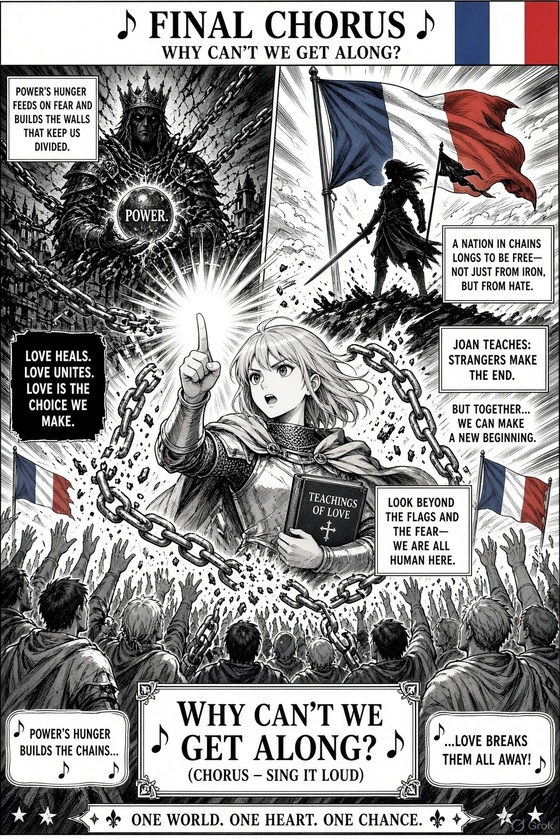
Why can’t we get along? The question still remains,
When power’s hunger outruns love and leaves a nation chained.
Yet Joan rode through the ashes where the great ones would not bend,
And taught a broken France that sometimes strangers make the end.


Read full Article
See More
Available on mobile and TV devices
google store google store app store app store
google store google store app tv store app tv store amazon store amazon store roku store roku store
Powered by Locals