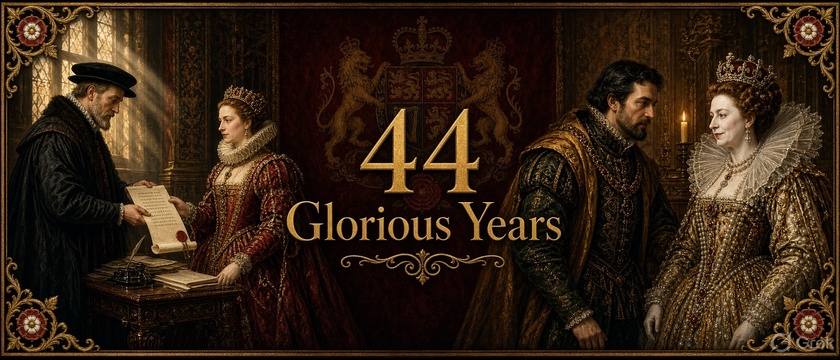
Why Can't we get along? Truce between Burgundy and Orléans
18–20 November 1407 (reconciliation) and 23 November 1407 (assassination)
This episode was the flashpoint that turned a bitter family and political rivalry into the Armagnac–Burgundian Civil War, which tore France apart for nearly three decades and left the kingdom catastrophically weak during the later stages of the Hundred Years’ War.
The Background (roughly 1392–1407)
King Charles VI of France had suffered intermittent but severe mental illness since the early 1390s. During his “absences,” power was contested by the great princes of the blood.
The two main rivals were:
- Louis I, Duke of Orléans (1372–1407) — the king’s younger brother. Handsome, spendthrift, and ambitious, he dominated the court for periods, controlled large amounts of royal revenue, and pursued an expansionist policy in the east (including the purchase of Luxembourg). He was widely rumoured to be the lover of Queen Isabeau of Bavaria.
- John the Fearless (Jean sans Peur, 1371–1419), Duke of Burgundy from 1404. Son of Philip the Bold, he inherited the vast Burgundian domains (Burgundy, Flanders, Artois, etc.). Flanders’ cloth industry depended on English wool, so John preferred peace or accommodation with England. He was a tough, unscrupulous politician who resented the decline in Burgundian influence and royal pensions after his father’s death.
Tensions had been rising for years over money, territory, control of the royal council, and foreign policy. Their uncle John, Duke of Berry, repeatedly tried to mediate. By late 1407 the two cousins were making open threats.
The Truce
On 20 November 1407 (some popular accounts say the 18th; contemporary sources point to the 20th), John of Berry secured a solemn public reconciliation. Louis and John the Fearless exchanged vows of perpetual friendship, attended Mass together, and received communion from the same priest. The appearance of peace was carefully staged.
The Assassination (23 November 1407)
Three days later, the truce was shattered. That evening Louis visited Queen Isabeau at the Hôtel Barbette on the Rue Vieille-du-Temple in Paris. A royal valet (who was part of the plot) delivered a false message that King Charles VI urgently required him at the Hôtel Saint-Paul.
As Louis rode back through the dark street with a small escort, he was ambushed by about fifteen masked men led by Raoul d’Anquetonville, a Norman knight in John the Fearless’s service. They cut off one of Louis’s hands, split his skull with an axe, and hacked him to death. His Flemish esquire Jacob was killed trying to shield him. Contemporary accounts describe the attackers beating the body “as if they were beating a mattress.”
John the Fearless did not deny the crime. Within days he admitted to his uncles that the murder had been done on his orders (“the Devil took possession of me”), then fled Paris. Later he had the Sorbonne theologian Jean Petit deliver a public justification framing the killing as legitimate tyrannicide — the removal of a tyrant who had allegedly plotted against the king and committed other crimes.
Aftermath and the Civil War
The murder ignited the Armagnac–Burgundian Civil War (c. 1407–1435).
- The Orléanist side was led first by Louis’s young son Charles, Duke of Orléans, and then increasingly by his powerful father-in-law Bernard VII, Count of Armagnac — hence the name “Armagnacs.”
- The Burgundians, led by John the Fearless, initially enjoyed strong support in Paris and among many urban groups.
The conflict was vicious and prolonged. It fatally weakened France just as Henry V of England renewed the Hundred Years’ War. French defeat at Agincourt (1415) and the subsequent English conquest of northern France were made possible in large part by this internal division. Paris changed hands more than once; both sides committed atrocities.
The cycle of revenge closed in 1419, when John the Fearless himself was assassinated on the bridge at Montereau during a meeting with the Dauphin (the future Charles VII). John’s son Philip the Good then allied Burgundy with England, prolonging the war until the Treaty of Arras (1435).
Key Figures
| Figure | Role |
|---|---|
| John the Fearless | Ordered the murder; leader of the Burgundians; later assassinated at Montereau (1419) |
| Louis I of Orléans | Victim; king’s brother and main rival for power |
| Charles VI | Mentally ill king whose incapacity created the power vacuum |
| Isabeau of Bavaria | Queen; often associated with the Orléans faction; rumoured lover of Louis |
| John, Duke of Berry | Uncle and mediator who arranged the short-lived truce |
| Charles of Orléans | Louis’s son; poet and long-time English prisoner; early leader of the Orléanists |
| Bernard VII of Armagnac | Military leader who gave the anti-Burgundian faction its lasting name |
| Raoul d’Anquetonville | The knight who led the actual ambush |
The 1407 assassination is one of the classic examples of how a single act of political murder can escalate a feud into a full-scale civil war with consequences far beyond the original protagonists.
= November 20th
These events all occurred on 18 November across different centuries. Here’s a concise overview of each, with the key context that makes them notable:
284 – Diocletian becomes Roman emperor
After the death of Emperor Numerian, the army at Nicomedia proclaimed the general Diocletian (born Diocles) as emperor. He would rule until 305 and is best known for ending the Crisis of the Third Century, reforming the empire’s administration and military, instituting the Tetrarchy (rule by four emperors), and launching the last major persecution of Christians.
762 – Tang forces recapture Luoyang
During the An Lushan Rebellion (755–763), one of the most destructive civil wars in Chinese history, Tang dynasty troops aided by Uyghur (Huihe) cavalry retook the eastern capital Luoyang from the rebel Yan dynasty. The rebellion ultimately killed millions and permanently weakened the Tang.
1194 – Henry VI takes Palermo
Henry VI, Holy Roman Emperor and King of Germany, captured Palermo, the capital of the Norman Kingdom of Sicily. This completed his conquest of southern Italy and Sicily, which he claimed through his wife Constance, the last legitimate Norman heir.
1407 – Truce between Burgundy and Orléans (broken days later)
A temporary truce was arranged between John the Fearless, Duke of Burgundy, and Louis, Duke of Orléans, under the mediation of their uncle John, Duke of Berry. Three days later (21 November), Burgundian agents assassinated Orléans in Paris, igniting the French civil war between the Armagnacs and Burgundians that lasted for decades and fatally weakened France during the Hundred Years’ War.
1695 – Zumbi dos Palmares executed
Zumbi, the last major leader of the runaway-slave kingdom of Palmares (Quilombo dos Palmares) in colonial Brazil, was captured and executed by Portuguese forces under the bandeirante Domingos Jorge Velho. Palmares had been the largest and longest-lasting independent community of escaped slaves and free people in the Americas; its fall marked the end of organised large-scale resistance of that kind in the region.
1739 – Battle of Porto Bello begins
British forces under Vice-Admiral Edward Vernon opened the attack on the Spanish colonial port of Porto Bello (Portobelo, Panama) during the War of Jenkins’ Ear. The British captured the town after a short fight; the victory was wildly celebrated in Britain and gave its name to places such as Portobello Road in London.
1776 – British capture Fort Lee; Continental Army retreats
In the American Revolutionary War, British troops under Cornwallis landed at the Palisades and seized Fort Lee, New Jersey. General Washington’s Continental Army abandoned the fort and began the long retreat across New Jersey that would end with the surprise crossing of the Delaware and the victories at Trenton and Princeton.
1789 – New Jersey first to ratify the Bill of Rights
New Jersey became the first state to ratify the proposed Bill of Rights (the first ten amendments to the U.S. Constitution). The amendments would eventually be ratified by the required three-quarters of the states and take effect in 1791.
Would you like a deeper dive into any one of these (Diocletian’s reforms, the An Lushan Rebellion, Zumbi and Palmares, or the 1776 New Jersey campaign, for example)?
=
Why Can't We Get Along
(A Ballad of the Armagnac–Burgundian Tragedy and the Hundred Years’ War)
[Verse 1]
The king sat pale upon his throne, his mind a broken glass,
Charles the Sixth, the Mad, they called, when reason would not last.
A hollow crown, an empty hall, while princes drew their knives,
And France, so proud and storied, bled for two ambitious lives.
[Verse 2]
Louis of Orléans, the brother bold, with fire in his eye,
He bought the lands and held the purse, and would not let France die.
He pushed against the English foe and dreamed a stronger realm,
Yet pride and rumour followed him and shook the royal helm.
[Verse 3]
John the Fearless, Burgundy, a soldier hard and keen,
He ruled the Flemish cloth and trade, a practical machine.
He spoke of order, lower tax, and peace the merchants need,
Yet feared the power Louis held and planted deadly seed.
[Chorus]
Why can’t we get along, when the English wait outside?
Two lions tearing at the throne while the kingdom’s open wide.
One brother, one bold cousin — each with something France could use,
But the sword between them finished what the madness first began.
[Verse 4]
They swore a truce on holy bread, three days of paper peace,
Then in the Rue Vieille-du-Temple the knives cut Louis free.
His hand upon the cobbles, his blood upon the stone,
And John confessed the Devil’s work and left the blame his own.
[Verse 5]
Twelve years the factions burned the land, Armagnac against Burgund,
Till on the bridge at Montereau the Dauphin’s men struck back.
John the Fearless fell in turn beneath an Armagnac blade,
And both the rivals’ corpses lay where French hopes were laid.
[Chorus]
Why can’t we get along, when the English wait outside?
Two lions tearing at the throne while the kingdom’s open wide.
One brother, one bold cousin — each with something France could use,
But the sword between them finished what the madness first began.
[Bridge]
Then out of Domrémy a girl in armour came,
With voices in the wind and a king’s forgotten name.
She raised the standard, broke the siege, and turned the English tide,
Where princes with their power failed, a peasant stood and tried.
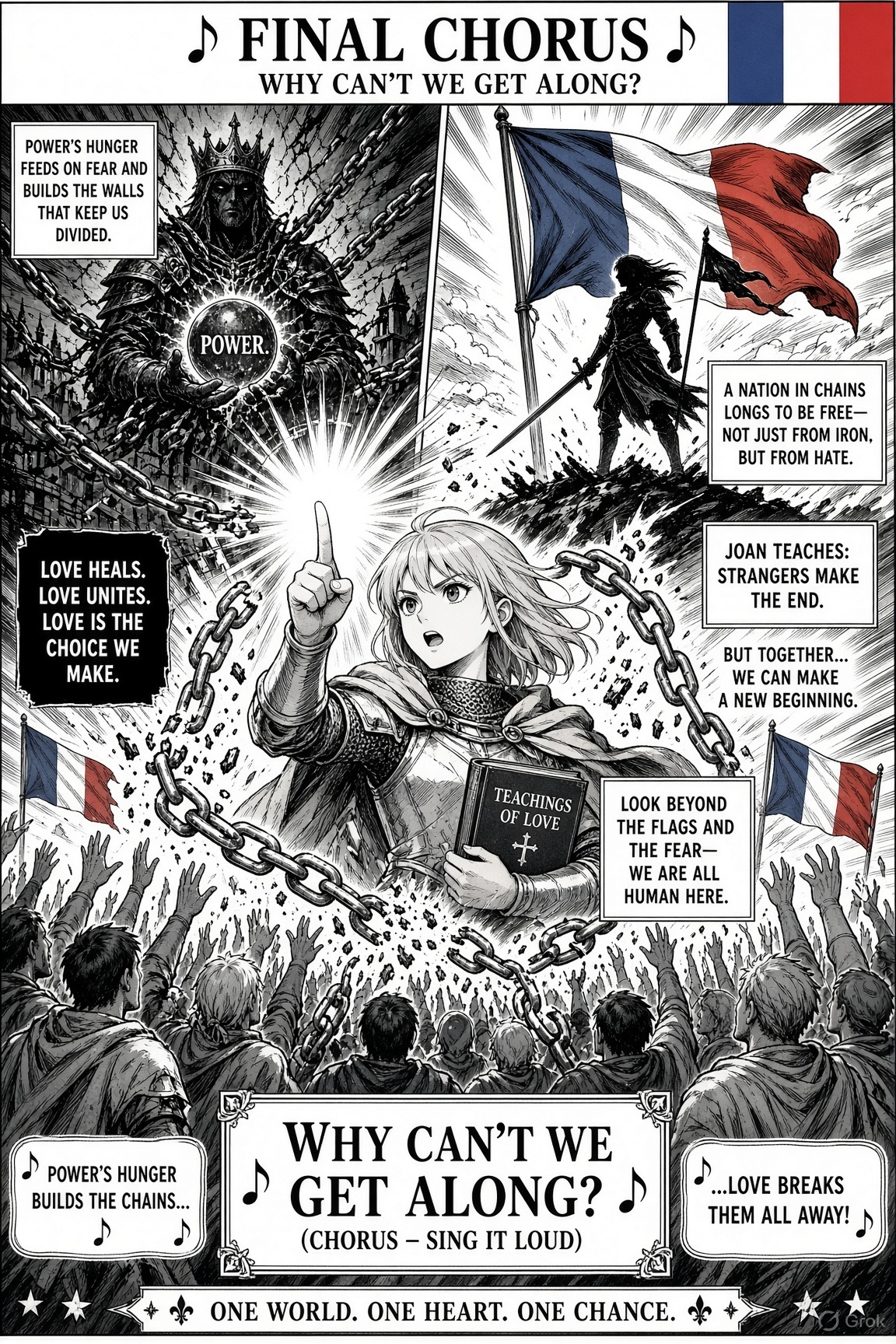
[Final Chorus / Outro]
Why can’t we get along? The question still remains,
When power’s hunger outruns love and leaves a nation chained.
Yet Joan rode through the ashes where the great ones would not bend,
And taught a broken France that sometimes strangers make the end.