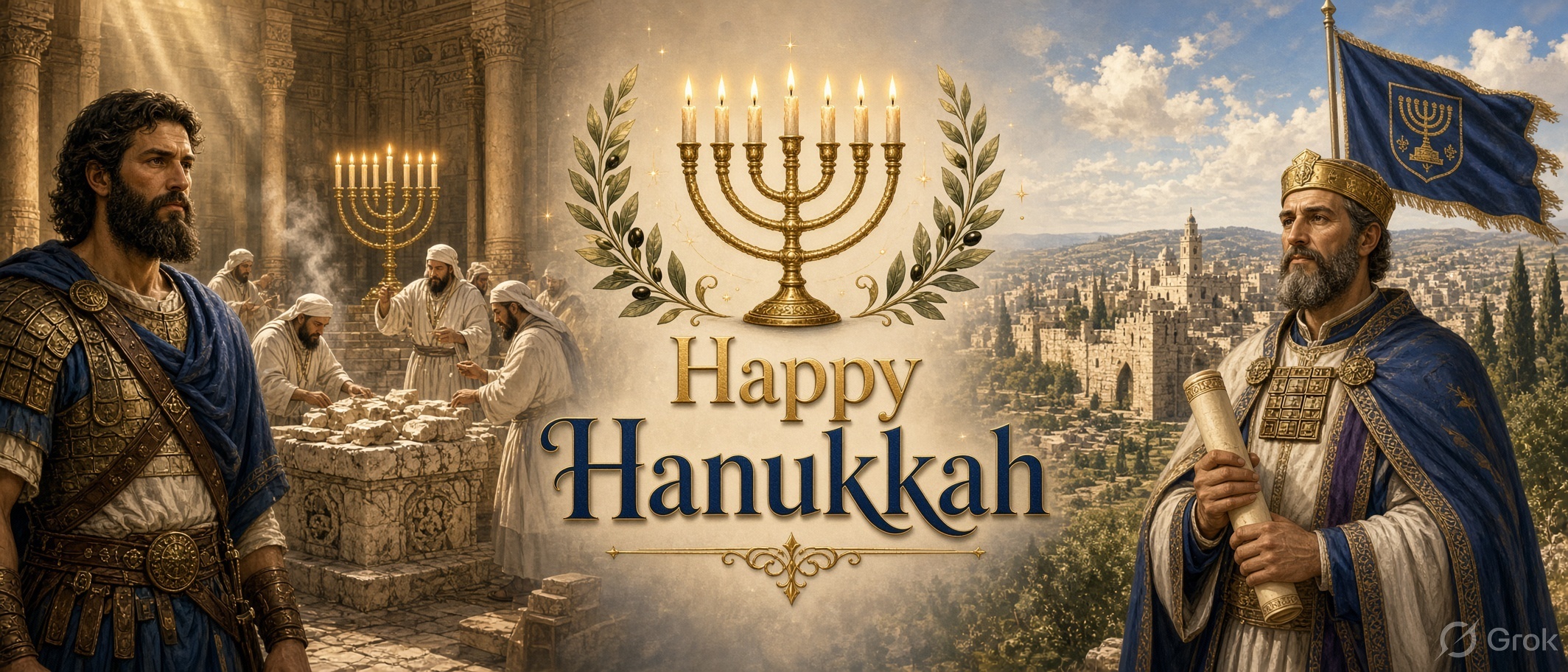
The Hammer who saved the world
164 BC: Judas Maccabeus restores and rededicates the Temple in Jerusalem (origin of Hanukkah)
This event marked a turning point in the Maccabean Revolt (167–141 BCE). Judas Maccabeus (Judah Maccabee) and his followers recaptured Jerusalem, cleansed the desecrated Second Temple, and rededicated it on 25 Kislev (corresponding to roughly mid-December 164 BCE in modern calendars; some historical lists associate it with 21 November). The eight-day festival of Hanukkah (“Dedication”) commemorates this.
Before: Context and Outbreak of the Revolt
Judea had been under Hellenistic rule since Alexander the Great’s conquests and the subsequent Wars of the Diadochi. By the 2nd century BCE it was part of the Seleucid Empire. Many upper-class Jews had adopted aspects of Greek culture, but traditional practice continued under relative tolerance.
Tensions rose under Antiochus IV Epiphanes (reigned 175–164 BCE). He sold the high priesthood to the highest bidder (first Jason, then Menelaus). Internal Jewish factional conflict, combined with Antiochus’s campaigns in Egypt and Roman pressure forcing him to withdraw, led him to treat unrest in Jerusalem as rebellion. In 167 BCE he issued decrees banning key Jewish practices (circumcision, Sabbath observance, possession of the Torah, dietary laws) on pain of death. A pagan altar (the “abomination of desolation,” associated with Zeus Olympios) was erected in the Temple, and traditional sacrifices ceased. A Seleucid garrison and citadel (the Acra) were established in Jerusalem. The Temple was plundered earlier as well.
In Modein (Modi’in), the priest Mattathias (Mattathias ben Johanan of the Hasmonean family) refused to perform a pagan sacrifice. He killed a Jewish man who stepped forward to do so, along with the Seleucid official, and fled with his five sons to the hills. He called for those “zealous for the law” to join him. This launched a guerrilla campaign. Mattathias died around 166 BCE after about a year, appointing his son Judas Maccabeus (“the Hammer”) as military leader.
Judas and the Maccabees (supported especially by the Hasidim/pious traditionalists) used mobile guerrilla tactics. They defeated smaller Seleucid forces (e.g., under Apollonius and Seron at Beth Horon) and won major victories at Emmaus (against Nicanor and Gorgias) and Beth Zur. Antiochus IV left for the east; his regent Lysias was preoccupied. News of Antiochus’s death in Persia (late 164 BCE) further weakened Seleucid efforts. The Maccabees entered Jerusalem in triumph, though the Acra garrison remained.
The Restoration and Rededication
Upon entering the Temple Mount, the Maccabees found the sanctuary desolate, the altar profaned, and the courts overgrown. According to 1 Maccabees, they tore down the defiled altar of burnt offering and stored its stones, then built a new altar of unhewn stones as required by Jewish law. They restored or remade the lampstand, table for showbread, altar of incense, and vessels; hung curtains; and purified the courts.
On the morning of 25 Kislev in the 148th year of the Seleucid era (164 BCE), they offered sacrifice on the new altar—the anniversary of the earlier desecration. They celebrated for eight days with songs, music, and joy. Judas and the assembly decreed that this rededication should be observed annually for eight days beginning on 25 Kislev. The Books of Maccabees (especially 1 Maccabees 4 and 2 Maccabees 10) are the primary early accounts; the later Talmudic story of a single sealed jar of pure oil miraculously lasting eight days (long enough to prepare new oil) is the best-known popular legend associated with the “Festival of Lights.”
After: Continued Struggle and Hasmonean Independence
The rededication was a major symbolic and practical victory, and Lysias later agreed to revoke the ban on Jewish practices. Many moderate/Hellenized Jews were satisfied once religious freedom was restored. The more radical Maccabees continued fighting for fuller political independence.
Judas campaigned to aid Jewish communities in Galilee and Transjordan, then besieged the Acra. Seleucid forces under Lysias and the young Antiochus V Eupator counterattacked, winning at Beth Zechariah and besieging Jerusalem (a sabbatical year complicated supplies). Political turmoil in Syria forced their withdrawal; a settlement restored Jewish religious freedom.
Judas later defeated Nicanor at Adasa (13 Adar, 161 BCE) and made a treaty with Rome. He was killed at the Battle of Elasa in 160 BCE against Bacchides. Leadership passed to his brothers Jonathan Apphus and then Simon Thassi. Internal Seleucid divisions and external problems allowed the Maccabees to expel the Acra garrison in 141 BCE. Simon was recognized as high priest and ethnarch, founding the independent Hasmonean dynasty (which ruled Judea until the Roman period). The Hasmoneans expanded territory but later faced internal conflicts and Hellenizing pressures of their own.
Significant Figures
- Mattathias: Priest from Modein who sparked the revolt by refusing pagan sacrifice and killing the enforcers; father of the five brothers; died c. 166 BCE.
- Judas Maccabeus (Judah Maccabee): Military genius and primary leader 166–160 BCE; won key early battles, rededicated the Temple; killed at Elasa.
- His brothers: Jonathan Apphus (succeeded Judas; later high priest), Simon Thassi (secured independence and founded the dynasty), Eleazar Avaran and John Gaddi (both died in the fighting).
- Antiochus IV Epiphanes: Seleucid king whose policies of forced Hellenization and Temple desecration provoked the revolt; died 164 BCE.
- Lysias: Seleucid regent who led campaigns against the Maccabees and later negotiated religious concessions.
- Other Seleucid commanders: Gorgias, Nicanor, Bacchides.
- Internal figures: Hellenizing high priests such as Jason and Menelaus (the latter’s actions contributed to tensions); later Alcimus.
Primary sources are 1 and 2 Maccabees (deuterocanonical), Josephus (Antiquities and Jewish War), and later rabbinic traditions. Dates and exact details vary slightly across sources, but the core narrative of revolt, Temple restoration, and the establishment of Hanukkah is consistent.
= November 21st
These are notable historical events traditionally associated with November 21 (New Style calendar; some earlier dates use the Old Style calendar, which was about 10 days behind at the time).
164 BC – Judas Maccabeus restores the Temple in Jerusalem (origin of Hanukkah)
Judas Maccabeus (“the Hammer”), son of the priest Mattathias of the Hasmonean family, led the Jewish Maccabean Revolt against the Seleucid Empire under Antiochus IV Epiphanes. Antiochus had banned Jewish practices and desecrated the Second Temple in Jerusalem (including sacrificing a pig). After victories at battles such as Emmaus and Beth Zur, Judas recaptured Jerusalem in 164 BC. He and his followers cleansed the Temple, removed the defiled altar, built a new one of unhewn stones, restored the sacred vessels, and rededicated it with sacrifices on 25 Kislev (traditionally linked to November 21 in some reckonings). This eight-day celebration of purification and rededication is the origin of the Jewish festival of Hanukkah (the Festival of Lights). A later legend describes a miracle in which a small amount of oil burned for eight days.
235 – Pope Anterus succeeds Pontian
Anterus (also Anteros or Antheros; possibly of Greek origin) became the 19th Bishop of Rome (pope) on November 21, 235, after Pope Pontian abdicated following his deportation to the Sardinian mines under Emperor Maximinus Thrax’s persecution of Christians. Anterus’s pontificate was very short (about 40–43 days), ending with his death on January 3, 236. Tradition (from the Liber Pontificalis) holds that he ordered the collection of the acts of the martyrs and was himself martyred for this, though some modern scholars question the martyrdom details and suggest he may have died of other causes amid the persecution. He was the first pope buried in the papal crypt of the Catacomb of Callixtus.
1009 – Lý Công Uẩn enthroned, founding the Lý dynasty
Lý Công Uẩn (974–1028), later known by the temple name Lý Thái Tổ, was enthroned as emperor of Đại Cồ Việt (early Vietnam) on or around November 21, 1009, after the death of the last Early Lê dynasty ruler, Lê Long Đĩnh (Lê Ngọa Triều). A former palace commander with strong support from the Buddhist establishment (including the monk Vạn Hạnh) and officials like Đào Cam Mộc, he rose peacefully to power. He established the Lý dynasty (which lasted until 1225), took the era name Thuận Thiên (“Accordance with Heaven”), and later moved the capital from Hoa Lư to Đại La (renamed Thăng Long, the site of modern Hanoi). This marked a long period of relative stability and cultural development in Vietnamese history.
1386 – Timur captures and sacks Tbilisi
The Turco-Mongol conqueror Timur (Tamerlane) of Samarkand, during the first of several invasions of the Kingdom of Georgia (framed by his chroniclers as a jihad), besieged and captured the Georgian capital of Tbilisi in late November 1386 (sources vary slightly between November 21 and 22). King Bagrat V and members of his family were taken captive. The city was sacked. Bagrat later feigned conversion to Islam to secure his release, then escaped with the help of his son George VII after an ambush of the accompanying Timurid forces. This was the start of repeated devastating Timurid campaigns against Georgia that lasted until the early 1400s.
1620 – Signing of the Mayflower Compact
While the Mayflower was anchored in what is now Provincetown Harbor (Cape Cod), 41 of the male passengers signed the Mayflower Compact on November 11, 1620 (Old Style), which corresponds to November 21 New Style. The group (Separatist “Pilgrims” and others) had landed outside the territory covered by their patent. The short document was a covenant creating a “civil body politic” to enact just and equal laws for the colony’s ordering and preservation, with submission and obedience promised. It served as an early basis for self-government in the Plymouth Colony. The original has been lost; the text is known from William Bradford’s writings.
1676 – Ole Rømer presents the first quantitative measurement of the speed of light
Danish astronomer Ole (Olaus) Rømer, working at the Paris Observatory, demonstrated that light travels at a finite (measurable) speed rather than instantaneously. By carefully timing the eclipses of Jupiter’s moon Io, he observed that the intervals appeared longer when Earth was moving farther from Jupiter and shorter when closer. He predicted a delay of about 10 minutes for a November 9 eclipse (which was confirmed) and estimated that light takes roughly 22 minutes to cross the diameter of Earth’s orbit. This implied a speed on the order of ~220,000 km/s (about 25–30% low by modern standards, due to imprecise knowledge of the astronomical unit at the time). He presented his findings around this period; a summary appeared in the Journal des sçavans in December 1676. This was the first quantitative estimate of the speed of light.
1783 – First untethered hot-air balloon flight
In Paris, Jean-François Pilâtre de Rozier and François Laurent, Marquis d’Arlandes, made the first free (untethered) human flight in a hot-air balloon designed by the Montgolfier brothers (Joseph-Michel and Jacques-Étienne). Launching from the grounds of the Château de la Muette (Bois de Boulogne) on November 21, they flew for about 25 minutes, covering roughly 5–5.5 miles (about 9 km) over the city before landing safely near the Butte-aux-Cailles. This followed earlier unmanned and tethered tests (including one with animals). It marked the beginning of human aviation. Pilâtre de Rozier later died in a 1785 Channel-crossing attempt with a hybrid balloon.
1789 – North Carolina ratifies the U.S. Constitution
North Carolina’s second ratification convention, meeting in Fayetteville, approved the United States Constitution on November 21, 1789, by a vote of roughly 194–77, making it the 12th state. A previous convention in Hillsborough (1788) had neither ratified nor rejected it, primarily due to the lack of a Bill of Rights. Assurances that a Bill of Rights would be added (it was proposed by Congress in September 1789), plus Federalist political efforts, shifted the outcome. North Carolina was the second-to-last of the original 13 states to ratify (Rhode Island followed in 1790).
These events span religion, politics, science, exploration, and technology, illustrating the range of human activity recorded on this date across more than two millennia.