

VoiceDDB
Politics • Culture • News
oDDBall analysis of conservative politics with a libertarian economic conservative twist. Small government, big freedom.
Interested? Want to learn more about the community?
September 19, 2021
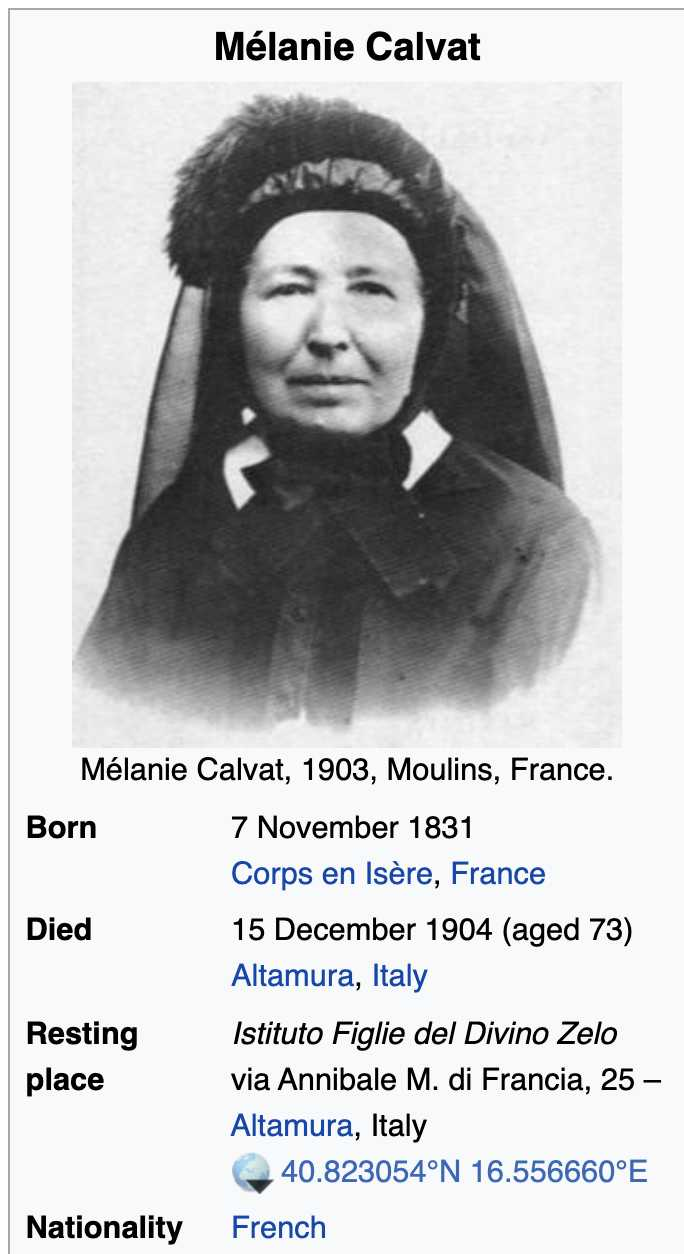
On this day, 19th Sept 1846 Marian visions

Françoise Mélanie Calvat (French: [fʁɑ̃swaz melani kalva], 7 November 1831 – 14 December 1904), called Mathieu, was a French Roman Catholic nun and Marian visionary. As a religious, she was called Sister Mary of the Cross. She and Maximin Giraud were the two Marian visionaries of Our Lady of La Salette.

https://conservativeweasel.blogspot.com/2021/09/19th-sept-review-of-historical-and.html

post photo preview
Interested? Want to learn more about the community?
What else you may like…
Videos
Posts
Articles
00:01:07
November 27, 2022
Jingle Bell Rock

Jingle bell, jingle bell, jingle bell rock
Jingle bells swing and jingle bells ring
Snowin' and blowin' up bushels of fun
Now the jingle hop has begun

Jingle bell, jingle bell, jingle bell rock
Jingle bells chime in jingle bell time
Dancin' and prancin' in Jingle Bell Square
In the frosty air

What a bright time, it's the right time
To rock the night away
Jingle bell time is a swell time
To go glidin' in a one-horse sleigh

Giddy-up jingle horse, pick up your feet
Jingle around the clock
Mix and a-mingle in the jinglin' feet
That's the jingle bell rock

Jingle bell, jingle bell, jingle bell rock
Jingle bell chime in jingle bell time
Dancin' and prancin' in Jingle Bell Square
In the frosty air

What a bright time, it's the right time
To rock the night away
Jingle bell time is a swell time
To go glidin' in a one-horse sleigh

Giddy-up jingle horse, pick up your feet
Jingle around the clock
Mix and a-mingle in the jinglin' feet
That's the jingle bell
That's the jingle...

00:02:04
September 01, 2021
Intro to Locals for the Conservative Voice

David Daniel Ball calls himself the Conservative Voice.

I'm a teacher with three decades experience teaching math to high school kids.I also work with first graders and kids in between first grade and high school. I know the legends of why Hypatia's dad is remembered through his contribution to Math theory. And I know the legend of why followers of Godel had thought he had disproved God's existence.

I'm not a preacher, but I am a Christian who has written over 28 books all of which include some reference to my faith. Twelve blog books on world history and current affairs, detailing world events , births and marriages on each day of the year, organised by month. Twelve books on the background to and history of Bible Quotes. One Bible quote per day for a year. An intro to a science fiction series I'm planning, post apocalyptic cyber punk. An autobiography with short story collections.

I'm known in Australia for my failure as a whistleblower over the negligence death of a school boy. ...

00:01:50
September 04, 2026
Should violent criminals be made fat? Grok says 'no'

No. Transferring gut bacteria from an obese person into a violent criminal is not a reliable, ethical, or effective way to make them “fat, sedentary, and less of a physical threat.”

The science does not deliver the outcome you want

Mouse studies in germ-free animals showed that microbiota from obese donors can increase energy harvest and adiposity compared with lean-donor microbiota. That is the origin of the idea. Human evidence is far weaker.

Randomized trials of fecal microbiota transplant (FMT) from lean donors into people with obesity have generally failed to produce meaningful, sustained weight loss. Microbiome composition can change; body weight and metabolic markers often do not, or the effects are small and inconsistent. Diet and the existing gut environment usually dominate. A 2025 Nature paper found diet outperformed microbial transplant for microbiome recovery. Human guts are already colonized, not sterile like lab mice, so engraftment is variable and effects unpredictable.

It is not a ...

post photo preview
August 28, 2026
Pfizer struggles to answer

Some in Australia are brilliant. Malcolm Roberts Investigates Pfizer over Covid vaccine.

Holiday break is over back to work tonight

Tonight I'll start double posting until I've caught up.

post photo preview
Win or lose, ones choices define them
Alexander at Gaugamela October 1st

Win or lose, ones choices define them 

Alexander at Gaugamela October 1st

Gaugamela, 1 October 331 BC, is the day the Achaemenid field army ceased to be a coherent instrument of empire. Everything after it — Babylon, Susa, Persepolis, the death of Darius — follows from that afternoon on a flattened plain near modern Erbil.

Background

Alexander had already beaten Darius once, at Issus in November 333. That battle cost Darius his camp, his family, and the western seaboard. He offered terms: the lands west of the Euphrates, a huge ransom, a marriage alliance. Alexander refused. After Tyre, Gaza and Egypt (including Siwa), he was no longer fighting a Greek “revenge war.” He was claiming Asia.

In summer 331 he left the Mediterranean, crossed the Euphrates at Thapsacus, and marched toward the Tigris. Darius had time. He called up the central and eastern satrapies — Bactrians, Sogdians, Indians, Saka cataphracts — and chose ground he could shape. Near the village the Greeks called Gaugamela (“camel’s hump”), he had the plain levelled so scythed chariots and massed cavalry could run freely. Arbela (Erbil) sat behind him as a supply base. He meant this to be his battle: open ground, no river pinning him as at Issus, numbers large enough to envelope both Macedonian flanks.

Greek figures for the Persian host (hundreds of thousands, even a million) are propaganda. What is credible is cavalry superiority — perhaps on the order of 30,000-plus horse against Alexander’s roughly 7,000 — and a line long enough to overlap him. Alexander brought about 40,000–47,000: the pike phalanx, hypaspists, Companion cavalry, Thessalians, light troops. Quality and cohesion, not mass.

On the night of 20–21 September, after the Macedonians crossed the Tigris, a near-total lunar eclipse occurred. Babylonian omen tradition read it against the king. Eleven days later the armies faced each other. On 30 September Alexander came in sight of the Persian line, spent the day reconnoitring, and refused Parmenion’s advice to attack in the dark. He let the Persians stand to arms all night. Dawn on 1 October was his.

On the field

Darius sat in the centre with the royal guard and Greek mercenaries — the last reliable infantry he had. Mazaeus held the Persian right; Bessus and the eastern horse the left. Chariots were posted in front to break the phalanx.

Alexander’s answer was not a straight clash. He formed something close to a hollow box: phalanx in the centre, Companions on the right under his own hand, Thessalians on the left under Parmenion, both wings refused (angled back) and screened by mixed cavalry and light infantry so a double envelopment could not immediately roll him up. A second infantry line covered the rear. The whole army could face outward if surrounded.

He then advanced obliquely, drifting to his right. That forced the Persian left to stretch and follow. Chariots that reached the line were channelled into lanes and cut down by Agrianians and light troops; they did not break the phalanx. As Persian cavalry peeled left to contain Alexander’s drift, a gap opened in their left-centre, near Darius.

That was the moment. Alexander pulled Companions, hypaspists and the rightmost taxeis of the phalanx into a wedge, himself at the point, and drove at the king. The “hammer and anvil” of Macedonian war: pike blocks pinning the centre, Companion wedge punching the seam. Darius’s chariot tangled in the press; the Greek sources have him quit it for a horse and flee. Whether he broke first or his guards did is less important than the effect: the imperial centre collapsed when the king left the field.

It was not yet over. On Alexander’s left, Mazaeus’s horse pressed Parmenion hard; some Persians and Indians even broke into the Macedonian camp. Parmenion sent for help. Alexander broke off the chase, turned, and met the returning Persian right in what several accounts treat as the bloodiest fighting of the day. The Thessalians held. When news of Darius’s flight reached Mazaeus’s wing, that effort also dissolved. The last Achaemenid army of the old style disintegrated rather than withdrew in order. The Babylonian diary is blunt: the king’s troops left him.

Macedonian dead, if Arrian is believed, were a few hundred; other authors give more. Persian losses were heavy. Darius himself escaped toward Media.

Immediate result

The road to the rich core of the empire was open.

  • Arbela was plundered.
  • Mazaeus, who had commanded the Persian right, rode to Babylon and twenty days after the battle surrendered the city. Alexander entered through the Ištar Gate, sacrificed to Marduk, and — the political masterstroke — kept Mazaeus as satrap. That told every remaining grandee: submit and keep your rank.
  • Susa opened in December 331; its treasury financed the next year.
  • The Persian Gates were forced in January 330 after a hard mountain fight with Ariobarzanes.
  • Persepolis was occupied the same month. The city was given to the army to sack; months later the palace complex was burned — revenge for Xerxes’ Greece, or a drunken decision, or both. Either way, the ceremonial heart of the dynasty was gone.

Darius still lived, gathering what he could at Ecbatana. That was already a remnant court, not an empire in arms.

Longer-term result

Gaugamela did not immediately kill Darius. Bessus and the eastern nobles did that in July 330, near modern Damghan, as Alexander closed in. They proclaimed Bessus “Artaxerxes,” which gave Alexander his next war-aim: punish the regicides, claim the Achaemenid mantle, and chase resistance into Bactria and Sogdia. Darius received a royal funeral. Alexander could now style himself successor, not only conqueror.

Structurally, the battle ended the Achaemenid system as a going concern:

  • The western and central satrapies had no covering army. One by one they bargained.
  • Alexander kept Persian forms — satraps, court ritual, later the proskynesis quarrel — because he needed the machine, not a vacuum. Gaugamela made that policy possible; Issus had only made it thinkable.
  • For the Greek world, the “Panhellenic” war was notionally complete. What followed (the east, India, the mutinies) was Alexander’s own imperial war.
  • For Iran, the shock was civilisational. A dynasty that had ruled from the Indus to the Aegean for two centuries lost its capitals in a single campaigning season after one lost afternoon. Later Iranian memory treated Alexander as both world-conqueror and destroyer of the sacred centre at Persepolis.

The fighting in the far east lasted years. The decision was 1 October 331. After Gaugamela there was no second Persian host that could meet Alexander in the open and hope to win. Everything else was pursuit, garrison, and the problem of ruling what the wedge had broken.

These are all 1 October events — a date that keeps turning up at hinges of empire, church, and revolution. Below is the cluster you listed, in order.

331 BC — Alexander defeats Darius III at Gaugamela.
Eleven days after a lunar eclipse on 20 September, Alexander’s Macedonians met Darius III on a prepared plain near modern Erbil in Iraqi Kurdistan. Darius had flattened the ground for scythed chariots and massed cavalry; the Greek numbers for the Persian host are inflated, but he almost certainly outnumbered Alexander’s roughly 47,000. Alexander refused a night attack, spent 30 September reconnoitring, then on 1 October drove a wedge toward Darius himself. The Great King fled; Babylon opened within weeks, Susa and Persepolis followed. The Achaemenid imperial centre did not recover. The date is fixed by a Babylonian astronomical diary that records both the eclipse and the battle.

366 — Damasus I is elected pope.
Liberius had died on 24 September. A minority consecrated the deacon Ursinus; the majority chose Damasus, consecrated at the Lateran on 1 October. Street fighting followed at the Julian and Liberian basilicas; the urban prefect backed Damasus and banished Ursinus. Damasus then spent eighteen years defending Nicaea against Arianism, commissioning Jerome’s Vulgate work, restoring catacombs, and pressing Rome’s apostolic claim against Constantinople. He is the patron of archaeologists.

959 — Edgar the Peaceful becomes king of all England.
His elder brother Eadwig died on 1 October. Since 957 the kingdom had been split at the Thames: Eadwig in Wessex, Edgar in Mercia and the north. Edgar, about sixteen, reunited it. The later nickname “Peaceful” is slightly misleading — he could ravage Thanet — but his reign (to 975) was unusually stable: Dunstan recalled and promoted, coinage protected, a large fleet built, and the Danelaw left its own law. The Bath coronation of 973 became the template for later English coronations.

965 — Pope John XIII is elected.
Five months after Leo VIII’s death, Otto I’s envoys (Otger of Speyer and Liutprand of Cremona) steered the Romans toward John, bishop of Narni. He was consecrated on Sunday 1 October. The Roman nobility kidnapped him that December; Otto restored him in 966 and punished the rebels. John then crowned the boy Otto II emperor (Christmas 967), crowned Theophano empress (972), and finally erected the metropolitan see of Magdeburg for the Slavic mission. He died in 972.

1553 — Coronation of Mary I of England.
At Westminster Abbey, Stephen Gardiner presented her as “rightful and undoubted inheritrix.” She was the first woman to take the English throne in her own right without a living husband as co-monarch. The rite restored Catholic ceremonial after Edward VI. The reign that followed — Spanish marriage, Wyatt’s rising, the heresy burnings — is why later Protestant memory fixed her as “Bloody Mary.” The coronation itself was the legal and liturgical claim that a woman could wear the crown alone.

1588 — Coronation of Shah Abbas I of Persia.
In Qazvin, the weak Shah Mohammad Khodabanda placed the crown on his seventeen-year-old son. The Qizilbash amir Murshid Qoli Khan Ostajlu had marched him west after an Uzbek invasion of Khorasan; a street demonstration finished the transfer. Abbas later broke the Qizilbash grip with a gholam army of Georgians, Circassians and Armenians, recaptured Tabriz and the Caucasus from the Ottomans, took Hormuz from the Portuguese with English help, and made Isfahan the Safavid capital. The 1 October ceremony is the start of that forty-year reign. (Some sources give late September 1587 for the palace handover; the conventional Western “coronation” date used in the October 1 lists is 1588.)

1730 — Ahmed III is forced off the Ottoman throne.
The Tulip Era ended in the Patrona Halil revolt. After Iranian successes against Ottoman garrisons, an Albanian former janissary raised the bazaar on 28 September. Ahmed had his son-in-law, Grand Vizier Nevşehirli Damat Ibrahim Pasha, strangled. It was not enough. On 1 October he abdicated for his nephew Mahmud I and went into the kafes. Rebels then wrecked the Kağıthane pleasure palaces. Ahmed died in confinement in 1736.

1787 — Suvorov beats the Turks at Kinburn.
Old Style 1 October (12 October New Style), on the sand spit opposite Ochakov at the Dnieper mouth. Hasan Pasha landed about 6,000 janissaries to take the weak fort covering Kherson. Suvorov counter-attacked with far fewer men, was wounded twice, and was saved by grenadier Stepan Novikov. A late Cossack flanking move across the shoals broke the landing. Ottoman dead ran to several thousand; the survivors swam for the boats at night. Catherine awarded Suvorov the Order of St Andrew. The fight opened the war that later took Ochakov and Izmail.

1791 — First session of the French Legislative Assembly.
The Constituent Assembly had dissolved itself after passing the Constitution of 1791 and, on Robespierre’s motion, barring its own members from the next house. Seven hundred and forty-five mostly young, inexperienced deputies met in the Salle du Manège. Louis XVI was now “King of the French” by constitution, not by divine right alone; he still held a veto he meant to use. The Feuillants sat to the right, Brissotins/Girondins to the left. Within a year the session produced war with Austria, the 10 August rising, and the Convention. The left–right seating of that room is the ancestor of the modern spectrum.

1795 — The Austrian Netherlands annexed by Revolutionary France.
After Fleurus (June 1794) Austria abandoned the southern Netherlands. On 9 Vendémiaire Year IV (1 October 1795) the Convention decreed the reunion of the Austrian Netherlands and the Prince-Bishopric of Liège with the Republic. They were cut into nine departments (Lys, Dyle, Ourthe, Forêts, and the rest). Campo Formio in 1797 made Austria admit the loss. The annexation is the legal birth of “Belgium” as a French administrative block; 1815 would rearrange it again.

Taken together, 1 October is a day of transfer: a Persian empire to a Macedonian king, a divided England to one teenager, two popes onto contested chairs, a Catholic queen onto a Reformation throne, a Safavid revival, an Ottoman tulip court smashed, a Russian general on a spit of sand, a French constitution that would not hold, and the Habsburg Low Countries folded into the Republic.

Read full Article
September 29, 2026
post photo preview
Starship reached orbit.
On Monday, 28 September 2026, at about ten o’clock at night Darwin time

On Monday, 28 September 2026, at about ten o’clock at night Darwin time, Starship reached orbit.

It was Flight 14: Super Heavy Booster 21 and Ship 41, the V3 stack, off Pad 2 at Starbase. Liftoff was 12:48 UTC. One Raptor on the ship shut down early. Controllers still called the insertion burn. The vehicle went into low Earth orbit for the first time. Then it did the thing previous flights had only rehearsed: it opened the bay and put up a working payload — twenty-six Starlink V3 satellites, all of them contacted, all of them operating. SpaceX cut the mission from a planned ten hours to about three. The booster made a controlled splashdown in the Gulf. The ship came down north of Hawaii on a landing burn, then tipped and burned off residual propellant in the water, as ocean recoveries of this vehicle usually do. No chopsticks this time. That first is still ahead.

Starship is not a finished article. V3 will become ordinary, then give way to V4. Falcon will shrink in the manifest because these satellites are too large for Falcon 9 and because one ship can, in time, put up the capacity of many Falcon loads. This flight flew twenty-six, not a full sixty. The capacity added is on the order of ten times a typical Falcon 9 flight of V2 Mini birds. Direct-to-cell is a different Starlink line; what went up on Monday is the heavy V3 broadband layer. Mobile coverage will ride the constellation as a whole, not this batch alone.

Still: first orbit. First operational payload. Firsts still owed — a ship caught in the tower, a double launch, a tanker rendezvous. Those will come. The night of the 28th was the hinge.

Congratulations to Elon Musk, to SpaceX, and to X, which carried the argument and the pictures while the vehicle was still in the air.


For 30 September

These eight moments sit on the last days of September — most of them on the 30th — and they share a family resemblance: a second blow, a baggage train lost, a crown claimed, a city burned, an opera that outlived its composer.

489 — Battle of Verona.
Theoderic’s Ostrogoths had already beaten Odoacer at the Isonzo on 28 August. A month later they met again outside Verona. English sources put the fight on 30 September; some Italian accounts say the 28th. Theoderic charged when his line wavered. Odoacer fled to Ravenna. The Western Empire had fallen in 476; Verona decided who would wear what was left of Italy.

737 — Battle of the Baggage.
Asad ibn Abdallah al-Qasri raided Khuttal. Suluk’s Türgesh came down. The Arabs got the army back across the Oxus. They did not get the baggage. On 30 September the train and its escort were taken. Hold on the upper Oxus collapsed. Kharistan later reversed the campaign. The baggage fight had already shown how thin the caliphate’s reach had become.

1399 — Henry IV proclaimed.
Richard II signed a formal abdication on the 29th. On the 30th an assembly sitting as Parliament accepted the deposition and acclaimed Henry of Bolingbroke. Coronation followed on 13 October. Lancaster began as a usurpation in legal dress. Richard was dead within months. The doubt over the title ran through the reign and into Shakespeare.

1541 — De Soto and the Tula.
The column had crossed the Mississippi in June. By autumn it was in western Arkansas among the Tula — likely Caddoan speakers. The fighting is usually placed in October near present-day Fort Smith, not on a single September day. It was hard enough that de Soto turned east and wintered at Utiangue. He died the next May at Guachoya. The gold was never there.

1551 — Tainei-ji.
On 28 September Sue Takafusa marched on Yamaguchi. Ōuchi Yoshitaka had tried to move Emperor Go-Nara and the court west and make the city a second Kyoto. His captains would not have it. The city burned. Weather drove Yoshitaka back from the coast. On 30 September he committed seppuku at Tainei-ji with a handful of men left. The courtiers who had followed him were killed. Ming official trade, which the Ōuchi had held, broke off.

1744 — Madonna dell’Olmo.
Outside Cuneo, 30 September, War of the Austrian Succession. Conti’s Franco-Spanish army held the convent and the road. Charles Emmanuel III came up from Saluzzo, lost the field, and withdrew in order. Cuneo did not fall. Rain and empty magazines sent the Bourbons back over the Alps. A win that did not open Piedmont.

1791 — Die Zauberflöte and the Constituent Assembly.
Same calendar day, two rooms. In Vienna, Mozart conducted the first night of The Magic Flute at Schikaneder’s Freihaus-Theater auf der Wieden. Schikaneder played Papageno. Mozart was dead on 5 December. The piece kept running. In Paris the National Constituent Assembly dissolved on 30 September. The Constitution of 1791 was in force. Robespierre and Pétion left the hall as “incorruptible patriots” because they had barred themselves from the next house. The Legislative Assembly met the next day. The constitutional monarchy lasted less than a year.

What holds the list together is not a theme so much as a hinge: second battles after first ones, a train of loot taken, a crown taken, a court that never arrived, an opera that did. Late September keeps producing those. Orbit, this week, was another.

Read full Article
September 27, 2026
post photo preview
Beginnings tend to define the shape of things to come.
Darius, son of Hystaspes

Beginnings tend to define the shape of things to come.

That is why the first of these late-September dates still matters more than its calendar slot. On the tenth of Bagayādiš — 29 September 522 BC by the usual conversion — Darius, son of Hystaspes, killed a king. Everything after that in Achaemenid history depends on who that king was. We still do not know. The uncertainty is not a modern flourish. It is the original condition of the throne.

Darius’s own version is carved high on the rock at Behistun, in Old Persian, Elamite and Babylonian, where travellers on the road from Babylon to Ecbatana could see the relief even if they could not read the letters. Cambyses, he says, secretly murdered his brother Bardiya before leaving for Egypt. The murder was hidden. While the king was away, “the Lie” spread in Persia, Media and the other lands. A Magian named Gaumāta rose on 11 March 522 in a mountain country called Arakadriš, in Paishiyāuvādā, and told the people: “I am Bardiya, son of Cyrus, brother of Cambyses.” The empire went over to him. On 1 July he seized the kingship. Then Cambyses “died his own death” — five words that have been argued over since the nineteenth century. No one dared move against the Magian. He killed those who had known the real prince, so that the fraud would hold. Temples were wrecked; pastures, herds, households and domains were taken from the people. On 29 September, Darius says, he prayed to Ahuramazda, went with a few men to the fortress of Sikayauvatiš in the Median district of Nisaya, and slew Gaumāta and his chief followers. “I dispossessed him of the kingdom. By the grace of Ahuramazda I became king.” Then he restored what had been stolen and put the dynasty back on its foundation.

That is a complete political theology in a few paragraphs. The enemy is not merely a rival. He is drauga, the Lie. The new king is the agent of arta, Truth and right order. The killing is not a coup. It is a cosmic correction. The relief makes the claim visible: Darius stands over a prostrate figure labelled Gaumāta, the other rebels roped in a file before him. Captions name them. The rock does not invite discussion. It invites assent.

Herodotus, writing in the next century, tells a story that rhymes with Behistun and then adds the details a court chronicle would never carve. In his version the false Smerdis is a Magian, set up by a Magian brother, Patizeithes. The new king never leaves the citadel and never summons the great Persians. Otanes is the first to smell the fraud. His daughter Phaedyme is in the harem — inherited, as the royal women were, from Cambyses. She cannot even ask Atossa, Cyrus’s daughter, who the man is, because the king has separated the women. Otanes sends a third message: when he sleeps, feel for his ears. Cyrus, for some old offence, had cut the ears off this Magian. Phaedyme does it, at the risk of her life, and finds none. Seven nobles form the plot. Darius, arriving late, is the seventh. They storm the palace. Darius helps kill the pretender. Five days later the seven debate monarchy, oligarchy and a kind of equality; monarchy wins; they agree that the one whose horse neighs first at dawn shall be king; Darius’s groom arranges it.

Ctesias calls the impersonator Sphendadates. Justin uses Cometes. The names shift. The structure does not: a hidden death, a look-alike, a priestly or Median colour to the fraud, seven conspirators, Darius on top. The Greeks even remember a popular Smerdis, the one who remitted taxes and military service for three years, so that “all Asia except the Persians” missed him when he was gone. Darius remembers the opposite: a wrecker of temples and a thief of land. Both memories can be propaganda. Both can contain a sliver of a real policy. We cannot tell which.

The case against Darius is not a conspiracy theory invented on the internet. It is the majority instinct of a long line of modern specialists — Olmstead, Dandamaev, Briant and others — and it rests on awkward facts inside Darius’s own success. He was not Cyrus’s son. He was a collateral Achaemenid; his father Hystaspes was still alive and serving when the son took the crown. The man who sat on the throne in the summer of 522 was recognised in Babylonian business tablets as Barziya/Bardiya. Those tablets move from Cambyses to Bardiya without a civil-war gap. The great wave of revolts — Elam, Babylon, Media, Persia itself, Parthia, Margiana, Sagartia and the rest — explodes after Darius kills the sitting king, not during the quiet months of Bardiya’s recognised reign. A second Persian, Vahyazdāta, later rose in the homeland still claiming to be Bardiya, son of Cyrus, which is a strange thing to do if everyone already knew Bardiya had been unmasked as a Magian months before. Darius married Parmys, Bardiya’s daughter, a classic legitimising move. He never produced the corpse of the “real” Bardiya. He never staged a public unmasking that would have settled the identity beyond the rock. And the killing itself is placed at a Median fortress, not in a crowded palace where hundreds would have known the king’s face.

On that reading the deception is Darius’s, not Gaumāta’s. The sitting king was the son of Cyrus. A coalition of Persian nobles, with Darius as its sharpest member, murdered him because his policy — tax relief, interference with noble estates, a shift of weight toward Media, a threat to the men who had done well out of Cyrus’s conquests — could not be borne. The Magian story then does the work every usurper needs: it turns a dead legitimate prince into a fraud, and the assassins into restorers of the house. The Lie is relocated. The man who tells the official story becomes the champion of Truth.

The case for Darius is not foolish either. No surviving ancient author, Greek or otherwise, says in so many words that Darius killed the real Bardiya. The list of the Seven is almost the same in Behistun and in Herodotus. A secret fratricide by Cambyses is ugly, but Cambyses’s reputation in Egypt and in later memory could carry it. Imposture at the scale of an empire is rare; it is not impossible in a world without portraits in every house, where most subjects never saw the king, and where a prince could be kept off-stage for years. Magi were a Median priestly grouping in Greek memory; a Median restoration after Cyrus’s Persian conquest is a motive that does not require Darius to have invented the whole cast. Darius’s later insistence that lying voids divine favour is either sincere theology or the boldest kind of cover. Men have used both.

What cannot be disputed is the sequel, and the sequel is the editorial point. Whoever died at Sikayauvatiš, the empire did not accept the new reign as a restoration. Within weeks Elam and Babylon rose. Then Media, then Persia, then the east. Nine rebel “kings,” Darius says; nineteen battles; one year. Several of the rebels used the same weapon he had just used or just denounced: they put on a dead royal name. Nidintu-Bēl became Nebuchadnezzar. Vahyazdāta became Bardiya again. The Lie, once introduced as the explanation of a throne, proved contagious. Darius crushed them, mutilated the captives, and put their bodies into the same monument that justified the first killing. The administrative empire that follows — satrapies, roads, tribute, the king’s eye, the king’s inscribed Truth — is the shape of a beginning that had to be argued from a rock because it could not be taken for granted in the palaces.

That is why the deception still sits in the story. If Gaumāta was a fraud, the beginning is a warning about how easily a hidden murder and a borrowed face can take a world. If Bardiya was real, the beginning is a warning about how completely the winner can rename the dead. Either way the first act is the same: a small group of armed men, a fortress or a bedchamber, a body, and then a public sentence that turns the body into a principle. Empires are not only built with spears. They are built with the first authorised account of how the last man died.

We do not know which account is true. The tablets prove a king called Bardiya reigned. They do not prove whose blood he had. The Greeks prove that a story of ears and Magians travelled west. They do not prove the ears. The rock proves what Darius needed the world, and the gods, to believe. It does not prove he was believed in his own house on the night of the killing. Beginnings define the shape of things to come. This one defined an empire that would last two centuries, and a question that has already lasted twenty-five. The question is not an academic remainder. It is the price of a throne taken in the dark and explained in stone.

Read full Article
See More
Available on mobile and TV devices
google store google store app store app store
google store google store app tv store app tv store amazon store amazon store roku store roku store
Powered by Locals