


VoiceDDB
Politics • Culture • News
oDDBall analysis of conservative politics with a libertarian economic conservative twist. Small government, big freedom.
Interested? Want to learn more about the community?
September 23, 2021
On this day, 23rd Sept 2014

Tonight Channel 9 feature a Ray Martin interview with former PM Julia Gillard. In the interview, Gillard will attempt to reinvent herself for post political employment opportunity. It is interesting the interviewer is Martin and not Laurie Oakes. Oakes is partisan ALP but part of the Rudd camp, having leaked damaging information about Gillard in favour of Rudd. Martin is partisan ALP but in the past has been called 'balanced' as he excused the ALP much when their corruption was obvious. Tonight, Gillard will lie about several significant things. Gillard will lie about how and why she deposed Rudd, claiming she was hesitant and in two minds. She has clearly been in two minds, vacillating over how her actions appear versus her need for power. She was clearly hesitant too, until she realised she didn't need to tell the truth about her activity, ever. Instead she will say that Rudd was damaged and weak, but being an ALP member, that is true of anyone, including herself. Gillard will also lie about her governments backflip to embrace a carbon dioxide tax. As subsequent events have shown, she and her colleagues always intended to foist one on the Australian Peoples and she and Swan lied when they said they wouldn't. She will lie too about her clammy embrace of corrupt parliamentarians like Carr, Slipper and Thomson. She will claim they mislead her and she trusted them. The truth is she would have used anyone to hang onto power, and did. Also, Gillard will claim she was treated poorly for her gender. Her claim that Abbott is a misogynist is a bare faced lie and the truth is much was excused her for being the worst female Prime Minister Australia has ever had. And in times to come, she will probably always be the worst ever female Prime Minister. Following Mr Abbott's election victory, ALP claimed the conservatives did not value science research as they did not have a science minister. The ministry had been poor, promoting fads, not science, and people died and the economy was encumbered as a result. However, the 2014 budget intended to create a $20 billion research fund, and the ALP has opposed it. A research fund like that is something that would be profoundly beneficial for science. Clearly the ALP have lied about their support for science. They need to embrace science and support the fund.

Terrorists have fans of science, as some loitering near Lucas Heights nuclear power station demonstrate. Just because they are four guys with beards being asked to move along does not mean Islamic peoples are being profiled unfairly. There have been planned attacks in the past and Australia has a security issue at the moment. Meanwhile a terrorist leader from Australia has a traditional past, having served time in organised crime as a brothel worker and attack dog. His own mother might have even smirked when she said she thought he was 'studying overseas.' It is not Islam, but terrorists and Islamo Fascists who use myths and excuses to murder and rape and torture a way to a new world. Sadly impotent Islamic leadership identify with the terrorists. One outrageous recent claim is that ISIS soldiers are raping women to raise a new generation of Islamic peoples. But children are not merely conceived, they are raised too, and these intended absent fathers will not achieve their claim, even as they achieve their aim. And so we have a terrorist manifesto, the voice of someone who hates us, a criminal, torturer, rapist and killer ordering his minions to go forth. And the pathetic mainstream media excuse the activity, saying there are legitimate reasons for the activity, blaming Jews for living, blaming Western culture for existing, blaming deprivation experienced by poor Islamic peoples who are badly led. But there is no excuse for terrorism. Wilkie has campaigned on one excuse. He has claimed that the invasion of Iraq was based on a lie that there were no weapons of mass destruction. He still claims this after Syria unleashed it on their own people. ALP is divided on security too. Their leader, Shorten, claims he is following the conservative lead, but his own members are saying the opposite. A french man is captured by ISIS, and Media Watch hosts of past and present sneer at raids which protect Australian peoples from similar.

A teacher has apparently used a mentally ill 14 yo girl as rape bait. The teacher's plans went awry when the girl went with a suspected violent rapist boy, also mentally ill, into the wrong lavatory. The girl was apparently raped and sodomised by the boy. There is no report yet of the teacher doing serious jail time for neglect and stupidity. A new migrant shop owner has been charged with setting an arson fire in his own business which claimed the lives of three people. Clive Palmer has claimed that Jacqui Lambie, his hand picked member of parliament in the senate, is not very bright. Seems to have taken him a long time to realise it.
https://conservativeweasel.blogspot.com/2021/09/23rd-sept-review-of-historical-and.html

post photo preview
Interested? Want to learn more about the community?
What else you may like…
Videos
Posts
Articles
00:01:07
November 27, 2022
Jingle Bell Rock

Jingle bell, jingle bell, jingle bell rock
Jingle bells swing and jingle bells ring
Snowin' and blowin' up bushels of fun
Now the jingle hop has begun

Jingle bell, jingle bell, jingle bell rock
Jingle bells chime in jingle bell time
Dancin' and prancin' in Jingle Bell Square
In the frosty air

What a bright time, it's the right time
To rock the night away
Jingle bell time is a swell time
To go glidin' in a one-horse sleigh

Giddy-up jingle horse, pick up your feet
Jingle around the clock
Mix and a-mingle in the jinglin' feet
That's the jingle bell rock

Jingle bell, jingle bell, jingle bell rock
Jingle bell chime in jingle bell time
Dancin' and prancin' in Jingle Bell Square
In the frosty air

What a bright time, it's the right time
To rock the night away
Jingle bell time is a swell time
To go glidin' in a one-horse sleigh

Giddy-up jingle horse, pick up your feet
Jingle around the clock
Mix and a-mingle in the jinglin' feet
That's the jingle bell
That's the jingle...

00:02:04
September 01, 2021
Intro to Locals for the Conservative Voice

David Daniel Ball calls himself the Conservative Voice.

I'm a teacher with three decades experience teaching math to high school kids.I also work with first graders and kids in between first grade and high school. I know the legends of why Hypatia's dad is remembered through his contribution to Math theory. And I know the legend of why followers of Godel had thought he had disproved God's existence.

I'm not a preacher, but I am a Christian who has written over 28 books all of which include some reference to my faith. Twelve blog books on world history and current affairs, detailing world events , births and marriages on each day of the year, organised by month. Twelve books on the background to and history of Bible Quotes. One Bible quote per day for a year. An intro to a science fiction series I'm planning, post apocalyptic cyber punk. An autobiography with short story collections.

I'm known in Australia for my failure as a whistleblower over the negligence death of a school boy. ...

00:01:50
September 04, 2026
Should violent criminals be made fat? Grok says 'no'

No. Transferring gut bacteria from an obese person into a violent criminal is not a reliable, ethical, or effective way to make them “fat, sedentary, and less of a physical threat.”

The science does not deliver the outcome you want

Mouse studies in germ-free animals showed that microbiota from obese donors can increase energy harvest and adiposity compared with lean-donor microbiota. That is the origin of the idea. Human evidence is far weaker.

Randomized trials of fecal microbiota transplant (FMT) from lean donors into people with obesity have generally failed to produce meaningful, sustained weight loss. Microbiome composition can change; body weight and metabolic markers often do not, or the effects are small and inconsistent. Diet and the existing gut environment usually dominate. A 2025 Nature paper found diet outperformed microbial transplant for microbiome recovery. Human guts are already colonized, not sterile like lab mice, so engraftment is variable and effects unpredictable.

It is not a ...

post photo preview
August 28, 2026
Pfizer struggles to answer

Some in Australia are brilliant. Malcolm Roberts Investigates Pfizer over Covid vaccine.

Holiday break is over back to work tonight

Tonight I'll start double posting until I've caught up.

post photo preview
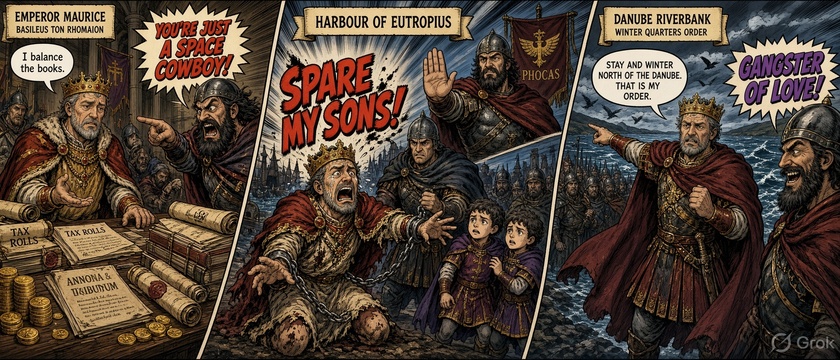
Tragic end of Maurice
November 27th

Tragic end of Maurice

The execution of Emperor Maurice on 27 November 602 was a brutal dynastic massacre that ended the Justinian dynasty, installed the usurper Phocas, and triggered the devastating Byzantine–Sasanian War of 602–628. It is one of the clearest turning points in late antiquity: a capable if austere reign gave way to chaos that left both the Eastern Roman (Byzantine) and Sasanian empires exhausted and vulnerable to the later Arab conquests.

Before: Maurice’s Reign and the Path to Revolt (582–602)

Maurice (Mauricius/Maurikios, born c. 539 in Cappadocia) became emperor on 13/14 August 582 as the last ruler of the Justinian dynasty. He was a capable administrator and military leader who had earlier served as a general. Key achievements included:

  • Ending the long war with Persia in 591 by restoring Khosrow II to the Sasanian throne after the revolt of Bahram Chobin. In return, the Romans gained territory in Armenia and Mesopotamia and stopped paying annual tribute to Persia.
  • Campaigning successfully against the Avars and Slavs in the Balkans in the 590s, pushing them back toward the Danube.

However, Maurice faced chronic financial strain and was austere to the point of unpopularity. He cut army pay, restricted booty, and refused to ransom thousands of captured soldiers (leading to their massacre by the Avars). In 602, he ordered the exhausted Balkan army to winter north of the Danube living off the land rather than returning to winter quarters. This final order sparked mutiny.

Earlier tensions had already surfaced: Phocas (a middle-ranking officer/centurion, probably from Thrace or Cappadocia) had been sent as a spokesman for the troops to complain about general Comentiolus and was publicly humiliated at court (his beard was pulled). Maurice’s perceived nepotism (favoring relatives) and failure to cultivate popularity in Constantinople further alienated both the army and the urban populace. Circus factions (especially the Greens) and food shortages had already produced unrest earlier in 602.

The Coup and the Execution (November 602)

In autumn 602 the Balkan army mutinied, first demanding to return inside the frontier. When refused, they raised Phocas on a shield in the traditional acclamation ritual and marched on Constantinople. Maurice had no reliable field army nearby. He tried to arm the circus factions and arrest the potential rival Germanus (father-in-law of his eldest son Theodosius), but this provoked riots. On the night of 22 November, Maurice, Empress Constantina, and their children fled by ship across the Bosporus toward Bithynia/Asia, seeking refuge near the shrine of St Autonomos.

Phocas was crowned emperor on 23 November by Patriarch Cyriacus in the church of St John the Baptist at the Hebdomon (outside the walls). He entered Constantinople on 25 November to popular acclamation, with no serious resistance.

Maurice and most of his family were captured. On 27 November (a Tuesday) at the Harbour of Eutropius near Chalcedon, Phocas’s men (notably Lilius) executed Maurice’s younger sons first while he was forced to watch. Maurice then recited “Thou art just, O Lord, and thy judgement is just” before being beheaded. Sources differ slightly on the exact number of sons present (five or six; the eldest, Theodosius, was recalled from Nicaea and killed nearby shortly afterward). Bodies were thrown into the sea; heads were displayed. Empress Constantina and their three daughters were initially spared and sent to a monastery.

After: Phocas, War with Persia, and Long-Term Consequences

Phocas (ruled 602–610) was a low-born military usurper deeply distrusted by the Constantinopolitan elite. He ruled tyrannically, executed potential rivals (including later Constantina, Germanus, and others around 605–606 after a conspiracy involving rumors that Theodosius had survived), and persecuted Miaphysites and Jews. He made peace with the Avars by increasing tribute so he could focus on the east, but this proved insufficient.

Khosrow II used Maurice’s murder as a pretext (claiming to avenge his benefactor and, in some accounts, supporting a pretender said to be Theodosius). The Byzantine–Sasanian War of 602–628 began almost immediately. Persian forces overran Mesopotamia (Dara, Amida, Edessa, etc.), reached deep into Anatolia, took Antioch, Damascus, and Jerusalem (614), and later Egypt. Both empires were devastated.

In 610, Heraclius (son of the Exarch of Africa) sailed to Constantinople, overthrew and executed Phocas, and eventually reversed the Persian gains in the 620s. The True Cross was restored to Jerusalem in 630, but both empires were exhausted. This weakness facilitated the rapid Arab-Muslim conquests that followed.

Significant Figures

  • Maurice: Last Justinianic emperor; competent but unpopular austerity and military orders triggered the crisis.
  • Phocas: Centurion-turned-usurper; spokesman for the mutinous troops who seized power and ordered the executions.
  • Constantina: Maurice’s wife (daughter of Tiberius II); survived the initial massacre but was later executed.
  • Theodosius: Eldest son and co-emperor (from 590); sent toward Persia for aid, recalled, and killed.
  • Germanus: Influential figure and father-in-law of Theodosius; briefly considered as a possible alternative emperor before submitting to Phocas.
  • Khosrow II (Khosrau II / Khusro): Sasanian king restored by Maurice in 591; launched the great war after 602 under the banner of avenging Maurice.
  • Heraclius: Future emperor who ended Phocas’s reign in 610 and later recovered most lost territories from Persia.
  • Lilius: Phocas’s associate who carried out the executions at Chalcedon.
  • Supporting sources include Theophylact Simocatta, the Chronicon Paschale, and later chroniclers.

The event was remembered as an act of particular cruelty. It marked the first successful violent deposition of a Roman emperor in the East since the third century and is widely seen as the catalyst for the last great war of antiquity between Rome and Persia.

= November 27th

These events are all traditionally dated to or around 27 November (with some calendar variations), and each marks a notable political, military, religious, or cultural turning point.

AD 25 – Luoyang becomes capital of the Eastern Han

After the collapse of Wang Mang’s short-lived Xin dynasty, Liu Xiu (Emperor Guangwu) proclaimed himself emperor in AD 25 and established his capital at Luoyang, roughly 335 km east of the former Western Han capital of Chang’an. This decision marked the formal start of the Eastern (or Later) Han dynasty (AD 25–220). Guangwu spent the next decade consolidating power, defeating rival claimants and the Red Eyebrows peasant army, and largely reunifying China by AD 36. Choosing Luoyang signalled a deliberate break from the western capital and its associations with the previous regime while remaining in the Chinese heartland.

176 – Marcus Aurelius elevates Commodus

On 27 November 176, Marcus Aurelius granted his son Commodus the title Imperator and effectively made him supreme commander of the legions (and soon co-Augustus). Commodus, born “in the purple,” became the first biological son to succeed a long line of adoptive “Five Good Emperors.” The elevation was celebrated with a joint triumph later that year. It ended the practice of selecting capable adult heirs by adoption and placed a teenager on the path to sole rule. Commodus’s later reign (especially after 180) is widely remembered for extravagance, megalomania, and instability that marked the end of the high imperial peak.

395 – Murder of Rufinus

Flavius Rufinus, Praetorian Prefect of the East and the dominant figure at the court of the young Emperor Arcadius after Theodosius I’s death, was killed on 27 November 395 outside Constantinople. Gothic troops under Gainas (recently recalled from the west) cut him down during a formal reception of the returning army. Contemporary accounts describe him being hacked to pieces and his head paraded. The murder removed a powerful rival to the western general Stilicho and reflected the growing influence of Gothic federate forces inside the Eastern Roman political system.

511 – Death of Clovis I

King Clovis I of the Franks died at Lutetia (Paris) on or about 27 November 511 and was buried in the Abbey of St Genevieve (which he had founded). Clovis had united the Salian Franks, defeated the last Roman authority in northern Gaul (Syagrius), conquered much of Aquitaine from the Visigoths, and converted to Catholic Christianity—cementing an alliance with the Gallo-Roman population and the Church. His death led to the partition of the kingdom among his four sons, establishing the characteristic Merovingian pattern of divided rule that lasted until the mid-eighth century.

602 – Execution of Emperor Maurice

On 27 November 602 the Byzantine emperor Maurice was executed by the usurper Phocas at the Harbour of Eutropius near Chalcedon. Maurice was forced to watch his younger sons killed first; he was then beheaded. (Accounts vary slightly on the exact number of sons present.) The coup ended a capable if austere reign and immediately triggered a major war with Sassanid Persia under Khosrow II, who used the murder of his former patron as a pretext. The subsequent decades of conflict exhausted both empires and left them vulnerable to the later Arab conquests.

1095 – Urban II launches the First Crusade

At the Council of Clermont (17–27 November 1095), Pope Urban II delivered his famous appeal on 27 November, calling on Christian warriors to aid the Byzantine Empire against the Seljuk Turks and to liberate Jerusalem. The speech (preserved in several later accounts) promised spiritual rewards, including remission of sins for those who took the cross. The response was immediate and massive; the First Crusade (1096–1099) followed, culminating in the capture of Jerusalem and the establishment of the Crusader states. The council itself also dealt with church reform and the Truce of God, but the crusading call overshadowed everything else.

1703 – Destruction of the first Eddystone Lighthouse

Henry Winstanley’s pioneering wooden lighthouse on the Eddystone Rocks (southwest of Plymouth) was swept away during the Great Storm of 1703. The storm, one of the most destructive in British history, peaked around 27 November (Old Style; 8 December New Style). Winstanley himself was on the rock completing improvements and perished with the structure; no trace of him or his companions was found. The disaster demonstrated both the extreme exposure of the site and the limits of early timber construction on offshore rocks; later stone towers eventually solved the problem.

1727 – Foundation of the Jerusalem Church, Berlin

The foundation stone of the new Jerusalem Church (Jerusalemkirche) in Berlin’s Friedrichstadt (today Kreuzberg) was laid in the mid-1720s under King Frederick William I; the church was completed and consecrated in 1728 to designs by Philipp Gerlach. It replaced an earlier chapel and smaller church on the same site (first mentioned in 1484). The building served the growing Lutheran and Calvinist population of the expanding city. Later rebuilt and enlarged in the nineteenth century, it was destroyed in the Second World War; its ground plan is still marked in the pavement near the Axel Springer building.

Together the dates illustrate a long arc: the re-founding of a major Chinese dynasty, the shift from adoptive to hereditary succession in Rome, the violent politics of late antiquity, the birth of the Merovingian kingdom, a disastrous Byzantine coup, the launching of the Crusades, the limits of early engineering, and the steady expansion of early-modern Berlin.
Read full Article
November 24, 2026
post photo preview
When the challenge fails
November 26th

When the challenge fails

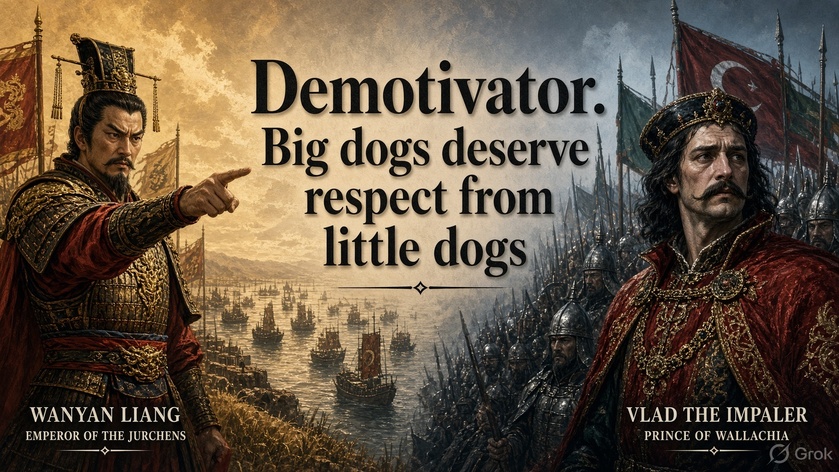
Battle of Caishi (26–27 November 1161) and Vlad the Impaler’s third reign in Wallachia (November 1476) were both short, high-stakes turning points that checked larger powers and highlighted the limits of personal ambition amid shifting alliances.

Battle of Caishi (Jin–Song Wars)

Before. The Jin–Song Wars grew out of the early 12th-century collapse of the Khitan Liao dynasty. Jurchen forces under the Jin allied with the Song against the Liao, then turned on their partners. By 1127 the Jin had taken the Northern Song capital Kaifeng, captured the emperor, and driven the Song court south of the Yangtze to establish the Southern Song at Hangzhou under Emperor Gaozong. The 1142 Treaty of Shaoxing fixed the border roughly along the Huai River, leaving the Jin in control of northern China and the Song in the south. Relative peace held until Wanyan Liang (Prince of Hailing) seized the Jin throne in 1150 after a palace coup. He pursued aggressive sinicization, moved the capital toward the Chinese heartland, and openly aimed to reunify China under Jin rule. In 1158 he claimed the Song had broken the 1142 treaty, launched large-scale conscription (including Han troops), and began building a fleet. The draft was deeply unpopular and sparked revolts that diverted Jin resources. On the Song side, Gaozong hoped to avoid war and delayed major fortifications; only limited garrisons were prepared in 1161. Chen Kangbo (Song prime minister and naval commander) shaped overall strategy, while the civil official Yu Yunwen happened to be at the front distributing awards when the crisis arrived and took effective field command.

The battle. On 26–27 November 1161 at Caishi on the Yangtze (near modern Nanjing/Ma’anshan), Wanyan Liang’s forces tried to cross and open the road into the Song heartland. Song strength is given as roughly 18,000; traditional accounts claim Jin numbers as high as several hundred thousand (figures modern historians treat skeptically—Herbert Franke and others note that the larger totals likely refer to the entire front, and desertions, earlier losses, and poor ship quality sharply reduced the force that actually attempted the crossing). The Song used paddle-wheel warships (faster and more maneuverable than the Jin’s lighter, often hastily built vessels) hidden behind an island. On a signal they sortied and bombarded the attackers with traction trebuchets launching “thunderclap bombs”—soft-cased gunpowder explosives containing lime and sulfur that burst into noxious, blinding clouds. Jin ships suffered from shallow-water losses earlier in the campaign and from poor construction; many troops deserted once it became clear that steppe cavalry was useless on the river. The Song won a clear tactical victory, forcing Wanyan Liang to burn remaining ships and retreat.

After. The defeat was politically fatal for Wanyan Liang. He was assassinated by his own officers in camp in December 1161 amid a military coup that installed Emperor Shizong. The Jin withdrew from the southern offensive in 1162. A formal peace in 1165 reaffirmed the Huai River boundary and ended major hostilities for decades. Song morale and political stability rose; Gaozong abdicated the following year. Traditional Chinese historiography ranked Caishi alongside the 383 Battle of Fei River as a classic southern victory that preserved independence against northern invaders, emphasizing naval technology and gunpowder over raw numbers. Later Jin probes continued in other sectors but avoided another serious Yangtze crossing attempt.

Significant figures.

  • Wanyan Liang — Jin emperor whose unification ambitions and sinicizing policies drove the war; defeated and assassinated.
  • Yu Yunwen — Song civil official who organized and commanded the field army at Caishi.
  • Chen Kangbo — Song prime minister and chief naval/strategic planner.
  • Emperor Gaozong of Song — Southern Song ruler who preferred peace but survived the crisis.
  • Emperor Shizong of Jin — Successor installed by the coup; reversed many of Liang’s policies and accepted the 1165 settlement.

Vlad the Impaler’s third reign (Wallachia, November 1476)

Before. Vlad III (Vlad Țepeș / Vlad Dracula), son of Vlad II Dracul, had already ruled Wallachia briefly in 1448 (with Ottoman backing) and from 1456 to 1462. His second reign is famous for mass impalements, brutal suppression of boyar opposition, and aggressive campaigns against the Ottomans. After the 1462 Ottoman invasion under Mehmed II (which installed his brother Radu), Vlad fled and was imprisoned by King Matthias Corvinus of Hungary on charges of secret dealings with the Ottomans. He spent roughly a dozen years in varying degrees of captivity. By the mid-1470s the strategic picture had shifted: Stephen III of Moldavia (Stephen the Great) had defeated the Ottomans at Vaslui in 1475 and requested Vlad’s release as a useful anti-Ottoman ally. Matthias released him (reportedly after a conversion to Catholicism), recognized him as the legitimate prince, and employed him in early 1476 raids into Ottoman-held territory in Bosnia, where Vlad again used terror tactics. That summer Mehmed II invaded Moldavia, defeated Stephen at Valea Albă (26 July), but then withdrew due to supply problems and disease. Vlad, Hungarian forces under Stephen V Báthory, and Stephen the Great then turned south into Wallachia against the Ottoman-backed Basarab Laiotă (Basarab the Elder), who had displaced Radu.

The campaign and brief reign. In November 1476 Báthory’s troops took Târgoviște (8 November); Vlad and Stephen occupied Bucharest. Basarab fled to the Ottomans (16 November). Vlad was reinstalled and crowned before 26 November—his third and shortest reign. He confirmed trading privileges for Brașov merchants and tried to consolidate control, but his position depended on the continued presence of the allied armies.

After. Once the bulk of the Hungarian and Moldavian forces withdrew, Basarab returned with Ottoman support. Vlad was killed in late December 1476 or early January 1477 near Snagov (north of Bucharest) while fighting the counter-attack; his small force (roughly 2,000 in one account) was overwhelmed. Accounts of the exact circumstances differ: some describe a battle death, others an ambush or assassination by a disguised Turk, and one version claims his own men mistook him for an enemy in the chaos. Contemporary reports state that his head was sent to Constantinople and displayed. His Moldavian bodyguard was also massacred (reported by Stephen the Great in a 10 January 1477 letter). Burial traditions point to Snagov monastery or possibly Comana, but no definitive tomb has been confirmed. Basarab regained Wallachia; the principality returned to the familiar cycle of Ottoman and Hungarian influence, with Stephen the Great later installing another candidate.

Significant figures.

  • Vlad III the Impaler — Restored briefly with foreign help; killed within weeks.
  • Basarab Laiotă — Rival who fled then returned with Ottoman backing.
  • Stephen the Great of Moldavia — Key ally who requested Vlad’s release, campaigned jointly, and left some troops for protection.
  • Stephen V Báthory — Hungarian commander whose forces took Târgoviște and enabled the restoration.
  • Matthias Corvinus — Hungarian king who imprisoned then released Vlad and authorized the campaign.
  • Mehmed II — Ottoman sultan whose earlier invasion of Moldavia and support for Basarab framed the events.

Both episodes show how naval or coalition technology and temporary alliances could halt expansionist rulers, yet neither produced lasting local dominance: the Song secured a stable southern border for decades, while Vlad’s restoration collapsed almost immediately.

= November 26th

These are notable events from late November (often around the 26th) in the listed years, drawn from historical records and Wikipedia-linked pages.

783: Adosinda confined to a monastery

Queen Adosinda of the Kingdom of Asturias (daughter of Alfonso I and Ermesinda, sister of Fruela I, and wife of King Silo) was forced into the monastery of San Juan de Pravia (Santianes de Pravia). Silo had ruled peacefully from 774 to 783 without heirs. On his death, Adosinda backed her nephew Alfonso II for the throne. Her half-brother Mauregatus (an illegitimate son of Alfonso I) seized power with military support, drove Alfonso into exile in Álava, and sidelined Adosinda. She entered the monastery as a nun (in the presence of figures including Beatus of Liébana) and remained there for the rest of her life. She is buried there with Silo.

1161: Battle of Caishi

On 26–27 November, Song dynasty forces decisively defeated a Jin dynasty fleet attempting to cross the Yangtze River at Caishi (near modern Nanjing) during the Jin–Song Wars. The Jin, under Emperor Wanyan Liang, sought to invade the Southern Song. Song commander Yu Yunwen (a civil official) and naval leader Chen Kangbo used superior paddle-wheel warships equipped with trebuchets that launched gunpowder-based “thunderclap bombs” (soft-cased explosives with lime and sulfur that created noxious clouds). The Song fleet outmaneuvered the Jin’s lighter, often hastily built ships; many Jin troops deserted as their steppe cavalry proved ineffective on water. Wanyan Liang was later assassinated by his own men. The victory boosted Song morale and contributed to a lasting peace treaty in 1165 along the Huai River boundary.

1476: Vlad the Impaler’s third reign in Wallachia

Vlad III (Vlad the Impaler / Vlad Dracula) defeated the forces of Basarab Laiotă (Basarab the Elder) with support from Stephen the Great of Moldavia and Stephen V Báthory (leading Hungarian troops). He retook the throne of Wallachia for the third time (after brief rule in 1448 and his main reign of 1456–1462). This came amid shifting alliances against Ottoman influence. The reign was short: Basarab returned with Ottoman backing, and Vlad was killed in battle near Snagov (late December 1476 or early January 1477). Accounts of his death vary (ambush, mistaken identity by his own men, or combat); his head was reportedly sent to Constantinople.

1778: Captain James Cook reaches Maui

During his third Pacific voyage (aboard HMS Resolution and Discovery), Cook’s expedition sighted and visited Maui in the Hawaiian Islands around 26 November 1778. This was the first recorded European contact with Maui (the archipelago as a whole had first been reached in January 1778, when Cook landed on Kauaʻi and named the group the Sandwich Islands). The ships traded with locals for provisions while exploring the coasts of Maui and Hawaiʻi Island before later anchoring at Kealakekua Bay. Cook was killed there in February 1779 during a conflict after returning for repairs.

1789: First national Thanksgiving Day in the United States

At Congress’s request, President George Washington proclaimed Thursday, 26 November 1789, as a day of public thanksgiving and prayer. Issued on 3 October 1789 in New York City (then the capital), the proclamation thanked God for the successful establishment of the Constitution and the new federal government, for protection during the Revolution, and for peace and liberty. Washington attended services at St. Paul’s Chapel and gave food and beer to debtors in prison. This was the first national Thanksgiving under the Constitution (earlier colonial and Continental Congress observances had occurred). It was a one-time event; the annual late-November tradition was later formalized by Abraham Lincoln in 1863.

These episodes span medieval succession struggles, early gunpowder naval warfare, Balkan resistance to the Ottomans, European exploration of the Pacific, and the founding of American national traditions.

Read full Article
November 24, 2026
post photo preview
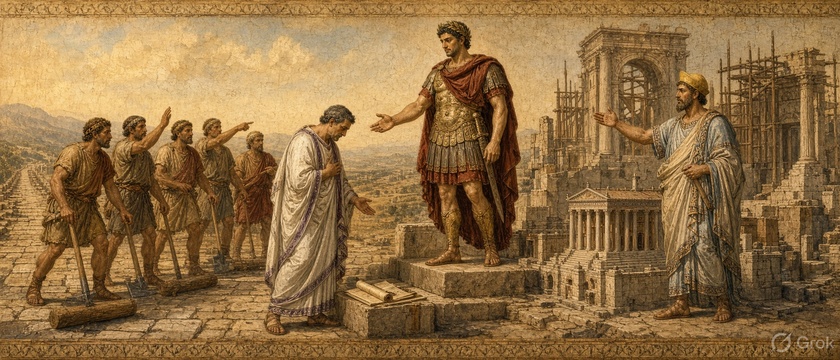
Rome ruled. Etruscans served
November 25th

Rome ruled. Etruscans served

Servius Tullius’s triumph of 571 BC is recorded in the Fasti Triumphales (the ancient Roman list of triumphators) as one of three triumphs he celebrated over the Etruscans. The precise entry reads (in restored form): Servius Tullius, king, over the Etruscans, on the 6th day before the Kalends of December (25 November) in the year 182/183 AUC. Two more followed later (one on 25 May 567 BC; the third is only partially preserved). These are traditional/legendary dates from later Roman historiography; no contemporary evidence exists.

Before the triumph: accession and early wars

Servius Tullius was the traditional sixth king of Rome (c. 578–535 BC), succeeding Lucius Tarquinius Priscus (the fifth king, an Etruscan from Tarquinia). According to the main Roman tradition (Livy, Dionysius of Halicarnassus), his origins were obscure and servile: he was the son of Ocrisia, a Latin captive woman from Corniculum in the household of Tarquinius Priscus. A flame was said to have appeared around the child’s head, which Queen Tanaquil (Tarquinius’s wife) interpreted as a sign of future greatness. He was raised in the royal household, married a daughter of Tarquinius Priscus (usually called Tarquinia or Gegania), and became a trusted figure.

Tarquinius Priscus was assassinated around 579/578 BC by the sons of the previous king Ancus Marcius (who resented the Etruscan dynasty). Tanaquil concealed the death, announced that Servius would act as regent, and later secured the Senate’s recognition of him as king—the first time, according to Livy, that the people were not formally involved in choosing a king. The sons of Ancus fled into exile.

Early in his reign Servius fought Veii (the nearest powerful Etruscan city, about 16 km north of Rome) and other Etruscan forces. Livy describes him as conspicuous for valour; he routed a large enemy army. The victory (or series of victories) helped consolidate his initially irregular position on the throne. The 571 BC triumph is the first of the three attributed to these campaigns. The wars appear to have been prolonged border conflicts rather than a single decisive conquest; some later sources (and Dionysius) expand them into a broader struggle against the Etruscan league after the death of Tarquinius Priscus.

The triumph itself

A Roman triumph was a ceremonial procession into the city honouring a major military victory. The triumphator wore a purple toga and laurel crown, rode in a chariot, and was accompanied by his troops, captured spoils, and (often) leading captives. The route traditionally ran from the Campus Martius through the city to the Capitol. For Servius the 571 BC entry in the Fasti simply records the fact, date, and enemy (“de Etruscis”); no further contemporary details survive. Later tradition presents it as confirmation of his military success and a boost to his authority early in the reign.

After the triumph: reforms, expansion, and downfall

Servius’s reign is remembered far more for institutional changes than for further military campaigns. He is credited with:

  • The first Roman census (Livy gives a figure of about 80,000 adult male citizens capable of bearing arms).
  • The Servian Constitution: organisation of citizens into wealth classes (five classes plus capite censi), each subdivided into centuries. This formed the basis of the army (hoplite-style equipment required of the wealthier classes) and the comitia centuriata (centuriate assembly), which gradually displaced the older curiate assembly. Voting was weighted toward the rich.
  • Territorial expansion of the city to include the Quirinal, Viminal, and Esquiline hills; creation of new urban tribes.
  • Religious foundations, especially the temple of Diana on the Aventine (linked to a Latin League) and temples or cults associated with Fortuna. He is also linked to the Compitalia festivals.

The so-called Servian Wall that later enclosed the expanded city is now dated by archaeologists to the 4th century BC (after the Gallic sack), though earlier defences existed. Many of the “Servian reforms” are viewed by modern scholars as a long, gradual process that began before him and continued into the Republic; the annalistic tradition simply attached them to the popular, reform-minded king.

He remained a popular figure among the lower classes. His reign ended violently around 535 BC. His ambitious younger daughter Tullia (the younger) conspired with her husband Lucius Tarquinius Superbus (son of Tarquinius Priscus). They arranged the murder of Servius’s older daughter’s husband and then of Servius himself. In the famous story, Tullia drove her chariot over her father’s corpse. Tarquinius Superbus seized power as the seventh (and last) king of Rome.

Significant figures

  • Tarquinius Priscus: predecessor; Etruscan king whose assassination opened the way for Servius.
  • Tanaquil: Priscus’s wife; prophetic figure who promoted Servius as successor.
  • Ocrisia: Servius’s mother in the Roman tradition (Latin captive).
  • Caelius Vibenna / Mastarna: In the alternative Etruscan tradition preserved by the emperor Claudius (from Etruscan sources), Servius was an Etruscan adventurer or mercenary named Mastarna, companion of the Vibenna brothers (Caeles and Aulus Vibenna). He came to Rome, occupied the Caelian Hill (named after Caeles), and took the Roman name Servius Tullius. This version is supported by a scene in the François Tomb at Vulci showing Macstrna freeing Caile Vipinas.
  • Tullia Minor: Servius’s daughter; co-conspirator in his murder.
  • Lucius Tarquinius Superbus: Servius’s son-in-law and successor; the last king of Rome.
  • Veii and the Etruscans: principal opponents in the wars that produced the triumphs.

The entire account is legendary, reconstructed by later Roman writers (especially Livy and Dionysius) centuries after the events. The Fasti Triumphales themselves are Augustan-era inscriptions that systematised earlier tradition. What is reasonably secure is that a figure remembered as Servius Tullius ruled Rome in the mid-6th century BC during a period of strong Etruscan cultural influence, and that later Romans attributed to him the foundational census, class organisation, and expansion of the city. The 571 BC triumph is the earliest dated military celebration assigned to him.

= November 25th

These events cluster around late November (most are conventionally dated to the 25th rather than the 24th; sources vary slightly due to calendar systems, traditional listings, and modern dating). Here is a concise overview of each, with context and significance.

571 BC – Servius Tullius’s triumph.
The legendary sixth king of Rome (traditionally reigned c. 578–535 BC) is recorded in the Fasti Triumphales as celebrating a triumph over the Etruscans on 25 November 571 BC (one of three such triumphs attributed to him). Servius was credited with major reforms (the Servian Constitution organizing citizens by wealth/class for military and political purposes), expanding Rome to include the Quirinal, Viminal, and Esquiline hills, and building temples. His origins were obscure (some traditions make him a slave or Etruscan interloper named Mastarna); he was eventually murdered by his daughter and son-in-law Tarquinius Superbus.

885 – Siege of Paris begins.
Viking forces (led by Sigfred and others, possibly including Rollo) arrived on or about 24/25 November 885 with a large fleet—contemporary poet Abbo Cernuus claimed up to 700 ships and tens of thousands of men (widely regarded as exaggerated; modern estimates often cite around 300 ships). They demanded tribute and, when refused, besieged Paris (then mainly the fortified Île de la Cité, protected by bridges). Count Odo and Bishop Gozlin led a small defense that held for months. The siege (lasting into 886) highlighted Paris’s strategic importance, weakened Carolingian authority, and elevated Odo, who later became king of the West Franks.

1034 – Death of Malcolm II of Scotland.
Máel Coluim mac Cináeda (Malcolm II), King of Alba from around 1005, died on 25 November 1034 (aged about 80), traditionally at Glamis. One of the longer-reigning early Scottish kings, he had no surviving sons and arranged the succession of his grandson Duncan I (Donnchad), son of his daughter Bethóc and Crínán of Dunkeld. Some later traditions also linked him as grandfather (via another daughter) to Macbeth. His reign involved campaigns in the north and against Northumbria (including the Battle of Carham).

1120 – Sinking of the White Ship.
On 25 November 1120, the White Ship (a newly refitted vessel carrying nobles, including William Adelin, the only legitimate son and heir of Henry I of England) struck a rock off Barfleur in the English Channel and sank. Of roughly 300 aboard, only one (a butcher from Rouen) survived. William drowned after turning back to try to save his half-sister. The disaster left Henry I without a clear male heir, contributing directly to the succession crisis and civil war known as The Anarchy after Henry’s death in 1135.

1177 – Battle of Montgisard.
On 25 November 1177, near Ramla (site debated; possibly near Gezer), the young leper king Baldwin IV of Jerusalem and Raynald of Châtillon led a smaller Crusader force (including Templars) to a decisive victory over Saladin’s much larger Ayyubid army. Saladin’s forces were caught dispersed and surprised; most of his army was destroyed or fled, and he escaped with only a fraction of his men. It was one of the most notable Crusader successes of the period, though temporary—Saladin later triumphed at Hattin and took Jerusalem in 1187.

1343 – Tyrrhenian Sea earthquake and tsunami.
An earthquake on 25 November 1343 in the Tyrrhenian Sea generated a tsunami that devastated Naples, the Amalfi coast, and other areas. Ships were destroyed, ports wrecked, and there was significant loss of life and damage. The poet Petrarch observed effects of the event. A 2019 study links it to a large submarine landslide, possibly from a flank collapse of Stromboli volcano.

1487 – Coronation of Elizabeth of York.
Elizabeth of York (daughter of Edward IV, wife of Henry VII) was crowned Queen of England on 25 November 1487 at Westminster Abbey (her coronation procession through London had taken place the previous day). The marriage (January 1486) united the houses of York and Lancaster after the Wars of the Roses. She was mother of Arthur, Prince of Wales, and of the future Henry VIII; her coronation had been delayed by pregnancy and political unrest.

1491 – Treaty of Granada.
Signed and ratified on 25 November 1491 (at the Christian camp near Santa Fe outside the city), the treaty (also called the Capitulations) ended the Granada War and the siege of Granada, the last Moorish stronghold in Spain. Emir Muhammad XII (Boabdil) surrendered the Nasrid Emirate to Ferdinand and Isabella. Formal handover of the city occurred on 2 January 1492, completing the Reconquista. The terms promised religious tolerance and rights to Muslims (and options for Jews), but these were later eroded, leading to forced conversions, expulsions, and the Morisco problem.

1667 – Shamakhi earthquake.
A powerful earthquake (estimated ~6.9 Ms, intensity X) struck near Shamakhi (in modern Azerbaijan, then under Safavid Iran) around 25 November 1667 (the exact day and even year are disputed in sources; some prefer early 1668). It destroyed the city (walls, fortress, mosque) and is estimated to have killed around 80,000 people. Aftershocks continued for years.

1755 – Royal protection for the Beaterio.
On 25 November 1755, King Ferdinand VI of Spain granted royal (civil) protection to the Beaterio de la Compañía de Jesús in Manila. This community of pious women, founded in 1684 by the Filipina Venerable Mother Ignacia del Espíritu Santo (a Chinese mestiza), later became the Congregation of the Religious of the Virgin Mary (RVM), the oldest Filipino religious congregation for women. It received further ecclesiastical approvals over time and expanded its educational and missionary work.

1758 – Capture of Fort Duquesne.
During the French and Indian War (Seven Years’ War), British and colonial forces under General John Forbes took Fort Duquesne (at the forks of the Ohio, Allegheny, and Monongahela rivers) on 25 November 1758. The French had burned and abandoned the fort the previous night as Forbes’s larger force approached (after building a new road and securing Native alliances). The British rebuilt it as Fort Pitt; the site became Pittsburgh. This was a major turning point that ended significant French control in the Ohio Valley.

1759 – Near East earthquakes.
A pair of major earthquakes struck the Levant (Ottoman Syria, including areas of modern Lebanon, Syria, and Israel/Palestine). A smaller event on 30 October (~6.6 Ms) was followed by a larger one on 25 November (~7.4 Ms). They destroyed or heavily damaged Beirut, Damascus, Baalbek, Safed, and many villages, with total deaths estimated in the tens of thousands (commonly cited figures of 30,000–40,000 for the sequence). Surface faulting and widespread ruin occurred along the Dead Sea fault system.

1783 – British evacuation of New York.
On 25 November 1783 (Evacuation Day), the last British troops left New York City, three months after the Treaty of Paris formally ended the American Revolutionary War. George Washington led the Continental Army into the city in a triumphal entry. A famous (partly legendary) episode involved the British greasing the flagpole at Fort George/the Battery so Americans could not immediately raise their flag; a soldier eventually climbed it. The day was long celebrated locally in New York.

1795 – Abdication of Stanisław August Poniatowski.
On 25 November 1795 (the anniversary of his 1764 coronation and the name-day of Empress Catherine II), Stanisław August Poniatowski, the last king of the independent Polish-Lithuanian Commonwealth, signed his abdication in Grodno under Russian pressure after the Third Partition and the defeat of the Kościuszko Uprising. He renounced all rights to the throne. He lived thereafter in Russian custody (later in St. Petersburg) and died in 1798. This marked the formal end of the Polish monarchy until the 20th century.

These events range from ancient Roman kingship and Viking sieges to Crusader battles, natural disasters, the end of Muslim rule in Spain, colonial wars in America, and the final partitions of Poland. Several (White Ship, Montgisard, Granada, Evacuation Day) had lasting political or cultural consequences.

Read full Article
See More
Available on mobile and TV devices
google store google store app store app store
google store google store app tv store app tv store amazon store amazon store roku store roku store
Powered by Locals