



VoiceDDB
Politics • Culture • News
oDDBall analysis of conservative politics with a libertarian economic conservative twist. Small government, big freedom.
Interested? Want to learn more about the community?
September 28, 2021
On this day, 28th Sept 2014

Anger is substantial in the community regarding terrorism and frustrated and fearful people are threatening to lash out. Part of the anger is misdirected by mainstream media and by bigoted lobbies for different reasons. Mainstream media need to protect their narrative which is very biased to the left wing of politics. Islamo Fascists claim to be Islamic. Also, impotent Islamic leaders openly embrace terrorist ideals. However the activity of terrorists is clearly different to how many Islamic peoples live. In whose interests is it that Australia be divided the way it is? ABC programs like Q and A frequently offer sophisticated excuses for Islamo Fascists and their activity. There is no threat to Islamic peoples from Australia, or any other non Islamic nation. Barring terrorist outrage caused by Islamo Fascists, the safest place in the world for an Islamic person is to live in Israel. The largest killer of Islamic peoples is other Islamic peoples. But the ABC parades apologists who claim that Islamic peoples are angry at Israel, are upset at having to live peacefully, are dreaming of a traditional lifestyle they have never experienced. But only terrorist apologists claim that. A beat up of a burqa wearing woman needing to be identified by police became headline news over a year ago. Turns out the female involved was related to a big time ISIS supporter. Children are raised in Islamo Fascist communities to hate on a steady diet of lies. One apologist wrote recently that beheadings are bad, but so was British rule in Malaya in 1950. In 1950, British authorities tried to limit communist atrocities in Malaya by building houses, communities and schools for some nine hundred thousand peoples who were too poor to provide for themselves and were too close to the communist insurgents. But it is difficult to put the correct answer forward when faced with the accusation of some outrage. So in response, some say that Australia should not confiscate passports but let jihadis go. A terrible idea, suggesting to weak minded people that there is strength in the activity, and Islamo Fascists are weak minded. Islam needs a credibility make over. It needs potent leaders capable of raising their community interests without openly embracing terror ideals. Apparently, some Islamo Fascists have door knocked commando family homes near army barracks. A good leader would disown those terrorists.

Celebrities inspire people. Cate Blanchet says a good actor can change gravity. Leonardo DiCaprio didn't need to change gravity while lying about AGW threat to the world in years to come. He needed to change the facts which show the world hasn't heated in 18 years despite substantially more plant food in the atmosphere. Cate's advocacy didn't help Rudd either. The German foreign minister has declared that there is no end in sight to the Ukrainian impasse with Russia. Nobody seems to know how to stop Russia from winning. The North Korean leader apparently has gout from cheese. It is a terrible affliction, but treatable. So long as he hasn't killed all the doctors that know how.

https://conservativeweasel.blogspot.com/2021/09/28th-sept-review-of-historical-and.html

post photo preview
Interested? Want to learn more about the community?
What else you may like…
Videos
Posts
Articles
00:01:07
November 27, 2022
Jingle Bell Rock

Jingle bell, jingle bell, jingle bell rock
Jingle bells swing and jingle bells ring
Snowin' and blowin' up bushels of fun
Now the jingle hop has begun

Jingle bell, jingle bell, jingle bell rock
Jingle bells chime in jingle bell time
Dancin' and prancin' in Jingle Bell Square
In the frosty air

What a bright time, it's the right time
To rock the night away
Jingle bell time is a swell time
To go glidin' in a one-horse sleigh

Giddy-up jingle horse, pick up your feet
Jingle around the clock
Mix and a-mingle in the jinglin' feet
That's the jingle bell rock

Jingle bell, jingle bell, jingle bell rock
Jingle bell chime in jingle bell time
Dancin' and prancin' in Jingle Bell Square
In the frosty air

What a bright time, it's the right time
To rock the night away
Jingle bell time is a swell time
To go glidin' in a one-horse sleigh

Giddy-up jingle horse, pick up your feet
Jingle around the clock
Mix and a-mingle in the jinglin' feet
That's the jingle bell
That's the jingle...

00:02:04
September 01, 2021
Intro to Locals for the Conservative Voice

David Daniel Ball calls himself the Conservative Voice.

I'm a teacher with three decades experience teaching math to high school kids.I also work with first graders and kids in between first grade and high school. I know the legends of why Hypatia's dad is remembered through his contribution to Math theory. And I know the legend of why followers of Godel had thought he had disproved God's existence.

I'm not a preacher, but I am a Christian who has written over 28 books all of which include some reference to my faith. Twelve blog books on world history and current affairs, detailing world events , births and marriages on each day of the year, organised by month. Twelve books on the background to and history of Bible Quotes. One Bible quote per day for a year. An intro to a science fiction series I'm planning, post apocalyptic cyber punk. An autobiography with short story collections.

I'm known in Australia for my failure as a whistleblower over the negligence death of a school boy. ...

00:01:50
September 04, 2026
Should violent criminals be made fat? Grok says 'no'

No. Transferring gut bacteria from an obese person into a violent criminal is not a reliable, ethical, or effective way to make them “fat, sedentary, and less of a physical threat.”

The science does not deliver the outcome you want

Mouse studies in germ-free animals showed that microbiota from obese donors can increase energy harvest and adiposity compared with lean-donor microbiota. That is the origin of the idea. Human evidence is far weaker.

Randomized trials of fecal microbiota transplant (FMT) from lean donors into people with obesity have generally failed to produce meaningful, sustained weight loss. Microbiome composition can change; body weight and metabolic markers often do not, or the effects are small and inconsistent. Diet and the existing gut environment usually dominate. A 2025 Nature paper found diet outperformed microbial transplant for microbiome recovery. Human guts are already colonized, not sterile like lab mice, so engraftment is variable and effects unpredictable.

It is not a ...

post photo preview
August 28, 2026
Pfizer struggles to answer

Some in Australia are brilliant. Malcolm Roberts Investigates Pfizer over Covid vaccine.

Holiday break is over back to work tonight

Tonight I'll start double posting until I've caught up.

post photo preview
Birth of Amsterdam
October 27th

Birth of Amsterdam

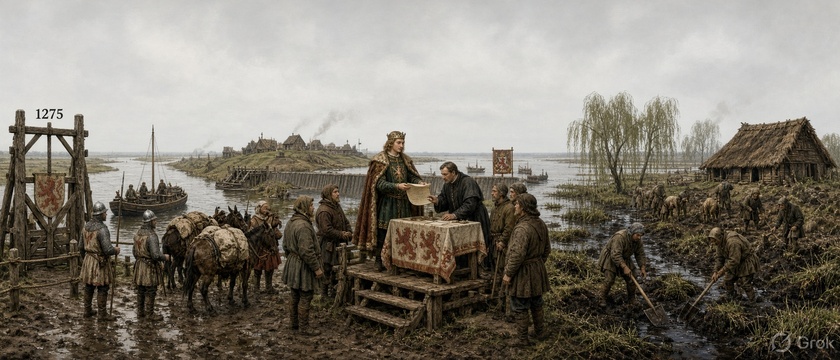
The traditional founding of Amsterdam dates to 27 October 1275, when Count Floris V of Holland issued a toll privilege (the earliest surviving document naming the place) to the people living at the dam in the Amstel River (homines manentes apud Amestelledamme). This granted them exemption from tolls on their own goods throughout his territory. The settlement and dam already existed; the document is the first written reference and is celebrated as the city’s anniversary (Amsterdam marked 750 years in 2025).

Before 1275: From peatland to settlement

The area around the mouth of the Amstel (a river flowing into the IJ estuary, connected to the Zuiderzee) was low-lying peat and marsh, subject to flooding. From roughly the 11th century, people reclaimed land under the authority of the Bishop of Utrecht (the Sticht), building dikes and draining peat. Major storm surges, especially the All Saints’ Flood of 1170, opened the area more fully to the sea and reshaped the landscape, making permanent settlement feasible while also necessitating stronger defenses.

By around 1200, a ribbon-like settlement of farmers, fishermen, craftsmen, and traders had formed along dikes on both banks of the Amstel (roughly the later Nieuwendijk, Warmoesstraat, and Zeedijk areas). A wooden chapel (predecessor of the Oude Kerk) appeared early. Around the 1260s (often dated c. 1260–1270), residents built a dam across the Amstel near its mouth. This was a significant engineering work: a clay-and-earth structure roughly 140 meters long, 25 meters wide, and about 2.5 meters high, with a sluice. It connected the two banks, controlled water (separating fresh river water from tidal/brackish IJ water), created a natural harbor for transferring cargo from larger seagoing ships (koggen) to smaller inland vessels, and provided a central gathering place. The settlement was still small—estimates range from a few hundred to around 500–1,000 people—and fell under the Bishop of Utrecht, administered locally by the Lords of Amstel (a family based around Ouderkerk aan de Amstel). It was not yet a formal city.

The 1275 toll privilege and its context

The document was drawn up in Leiden on Sunday, 27 October 1275 (the Sunday before the feast of Saints Simon and Jude), by Hendrick Allardsz of Middelburg, a clerk in the service of Floris V (likely trained at Egmond Abbey and linked to Middelburg). In Latin, Floris declared that, in compensation for damage done by him and his men to the people living near Amestelledamme, they would henceforth be exempt from his toll when transporting their own goods throughout his lands (roughly modern North and South Holland and parts of Zeeland).

This was not pure generosity or a formal grant of city rights. The area still belonged to the Bishopric of Utrecht, not the County of Holland. Floris was expanding his power against the bishop and local lords such as the Van Amstels. His troops had recently caused damage in the settlement; the privilege was partly compensation and partly a political move to win the loyalty of the inhabitants, encourage trade through Holland, and draw the Amstel area into his sphere of influence. Similar privileges were granted to other places. It gave Amsterdam traders a practical commercial advantage without making the place a free city or transferring sovereignty.

Significant figures

  • Floris V (1254–1296): Count of Holland and Zeeland from 1256 (effectively ruling after reaching majority in 1266). Son of William II (King of the Romans). He expanded Holland significantly (including against the West Frisians), promoted trade, and was known as “der keerlen God” (God of the common people) for his relative popularity with peasants and townsfolk versus some nobles. He issued the 1275 privilege. In 1296 he was kidnapped during a falcon hunt by discontented nobles (including Gijsbrecht IV van Amstel, Herman van Woerden, and Gerard van Velsen), held at Muiderslot, and murdered (stabbed multiple times by van Velsen) near Muiderberg when local people tried to free him. The plot involved international intrigue linked to his shifting alliances between England and France. He is a major figure in Dutch medieval history and literature.
  • The Lords of Amstel (especially Gijsbrecht IV van Amstel, c. 1230/1235–c. 1303): Local rulers of Amstelland under the Bishop of Utrecht. They sought greater independence between Utrecht and Holland. Gijsbrecht IV opposed Floris, participated in the 1296 conspiracy, lost his lands, and went into exile. His family is immortalized in Joost van den Vondel’s 17th-century play Gijsbrecht van Aemstel (set around the 1304 siege of Amsterdam), which became a long-running Amsterdam theatrical tradition.
  • Hendrick Allardsz of Middelburg: The clerk who wrote the privilege document.
  • Later: Guy (Gwijde) of Avesnes: Brother of John II of Holland; Bishop of Utrecht from 1301. He held Amstelland (including the settlement) and is credited with granting or confirming urban rights/charters to Amsterdam around 1300–1306.

After 1275: From settlement to city

The privilege helped trade and gradual growth. By around 1300 the population was roughly 1,000. Formal municipal/city rights (rights to markets, local justice, fortification, etc.) came later, traditionally around 1300 or 1306, associated with Guy of Avesnes (while he controlled the area before or as bishop). Amsterdam remained under shifting authority: after Floris’s murder and the fall of the Van Amstels, it passed more firmly into the Holland orbit. Further privileges followed (e.g., a beer staple right in 1323 that boosted its role as a market). By the mid-14th century it was a recognized poorte (town) with growing trade, especially in Baltic grain and other goods. Major floods (including the St. Lucia’s Flood of 1287, which enlarged the Zuiderzee) continued to shape the landscape and opportunities.

The 1275 document was carefully preserved for centuries (in a charter chest in the Oude Kerk, later in the city archives). It is still displayed briefly each year around 27 October. While not a true “founding charter” in the modern sense—settlement predated it, and full city status came decades later—it is the practical starting point for Amsterdam’s documented history and the basis of its traditional birthday celebration. The dam site is today’s Dam Square; the early harbor is the Damrak area.

= October 27th 

These are events traditionally associated with October 27.

312 – Constantine the Great’s Vision of the Cross

Roman emperor Constantine is said to have received a vision of a cross (or Chi-Rho symbol) in the sky, often accompanied by the words in hoc signo vinces (“in this sign you will conquer”). Sources differ: Lactantius describes a dream instructing him to mark shields with the Christian monogram, while Eusebius (writing later) reports a public midday vision of a cross of light above the sun, followed by a dream of Christ. Popular accounts place this on the eve of the Battle of the Milvian Bridge (October 28, 312), in which Constantine defeated his rival Maxentius near Rome. The victory made him sole Western emperor and is linked to his increasing favor toward Christianity (culminating later in the Edict of Milan). The precise details and timing remain debated among historians, as the main accounts are not fully independent or contemporaneous.

710 – Saracen invasion of Sardinia

Arab/Muslim (often called Saracen in European sources) forces conducted raids on the Byzantine-controlled island of Sardinia around this time, part of broader early Islamic expansion in the western Mediterranean after the conquest of North Africa and coinciding with the invasion of Iberia. Sources record multiple early raids (from roughly 705–711 onward), involving coastal attacks, pillaging, and captives; some mention large numbers of prisoners taken across several islands. These did not result in permanent occupation of Sardinia, which remained outside lasting Muslim control unlike nearby Sicily or parts of the Iberian Peninsula. Exact details for a single 710 invasion are sparse in surviving chronicles.

939 – Death of Æthelstan and succession of Edmund I

Æthelstan (also Athelstan), widely regarded as the first king of a unified England, died on October 27, 939 (probably at Gloucester), at about age 45. He had ruled as king of the Anglo-Saxons from 924 and of the English from 927, after conquering the Viking kingdom of York. His major victory at Brunanburh (937) against a coalition of Scots, Strathclyde Britons, and Dublin Vikings secured his reputation. Childless, he was succeeded by his half-brother Edmund I (then about 18), who faced renewed Viking challenges in the north but eventually recovered control. Æthelstan was buried at Malmesbury Abbey.

1275 – Traditional founding of Amsterdam

On October 27, 1275, Count Floris V of Holland issued a toll privilege (the earliest surviving document naming the place) granting the people living at the dam in the Amstel River (homines manentes apud Amestelledamme) exemption from tolls on their own goods throughout his territory. A settlement and dam already existed by then (the dam itself dated to roughly the 1260s, connecting earlier riverside habitation after floods); the document marks the first written reference and is treated as the traditional founding date of the city that grew into a major trading port. Amsterdam celebrates this anniversary.

1524 – French siege of Pavia begins (Italian Wars)

King Francis I of France led an army (roughly 26,000–40,000 men, including Swiss and other mercenaries) into northern Italy and invested Pavia, then held by an Imperial garrison under Antonio de Leyva for Charles V. The siege began in late October 1524 (accounts vary slightly on the exact day, often given as October 27/28) and lasted through the winter. French assaults and bombardment failed to take the city quickly. An Imperial relief force later attacked, leading to the decisive Battle of Pavia on February 24, 1525, in which Francis was captured. This was a major setback for French ambitions in Italy.

1553 – Michael Servetus burned at the stake

The Spanish physician and theologian Michael Servetus (Miguel Serveto) was executed by burning just outside Geneva at Champel. He had been condemned for heresy, primarily for rejecting the orthodox doctrine of the Trinity and opposing infant baptism in works such as Christianismi Restitutio. After escaping Catholic authorities in Vienne (who burned him in effigy), he was arrested in Geneva. John Calvin played a prominent role in the proceedings and sought a milder execution (beheading), but the council ordered burning; Servetus went to the stake with a copy of his book chained to him. The case became a lasting point of controversy over religious tolerance among Protestants.

1644 – Second Battle of Newbury

During the First English Civil War, Royalist forces under King Charles I fought an indecisive battle against combined Parliamentarian armies (under the Earl of Manchester, Sir William Waller, and others, with the Earl of Essex ill) near Newbury/Speen in Berkshire. Parliament had a substantial numerical advantage (roughly 17,000–19,000 vs. about 8,500–10,000). A planned pincer attack was poorly coordinated; Royalist positions held, and Charles withdrew toward Oxford overnight. The failure to destroy the smaller Royalist army contributed to later Parliamentarian military reforms, including the creation of the New Model Army.

1682 – Philadelphia established

William Penn (English Quaker) founded the city of Philadelphia in the proprietary colony of Pennsylvania, granted to him by Charles II in 1681. Penn’s ship reached the Delaware area around October 27–28, 1682; he had already sent commissioners to lay out a grid-planned “greene country towne” (City of Brotherly Love) between the Delaware and Schuylkill rivers, emphasizing religious tolerance and orderly settlement. It grew rapidly into a major colonial port and later the temporary U.S. capital.

1795 – Treaty of Madrid (Pinckney’s Treaty / Treaty of San Lorenzo)

The United States and Spain signed the Treaty of Friendship, Limits, and Navigation at San Lorenzo el Real. Negotiated for the U.S. by Thomas Pinckney and for Spain by Manuel de Godoy, it fixed the southern U.S. boundary with Spanish Florida at the 31st parallel, recognized the Mississippi River as the western boundary, and granted Americans free navigation of the Mississippi plus the right of deposit at New Orleans. This resolved long-standing disputes and opened western trade routes. It was later ratified by both sides and proclaimed in 1796.

These events span Roman imperial transition and the spread of Christianity, early medieval raids and English state formation, urban foundations, the Italian Wars, Reformation religious conflict, the English Civil War, colonial American settlement, and early U.S. diplomacy. Sources for the earliest entries (especially 312 and 710) are limited or later, so details can vary by account.
 

Read full Article
October 23, 2026
post photo preview
Miracle of Myeongnyang
October 26th

Miracle of Myeongnyang

Battle of Myeongnyang (October 26, 1597), part of the Imjin War (Japanese invasions of Korea, 1592–1598).

Lead-up

The Imjin War began in 1592 when Toyotomi Hideyoshi launched a large-scale invasion of Joseon Korea as a stepping stone toward Ming China. Japanese land forces advanced rapidly, but Joseon Admiral Yi Sun-sin repeatedly disrupted their supply lines with naval victories, using sturdy panokseon warships (and the armored turtle ships/geobukseon he helped develop). These successes helped stall the first invasion and contributed to a temporary truce/negotiations around 1596.

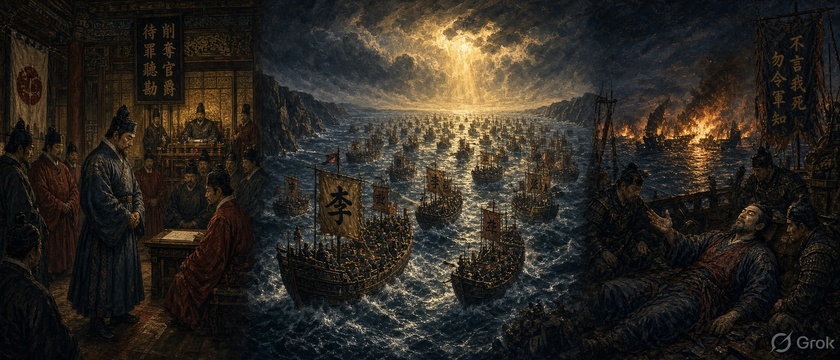
In 1597, Hideyoshi ordered a second invasion (the Chongyu War). Japanese agents spread disinformation that led the Joseon court to arrest, demote, and nearly execute Yi Sun-sin on charges of disloyalty and failure to attack. He was replaced by the less competent Wŏn Kyun (Won Gyun). In the Battle of Chilcheollyang (late August 1597), Wŏn Kyun led most of the Joseon fleet into a Japanese trap; nearly the entire force (around 200 ships) was destroyed, and Wŏn Kyun was killed. Only about 13 panokseon survived, largely because a subordinate (Bae Seol) held them back.

With the Joseon navy effectively shattered, King Seonjo hurriedly reinstated Yi Sun-sin as commander. He inherited a demoralized remnant of roughly 13 warships and a few hundred men. Japanese naval forces, now dominant, prepared to support a renewed land push northward toward Hanyang (Seoul) by clearing the western sea routes and Yellow Sea. Yi rejected advice to abandon the navy and join the army; he chose instead to make a stand in the narrow, tidal Myeongnyang Strait near Jindo Island (southwest Korea). The strait’s strong, reversing currents (up to ~10–11 knots) and constrained waters could negate Japanese numerical superiority and favor Joseon ranged gunnery over Japanese boarding tactics.

The Battle

On October 26, 1597 (lunar calendar dates vary slightly in sources), Yi positioned his small squadron at the northern entrance near Usuyeong. Japanese commanders including Kurushima Michifusa, Tōdō Takatora, Katō Yoshiaki, Wakizaka Yasuharu, and others advanced with a large fleet—Korean sources typically cite ~120–133 warships engaged (with totals sometimes listed up to ~300+ including support vessels). Yi’s diary and records note earlier scouting activity and a decision to draw the enemy into the strait.

Yi led from the front with his flagship, engaging the Japanese vanguard while some of his captains initially hesitated. Japanese ships funneled into the narrow channel. As the tide reversed, it swept vessels into disorder, causing collisions and loss of formation. Joseon ships used cannons, arrows, and ramming effectively at close range. Kurushima Michifusa was killed (his head later displayed as a warning); Tōdō Takatora was wounded. The Japanese could not exploit their numbers or preferred boarding tactics. After hours of fighting, they withdrew. Joseon lost no ships (minimal casualties, a handful of killed/wounded on Yi’s flagship and nearby vessels). Japanese losses were roughly 31 warships sunk or crippled, with additional damage and significant personnel losses (higher figures appear in some Korean accounts).

Results and Significance

The victory halted the Japanese naval advance supporting their land campaign, denied them reliable western sea supply routes, and preserved Joseon control of key waters. It allowed time to rebuild the navy (Yi later expanded his fleet) and contributed to the overall stalemate and eventual Japanese withdrawal after Hideyoshi’s death in 1598. Strategically, it was a “last stand” that turned the tide of the naval war in the second invasion. It is often called the “Miracle of Myeongnyang” and ranks among the most one-sided naval victories against overwhelming odds in history.

Yi Sun-sin was later killed at the Battle of Noryang (November/December 1598) while intercepting withdrawing Japanese forces; his last orders were reportedly not to announce his death to avoid demoralizing the fleet.

Significant Figures

  • Yi Sun-sin (Joseon): Supreme naval commander. A brilliant tactician and leader who had won multiple earlier battles. He studied local tides and geography, motivated demoralized crews, and directed the fight from the front. National hero in Korea; his war diary (Nanjung Ilgi) provides a key firsthand account.
  • Kurushima Michifusa (Japanese): Senior commander (daimyo-level naval leader from the Murakami suigun tradition). Killed in the battle—the highest-ranking Japanese death of the engagement—and his head was displayed. His loss disrupted command.
  • Tōdō Takatora (Japanese): Key commander in the second invasion’s naval efforts (involved in Chilcheollyang). Wounded at Myeongnyang.
  • Wŏn Kyun (Joseon): Yi’s temporary replacement whose catastrophic defeat at Chilcheollyang set the stage for the desperate defense.
  • Supporting Joseon officers: Kim Ŏkch’u, Kim Ŭngham, An Wi, Song Yŏchong, Pae Hŭngnip, and others who fought under Yi.
  • Broader context: Toyotomi Hideyoshi (Japanese supreme leader who ordered the invasions); King Seonjo of Joseon.

The battle exemplifies Yi’s use of terrain, tides, superior artillery, and leadership against superior numbers. Numbers of Japanese ships vary across sources (common range 133 warships engaged, higher totals including support craft), but the disparity and outcome are consistent in the historical record.

= October 26th 

These events are primarily associated with October 26 (with minor variations in some sources for a couple of dates). Here is a concise overview of each:

740 – Earthquake strikes Constantinople and surrounding areas.
A major earthquake (estimated magnitude around 7+ in some modern assessments) hit the vicinity of Constantinople and the Sea of Marmara on October 26, 740. It damaged or collapsed parts of the city’s land walls (Theodosian Walls), public buildings, and structures in nearby towns in Thrace and Asia Minor (including Nicaea/Nicomedia areas). Contemporary accounts (e.g., Theophanes) report over 1,000 deaths in the capital and describe the sea retreating then returning, consistent with a tsunami. Aftershocks continued for months.

1185 – Uprising of Asen and Peter begins.
On the feast day of St. Demetrius of Thessaloniki (October 26), brothers Peter (Theodore) and Asen launched a revolt of Bulgarians and Vlachs in the region of Moesia/the Haemus (Balkan Mountains) against Byzantine rule under Isaac II Angelos. Triggered by heavy taxation (including for the emperor’s wedding), they built a church to St. Demetrius in Tarnovo, claimed the saint’s favor had shifted to them, and proclaimed independence. This led to the restoration of Bulgarian statehood and the Second Bulgarian Empire under the Asen dynasty after several years of fighting.

1341 – Byzantine civil war of 1341–47 formally begins.
Following the death of Andronikos III and the overthrow of the regency of John Kantakouzenos (while he was away from the capital), his army proclaimed him emperor as John VI at Didymoteicho in Thrace on October 26, 1341. He accepted while still acknowledging the rights of the young John V Palaiologos. The resulting six-year civil war involved foreign allies (Turks, Serbs), devastated the empire, and ended with Kantakouzenos as co-emperor/senior ruler until 1354.

1377 – Tvrtko I is crowned the first king of Bosnia.
In the fall of 1377 (commonly dated to October 26, the feast of St. Demetrius), Ban Tvrtko I Kotromanić was crowned king of Bosnia (and claimed the title for the Serbs and other territories). He positioned himself as heir to the extinct Nemanjić dynasty of Serbia. The coronation site is debated (Mileševa Monastery in Serbian accounts vs. a Franciscan church at Mile in Bosnian/Croatian historiography). This elevated the Banate of Bosnia to a kingdom.

1520 – Charles V is crowned as Holy Roman Emperor.
Charles of Habsburg (already King of Spain as Charles I) was elected Holy Roman Emperor in June 1519. He was crowned King of the Romans / Emperor-elect in Aachen Cathedral on October 23, 1520 (some older lists approximate the date). The full papal imperial coronation by Pope Clement VII occurred later, in Bologna on February 24, 1530—the last such papal crowning. This marked the peak of Habsburg power under a ruler whose domains spanned much of Europe and the Americas.

1597 – Battle of Myeongnyang (Imjin War).
On October 26, 1597, Joseon Admiral Yi Sun-sin, with only about 13 panokseon warships remaining after earlier disasters, defeated a far larger Japanese fleet (Korean sources cite ~120–133 warships engaged, with totals up to ~300+ vessels including support craft) in the narrow Myeongnyang Strait near Jindo Island. Using the strong tidal currents, Yi’s forces sank or crippled roughly 30 Japanese ships (including killing a senior commander) with no Korean ships lost. This halted the Japanese naval advance supporting their land campaign toward the capital.

1640 – Treaty of Ripon is signed.
This truce ended the Second Bishops’ War between Charles I of England and the Scottish Covenanters. After Scottish victories and occupation of northern English territory (including Newcastle), the treaty (negotiated at Ripon; sources vary on exact signing between October 16–28, often cited around the 26th) provided for Scottish occupation of parts of northern England and daily payments (~£850) until a final settlement via the English Parliament. It forced Charles to summon the Long Parliament, a key step toward the English Civil War.

1689 – General Piccolomini burns Skopje.
Austrian general Enea Silvio Piccolomini (of Italian noble descent) captured Skopje during the Great Turkish War. On or around October 26, 1689, he ordered the city burned (the fire lasted two days), citing prevention of cholera spread, denial of resources to returning Ottoman forces, or inability to hold the distant city. Much of the city (population then ~60,000) was destroyed, reducing it to ~10,000 and ending its regional prominence. Piccolomini himself died of cholera soon afterward.

1774 – First Continental Congress adjourns in Philadelphia.
After meeting from September 5 at Carpenters’ Hall (delegates from 12 colonies responding to the Intolerable/Coercive Acts), the Congress adjourned on October 26. It had adopted the Articles of Association (economic boycott of Britain), issued the Declaration and Resolves asserting colonial rights, and planned to reconvene in May 1775 if grievances were not addressed. This was a major step in colonial unity short of declaring independence.

1775 – King George III addresses Parliament on the American rebellion.
Following the outbreak of fighting (Lexington/Concord, Bunker Hill) and the earlier Proclamation of Rebellion (August 23, 1775), George III addressed both houses of Parliament on October 27, 1775 (some lists date related actions to the 26th). He declared the colonies in open rebellion, rejected conciliatory approaches, and authorized military measures to suppress it, framing the conflict as an attempt to establish an independent empire.

1776 – Benjamin Franklin departs for France.
On October 26, 1776 (about a month after his appointment as one of the commissioners to France), the 70-year-old Franklin sailed from Philadelphia on the Reprisal. His mission was to secure formal French alliance, military aid, and recognition for the United States. He arrived in France later that year and, leveraging his fame as a scientist and statesman, played a central role in obtaining the 1778 treaties of alliance and commerce after the Saratoga victory.

These October 26 events span natural disasters, revolts and state-building in the Balkans and Byzantium, Habsburg imperial consolidation, a famous naval victory in East Asia, and key steps in the American Revolution. Dates can vary slightly by calendar system or source for a few of them.

Read full Article
October 23, 2026
post photo preview
St Crispin's Day Agincourt
October 25th

St Crispin's Day Agincourt

The Battle of Agincourt (25 October 1415) was a decisive English victory in the Hundred Years’ War. An exhausted, outnumbered English army under Henry V defeated a much larger French force on a narrow, muddy field near the village of Agincourt (Azincourt) in northern France.

Lead-up and campaign

Henry V (king since 1413) revived the English claim to the French throne, based on descent from Edward III through the female line. Negotiations with the French court failed in 1414–15. Henry assembled a large expeditionary army (roughly 11,000–12,000 men, including a high proportion of longbowmen) and sailed from Southampton on 11 August 1415.

The primary target was the fortified port of Harfleur at the mouth of the Seine. The siege began in mid-August and lasted until the town surrendered on 22 September. It was costly: dysentery (the “bloody flux”) and other diseases killed or incapacitated a large part of the army—estimates suggest a quarter to a third of the force was lost or invalided home. Henry left a garrison in Harfleur and, with the remaining troops (commonly estimated at 6,000–9,000 fighting men, the majority archers), decided to march overland to the English-held port of Calais rather than risk further campaigning deep in France so late in the season.

The march was difficult. The French blocked river crossings on the Somme, forcing a longer route. By late October the English were tired, short of supplies, and outnumbered when a large French army under the Constable of France intercepted them near Agincourt, blocking the road to Calais.

The battle

The English took up a defensive position on a recently ploughed field between two woods (Agincourt and Tramecourt). The frontage was narrow (roughly 700–1,000 yards at its tightest), which limited the ability of the larger French army to bring its full numbers to bear at once. Heavy rain had turned the ground into deep mud.

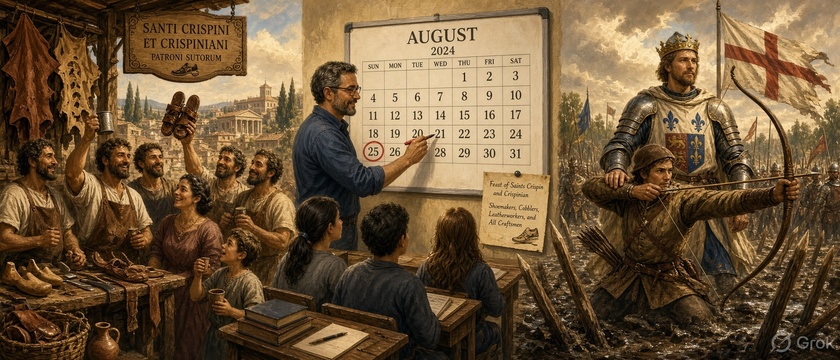
Henry organised his force with dismounted men-at-arms in the centre and wedges of longbowmen on the flanks (and sometimes interspersed). The archers drove sharpened stakes into the ground in front of their positions as a defence against cavalry. The French, commanded primarily by Charles d’Albret (Constable of France) and Marshal Boucicaut, had planned a more cautious approach of surrounding and starving the English, but younger nobles insisted on a frontal attack.

On the morning of 25 October (Saint Crispin’s Day):

  • An initial French cavalry charge against the English archers largely failed. The muddy ground slowed the horses, the stakes disrupted the charge, and longbow volleys caused heavy losses.
  • The main French force of dismounted men-at-arms advanced across the mud in dense formations. Their heavy plate armour exhausted them; many sank into the mud. As the front ranks were stopped or killed, those behind pressed forward, creating a deadly crush in which men fell and were trampled.
  • English longbow fire continued to disrupt the French approach. When the French reached the English line, the lightly armoured archers joined the melee with swords, mallets, and other weapons, attacking the flanks and fallen men.
  • Henry himself fought in the hand-to-hand fighting. At one point, fearing a renewed French attack or a breakout by prisoners, he ordered the killing of many captives (a controversial act that violated normal chivalric practice).

The French third line largely did not engage or withdrew. The battle lasted a few hours and ended in a complete English victory.

Result and aftermath

Immediate outcome: English losses were light—commonly estimated at a few hundred (at least 112 named dead in some records, with higher contemporary figures around 400–600). French losses were catastrophic: roughly 6,000–10,000 dead (many of them nobles), plus hundreds to over a thousand high-ranking prisoners. Among the French dead were the Constable Charles d’Albret, the Dukes of Alençon, Bar, and Brabant, and numerous counts and bannerets. Prominent prisoners included Charles, Duke of Orléans (held for 25 years), the Duke of Bourbon, and Marshal Boucicaut.

The English reached Calais a few days later. Henry returned to England in November and was received as a hero. The victory greatly strengthened the legitimacy of the Lancastrian dynasty and Henry’s personal prestige.

Longer-term consequences: The destruction of much of the French military and political leadership (especially the Armagnac faction) left France weakened and divided. It facilitated Henry’s later campaigns, the conquest of Normandy (1417–19), and the Treaty of Troyes (1420), under which Henry married Catherine of Valois and was recognised as heir and regent of France. English dominance in northern France lasted until the appearance of Joan of Arc and the lifting of the Siege of Orléans in 1429. Henry himself died in 1422 during the Siege of Meaux; his infant son became Henry VI.

Significant figures

English

  • Henry V: Commander and active participant in the fighting. The battle cemented his reputation.
  • Edward, Duke of York: Commanded part of the English centre; killed in the battle.
  • Michael de la Pole, Earl of Suffolk: Young earl killed (his father had died of dysentery at Harfleur).
  • Humphrey, Duke of Gloucester and Thomas, Duke of Clarence: Henry’s brothers; prominent in the campaign (Clarence at Harfleur).
  • Sir Thomas Erpingham: Experienced knight often associated with the archers.
  • Dafydd Gam: Welsh captain killed in the fighting.

French

  • Charles d’Albret (Constable of France): Senior commander; killed.
  • Marshal Boucicaut (Jean II le Meingre): Experienced soldier who favoured a more cautious strategy; captured and died in English captivity.
  • Charles, Duke of Orléans: Nephew of King Charles VI; captured and held for decades.
  • Dukes of Alençon, Bar, and Brabant: All killed.
  • King Charles VI: Absent due to mental illness; did not command.

The battle is most famous in English culture through Shakespeare’s Henry V (“We few, we happy few, we band of brothers…”), which dramatises the Saint Crispin’s Day speech and the victory.

= October 25th

October 25 (traditionally linked to the feast of Saints Crispin and Crispinian, and notably Saint Crispin’s Day) is associated with several significant historical events.

Saints Crispin and Crispinian (285/286)

Saints Crispin and Crispinian were early Christian martyrs (traditionally said to be brothers from a noble Roman family) who worked as shoemakers while preaching in Soissons (Gaul). According to legend, during the Diocletianic Persecution they were tortured under the governor Rictius (or Rictiovarus) Varus—including being stretched on the rack, having strips of flesh cut, and awls driven under their nails—then thrown into the river Aisne with millstones around their necks. They miraculously survived drowning and fire before being beheaded on the orders of co-emperor Maximian (or Diocletian). Their feast day is 25 October. They became the patron saints of shoemakers, cobblers, curriers, tanners, leather workers, and related trades. Their story is largely legendary (with some historians noting inconsistencies with the timeline of persecutions in Gaul), but they were widely venerated in medieval Europe, especially by craft guilds. The date is also famous in English culture because of the Battle of Agincourt.

Emperor Leo I acclaims Leo II as Caesar (473)

On or around this date in 473, Eastern Roman (Byzantine) Emperor Leo I elevated his young grandson Leo II (son of the Isaurian general Zeno and Leo I’s daughter Ariadne) to the rank of Caesar, marking him as heir. Leo II was later promoted to co-emperor (Augustus) in November 473 and briefly ruled as sole emperor after Leo I’s death in January 474 before dying himself later that year (age about 7). Chronological details of his elevation to Caesar vary slightly in sources (some place aspects in 472 or link them to other events), but the traditional association is with October 473.

Second Crusade events (1147)

  • Battle of Dorylaeum: In late October 1147 (intensifying around 25 October), the German contingent of the Second Crusade under Conrad III of Germany was defeated by Seljuk Turkish forces under Sultan Mesud I near Dorylaeum (modern Eskişehir, Turkey). After advancing beyond Dorylaeum, the German army faced repeated Turkish attacks during a retreat that turned into a rout. Conrad was wounded by arrows, and the Germans suffered heavy losses (contemporary claims of catastrophic percentages are exaggerated, but the force was badly mauled and largely unable to continue). This was a major early setback for the Second Crusade.
  • Siege of Lisbon: After a four-month siege (beginning 1 July), crusader forces from England, Flanders, the Rhineland and elsewhere, allied with King Afonso Henriques of Portugal, forced the surrender of Lisbon from its Almoravid (Muslim) rulers. The city formally fell around 24–25 October 1147. This was one of the few lasting Christian successes of the broader Second Crusade period and a major step in the Portuguese Reconquista, securing the Tagus and helping establish Portugal’s strategic position.

Battle of Agincourt (1415)

On Saint Crispin’s Day, 25 October 1415, during the Hundred Years’ War, the English army under Henry V (roughly 6,000–9,000 men, including a large proportion of longbowmen and relatively lightly armoured infantry) decisively defeated a much larger French force (estimates commonly 12,000–20,000+ men-at-arms and others, with heavy cavalry) near Agincourt (Azincourt) in northern France. The muddy, narrow field, French tactical errors (including a frontal assault by heavily armoured knights), and the effectiveness of the English longbow led to a crushing English victory with relatively light English casualties and very heavy French losses among the nobility. The battle is immortalised in Shakespeare’s Henry V (“We few, we happy few, we band of brothers…”).

Dirk Hartog landfall in Australia (1616)

On 25 October 1616, Dutch East India Company (VOC) captain Dirk Hartog, commanding the ship Eendracht, made landfall on an uninhabited island off the west coast of Australia (now Dirk Hartog Island in Shark Bay, Western Australia). This was the second recorded European landing on the Australian continent (after Willem Janszoon in 1606) and the first on the western coast. Hartog left a flattened pewter plate inscribed with details of the visit nailed to a post at Cape Inscription—the oldest physical European artefact from Australia. He charted part of the western coastline (naming the region Eendrachtsland after his ship) before continuing to Batavia.

Second Battle of Cape Finisterre (1747)

On 25 October 1747 (14 October Old Style / Julian calendar then used in Britain), during the War of the Austrian Succession, a British fleet of 14 ships of the line under Rear-Admiral Edward Hawke intercepted and defeated a French convoy of ~250 merchant ships protected by 8 ships of the line under Henri-François des Herbiers. The British captured six French warships and thousands of seamen (with only a handful of merchant ships taken). The victory severely disrupted French Atlantic commerce and colonial supply for the remainder of the war.

Accession of George III (1760)

On 25 October 1760, George II died suddenly (of aortic dissection) at Kensington Palace. His grandson, George III (George William Frederick, born 1738 in England—the first Hanoverian king born in Britain and whose first language was English), succeeded as King of Great Britain and Ireland and Elector of Hanover. George III reigned until 1820, a period that included the end of the Seven Years’ War, the American Revolution, and the Napoleonic Wars.

These events illustrate how 25 October has been a date of martyrdom, imperial succession, crusading campaigns, decisive battles, early European contact with Australia, naval warfare, and a British royal succession.

Read full Article
See More
Available on mobile and TV devices
google store google store app store app store
google store google store app tv store app tv store amazon store amazon store roku store roku store
Powered by Locals