




Executions. Spencer and Salem Witch trials
Two different cases Religious faith
Historical cores
George Spencer (New Haven Colony, 1642).
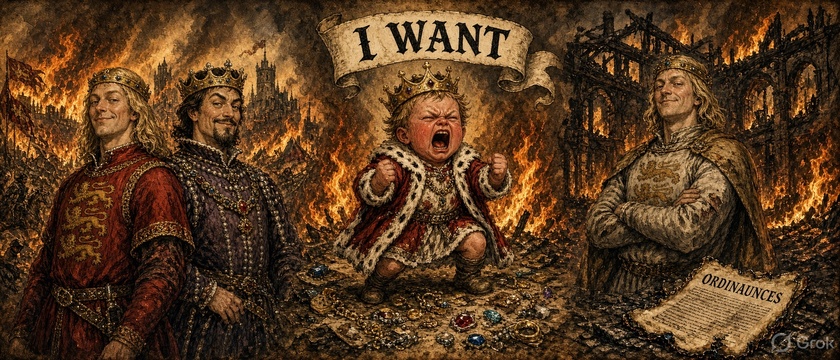
A sow produced a stillborn, severely deformed piglet with a single central eye and other features that observers found human-like. Spencer, a servant with a deformed eye and a reputation for irreligion and lewdness, was identified as the cause. The resemblance was treated as divine evidence of bestiality (Leviticus 20:15 required both man and beast to die). Spencer confessed under examination, then recanted; the confession (or reports of it) plus the piglet itself satisfied the two-witness requirement for a capital case. The sow was killed by the sword in his presence; he was hanged on 8 April 1642. Later analysis (including by Judge Jon C. Blue) treats the paternity claim as biologically impossible and the confession as unreliable or coerced—the first clear false confession in the American record. The process was “by the book” for the time: biblical law, attention to witnesses and confessions, and a shared belief that monstrous births revealed specific sins. That scrupulousness is why the records survive and why the unfairness is visible today. Whether Spencer had sexual contact with the sow is unknowable and secondary; the decisive error was treating an impossible paternity as proof and elevating a pressured confession under a worldview that made the conclusion nearly inevitable.
Salem (1692).
Girls in Salem Village exhibited fits, contortions, and spectral accusations. The Court of Oyer and Terminer, established by Governor Phips and led by William Stoughton, accepted spectral evidence and other tests. One contemporary account involves urine from an afflicted person being given to a dog, which then behaved strangely and was destroyed—interpreted as confirming the presence of a witch’s spirit. Authorities acted within a framework in which demonic assault was real, Jesus had cast out demons, and the community was under spiritual attack. Nineteen people were hanged, Giles Corey was pressed to death, and others died in custody. Increase Mather’s Cases of Conscience and the spread of accusations (including toward higher-status people) contributed to Phips halting spectral evidence and dissolving the court in late October 1692; a successor court largely excluded that evidence and most remaining defendants were acquitted or pardoned by May 1693. Later apologies (Samuel Sewall, jurors, Ann Putnam Jr.), the 1711 reversals of attainder, and eventual legislative clearances followed.
The ergot (Claviceps purpurea) hypothesis (Caporael, 1976) notes wet conditions in 1691, rye as a staple, and symptom overlap with convulsive ergotism (hallucinations, spasms). It has not held up well among historians: the pattern was not epidemic, many classic gastrointestinal or gangrenous signs are absent from the records, and the accusations and court process were selective and socially patterned rather than a mass physiological event. Arthur Miller’s The Crucible framed the episode primarily as political persecution and personal score-settling under the cover of ideology. That captures real factional tensions in Salem Village but underplays the sincere religious conviction that the court was confronting spiritual assault. Both the physiological theory and the purely political reading leave residual uncertainty; the procedural record shows authorities who believed they were protecting the community and who eventually demurred when the evidentiary and social costs became clear.
Shared structure
In both episodes the dominant framework (Puritan biblical law and demonology) supplied the categories, the tests, and the presumption that anomalous events or accusations required action. Procedures that were careful by contemporary standards—confessions, witnesses, biblical citations, ministerial consultation—still produced capital outcomes later viewed as miscarriages. The record of those procedures is what allows modern observers to say, with high confidence, that Spencer did not father a piglet and that the Salem executed were not witches, while still seeing how the authorities reached the opposite conclusion in good faith. The “fever” (social contagion, expanding accusations, institutional momentum) outran the evidence until external or internal limits were imposed.
Modern parallel and the editorial frame
The Cornell 7 case supplies a contemporary illustration of the same structural risk when a single narrative is treated as decisive. Public reporting, university process, and later political intervention have centered Jane Doe’s account of being drugged and assaulted by multiple Chi Phi members. Snapchat messages (“free pussy upstairs,” “Shop still open?”) have been widely circulated as corroboration. Counter-elements—texts and statements that complicate consent or timing, Cornell’s internal findings that at least one accused was not responsible for sexual assault, the DA’s initial assessment that the police transcript did not support charges, differences between the early police account and the later complaint, and claims of selective quotation—have received less sustained attention in much mainstream coverage. The YouTube discussion you linked (Nate the Lawyer on TMZ’s release of messages versus ABC and New York Times framing) is one example of the push for fuller context.
Whether the night involved criminal sexual assault, incapacitation, or more ambiguous sexual activity among intoxicated young adults is not settled by the public record; the criminal investigation was reopened and the civil case is pending. What is already visible is the institutional and media pattern: one party’s version drives headlines, sanctions, and political response, while contrary or complicating evidence is slower to surface or is treated as secondary. That is the modern analogue to the piglet’s eye or the spectral vision—evidence interpreted inside a framework that makes a particular conclusion nearly automatic, with procedures that look regular to those inside the framework.
An editorial can explore the three cases without equating them. It can note that religious authorities in 1642 and 1692 were not uniquely cruel; they were applying the best available understanding of reality and justice and still produced irreversible harm. It can observe that secular institutions today (universities, media, prosecutors under political pressure) can exhibit parallel failures when a preferred narrative about power, trauma, or vulnerability is allowed to override ordinary standards of evidence, consistency, and the presumption that the accused’s account also matters. The Spencer and Salem records are valuable precisely because the authorities were relatively scrupulous; the modern record will be valuable to the extent that texts, hearing transcripts, and conflicting statements remain available rather than filtered. The lasting lesson is not that faith (or any other shared worldview) is the problem, but that any framework strong enough to justify execution or severe sanction requires unusually strong safeguards against the tendency to treat the framework’s preferred interpretation as self-evident.
=
Background and “evidence”
George Spencer (c. 1600–1642) was a servant with a poor reputation in the strict Puritan community. Contemporary records call him a “prophane, lying, scoffing and lewd speritt.” He had a deformed or glass eye (one functional eye).
In early 1642, a sow owned by planter John Wakeman (previously belonging to Henry Browning, for whom Spencer had worked) gave birth to a litter that included one stillborn, severely malformed piglet. Colonial records describe it in detail: hairless, with reddish-white skin like a child’s; a single large eye in the middle of the face resembling a blemished human eye; a growth of flesh hanging from the forehead that was hollow and likened to a male sexual organ; and other human-like features of the nose, mouth, chin, neck, and ears.
Puritan authorities and neighbors treated the deformity as a divine sign or “prodigious monster” proving an unnatural act. The piglet’s single eye was compared to Spencer’s and judged strikingly similar (“as like as the eye in the glass to the eye in the face”). This resemblance, plus Spencer’s bad character, led to the accusation that he had committed bestiality with the sow and fathered the piglet. At the time, many people accepted the possibility of interspecies offspring under certain circumstances (influenced by biblical and folk ideas about monstrous births as signs of sin).
Trial
Spencer was examined. He initially confessed to the act (accounts vary on whether this was under pressure, in hope of mercy, or otherwise), then retracted the confession, denied the charge, and was described as obstinate. Witnesses testified to his earlier statements.
New Haven law, drawing on biblical standards (especially Deuteronomy’s requirement of two witnesses for capital cases), treated Spencer’s (retracted) confessions as one form of evidence and the physical appearance of the piglet itself as the other. The court found him guilty of the “unnatural and abominable crime of bestiality,” ruling that he was influenced by a “lying spirit” in his denials.
The legal basis was Leviticus 20:15: “If a man lie with a beast, he shall surely be put to death: and ye shall slay the beast.” Both Spencer and the sow were sentenced to death.
Execution
On 8 April 1642, the sow was first put to death by the sword in Spencer’s presence. Spencer was then hanged. Accounts indicate that, once the noose was fitted or on the gallows, he confessed again to the bestiality. He was among the earliest people executed in the Connecticut area (reported as the second overall and the first non-Native colonist).
Context and later assessment
This occurred in the early New Haven Colony under strict biblical law, where capital offenses included bestiality, and omens or monstrous births could be treated as evidence. A few years later (around 1647), another man, Thomas Hogg, faced a similar accusation involving piglets said to resemble him; he refused to confess and avoided execution, though he was punished for other offenses.
Modern analysis, including by Connecticut Superior Court Judge Jon C. Blue (in his book The Case of the Piglet’s Paternity), treats the case as involving a false confession. Fathering a piglet is biologically impossible; Blue and others describe Spencer’s admission as coerced or unreliable and call it one of the earliest verifiable false confessions in American legal history. In 2015 Blue effectively cleared Spencer posthumously in scholarly terms. The episode is often cited as an example of the harsh, theologically driven justice of early Puritan New England and the risks of relying on confessions plus circumstantial “signs.”
It is distinct from the 1692 Salem trials (which centered on witchcraft and spectral evidence) but shares the broader colonial Puritan context of capital punishment for sexual and religious offenses, heavy weight given to confessions, and interpretation of unusual events as divine proof of sin.
=
The end of the Salem witch trials in October 1692 was driven by mounting skepticism about spectral evidence, the widening circle of accusations (reaching high-status people), and decisive action by Governor Sir William Phips. By that point 19 people had been hanged, one (Giles Corey) pressed to death, and at least five had died in custody. The special Court of Oyer and Terminer was dissolved, spectral evidence was sidelined, and the remaining cases collapsed.
Antecedents
The crisis began in Salem Village (present-day Danvers) in January–February 1692. Betty Parris (daughter of the minister Samuel Parris) and Abigail Williams (his niece), along with other girls, experienced fits, contortions, and claims of being tormented. Local physician William Griggs suggested witchcraft. The girls named Tituba (an enslaved woman in the Parris household), Sarah Good, and Sarah Osborne. Examinations followed, and accusations multiplied.
Underlying tensions in the village included factional disputes (partly involving the Parris family and land/church authority), economic strains, and the broader stresses of King William’s War on the frontier. As accusations spread beyond the village to Andover, Topsfield, and elsewhere, the newly arrived royal governor, Sir William Phips, established a special Court of Oyer and Terminer in late May 1692, appointing Lieutenant Governor William Stoughton as chief justice. The court heavily relied on spectral evidence (claims that the devil appeared in the shape of the accused to afflict the girls). This was theologically contested: some ministers argued the devil could impersonate the innocent. Early executions began in June (Bridget Bishop first) and continued through September. Confessions and further accusations fed the process; roughly 200 people were accused overall.
Significant persons
- Sir William Phips: First royal governor of the Massachusetts Bay Colony under the new charter. A former ship’s carpenter and treasure salvager who had recovered a Spanish wreck, he arrived in May 1692 and quickly authorized the special court to restore order. He was frequently absent dealing with frontier fighting in Maine. By late September, after returning, he faced reports of growing dissatisfaction and accusations reaching prominent people, including (according to contemporary accounts) his own wife, Mary. He banned further reliance on spectral evidence, stopped new arrests, and dissolved the court.
- Increase Mather: Influential Puritan minister, Harvard president, and Phips’s ally (he had helped secure Phips’s appointment in England). In early October he published Cases of Conscience Concerning Evil Spirits, arguing that it was better for ten suspected witches to escape than for one innocent person to be condemned, and questioning the reliability of spectral evidence. His intervention carried significant weight.
- William Stoughton: Zealous chief justice of the Court of Oyer and Terminer. He pressed for convictions and later resented the restrictions placed on the successor court.
- Cotton Mather: Increase’s son; more supportive of the proceedings early on and later published a defense (Wonders of the Invisible World). He and his father differed in emphasis.
- The afflicted girls / accusers: Abigail Williams, Ann Putnam Jr., Mercy Lewis, and others whose spectral claims and fits drove many accusations. Their testimony was central until the evidentiary rules changed.
- Other key figures: Samuel Sewall (judge who later publicly apologized); Thomas Brattle (who circulated a critical letter); various ministers who debated the evidence.
The halt in October 1692
On or about 12 October, Phips wrote to the Privy Council in England that he had stopped the proceedings, noting the danger if “the evidence of the afflicted persons only did prevail” (i.e., spectral evidence) and that the devil appeared to be taking the shapes of innocent people of good reputation. He forbade further incarcerations based on such claims. On 29 October he formally dissolved the Court of Oyer and Terminer, ordered many prisoners released (especially where evidence was primarily spectral), and halted new arrests. Accusations against high-status individuals had made the situation politically and socially unsustainable.
What followed
A Superior Court of Judicature convened in early 1693 under instructions that largely excluded spectral evidence. Of those tried, the great majority were acquitted. Only a handful were convicted; Phips reprieved or pardoned them. By May 1693 he had issued a general pardon, and virtually everyone remaining in custody on witchcraft charges was released (though many had to pay prison fees). No further executions occurred.
Longer-term reckoning was gradual and incomplete for centuries:
- January 1697: The General Court declared a day of fasting and repentance. Judge Samuel Sewall publicly confessed his error in church (the only sitting judge to do so); twelve jurors signed a statement admitting they had been “sadly deluded and mistaken.”
- 1702: The General Court declared the 1692 trials unlawful.
- 1706: Ann Putnam Jr. made a formal public apology, saying she had been deluded by Satan.
- 1711: Legislation reversed the attainders of many convicted persons, restored some legal rights, and provided limited financial restitution to families.
- Later clearances continued into the 20th and 21st centuries. Massachusetts formally apologized in 1957; additional names were cleared in 2001; the last known convicted person, Elizabeth Johnson Jr. (convicted in 1693 but never executed), was exonerated in 2022 after advocacy by a middle-school civics class.
The episode damaged the prestige of the Puritan theocracy, contributed to greater caution about spectral and hearsay evidence, and became a lasting cautionary tale about mass hysteria, due process, and the dangers of unchecked accusation. It influenced later legal thinking on the rights of the accused and remains a frequent reference point in American culture (most famously in Arthur Miller’s The Crucible). Stoughton never publicly recanted; many others involved showed little immediate remorse. The precise number of deaths is usually given as 20 executed plus those who died in jail, out of roughly 200 accused.
= from October 12th
539 BC – Fall of Babylon. Persian forces under Cyrus the Great’s general Gobryas (Ugbaru) entered Babylon without a major battle on the 16th of Tashritu (roughly 12 October on the Julian calendar), after taking Sippar two days earlier. Cyrus himself entered the city about 17 days later. This ended the Neo-Babylonian Empire. Cyrus presented himself as a liberator chosen by Marduk, returned deported peoples (including the Jews) to their homelands, and issued the famous Cyrus Cylinder proclaiming his legitimacy. The event marks the rise of the Achaemenid Persian Empire as a true world power.
633 – Battle of Hatfield Chase (or Heathfield). Fought on 12 October 633 (Bede’s date; the Anglo-Saxon Chronicle has the 14th). King Edwin of Northumbria was defeated and killed by an alliance of Cadwallon of Gwynedd (British/Welsh Christian) and Penda of Mercia (pagan). Edwin’s son Osfrith was also killed and another son captured. The battle temporarily shattered Northumbrian hegemony, split the kingdom into Bernicia and Deira, and set back the progress of Roman-influenced Christianity in northern Britain until Oswald’s later recovery. Location is usually given as the marshy Hatfield Chase area near Doncaster, though some debate alternatives.
1113 – First documented mention of Oradea (Varadinum). The city in what is now northwestern Romania appears in a Latin diploma of the Benedictine abbey of Zobor (in present-day Slovakia) under the name Varadinum. The name derives from Hungarian vár (“fortress”). King Ladislaus I of Hungary had founded a bishopric there in the late 11th century; the 1113 reference is the earliest surviving written attestation of the settlement as a fortified ecclesiastical center.
1279 – Nichiren inscribes the Dai-Gohonzon. According to Nichiren Shōshū (and related traditions), the Japanese Buddhist monk Nichiren inscribed the large central mandala known as the Dai-Gohonzon on 12 October 1279, during the Atsuhara persecutions. It is regarded as the supreme object of worship embodying Nam-myoho-renge-kyo and the purpose of his advent. Other Gohonzon used in practice are understood as transcriptions of it. The date is commemorated in some Nichiren lineages.
1398 – Treaty of Salynas. Signed on 12 October 1398 on an island in the Neman River between Grand Duke Vytautas the Great of Lithuania and Grand Master Konrad von Jungingen of the Teutonic Knights. Vytautas ceded Samogitia (Žemaitija) to the Order in exchange for peace and support for his eastern campaigns. It was one of several temporary cessions of the strategically vital territory that separated the Order’s Prussian and Livonian branches; the issue was not finally settled until the Treaty of Melno in 1422. Contemporary accounts even claim Lithuanian nobles proclaimed Vytautas king during the celebrations.
1492 – Columbus’s landfall in the Bahamas. On 12 October 1492 (Julian), after more than a month at sea, Columbus’s three ships sighted land at an island the Lucayan Taíno called Guanahani (which he renamed San Salvador). He believed he had reached the outer islands of Asia/the Indies. The exact modern island is still debated (Watling Island/San Salvador is the traditional candidate). This contact opened the sustained European colonization of the Americas.
1582 – Gregorian calendar reform skips the day. In the papal bull Inter gravissimas, Pope Gregory XIII ordered the Julian calendar corrected by dropping 10 days. In Italy, Poland, Portugal, and Spain, 4 October 1582 was followed immediately by 15 October; the intervening dates (including 10 October) simply did not exist that year. Other Catholic countries followed soon after; Protestant and Orthodox lands adopted the reform much later (Britain in 1752).
1654 – Delft Explosion (“Delft Thunderclap”). On 12 October a gunpowder magazine (the “Secreet van Holland”) in Delft exploded, detonating roughly 80,000–90,000 pounds of powder. The blast destroyed hundreds of houses, was heard as far as Texel, and killed at least 100 people (higher estimates exist); the painter Carel Fabritius was among the dead. The exact cause is uncertain but is traditionally linked to a lantern carried by the magazine’s keeper.
1692 – End of the Salem witch trials. Governor Sir William Phips effectively halted the proceedings. On or about 12 October he wrote to the Privy Council stating he had stopped the use of spectral evidence and the trials; on 29 October he formally dissolved the Court of Oyer and Terminer and ordered the release of many prisoners. By then 20 people had been executed. Spectral evidence and the growing circle of accusations (including of high-status people) had made the trials unsustainable.
1748 – Battle of Havana. Fought 12–14 October off Havana during the War of Jenkins’ Ear (part of the broader War of the Austrian Succession). A British squadron under Rear-Admiral Charles Knowles engaged a Spanish squadron under Andrés Reggio. The British captured one ship of the line and forced the Spanish flagship aground (where it was blown up); the Spanish retreated to Havana. The battle was tactically a British success but strategically limited—Knowles failed to intercept the treasure fleet—and news of the Treaty of Aix-la-Chapelle soon ended the war.
1773 – First public insane asylum in America. On 12 October the Public Hospital for Persons of Insane and Disordered Minds opened in Williamsburg, Virginia (later known as Eastern State Hospital). It was the first institution in the British colonies built specifically for the treatment of the mentally ill rather than merely confining them in jails or almshouses. Early treatments were crude by modern standards; the hospital continued in various forms for centuries.
1792 – First Columbus Day celebration in the United States. On 12 October in New York City the Society of St. Tammany (Columbian Order) held the first recorded American commemoration of Columbus’s landing, marking the 300th anniversary. It included speeches, a banquet, and the unveiling of an obelisk. Later 19th- and 20th-century observances grew into the federal holiday (now observed on the second Monday in October).
1793 – Cornerstone of Old East, University of North Carolina. On 12 October William Richardson Davie (Grand Master Mason and future governor) laid the cornerstone of Old East at Chapel Hill. It is the oldest state university building still standing in the United States. Originally a two-story dormitory and classroom building, it has been expanded and renovated many times and remains a residence hall. The university celebrates 12 October as University Day.
1798 – Peasants’ War (Boerenkrijg / Klëppelkrich). Beginning on 12 October in Overmere (Flanders) and spreading across the Southern Netherlands (modern Belgium and Luxembourg), peasants rose against French Republican rule. Triggers included anti-clerical policies and the introduction of conscription. The poorly armed rebels enjoyed early local successes but were crushed by early December (notably at Hasselt). Casualties in Flanders are estimated in the thousands; the rising is sometimes viewed as an early expression of Belgian national sentiment.
1799 – Jeanne Geneviève Labrosse’s parachute descent. On 12 October the French balloonist Jeanne Geneviève Labrosse (later Garnerin) became the first woman to make a parachute jump, descending from a balloon at about 900 meters. She was a pupil (and later wife) of André-Jacques Garnerin, who had made the first modern parachute descent from a balloon in 1797. She continued aeronautical work and later filed a patent related to parachute design on her husband’s behalf.
These events span ancient Near Eastern empire-building, early medieval British power struggles, the European discovery of the Americas, the Gregorian calendar reform, early modern disasters and religious persecutions, and milestones in education, mental health care, and aviation. Several of the later ones cluster tightly around the mid-October period in the late 18th century.