


VoiceDDB
Politics • Culture • News
oDDBall analysis of conservative politics with a libertarian economic conservative twist. Small government, big freedom.
Interested? Want to learn more about the community?
October 02, 2021
On this day, 2nd Oct 2013

The world seems focused on the shutdown of the US government. The shutdown is a result of US debt reaching $17 trillion. The shut down would not have happened had Obama cut spending. Instead, Obama is introducing Obama Care which increases spending and does not address basic health care needs for most US citizens. Healthcare is a problem in the US, but spending money that is borrowed doesn't address the problem. The economic truth is no one can own what they can't afford. Parks and museums are shut down at the moment, but if irresponsible government continues unchecked, then US infrastructure crumbles, and world economic confidence ebbs. The danger is Obama will believe he wins a game of chicken if GOP blinks.

US foreign policy is also sadly lacking. Some years ago, I wrote a blog after Hamas trounced Fatah in an election. I pointed out that the worst event had not happened. Fatah is a terrorist group too. The danger of a Hamas win was that democracy would unravel in the Middle East. The Jordanians calling themselves Palestinians have a substantial amount of aid, a lot of which comes from Israel. Israel is a modern democracy, offering freedom for all of her people. So called Palestine is a terrorist military state offering no basic freedoms for anyone but endless civil war. Naturally the UN wants Palestine and despises Israel.Today, the conservative PM of Israel promised to act before Iran acquired nuclear weapons. That is important for world peace. Meanwhile, Obama has asked for Israel (forced) to release killers into the community. A Middle East Islamic scholar has apparently (linked) proven Obama is Muslim according to Islamic law .. meaning Obama is in fact apostate as he falls asleep in a Christian church. Worth considering when one hears that Kenya was warned by Israel of the specific threat to Westgate last year but was ignored (other targets were highlighted too). The Kenyan blooded Obama has relatives who are on the wrong side of the struggle against terror. Victims at Westgate had their Islam bona fides checked. How would the cross dressing terrorists respond to the apostate President? I couldn't make up this story for fear that the suspension of disbelief would be too difficult. Meanwhile a Jewish boy of mixed blood gives to his community (linked) and a brave Israeli widow keeps her husband's farm running, after he was killed by terrorists (linked yesterday). As I have linked, so called Palestinians are being raised to hate and kill, and that breaks many international laws, but apparently the UN approves.

Mr Abbott is a statesman. He has given appropriate weight to Indonesia, The result is a deal that should close down the murderous people trafficking that ALP initiated in 2008 after taking down the pacific solution. Abbott has been criticised by many for many bad reasons. Shorten Burke and Bowen have complained at the secrecy surrounding military operations and boat people. Of course, they had military secrets too, only, not about soldiers sleeping around.

SBS have inflated false claims to create enmity between Australia and Islamics. ABC have lied to protect global warming belief. Details of all the editorial are in todays linked material.

post photo preview
Interested? Want to learn more about the community?
What else you may like…
Videos
Posts
Articles
00:01:07
November 27, 2022
Jingle Bell Rock

Jingle bell, jingle bell, jingle bell rock
Jingle bells swing and jingle bells ring
Snowin' and blowin' up bushels of fun
Now the jingle hop has begun

Jingle bell, jingle bell, jingle bell rock
Jingle bells chime in jingle bell time
Dancin' and prancin' in Jingle Bell Square
In the frosty air

What a bright time, it's the right time
To rock the night away
Jingle bell time is a swell time
To go glidin' in a one-horse sleigh

Giddy-up jingle horse, pick up your feet
Jingle around the clock
Mix and a-mingle in the jinglin' feet
That's the jingle bell rock

Jingle bell, jingle bell, jingle bell rock
Jingle bell chime in jingle bell time
Dancin' and prancin' in Jingle Bell Square
In the frosty air

What a bright time, it's the right time
To rock the night away
Jingle bell time is a swell time
To go glidin' in a one-horse sleigh

Giddy-up jingle horse, pick up your feet
Jingle around the clock
Mix and a-mingle in the jinglin' feet
That's the jingle bell
That's the jingle...

00:02:04
September 01, 2021
Intro to Locals for the Conservative Voice

David Daniel Ball calls himself the Conservative Voice.

I'm a teacher with three decades experience teaching math to high school kids.I also work with first graders and kids in between first grade and high school. I know the legends of why Hypatia's dad is remembered through his contribution to Math theory. And I know the legend of why followers of Godel had thought he had disproved God's existence.

I'm not a preacher, but I am a Christian who has written over 28 books all of which include some reference to my faith. Twelve blog books on world history and current affairs, detailing world events , births and marriages on each day of the year, organised by month. Twelve books on the background to and history of Bible Quotes. One Bible quote per day for a year. An intro to a science fiction series I'm planning, post apocalyptic cyber punk. An autobiography with short story collections.

I'm known in Australia for my failure as a whistleblower over the negligence death of a school boy. ...

00:01:50
September 04, 2026
Should violent criminals be made fat? Grok says 'no'

No. Transferring gut bacteria from an obese person into a violent criminal is not a reliable, ethical, or effective way to make them “fat, sedentary, and less of a physical threat.”

The science does not deliver the outcome you want

Mouse studies in germ-free animals showed that microbiota from obese donors can increase energy harvest and adiposity compared with lean-donor microbiota. That is the origin of the idea. Human evidence is far weaker.

Randomized trials of fecal microbiota transplant (FMT) from lean donors into people with obesity have generally failed to produce meaningful, sustained weight loss. Microbiome composition can change; body weight and metabolic markers often do not, or the effects are small and inconsistent. Diet and the existing gut environment usually dominate. A 2025 Nature paper found diet outperformed microbial transplant for microbiome recovery. Human guts are already colonized, not sterile like lab mice, so engraftment is variable and effects unpredictable.

It is not a ...

post photo preview
August 28, 2026
Pfizer struggles to answer

Some in Australia are brilliant. Malcolm Roberts Investigates Pfizer over Covid vaccine.

Holiday break is over back to work tonight

Tonight I'll start double posting until I've caught up.

post photo preview
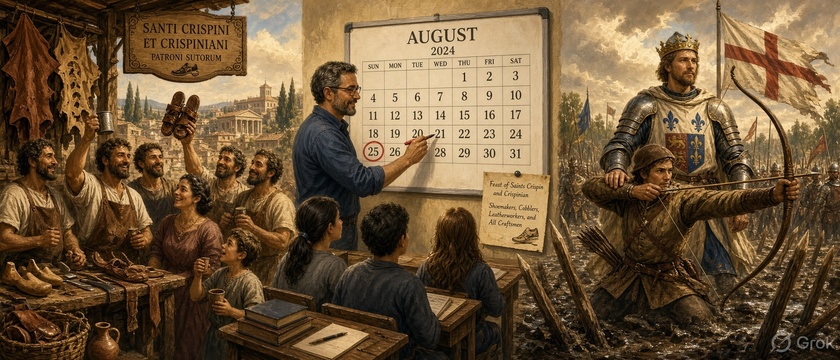
St Crispin's Day Agincourt
October 25th

St Crispin's Day Agincourt

The Battle of Agincourt (25 October 1415) was a decisive English victory in the Hundred Years’ War. An exhausted, outnumbered English army under Henry V defeated a much larger French force on a narrow, muddy field near the village of Agincourt (Azincourt) in northern France.

Lead-up and campaign

Henry V (king since 1413) revived the English claim to the French throne, based on descent from Edward III through the female line. Negotiations with the French court failed in 1414–15. Henry assembled a large expeditionary army (roughly 11,000–12,000 men, including a high proportion of longbowmen) and sailed from Southampton on 11 August 1415.

The primary target was the fortified port of Harfleur at the mouth of the Seine. The siege began in mid-August and lasted until the town surrendered on 22 September. It was costly: dysentery (the “bloody flux”) and other diseases killed or incapacitated a large part of the army—estimates suggest a quarter to a third of the force was lost or invalided home. Henry left a garrison in Harfleur and, with the remaining troops (commonly estimated at 6,000–9,000 fighting men, the majority archers), decided to march overland to the English-held port of Calais rather than risk further campaigning deep in France so late in the season.

The march was difficult. The French blocked river crossings on the Somme, forcing a longer route. By late October the English were tired, short of supplies, and outnumbered when a large French army under the Constable of France intercepted them near Agincourt, blocking the road to Calais.

The battle

The English took up a defensive position on a recently ploughed field between two woods (Agincourt and Tramecourt). The frontage was narrow (roughly 700–1,000 yards at its tightest), which limited the ability of the larger French army to bring its full numbers to bear at once. Heavy rain had turned the ground into deep mud.

Henry organised his force with dismounted men-at-arms in the centre and wedges of longbowmen on the flanks (and sometimes interspersed). The archers drove sharpened stakes into the ground in front of their positions as a defence against cavalry. The French, commanded primarily by Charles d’Albret (Constable of France) and Marshal Boucicaut, had planned a more cautious approach of surrounding and starving the English, but younger nobles insisted on a frontal attack.

On the morning of 25 October (Saint Crispin’s Day):

  • An initial French cavalry charge against the English archers largely failed. The muddy ground slowed the horses, the stakes disrupted the charge, and longbow volleys caused heavy losses.
  • The main French force of dismounted men-at-arms advanced across the mud in dense formations. Their heavy plate armour exhausted them; many sank into the mud. As the front ranks were stopped or killed, those behind pressed forward, creating a deadly crush in which men fell and were trampled.
  • English longbow fire continued to disrupt the French approach. When the French reached the English line, the lightly armoured archers joined the melee with swords, mallets, and other weapons, attacking the flanks and fallen men.
  • Henry himself fought in the hand-to-hand fighting. At one point, fearing a renewed French attack or a breakout by prisoners, he ordered the killing of many captives (a controversial act that violated normal chivalric practice).

The French third line largely did not engage or withdrew. The battle lasted a few hours and ended in a complete English victory.

Result and aftermath

Immediate outcome: English losses were light—commonly estimated at a few hundred (at least 112 named dead in some records, with higher contemporary figures around 400–600). French losses were catastrophic: roughly 6,000–10,000 dead (many of them nobles), plus hundreds to over a thousand high-ranking prisoners. Among the French dead were the Constable Charles d’Albret, the Dukes of Alençon, Bar, and Brabant, and numerous counts and bannerets. Prominent prisoners included Charles, Duke of Orléans (held for 25 years), the Duke of Bourbon, and Marshal Boucicaut.

The English reached Calais a few days later. Henry returned to England in November and was received as a hero. The victory greatly strengthened the legitimacy of the Lancastrian dynasty and Henry’s personal prestige.

Longer-term consequences: The destruction of much of the French military and political leadership (especially the Armagnac faction) left France weakened and divided. It facilitated Henry’s later campaigns, the conquest of Normandy (1417–19), and the Treaty of Troyes (1420), under which Henry married Catherine of Valois and was recognised as heir and regent of France. English dominance in northern France lasted until the appearance of Joan of Arc and the lifting of the Siege of Orléans in 1429. Henry himself died in 1422 during the Siege of Meaux; his infant son became Henry VI.

Significant figures

English

  • Henry V: Commander and active participant in the fighting. The battle cemented his reputation.
  • Edward, Duke of York: Commanded part of the English centre; killed in the battle.
  • Michael de la Pole, Earl of Suffolk: Young earl killed (his father had died of dysentery at Harfleur).
  • Humphrey, Duke of Gloucester and Thomas, Duke of Clarence: Henry’s brothers; prominent in the campaign (Clarence at Harfleur).
  • Sir Thomas Erpingham: Experienced knight often associated with the archers.
  • Dafydd Gam: Welsh captain killed in the fighting.

French

  • Charles d’Albret (Constable of France): Senior commander; killed.
  • Marshal Boucicaut (Jean II le Meingre): Experienced soldier who favoured a more cautious strategy; captured and died in English captivity.
  • Charles, Duke of Orléans: Nephew of King Charles VI; captured and held for decades.
  • Dukes of Alençon, Bar, and Brabant: All killed.
  • King Charles VI: Absent due to mental illness; did not command.

The battle is most famous in English culture through Shakespeare’s Henry V (“We few, we happy few, we band of brothers…”), which dramatises the Saint Crispin’s Day speech and the victory.

= October 25th

October 25 (traditionally linked to the feast of Saints Crispin and Crispinian, and notably Saint Crispin’s Day) is associated with several significant historical events.

Saints Crispin and Crispinian (285/286)

Saints Crispin and Crispinian were early Christian martyrs (traditionally said to be brothers from a noble Roman family) who worked as shoemakers while preaching in Soissons (Gaul). According to legend, during the Diocletianic Persecution they were tortured under the governor Rictius (or Rictiovarus) Varus—including being stretched on the rack, having strips of flesh cut, and awls driven under their nails—then thrown into the river Aisne with millstones around their necks. They miraculously survived drowning and fire before being beheaded on the orders of co-emperor Maximian (or Diocletian). Their feast day is 25 October. They became the patron saints of shoemakers, cobblers, curriers, tanners, leather workers, and related trades. Their story is largely legendary (with some historians noting inconsistencies with the timeline of persecutions in Gaul), but they were widely venerated in medieval Europe, especially by craft guilds. The date is also famous in English culture because of the Battle of Agincourt.

Emperor Leo I acclaims Leo II as Caesar (473)

On or around this date in 473, Eastern Roman (Byzantine) Emperor Leo I elevated his young grandson Leo II (son of the Isaurian general Zeno and Leo I’s daughter Ariadne) to the rank of Caesar, marking him as heir. Leo II was later promoted to co-emperor (Augustus) in November 473 and briefly ruled as sole emperor after Leo I’s death in January 474 before dying himself later that year (age about 7). Chronological details of his elevation to Caesar vary slightly in sources (some place aspects in 472 or link them to other events), but the traditional association is with October 473.

Second Crusade events (1147)

  • Battle of Dorylaeum: In late October 1147 (intensifying around 25 October), the German contingent of the Second Crusade under Conrad III of Germany was defeated by Seljuk Turkish forces under Sultan Mesud I near Dorylaeum (modern Eskişehir, Turkey). After advancing beyond Dorylaeum, the German army faced repeated Turkish attacks during a retreat that turned into a rout. Conrad was wounded by arrows, and the Germans suffered heavy losses (contemporary claims of catastrophic percentages are exaggerated, but the force was badly mauled and largely unable to continue). This was a major early setback for the Second Crusade.
  • Siege of Lisbon: After a four-month siege (beginning 1 July), crusader forces from England, Flanders, the Rhineland and elsewhere, allied with King Afonso Henriques of Portugal, forced the surrender of Lisbon from its Almoravid (Muslim) rulers. The city formally fell around 24–25 October 1147. This was one of the few lasting Christian successes of the broader Second Crusade period and a major step in the Portuguese Reconquista, securing the Tagus and helping establish Portugal’s strategic position.

Battle of Agincourt (1415)

On Saint Crispin’s Day, 25 October 1415, during the Hundred Years’ War, the English army under Henry V (roughly 6,000–9,000 men, including a large proportion of longbowmen and relatively lightly armoured infantry) decisively defeated a much larger French force (estimates commonly 12,000–20,000+ men-at-arms and others, with heavy cavalry) near Agincourt (Azincourt) in northern France. The muddy, narrow field, French tactical errors (including a frontal assault by heavily armoured knights), and the effectiveness of the English longbow led to a crushing English victory with relatively light English casualties and very heavy French losses among the nobility. The battle is immortalised in Shakespeare’s Henry V (“We few, we happy few, we band of brothers…”).

Dirk Hartog landfall in Australia (1616)

On 25 October 1616, Dutch East India Company (VOC) captain Dirk Hartog, commanding the ship Eendracht, made landfall on an uninhabited island off the west coast of Australia (now Dirk Hartog Island in Shark Bay, Western Australia). This was the second recorded European landing on the Australian continent (after Willem Janszoon in 1606) and the first on the western coast. Hartog left a flattened pewter plate inscribed with details of the visit nailed to a post at Cape Inscription—the oldest physical European artefact from Australia. He charted part of the western coastline (naming the region Eendrachtsland after his ship) before continuing to Batavia.

Second Battle of Cape Finisterre (1747)

On 25 October 1747 (14 October Old Style / Julian calendar then used in Britain), during the War of the Austrian Succession, a British fleet of 14 ships of the line under Rear-Admiral Edward Hawke intercepted and defeated a French convoy of ~250 merchant ships protected by 8 ships of the line under Henri-François des Herbiers. The British captured six French warships and thousands of seamen (with only a handful of merchant ships taken). The victory severely disrupted French Atlantic commerce and colonial supply for the remainder of the war.

Accession of George III (1760)

On 25 October 1760, George II died suddenly (of aortic dissection) at Kensington Palace. His grandson, George III (George William Frederick, born 1738 in England—the first Hanoverian king born in Britain and whose first language was English), succeeded as King of Great Britain and Ireland and Elector of Hanover. George III reigned until 1820, a period that included the end of the Seven Years’ War, the American Revolution, and the Napoleonic Wars.

These events illustrate how 25 October has been a date of martyrdom, imperial succession, crusading campaigns, decisive battles, early European contact with Australia, naval warfare, and a British royal succession.
Read full Article
October 22, 2026
post photo preview
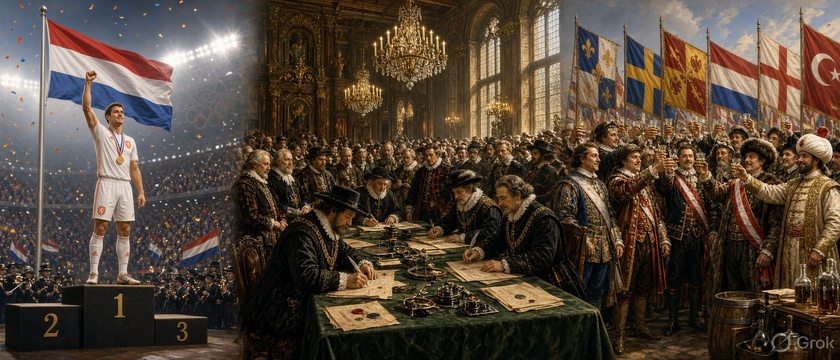
Modern states came into being
October 24th

Modern states came into being

The Peace of Westphalia (24 October 1648) ended the Thirty Years’ War in the Holy Roman Empire and the related phase of the Eighty Years’ War between Spain and the Dutch Republic. It consisted primarily of the Treaty of Münster (between the Emperor and France and their allies) and the Treaty of Osnabrück (between the Emperor and Sweden and their allies), signed the same day in the Westphalian cities of Münster and Osnabrück. A separate Spanish–Dutch treaty had been signed earlier that year (30 January 1648).

Lead-up: The Thirty Years’ War

The war (1618–1648) began as a conflict within the Holy Roman Empire over religion and imperial authority and expanded into a broader European struggle involving dynastic, territorial, and balance-of-power motives.

It was triggered by the Defenestration of Prague (1618), when Protestant Bohemian nobles threw Habsburg officials out of a window in protest against efforts to reverse Protestant gains. This led to the election of the Calvinist Elector Frederick V of the Palatinate as King of Bohemia, which the Catholic Habsburg Emperor Ferdinand II suppressed with Spanish and Bavarian help (Battle of White Mountain, 1620). The war then drew in Denmark (1625–1629), Sweden under Gustavus Adolphus (from 1630; he was killed at Lützen in 1632), and finally Catholic France under Cardinal Richelieu (openly from 1635), which intervened to weaken the Habsburgs despite sharing their religion.

The conflict devastated large parts of Germany through fighting, famine, and disease. Population losses in the Empire are estimated in the millions (modern scholarship often places total deaths in the 4.5–8 million range across the war’s theatres). By the 1640s both sides were exhausted. Preliminary talks and a Franco-Swedish agreement in 1641 set the stage for a general congress; formal negotiations opened in Münster and Osnabrück in 1643–1644, with fighting continuing in parallel to improve bargaining positions. Emperor Ferdinand II had died in 1637; his son Ferdinand III (r. 1637–1657) faced a deteriorating military situation and was forced to negotiate seriously.

The Negotiations and Signing

Talks were complex and protracted. More than 100 delegations represented the Emperor, France, Sweden, Spain, the Dutch, numerous German princes and free cities, and others (England, Poland, Russia, and the Ottomans were not present). Catholic powers largely met in Münster; Protestant ones in Osnabrück. The papal nuncio Fabio Chigi (later Pope Alexander VII) and the Venetian envoy Alvise Contarini acted as mediators.

Key negotiators included:

  • Imperial side: Count Maximilian von Trauttmansdorff (chief plenipotentiary, widely credited with driving the process to a conclusion), assisted by figures such as Johann Ludwig von Nassau-Hadamar and Isaak Volmar.
  • France: Henri II d’Orléans, Duke of Longueville (nominal head), with Claude de Mesmes, Count d’Avaux, and Abel Servien as the principal diplomats.
  • Sweden: Count Johan Oxenstierna (son of the Swedish chancellor Axel Oxenstierna) and Johan Adler Salvius.
  • Spain: Gaspar de Bracamonte y Guzmán and others.
  • Brandenburg and other German states sent their own envoys; Johann von Sayn-Wittgenstein was prominent among the Protestants.

The treaties were signed on 24 October 1648.

Results and Terms

The settlement combined territorial adjustments, religious arrangements, and constitutional changes within the Empire:

  • Territorial gains: Sweden received Western Pomerania (including Stettin), Wismar, and the secularized bishoprics of Bremen and Verden, giving it control of key Baltic and North Sea river mouths and a seat in the Imperial Diet. France gained the Décapole cities in Alsace (with exceptions) and confirmation of Metz, Toul, and Verdun, strengthening its Rhine frontier. Brandenburg obtained Eastern Pomerania and several secularized bishoprics (and the reversion of Magdeburg). Bavaria kept the Upper Palatinate and its electoral title; the Rhenish Palatinate was restored to Frederick V’s son Charles Louis with a new (eighth) electoral vote.
  • Religious settlement: The Peace of Augsburg (1555) was reaffirmed and extended. The principle of cuius regio, eius religio continued, but Calvinism was now recognized alongside Catholicism and Lutheranism. The normal year for determining religious possession was set at 1 January 1624. Forced emigration was restricted, and confessional parity was introduced in certain Imperial institutions.
  • Independence and sovereignty: The Dutch Republic’s independence from Spain was confirmed, ending the Eighty Years’ War. The Swiss Confederation’s independence from the Empire was recognized. The Imperial estates (German princes and free cities) received greater autonomy, including the right to form alliances (with limits) and more control over their internal affairs; the Emperor’s ability to act unilaterally in the Empire was curtailed.
  • Other: Amnesties, restitution rules, and demobilization arrangements were included. France and Sweden became guarantors of the Imperial constitution.

France and Spain continued fighting until the Peace of the Pyrenees (1659). The war’s demographic and economic costs in Germany were severe, though modern estimates are lower than older claims of near-total ruin.

Significance and Legacy

The Peace is traditionally viewed as a landmark in the development of the modern European state system—emphasizing the sovereignty of territorial states, the principle of non-interference in internal affairs, and a shift away from religiously defined universal authority toward a balance-of-power order. Within the Empire it confirmed the fragmentation of authority among hundreds of semi-sovereign entities, limiting Habsburg centralization. Historians debate the precise extent of the “Westphalian system” as a clean break, but the treaties remain a foundational reference point in the history of international relations.

The settlement closed one of the most destructive conflicts in European history and redrew the map of Central Europe for the remainder of the early modern period.

= October 24th

These are all events associated with October 24 in various years.

AD 69 – Second Battle of Bedriacum (also called the Second Battle of Cremona)

During the Year of the Four Emperors, forces loyal to Vespasian (led by Marcus Antonius Primus, commanding Danube/Pannonian and Moesian legions including Legio III Gallica, VII Galbiana, VII Claudia, VIII Augusta, and XIII Gemina) defeated the forces of Emperor Vitellius near Bedriacum (modern Calvatone) in northern Italy, between Bedriacum and Cremona.

Vitellius had sent Aulus Caecina Alienus with a strong army (including XXI Rapax, V Alaudae, I Italica, XXII Primigenia and others), but Caecina’s attempted defection left the Vitellians effectively leaderless. Fighting began on 24 October with a cavalry clash; the main battle raged through the night. At dawn, the III Gallica (which had served in the East) saluted the rising sun in their adopted custom; the Vitellians mistook this for the arrival of eastern reinforcements and broke. The Flavian victory opened the way to Cremona (which was stormed and sacked) and ultimately to Rome, where Vitellius was soon killed. Vespasian became undisputed emperor.

1260 – Dedication of Chartres Cathedral

The Gothic Cathedral of Our Lady of Chartres (Notre-Dame de Chartres) in France was dedicated in the presence of King Louis IX (Saint Louis). The cathedral had been rebuilt after a major fire in 1194 that destroyed most of the previous Romanesque structure (though the west front, Royal Portal, and crypt survived). Construction of the High Gothic building proceeded rapidly; the main fabric was largely complete within about 30 years. It is renowned for its architecture, sculpture, and nearly complete ensemble of 12th- and 13th-century stained glass, and it has been a UNESCO World Heritage Site since 1979.

1360 – Treaty of Brétigny (Treaty of Calais) ratified

The Treaty of Brétigny (drafted 8 May 1360 near Chartres) was ratified at Calais on 24 October 1360 between Edward III of England and John II of France. It ended the first phase of the Hundred Years’ War. Edward renounced his claim to the French throne in exchange for large territories in southwestern France (Aquitaine/Guyenne and associated regions) held in full sovereignty, plus a massive ransom for the captive John II. France later repudiated the treaty under Charles V, and the war resumed.

1590 – John White returns from Roanoke

John White, governor of the second Roanoke Colony (the “Lost Colony”), returned to England (Plymouth) on 24 October after an unsuccessful search. He had left the colonists in 1587 and was delayed by the Spanish Armada crisis. Arriving at Roanoke on 18 August 1590 (his granddaughter Virginia Dare’s third birthday), he found the settlement abandoned. The only clues were “CRO” carved on a tree and “CROATOAN” on a palisade post—indicating, in White’s view, that the settlers had moved to Croatoan (likely modern Hatteras Island) to join the friendly Croatoan people. Bad weather prevented further search, and the fate of the colonists remains a mystery.

1605 – Accession/Coronation of Jahangir

Nur-ud-Din Muhammad Salim, eldest son of Emperor Akbar, ascended the Mughal throne in Agra as Emperor Jahangir (“Conqueror of the World”) after his father’s death. Contemporary sources, including Jahangir’s own memoirs, place the accession around 24 October 1605 (some modern lists give 3 or 24 November depending on calendar conventions). He ruled until 1627 and is noted for his patronage of the arts (especially miniature painting), his memoirs (Jahangirnama), and the cultural flourishing of the Mughal court, despite later political intrigues and his son Khusrau’s rebellion.

1641 – Proclamation of Dungannon

Sir Phelim (Felim) O’Neill of Kinard, a leader of the Irish Rebellion that had begun the previous day, issued the Proclamation of Dungannon. It justified the uprising as a defense of the rights and liberty of the native Irish and of Catholics, while declaring continued loyalty to King Charles I and denying any intent to harm the king or his English and Scottish subjects. O’Neill claimed (falsely, according to later historical consensus) to hold a royal commission authorizing the action against Protestant opponents of the king. The proclamation helped frame the rebellion politically and contributed to its spread into the Irish Confederate Wars.

1648 – Peace of Westphalia signed

The Peace of Westphalia (Treaties of Münster and Osnabrück) was signed on 24 October 1648, ending the Thirty Years’ War (1618–1648) in the Holy Roman Empire and the related phase of the Eighty Years’ War between Spain and the Dutch. Negotiated in the Westphalian cities of Münster and Osnabrück, the settlements involved the Holy Roman Emperor, German princes, France, Sweden, and others. Key outcomes included territorial adjustments, recognition of the independence of the Dutch Republic and Swiss Confederation, and greater autonomy for the states of the Empire (including religious rights under an expanded cuius regio, eius religio principle). It is often cited as a foundational moment in the development of the modern system of sovereign states.

1795 – Third Partition of Poland

Representatives of Austria, Prussia, and Russia agreed on 24 October 1795 to the Third Partition of the Polish–Lithuanian Commonwealth, completely erasing the remaining independent Polish state. This followed the suppression of the Kościuszko Uprising (1794). Russia, Prussia, and Austria divided the residual territory (roughly: Russia took eastern Lithuania and other areas; Prussia gained Warsaw and surrounding districts; Austria received western Galicia and southern Masovia). King Stanisław August Poniatowski was forced to abdicate. Poland did not regain full independence until 1918.

These events span Roman civil war, medieval cathedral building and diplomacy, early English colonization, Mughal succession, the Irish Rebellion, the end of the Thirty Years’ War, and the final erasure of the Polish–Lithuanian Commonwealth.

Read full Article
October 21, 2026
post photo preview
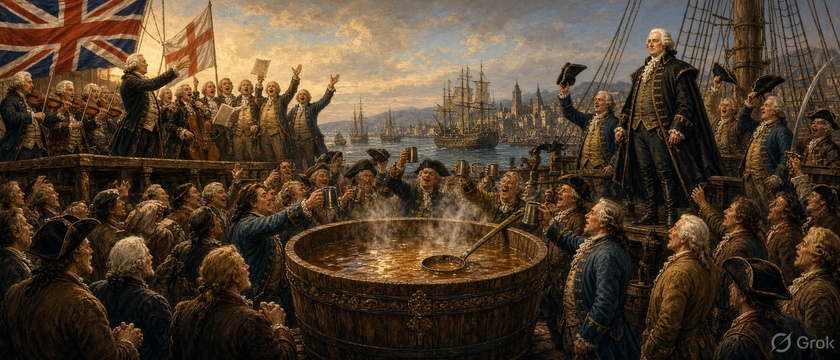
War of Jenkin's Ear
From October 23rd

War of Jenkin's Ear

“Rule, Britannia!”, Admiral Edward Vernon, and the word “grog” are closely linked through the early years of the War of Jenkins’ Ear and the Royal Navy of the 1740s.

Rule, Britannia!

“Rule, Britannia!” began as a poem by the Scottish writer James Thomson (with contributions associated with David Mallet), set to music by the English composer Thomas Arne. It was the finale of Arne’s 1740 masque Alfred, about the Anglo-Saxon king Alfred the Great.

The first performance took place on 1 August 1740 at Cliveden, the country home of Frederick, Prince of Wales. The masque celebrated the anniversary of George I’s accession and the birthday of Princess Augusta, while also reflecting the political atmosphere of the time. Frederick and the “Patriot” opposition to Robert Walpole’s ministry used Alfred’s victories over the Danes as a parallel for contemporary British naval strength and resistance to foreign tyranny. Vernon’s recent capture of Porto Bello (November 1739) was still fresh in public memory and fitted the patriotic mood; some accounts note that the song was later sung at celebrations honouring Vernon.

The famous refrain—“Rule, Britannia! rule the waves; Britons never, never, never will be slaves”—expresses the idea of Britain as a free maritime power that would not submit to foreign rule. It quickly took on a life of its own beyond the masque, becoming a popular patriotic anthem strongly associated with the Royal Navy. It is still performed at events such as the Last Night of the Proms. (Note that the lyrics refer primarily to political or national “slavery” under foreign domination rather than the Atlantic slave trade, though the song later became entangled in broader debates about empire.)

Edward Vernon (“Old Grog”)

Edward Vernon (1684–1757) was a Royal Navy officer best known for his command during the War of Jenkins’ Ear. In November 1739 he led a small squadron that captured the Spanish port of Porto Bello (in present-day Panama) in about a day. The victory made him a national hero; medals were struck in his honour, places were named Portobello after it, and he became a symbol of aggressive naval action against Spain.

He later commanded the much larger expedition against Cartagena de Indias in 1741, which ended in costly failure due to disease, logistical problems, and friction with the army commander. Lawrence Washington (George Washington’s half-brother) served under him and later renamed the family estate Mount Vernon in his honour.

Vernon’s other lasting mark came from his clothing and an order he issued in 1740. He habitually wore a boat-cloak made of grogram (from French gros grain, a coarse, stiff fabric of silk, mohair, or wool, often waterproofed). Sailors nicknamed him “Old Grog” or “Old Grogram.”

Etymology of “grog”

In August 1740, while commanding in the West Indies, Vernon ordered that the sailors’ daily rum ration (then half a pint of neat spirits) be diluted with water—typically four parts water to one of rum—and issued in two servings rather than all at once. The aim was to reduce drunkenness, accidents, and discipline problems; sugar and sometimes citrus were sometimes added to make it more palatable. The watered-down rum was soon called grog, after Vernon’s nickname.

The practice became standard in the Royal Navy (formalised later and continuing, in reduced form, until the “tot” ended in 1970). “Grog” later broadened in popular use to mean any strong drink, and “groggy” came to describe the unsteady state produced by alcohol (and, by extension, any dazed or shaky condition).

In short: Vernon’s Porto Bello success helped fuel the patriotic atmosphere in which “Rule, Britannia!” appeared in 1740; his grogram cloak gave him the nickname that was transferred to the diluted rum he introduced the same year; and both the song and the drink became enduring parts of British naval and popular culture.

=

The War of Jenkins’ Ear (1739–1748) was an Anglo-Spanish colonial conflict driven by commercial rivalry in the Caribbean and Spanish America. It began under intense domestic pressure on Prime Minister Robert Walpole and largely merged into the wider War of the Austrian Succession. Fighting concentrated in the West Indies, with limited action on the Georgia–Florida border; the outcome was essentially a return to the pre-war status quo.

Lead-up and causes

Tensions had built for decades after the 1713 Treaty of Utrecht. Britain held the asiento (the monopoly on supplying enslaved Africans to Spanish colonies) and the limited right to send one annual “permission ship” of goods, but British merchants also engaged extensively in illicit trade. Spanish guarda costas (coast-guard vessels) regularly searched British ships for contraband, sometimes harshly.

The symbolic flashpoint occurred on 9 April 1731, when Spanish sailors boarded Captain Robert Jenkins’s brig Rebecca near Havana. Jenkins later claimed they cut off part of his ear; the incident received little immediate attention. By the later 1730s, Spanish enforcement tightened, merchant complaints multiplied, and the opposition (Tories and elements of the City of London trading interests) used the episode and similar depredations to attack Walpole’s long Whig ministry as weak on commerce and national honour.

Jenkins was called to testify before the House of Commons in March 1738 and is said to have produced the ear (preserved in a jar). Public and parliamentary agitation grew. Walpole, a consistent advocate of peace who preferred commercial profits to the costs of war, sought a negotiated settlement. The Convention of the Pardo (early 1739) offered Britain compensation for seized ships while requiring payment of outstanding duties linked to the asiento. It proved deeply unpopular in Britain and was only narrowly approved by the Commons. Both sides then violated its terms; Spain suspended the asiento. Under mounting pressure from merchants, public opinion, parliamentary opposition, and a divided ministry, Walpole’s government moved to war in October 1739 (formal declaration and hostilities crystallising around 19–23 October).

Course of the war and results

Britain’s main effort was naval and amphibious operations in the Caribbean aimed at Spanish ports and the silver trade.

  • Porto Bello (November 1739): Vice Admiral Edward Vernon captured the lightly defended Panamanian port with six ships of the line in about a day. The British destroyed fortifications and facilities before withdrawing. The victory made Vernon a national hero, prompted medals, place-names (including Portobello Road in London), and was linked to the public debut of “Rule, Britannia.”
  • Cartagena de Indias (March–May 1741): The war’s largest operation. Vernon commanded a huge expedition (scores of ships and tens of thousands of men, including American colonial troops). Spanish forces under Blas de Lezo, using strong fortifications and exploiting British command friction (especially between Vernon and the army commander) plus tropical disease, repelled the assault. British losses were catastrophic—many thousands dead, mostly from disease—and the expedition withdrew. This was the decisive check on British ambitions.

Other actions included minor engagements in Spanish Florida/Georgia (notably James Oglethorpe’s defence of Georgia and the Battle of Bloody Marsh in 1742), privateering, and Commodore George Anson’s circumnavigation and capture of a Spanish treasure galleon. After the Cartagena failure, major Caribbean offensives largely ceased. From 1740–44 the conflict was absorbed into the War of the Austrian Succession (and its North American counterpart, King George’s War). Formal hostilities between Britain and Spain ended with the 1748 Treaty of Aix-la-Chapelle, which restored the status quo ante bellum in the Americas. Underlying trade grievances were later settled by the 1750 Treaty of Madrid, in which Britain renounced the asiento for a cash payment.

The war achieved little lasting territorial or commercial gain for Britain. It damaged Walpole politically (he resigned in 1742) and illustrated the high cost of Caribbean expeditions in the age of sail and disease. Spain successfully defended its American possessions.

Significant figures

  • Robert Walpole (Britain’s leading minister 1721–1742): Reluctantly authorised war under domestic and commercial pressure; his ministry was weakened by the conflict and the Cartagena disaster.
  • Edward Vernon (“Old Grog”): Naval commander of the successful Porto Bello raid and the failed Cartagena expedition; a popular hero whose name entered naval lore (and whose grog ration influenced the term “grog”).
  • Blas de Lezo: Spanish admiral and defender of Cartagena; severely disabled yet highly effective in the 1741 victory.
  • Robert Jenkins: Merchant captain whose 1731 ear injury became the war’s memorable (if secondary) symbol when publicised in 1738.
  • James Oglethorpe: Founder of Georgia; led colonial forces that helped secure the Georgia–Florida border against Spanish attack.
  • George Anson: Led a Pacific squadron that circumnavigated the globe and captured the Manila galleon, one of the war’s more profitable British successes.

In short, a commercial and prestige dispute that the public and opposition turned into war produced one celebrated naval raid, a costly strategic failure at Cartagena, limited border fighting in North America, and no major permanent changes—while contributing to the end of Walpole’s long dominance and being subsumed into a larger European conflict.

= October 23rd

These are notable events clustered around 21–23 October across centuries (many sources pin the precise day as 23 October). Here is a concise overview of each, with context and significance.

42 BC – Second Battle of Philippi (Liberators’ civil war): Mark Antony and Octavian (of the Second Triumvirate) decisively defeated the remaining army of Brutus after an earlier inconclusive clash on 3 October in which Cassius had already committed suicide. On 23 October Brutus was pressured into fighting again; his forces were broken, he took his own life, and the Republican cause against Caesar’s heirs collapsed. This left the triumvirs dominant and paved the way for the end of the Roman Republic and the rise of the Empire under Octavian (later Augustus).

425 – Elevation of Valentinian III: The six-year-old son of Constantius III and Galla Placidia was installed as Western Roman emperor (Augustus) in Rome on 23 October after the defeat of the usurper Joannes. He reigned until his assassination in 455, but real power rested with regents (notably his mother and later the general Aetius). His long minority and reign coincided with major losses of territory to barbarian groups, including the Vandals in Africa.

501/502 – Synodus Palmaris (Palm Synod): Called under the influence of the Ostrogothic king Theoderic the Great, this session of a Roman synod (held around 23 October) discharged Pope Symmachus of accusations brought by supporters of the antipope Laurentius. The bishops declared they could not judge the pope (leaving the matter to God), restored him fully to office and church property, and effectively ended the schism that had begun with the dual election of 498. It reinforced the principle that the Roman See was not subject to trial by other bishops.

1086 – Battle of Sagrajas (Zallaqa/Zalaca): Near Badajoz, the Almoravid forces under Yusuf ibn Tashfin, reinforced by taifa Muslim allies, crushed the army of Alfonso VI of Castile-León. The battlefield became known as “the slippery place” from the bloodshed. The defeat checked Christian advances after the recent capture of Toledo, brought Almoravid power into al-Andalus, and temporarily stabilized Muslim rule in Iberia during the Reconquista.

1157 – Battle of Grathe Heath: In Jutland this short but decisive fight ended the Danish civil war among claimants Sweyn III, Canute V, and Valdemar I. Valdemar’s forces routed Sweyn’s; Sweyn fled into swampy ground and was killed (by tradition with an axe by peasants). Valdemar I the Great emerged as sole king and began consolidating the realm.

1295 – Auld Alliance treaty: Signed in Paris on 23 October between representatives of John Balliol of Scotland and Philip IV of France. It was a mutual-defence pact against England: if either was attacked by the English, the other would invade English territory. Ratified later in Scotland, it became the foundation of the long-running Franco-Scottish alliance (renewed repeatedly) that shaped relations through the Wars of Scottish Independence, the Hundred Years’ War, and beyond until the 16th century.

1641 – Irish Catholic gentry attempt on Dublin Castle: Ulster and other Catholic gentry (including figures linked to Phelim O’Neill, Rory O’More, and Conor Maguire) planned a coordinated coup for 23 October to seize Dublin Castle and other strongpoints, force concessions on religion and land, and forestall possible English/Scottish action. The Dublin plot was betrayed (notably by Owen O’Connolly); the castle was not taken, but the rising erupted successfully across much of Ulster and spread, igniting the 1641 Rebellion and the broader Irish Confederate Wars within the Wars of the Three Kingdoms.

1642 – Battle of Edgehill: The first major pitched battle of the First English Civil War, fought on 23 October in Warwickshire between the Royalist army under Charles I and the Parliamentarian forces under the Earl of Essex. It was bloody and inconclusive (neither side achieved a clear strategic victory), but it demonstrated that the conflict had moved beyond political crisis into open war and set the pattern for further campaigns.

1690 (listed as 1694) – Sir William Phips fails at Quebec: In October 1690, during King William’s War, New England colonial forces under Sir William Phips attempted to capture Quebec from the French under Governor Frontenac. After a failed or limited landing, bombardment, and skirmishes (including the death of a key French commander), Phips withdrew in late October amid disease, weather, and supply problems. The expedition failed, and Quebec remained French. (Phips later became governor of Massachusetts and is also linked to the Salem witch trials; he died in 1695.)

1707 – First Parliament of Great Britain: Following the Acts of Union that created the Kingdom of Great Britain (effective 1 May 1707), the first united Parliament met at Westminster on 23 October. It incorporated existing English members plus Scottish representatives; John Smith was chosen Speaker of the Commons. This institutionalised the political union of England and Scotland under Queen Anne.

1739 – War of Jenkins’ Ear begins: Prime Minister Robert Walpole’s government, under intense public and parliamentary pressure over Spanish actions against British shipping in the Caribbean (highlighted by the earlier seizure of Captain Robert Jenkins’ ear), formally moved toward war with Spain. Hostilities and declarations crystallised in October 1739 (with naval actions beginning around then and formal parliamentary ratification around 23 October). The conflict, fought mainly in the Caribbean and related theatres, merged into the wider War of the Austrian Succession.

1812 – Malet conspiracy against Napoleon: On the night of 22–23 October, while Napoleon was deep in the disastrous Russian campaign, General Claude François de Malet (a republican opponent) escaped custody, forged documents announcing the emperor’s death, and briefly seized control of parts of Paris and the National Guard. He released other conspirators, arrested some officials, and proclaimed a provisional government before being stopped. The plot collapsed within hours; Malet and key accomplices were tried and executed. It shocked Napoleon and underscored the regime’s dependence on his personal presence.

These episodes range from the final destruction of Republican resistance in Rome, through medieval dynastic and reconquest battles, early-modern coups and civil wars, colonial expeditions, the birth of the British parliamentary union, imperial rivalries, and a near-miss Napoleonic coup. Several (Philippi, Edgehill, the Irish rising, Grathe Heath, Sagrajas) were turning-point military or political moments; others consolidated institutions or alliances that lasted for generations. Dates in pre-modern sources can vary slightly by calendar or tradition, which is why lists often cluster them around 21–23 October.


Read full Article
See More
Available on mobile and TV devices
google store google store app store app store
google store google store app tv store app tv store amazon store amazon store roku store roku store
Powered by Locals