



The Guillotine was too slow?
The Drownings at Nantes (noyades de Nantes) were a series of mass executions by drowning carried out in the Loire River at Nantes, France, from mid-November 1793 to late February 1794. They occurred during the Reign of Terror as part of the Republican effort to crush the War in the Vendée (the Catholic and Royalist uprising in western France).
Before the Drownings
By late 1793 the Vendée rebellion had produced large numbers of prisoners. Nantes’s jails (including the Bouffay, the Coffee Warehouse/Entrepôt, and floating prison ships) were overcrowded with refractory (non-juring) Catholic clergy, Vendéan combatants and civilians, suspected royalists, and others arrested under the Law of Suspects (17 September 1793). Disease (especially typhus) and food shortages were acute.
Jean-Baptiste Carrier (1756–1794), a Montagnard/Jacobin deputy from the Cantal to the National Convention and member of the Cordeliers and Jacobin clubs, was sent as representative-on-mission to Brittany and then to Nantes (arriving around mid-October 1793). The Committee of Public Safety charged him with restoring order, securing supplies, and suppressing counter-revolution. He reorganized the local Revolutionary Committee of Nantes, established or reinforced a revolutionary tribunal, and relied on radical local forces, especially the Compagnie Marat (Marat Company).
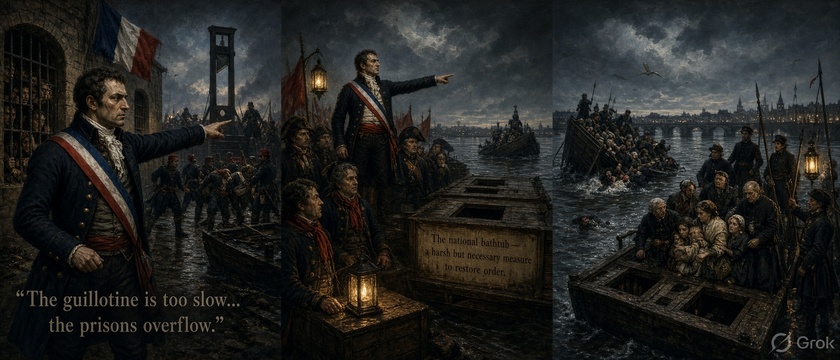
Prisons were already full when Carrier arrived. Earlier methods (shootings, guillotine) could not keep pace with arrivals. Carrier and his subordinates began planning mass disposal of prisoners; he referred to drowning as “vertical deportation” or the “national bathtub.”
The Drownings and Key Figures
The first major operation took place on the night of 16–17 November 1793 (26 Brumaire Year II). Roughly 90–160 refractory priests (held for months after refusing the oath to the Civil Constitution of the Clergy) were transferred onto specially modified flat-bottomed barges (gabares or sapines) with openings cut in the hulls. These were taken into the Loire (near the Sécherie or toward Chantenay) and sunk. A few survivors were later recovered and re-executed. Guillaume Lamberty (or Lambertye; 1754–1794), an adjutant-general and former carriage-maker whom Carrier made his close lieutenant, directed this first drowning, assisted by men from the Compagnie Marat and others such as Fouquet.
Subsequent operations followed a similar pattern:
- Further drownings of priests (including groups brought from Angers).
- Larger “Bouffay” and other night-time operations in December 1793 that included hundreds of mixed prisoners (Vendéans, civilians, women, and children).
- Later “galiote” drownings into January–February 1794 using larger vessels.
Bodies often washed ashore or floated visibly, drawing local attention. Estimates of total drowned range from about 1,800 to 4,800–5,000 (some higher contemporary or later claims exist; modern scholarship typically clusters in the 1,800–4,800 range for the noyades themselves). Additional thousands died from shootings (including at the Gigant quarry), starvation, or disease in the prisons. Carrier and the Nantes committee also ordered other repressive measures. The “republican marriages” (tying naked male and female prisoners together before drowning) are mentioned in some accounts but are often treated by historians as exaggerated or propagandistic.
Key supporting figures included members of the Revolutionary Committee of Nantes (such as Jean-Jacques Goullin and others) and local radicals who supplied lists of victims and carried out the operations. Carrier’s actions were initially endorsed or tolerated by the Committee of Public Safety in Paris.
After the Drownings
Word of the scale of the killings reached Paris. Carrier was recalled in February 1794 (he left Nantes around 16 February). He continued to justify harsh measures against the Vendée and briefly held office in the Convention. After the fall of Robespierre on 9 Thermidor (27 July 1794), the Thermidorian reaction turned against the most extreme Terrorists. Carrier was arrested in early September 1794, tried by the Revolutionary Tribunal for mass murder (including the drownings and shootings of non-combatants), convicted, and guillotined in Paris on 16 December 1794. Lamberty was also arrested after Carrier’s departure, tried by a local commission, and executed in Nantes in April 1794 (officially on other charges, though his role in the drownings was well known).
The noyades became one of the most notorious symbols of the excesses of the Terror. Contemporary and later writers (including Gracchus Babeuf and historians such as Jules Michelet) condemned them; they continue to feature in accounts of revolutionary violence, the Vendée war, and the limits of the Terror. Exact victim counts remain debated because many operations were semi-clandestine and records incomplete, but the events are firmly attested by contemporary testimony, trial evidence, and local archives.
= November 16th
These are notable historical events traditionally associated with mid-November (most commonly listed under 16 November). Here is a concise account of each.
951 – Conquest of Chu by Southern Tang
During the Five Dynasties and Ten Kingdoms period, Emperor Li Jing of the Southern Tang sent an expeditionary force of about 10,000 men under the general Bian Hao against the neighbouring state of Chu (Ma Chu). Chu had been weakened by civil war among the ruling Ma brothers. Bian Hao accepted the surrender of the capital (Changsha/Tan Prefecture), the Ma ruling family was removed to the Southern Tang capital at Nanjing (Jinling), and the Chu kingdom was formally ended.
Southern Tang control proved fragile; local Chu generals soon rebelled and largely expelled the occupiers the following year. The campaign still marked a clear territorial expansion for Li Jing before later pressures from the Later Zhou and Song.
1272 – Edward becomes King of England while on Crusade
Prince Edward (later Edward I “Longshanks”) was in the Holy Land leading the Ninth Crusade when he received news of the death of his father, Henry III of England (16 November 1272). He therefore became king while still abroad.
Edward was in no hurry to return. He recovered from an assassination attempt (a poisoned dagger), travelled through Sicily, Italy, Gascony and France, and only reached England in 1274, where he was crowned at Westminster Abbey on 19 August. The Ninth Crusade is generally regarded as the last major Western expedition to the Holy Land before the final fall of Acre in 1291.
1491 – Auto-da-fé of the Holy Child of La Guardia
On 16 November 1491 an auto-da-fé was held in the Brasero de la Dehesa outside Ávila. It concluded the case of the “Holy Child of La Guardia,” a blood-libel accusation that a group of Jews and conversos had kidnapped and ritually murdered a Christian child (whose heart was supposedly used for sorcery).
Several Jews and conversos were burned (sources commonly cite around six conversos and two or three Jews). No body was ever found, the confessions were obtained under torture, and the details were inconsistent. The case occurred just months before the 1492 Alhambra Decree expelling the Jews from Spain and is widely regarded by historians as one of the most infamous Spanish blood libels.
1532 – Capture of Atahualpa at Cajamarca
On 16 November 1532 Francisco Pizarro and a force of roughly 168 Spanish soldiers and auxiliaries ambushed the Inca emperor Atahualpa in the plaza of Cajamarca (in present-day Peru). Atahualpa had entered the town with a large, largely unarmed retinue while tens of thousands of his troops camped nearby.
The Spanish opened fire with guns and cannons, charged with cavalry, and killed thousands of attendants in a short, one-sided action. Atahualpa was seized alive. The capture paralysed Inca resistance, opened the way for the Spanish conquest of the Inca Empire, and led (after a massive gold-and-silver ransom) to Atahualpa’s execution in 1533.
1776 – Capture of Fort Washington
British and Hessian forces under General William Howe attacked Fort Washington (near the northern end of Manhattan) on 16 November 1776. After fighting on the outer lines, the American garrison under Colonel Robert Magaw surrendered.
The Patriots lost roughly 2,800 men as prisoners (plus killed and wounded). Most of the prisoners were confined on British prison ships in New York harbour, where disease and harsh conditions killed a large majority. It was one of the worst American defeats of the Revolutionary War and left the British in control of Manhattan.
1776 – “First Salute” by the Dutch (St. Eustatius)
On the same day (16 November 1776) the American brig Andrew Doria, flying the Grand Union flag, entered the harbour of the Dutch Caribbean island of St. Eustatius. Governor Johannes de Graaff ordered Fort Oranje to return the ship’s salute with an 11-gun volley.
This is widely remembered as the First Salute—the first formal acknowledgement of American sovereignty by an official of a foreign power. Formal diplomatic recognition by the Dutch Republic itself came later (1782), but the gesture was treated by Britain as a provocative act and contributed to rising Anglo-Dutch tensions.
1793 – Drownings at Nantes begin
During the Reign of Terror, the Convention’s representative-on-mission Jean-Baptiste Carrier began the mass drownings (noyades) in Nantes. On the night of 16 November 1793 the first large group—approximately 90–160 refractory (non-juring) Catholic priests—was loaded onto barges and sunk in the Loire.
Carrier called the method “the national bathtub.” The drownings continued until early 1794 and claimed thousands of victims (estimates range from roughly 1,800 to 4,800 or more), including priests, nuns, Vendéan prisoners, and other “suspects.” They remain one of the most notorious atrocities of the Revolution.
1797 – Accession of Frederick William III of Prussia
On 16 November 1797 the Prussian heir apparent became King of Prussia as Frederick William III upon the death of his father, Frederick William II. He reigned until 1840.
Early in his reign he pursued neutrality, austerity, and limited reform. Prussia later entered the Napoleonic Wars (disastrously in 1806), then played a major role in the final coalition that defeated Napoleon. His queen, Louise of Mecklenburg-Strelitz, was especially popular and became a symbol of Prussian resistance and recovery.
These episodes range from dynastic conquest and crusading kingship to blood libel, the fall of the Inca Empire, the American Revolution, revolutionary terror, and the start of a long Prussian reign.