


October 22nd, When Time Began
Here is a fuller account of the two events, with what came before, what followed, and the main figures involved.
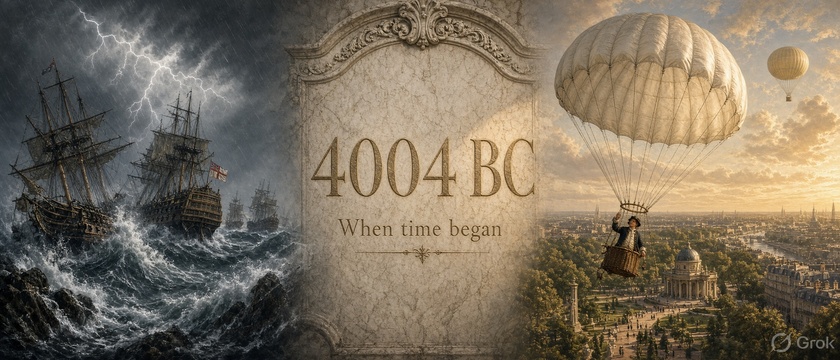
1707 – Scilly naval disaster
Before: The disaster occurred during the War of the Spanish Succession. Admiral Sir Cloudesley Shovell (1650–1707), one of the leading British naval commanders of the age, had led a fleet in an unsuccessful allied attempt to capture Toulon. The French scuttled much of their Mediterranean fleet to prevent its capture. Shovell was ordered home with roughly 21 ships. After leaving Gibraltar, the squadron faced prolonged bad weather that prevented reliable sun sights. Navigation relied on dead reckoning (compass + estimated speed) and occasional soundings. On 21–22 October the captains conferred and concluded they were near Ushant (off Brittany). In reality they were farther north, approaching the dangerous Western Rocks of the Isles of Scilly.
The disaster (22 October 1707, Old Style): Around 8 pm, in dark, rainy, stormy conditions with a strong wind, the fleet ran among the rocks. HMS Association (90-gun flagship, Captain Edmund Loades) struck the Outer Gilstone Rock and sank within minutes with the loss of her entire crew of about 800, including Shovell and his two Narborough stepsons. HMS Eagle (70 guns) and HMS Romney (50 guns) were also lost with almost all hands (only one survivor from Romney, quartermaster George Lawrence). The fireship Firebrand was lost with most of her crew. Total deaths are estimated at 1,400–2,000. Bodies, including Shovell’s, washed ashore on St Mary’s (notably at Porth Hellick Cove). Contemporary reports noted the scale of the loss; one persistent (though not fully verified) story is that Shovell was still alive when washed up and was killed by a local woman for a valuable ring.
After and significant figures: The catastrophe caused national shock. Shovell’s body was recovered, identified, and eventually buried with a monument by Grinling Gibbons in Westminster Abbey. The immediate navigational failure was largely one of position (a combination of latitude and longitude error under poor conditions), but the scale of the loss drew lasting attention to the difficulty of determining longitude at sea. In 1714 Parliament passed the Longitude Act, offering prizes of up to £20,000 (a fortune at the time) for a practical method accurate to within half a degree. This led to the Board of Longitude. The eventual practical solution came from clockmaker John Harrison (1693–1776), who spent decades developing marine chronometers (especially his H4 sea watch). After lengthy trials and disputes with the Board (including rivalry with astronomers favouring lunar distances), Harrison received substantial rewards in the 1760s–1770s with the intervention of King George III. Reliable chronometers and improved methods transformed long-distance navigation and reduced such disasters.
Other figures include the captains of the lost ships (Loades, Hancock of Eagle, Coney of Romney) and later chronometer developers who built on Harrison’s work.
1797 – First recorded parachute jump
Before: André-Jacques Garnerin (1769–1823) was a French balloonist and aeronaut who had witnessed early balloon flights. During the French Revolutionary Wars he was captured and imprisoned for about three years in Buda (Budapest). While a prisoner he studied aeronautics and considered parachutes (building on earlier experiments such as Louis-Sébastien Lenormand’s 1783 jumps from towers or trees with framed or umbrella-like devices). After his release he continued balloon work and designed a frameless parachute.
The jump (22 October 1797 / 1 Brumaire Year VI): At Parc Monceau (then often called Parc de Mousseaux) in Paris, Garnerin ascended in a hydrogen balloon with a closed, frameless canvas (or silk) canopy roughly 7 metres / 23 feet in diameter attached to a basket/gondola. At about 1,000 metres (roughly 3,000–3,200 feet) he cut the connecting rope. The balloon continued upward (and later burst or deflated); the canopy opened and Garnerin descended in the basket. The descent was violent because the canopy lacked a central vent—it oscillated wildly, alarming spectators (some women reportedly fainted). He landed roughly and shaken but essentially uninjured (some accounts mention a sprained ankle or foot) and was celebrated by the crowd. Astronomer Jérôme Lalande recorded the event and later suggested a vent to stabilise future canopies.
After and significant figures: The jump made Garnerin famous. He repeated descents and became known as the Official Aeronaut of France under Napoleon for a time. In 1798–99 he worked with pupils including Jeanne-Geneviève Labrosse (later his wife), who made one of the earliest female balloon flights and, on 12 October 1799, became the first woman to make a parachute descent (from about 900 m). Garnerin’s niece Élisa Garnerin also became an aeronaut and parachutist. Improvements followed: a central vent (associated with Lalande’s suggestion, implemented around 1804) greatly reduced oscillations. Garnerin performed further jumps and long balloon voyages in France, Britain, and elsewhere, though he later fell from favour after a mishap involving a ceremonial balloon at Napoleon’s coronation. He died in 1823 while preparing equipment. The 1797 descent is widely regarded as the first successful high-altitude parachute jump using a frameless canopy.
These two events are linked only by the calendar date; one is a major naval tragedy that accelerated the solution to the longitude problem, the other a pioneering (and highly public) demonstration of controlled aerial descent.
=
These are events traditionally associated with October 22. They span biblical chronology, early Church history, medieval Asia and Europe, colonial and naval history, the American Revolution, and early aviation.
4004 BC – Ussher chronology
Irish archbishop James Ussher (in his 1650 Annales Veteris Testamenti) calculated that creation occurred in 4004 BC near the autumnal equinox. He placed the first day of creation on 23 October (proleptic Julian calendar), with the “beginning of time” at the start of the preceding evening—i.e., the evening of 22 October. Popular accounts often say “about six o’clock in the evening” on the 22nd. This was one of several 17th-century biblical chronologies that produced a date near 4000 BC; it is not accepted by modern historical or scientific dating.
362 – Temple of Apollo at Daphne
The temple of Apollo at Daphne (near Antioch) was destroyed by a mysterious fire. The cause was never clearly established.
451 – Council of Chalcedon
The fourth ecumenical council (convened by Emperor Marcian) adopted the Chalcedonian Definition/Creed on 22 October during its fifth session. It affirmed that Jesus Christ is one person in two natures (fully divine and fully human), “without confusion, without change, without division, without separation.” The council met at Chalcedon (near Constantinople) from 8 October to 1 November and was the largest of the early ecumenical councils (roughly 500+ bishops). The definition remains foundational for Catholic, Eastern Orthodox, and most Protestant traditions, while Oriental Orthodox churches rejected it.
794 – Heian-kyō
Emperor Kanmu moved the Japanese capital from Nara to Heian-kyō (modern Kyoto), beginning the Heian period.
906 – Ahmad ibn Kayghalagh’s raid
The Abbasid general Ahmad ibn Kayghalagh led a raid from Tarsus into Byzantine territory, reaching the Halys River and taking 4,000–5,000 captives.
1383 – Portuguese succession crisis
King Fernando I of Portugal died without a male heir. This triggered the 1383–85 Crisis (civil war and succession struggle) that eventually brought the House of Aviz to the throne.
1575 – Foundation of Aguascalientes
The city of Aguascalientes (in present-day Mexico) was founded.
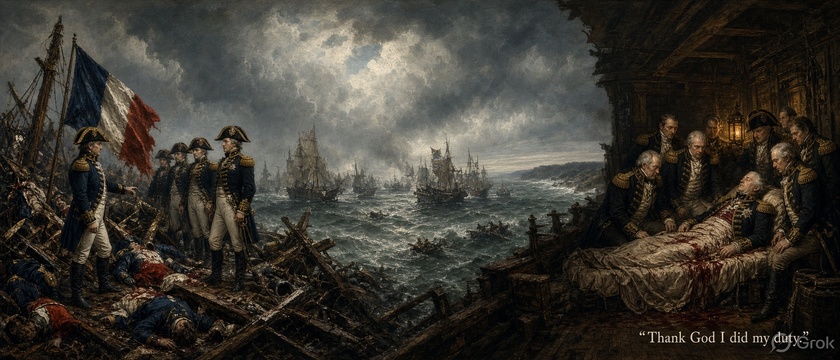
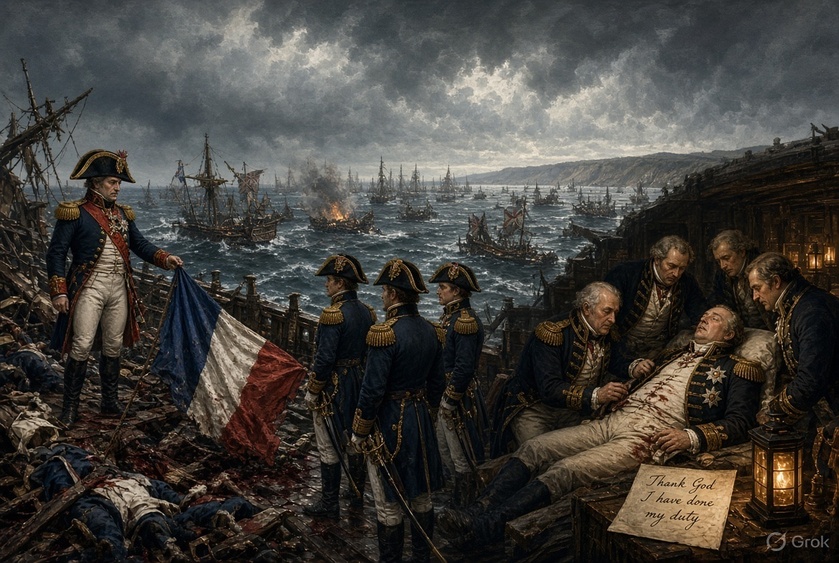
1633 – Battle of Liaoluo Bay
Ming Chinese naval forces under Zheng Zhilong defeated a Dutch East India Company (VOC) fleet (under Hans Putmans) plus Chinese pirate allies in Liaoluo Bay off Kinmen in the Taiwan Strait. It was the largest Chinese–European naval engagement before the Opium Wars. The Ming used fireships effectively; the Dutch lost ships and were driven from the Chinese coast.
1707 – Scilly naval disaster
Four Royal Navy ships (including the flagship Association under Admiral Sir Cloudesley Shovell) ran aground on the Isles of Scilly in stormy weather due to navigational error (faulty dead reckoning after poor weather). Roughly 1,400–2,000 men died; it was one of the worst maritime disasters in British history. The catastrophe highlighted the urgent need for a reliable method of finding longitude at sea and helped spur the Longitude Act of 1714, which offered large prizes and led to the development of marine chronometers.
1730 – Ladoga Canal
Construction of the Ladoga Canal (in Russia) was completed.
1746 – College of New Jersey
The College of New Jersey (later Princeton University) received its charter.
1777 – Battle of Red Bank
In the American Revolutionary War, American defenders of Fort Mercer on the Delaware River repulsed repeated Hessian attacks.
1784 – Russian colony on Kodiak Island
Russia founded a colony on Kodiak Island in Alaska.
1790 – Northwest Indian War
Warriors of the Miami people under Chief Little Turtle defeated U.S. troops under General Josiah Harmar near present-day Fort Wayne, Indiana (part of the Harmar Campaign).
1797 – First recorded parachute jump
André-Jacques Garnerin made the first documented parachute descent from a hydrogen balloon, from about 1,000 metres (roughly 3,000–3,200 feet) over Parc Monceau in Paris. He used a frameless silk/canvas canopy attached to a basket. The descent was violent (the canopy lacked a vent, causing wild oscillations), but he landed uninjured. This is widely regarded as the first successful parachute jump from significant altitude.
These entries mix well-documented events with the Ussher calculation (a scholarly but non-scientific reconstruction). The Council of Chalcedon, the Scilly disaster, the Battle of Liaoluo Bay, and Garnerin’s jump are among the more consequential of the day.