



Miracle of Myeongnyang
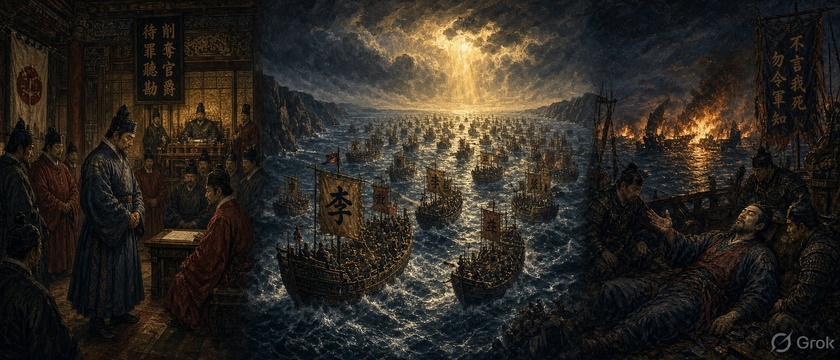
Battle of Myeongnyang (October 26, 1597), part of the Imjin War (Japanese invasions of Korea, 1592–1598).
Lead-up
The Imjin War began in 1592 when Toyotomi Hideyoshi launched a large-scale invasion of Joseon Korea as a stepping stone toward Ming China. Japanese land forces advanced rapidly, but Joseon Admiral Yi Sun-sin repeatedly disrupted their supply lines with naval victories, using sturdy panokseon warships (and the armored turtle ships/geobukseon he helped develop). These successes helped stall the first invasion and contributed to a temporary truce/negotiations around 1596.
In 1597, Hideyoshi ordered a second invasion (the Chongyu War). Japanese agents spread disinformation that led the Joseon court to arrest, demote, and nearly execute Yi Sun-sin on charges of disloyalty and failure to attack. He was replaced by the less competent Wŏn Kyun (Won Gyun). In the Battle of Chilcheollyang (late August 1597), Wŏn Kyun led most of the Joseon fleet into a Japanese trap; nearly the entire force (around 200 ships) was destroyed, and Wŏn Kyun was killed. Only about 13 panokseon survived, largely because a subordinate (Bae Seol) held them back.
With the Joseon navy effectively shattered, King Seonjo hurriedly reinstated Yi Sun-sin as commander. He inherited a demoralized remnant of roughly 13 warships and a few hundred men. Japanese naval forces, now dominant, prepared to support a renewed land push northward toward Hanyang (Seoul) by clearing the western sea routes and Yellow Sea. Yi rejected advice to abandon the navy and join the army; he chose instead to make a stand in the narrow, tidal Myeongnyang Strait near Jindo Island (southwest Korea). The strait’s strong, reversing currents (up to ~10–11 knots) and constrained waters could negate Japanese numerical superiority and favor Joseon ranged gunnery over Japanese boarding tactics.
The Battle
On October 26, 1597 (lunar calendar dates vary slightly in sources), Yi positioned his small squadron at the northern entrance near Usuyeong. Japanese commanders including Kurushima Michifusa, Tōdō Takatora, Katō Yoshiaki, Wakizaka Yasuharu, and others advanced with a large fleet—Korean sources typically cite ~120–133 warships engaged (with totals sometimes listed up to ~300+ including support vessels). Yi’s diary and records note earlier scouting activity and a decision to draw the enemy into the strait.
Yi led from the front with his flagship, engaging the Japanese vanguard while some of his captains initially hesitated. Japanese ships funneled into the narrow channel. As the tide reversed, it swept vessels into disorder, causing collisions and loss of formation. Joseon ships used cannons, arrows, and ramming effectively at close range. Kurushima Michifusa was killed (his head later displayed as a warning); Tōdō Takatora was wounded. The Japanese could not exploit their numbers or preferred boarding tactics. After hours of fighting, they withdrew. Joseon lost no ships (minimal casualties, a handful of killed/wounded on Yi’s flagship and nearby vessels). Japanese losses were roughly 31 warships sunk or crippled, with additional damage and significant personnel losses (higher figures appear in some Korean accounts).
Results and Significance
The victory halted the Japanese naval advance supporting their land campaign, denied them reliable western sea supply routes, and preserved Joseon control of key waters. It allowed time to rebuild the navy (Yi later expanded his fleet) and contributed to the overall stalemate and eventual Japanese withdrawal after Hideyoshi’s death in 1598. Strategically, it was a “last stand” that turned the tide of the naval war in the second invasion. It is often called the “Miracle of Myeongnyang” and ranks among the most one-sided naval victories against overwhelming odds in history.
Yi Sun-sin was later killed at the Battle of Noryang (November/December 1598) while intercepting withdrawing Japanese forces; his last orders were reportedly not to announce his death to avoid demoralizing the fleet.
Significant Figures
- Yi Sun-sin (Joseon): Supreme naval commander. A brilliant tactician and leader who had won multiple earlier battles. He studied local tides and geography, motivated demoralized crews, and directed the fight from the front. National hero in Korea; his war diary (Nanjung Ilgi) provides a key firsthand account.
- Kurushima Michifusa (Japanese): Senior commander (daimyo-level naval leader from the Murakami suigun tradition). Killed in the battle—the highest-ranking Japanese death of the engagement—and his head was displayed. His loss disrupted command.
- Tōdō Takatora (Japanese): Key commander in the second invasion’s naval efforts (involved in Chilcheollyang). Wounded at Myeongnyang.
- Wŏn Kyun (Joseon): Yi’s temporary replacement whose catastrophic defeat at Chilcheollyang set the stage for the desperate defense.
- Supporting Joseon officers: Kim Ŏkch’u, Kim Ŭngham, An Wi, Song Yŏchong, Pae Hŭngnip, and others who fought under Yi.
- Broader context: Toyotomi Hideyoshi (Japanese supreme leader who ordered the invasions); King Seonjo of Joseon.
The battle exemplifies Yi’s use of terrain, tides, superior artillery, and leadership against superior numbers. Numbers of Japanese ships vary across sources (common range 133 warships engaged, higher totals including support craft), but the disparity and outcome are consistent in the historical record.
= October 26th
These events are primarily associated with October 26 (with minor variations in some sources for a couple of dates). Here is a concise overview of each:
740 – Earthquake strikes Constantinople and surrounding areas.
A major earthquake (estimated magnitude around 7+ in some modern assessments) hit the vicinity of Constantinople and the Sea of Marmara on October 26, 740. It damaged or collapsed parts of the city’s land walls (Theodosian Walls), public buildings, and structures in nearby towns in Thrace and Asia Minor (including Nicaea/Nicomedia areas). Contemporary accounts (e.g., Theophanes) report over 1,000 deaths in the capital and describe the sea retreating then returning, consistent with a tsunami. Aftershocks continued for months.
1185 – Uprising of Asen and Peter begins.
On the feast day of St. Demetrius of Thessaloniki (October 26), brothers Peter (Theodore) and Asen launched a revolt of Bulgarians and Vlachs in the region of Moesia/the Haemus (Balkan Mountains) against Byzantine rule under Isaac II Angelos. Triggered by heavy taxation (including for the emperor’s wedding), they built a church to St. Demetrius in Tarnovo, claimed the saint’s favor had shifted to them, and proclaimed independence. This led to the restoration of Bulgarian statehood and the Second Bulgarian Empire under the Asen dynasty after several years of fighting.
1341 – Byzantine civil war of 1341–47 formally begins.
Following the death of Andronikos III and the overthrow of the regency of John Kantakouzenos (while he was away from the capital), his army proclaimed him emperor as John VI at Didymoteicho in Thrace on October 26, 1341. He accepted while still acknowledging the rights of the young John V Palaiologos. The resulting six-year civil war involved foreign allies (Turks, Serbs), devastated the empire, and ended with Kantakouzenos as co-emperor/senior ruler until 1354.
1377 – Tvrtko I is crowned the first king of Bosnia.
In the fall of 1377 (commonly dated to October 26, the feast of St. Demetrius), Ban Tvrtko I Kotromanić was crowned king of Bosnia (and claimed the title for the Serbs and other territories). He positioned himself as heir to the extinct Nemanjić dynasty of Serbia. The coronation site is debated (Mileševa Monastery in Serbian accounts vs. a Franciscan church at Mile in Bosnian/Croatian historiography). This elevated the Banate of Bosnia to a kingdom.
1520 – Charles V is crowned as Holy Roman Emperor.
Charles of Habsburg (already King of Spain as Charles I) was elected Holy Roman Emperor in June 1519. He was crowned King of the Romans / Emperor-elect in Aachen Cathedral on October 23, 1520 (some older lists approximate the date). The full papal imperial coronation by Pope Clement VII occurred later, in Bologna on February 24, 1530—the last such papal crowning. This marked the peak of Habsburg power under a ruler whose domains spanned much of Europe and the Americas.
1597 – Battle of Myeongnyang (Imjin War).
On October 26, 1597, Joseon Admiral Yi Sun-sin, with only about 13 panokseon warships remaining after earlier disasters, defeated a far larger Japanese fleet (Korean sources cite ~120–133 warships engaged, with totals up to ~300+ vessels including support craft) in the narrow Myeongnyang Strait near Jindo Island. Using the strong tidal currents, Yi’s forces sank or crippled roughly 30 Japanese ships (including killing a senior commander) with no Korean ships lost. This halted the Japanese naval advance supporting their land campaign toward the capital.
1640 – Treaty of Ripon is signed.
This truce ended the Second Bishops’ War between Charles I of England and the Scottish Covenanters. After Scottish victories and occupation of northern English territory (including Newcastle), the treaty (negotiated at Ripon; sources vary on exact signing between October 16–28, often cited around the 26th) provided for Scottish occupation of parts of northern England and daily payments (~£850) until a final settlement via the English Parliament. It forced Charles to summon the Long Parliament, a key step toward the English Civil War.
1689 – General Piccolomini burns Skopje.
Austrian general Enea Silvio Piccolomini (of Italian noble descent) captured Skopje during the Great Turkish War. On or around October 26, 1689, he ordered the city burned (the fire lasted two days), citing prevention of cholera spread, denial of resources to returning Ottoman forces, or inability to hold the distant city. Much of the city (population then ~60,000) was destroyed, reducing it to ~10,000 and ending its regional prominence. Piccolomini himself died of cholera soon afterward.
1774 – First Continental Congress adjourns in Philadelphia.
After meeting from September 5 at Carpenters’ Hall (delegates from 12 colonies responding to the Intolerable/Coercive Acts), the Congress adjourned on October 26. It had adopted the Articles of Association (economic boycott of Britain), issued the Declaration and Resolves asserting colonial rights, and planned to reconvene in May 1775 if grievances were not addressed. This was a major step in colonial unity short of declaring independence.
1775 – King George III addresses Parliament on the American rebellion.
Following the outbreak of fighting (Lexington/Concord, Bunker Hill) and the earlier Proclamation of Rebellion (August 23, 1775), George III addressed both houses of Parliament on October 27, 1775 (some lists date related actions to the 26th). He declared the colonies in open rebellion, rejected conciliatory approaches, and authorized military measures to suppress it, framing the conflict as an attempt to establish an independent empire.
1776 – Benjamin Franklin departs for France.
On October 26, 1776 (about a month after his appointment as one of the commissioners to France), the 70-year-old Franklin sailed from Philadelphia on the Reprisal. His mission was to secure formal French alliance, military aid, and recognition for the United States. He arrived in France later that year and, leveraging his fame as a scientist and statesman, played a central role in obtaining the 1778 treaties of alliance and commerce after the Saratoga victory.
These October 26 events span natural disasters, revolts and state-building in the Balkans and Byzantium, Habsburg imperial consolidation, a famous naval victory in East Asia, and key steps in the American Revolution. Dates can vary slightly by calendar system or source for a few of them.