



Rome ruled. Etruscans served
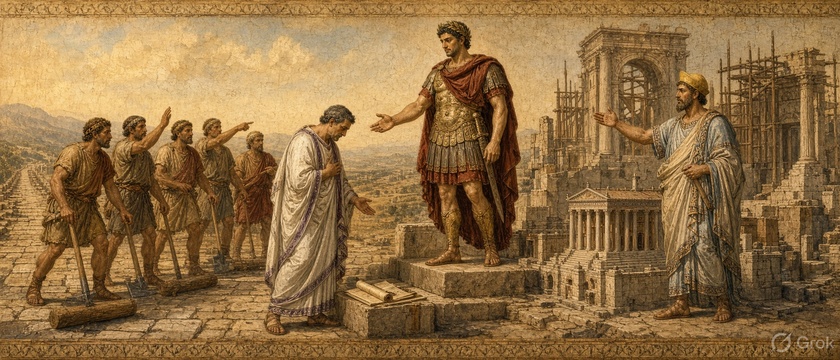
Servius Tullius’s triumph of 571 BC is recorded in the Fasti Triumphales (the ancient Roman list of triumphators) as one of three triumphs he celebrated over the Etruscans. The precise entry reads (in restored form): Servius Tullius, king, over the Etruscans, on the 6th day before the Kalends of December (25 November) in the year 182/183 AUC. Two more followed later (one on 25 May 567 BC; the third is only partially preserved). These are traditional/legendary dates from later Roman historiography; no contemporary evidence exists.
Before the triumph: accession and early wars
Servius Tullius was the traditional sixth king of Rome (c. 578–535 BC), succeeding Lucius Tarquinius Priscus (the fifth king, an Etruscan from Tarquinia). According to the main Roman tradition (Livy, Dionysius of Halicarnassus), his origins were obscure and servile: he was the son of Ocrisia, a Latin captive woman from Corniculum in the household of Tarquinius Priscus. A flame was said to have appeared around the child’s head, which Queen Tanaquil (Tarquinius’s wife) interpreted as a sign of future greatness. He was raised in the royal household, married a daughter of Tarquinius Priscus (usually called Tarquinia or Gegania), and became a trusted figure.
Tarquinius Priscus was assassinated around 579/578 BC by the sons of the previous king Ancus Marcius (who resented the Etruscan dynasty). Tanaquil concealed the death, announced that Servius would act as regent, and later secured the Senate’s recognition of him as king—the first time, according to Livy, that the people were not formally involved in choosing a king. The sons of Ancus fled into exile.
Early in his reign Servius fought Veii (the nearest powerful Etruscan city, about 16 km north of Rome) and other Etruscan forces. Livy describes him as conspicuous for valour; he routed a large enemy army. The victory (or series of victories) helped consolidate his initially irregular position on the throne. The 571 BC triumph is the first of the three attributed to these campaigns. The wars appear to have been prolonged border conflicts rather than a single decisive conquest; some later sources (and Dionysius) expand them into a broader struggle against the Etruscan league after the death of Tarquinius Priscus.
The triumph itself
A Roman triumph was a ceremonial procession into the city honouring a major military victory. The triumphator wore a purple toga and laurel crown, rode in a chariot, and was accompanied by his troops, captured spoils, and (often) leading captives. The route traditionally ran from the Campus Martius through the city to the Capitol. For Servius the 571 BC entry in the Fasti simply records the fact, date, and enemy (“de Etruscis”); no further contemporary details survive. Later tradition presents it as confirmation of his military success and a boost to his authority early in the reign.
After the triumph: reforms, expansion, and downfall
Servius’s reign is remembered far more for institutional changes than for further military campaigns. He is credited with:
- The first Roman census (Livy gives a figure of about 80,000 adult male citizens capable of bearing arms).
- The Servian Constitution: organisation of citizens into wealth classes (five classes plus capite censi), each subdivided into centuries. This formed the basis of the army (hoplite-style equipment required of the wealthier classes) and the comitia centuriata (centuriate assembly), which gradually displaced the older curiate assembly. Voting was weighted toward the rich.
- Territorial expansion of the city to include the Quirinal, Viminal, and Esquiline hills; creation of new urban tribes.
- Religious foundations, especially the temple of Diana on the Aventine (linked to a Latin League) and temples or cults associated with Fortuna. He is also linked to the Compitalia festivals.
The so-called Servian Wall that later enclosed the expanded city is now dated by archaeologists to the 4th century BC (after the Gallic sack), though earlier defences existed. Many of the “Servian reforms” are viewed by modern scholars as a long, gradual process that began before him and continued into the Republic; the annalistic tradition simply attached them to the popular, reform-minded king.
He remained a popular figure among the lower classes. His reign ended violently around 535 BC. His ambitious younger daughter Tullia (the younger) conspired with her husband Lucius Tarquinius Superbus (son of Tarquinius Priscus). They arranged the murder of Servius’s older daughter’s husband and then of Servius himself. In the famous story, Tullia drove her chariot over her father’s corpse. Tarquinius Superbus seized power as the seventh (and last) king of Rome.
Significant figures
- Tarquinius Priscus: predecessor; Etruscan king whose assassination opened the way for Servius.
- Tanaquil: Priscus’s wife; prophetic figure who promoted Servius as successor.
- Ocrisia: Servius’s mother in the Roman tradition (Latin captive).
- Caelius Vibenna / Mastarna: In the alternative Etruscan tradition preserved by the emperor Claudius (from Etruscan sources), Servius was an Etruscan adventurer or mercenary named Mastarna, companion of the Vibenna brothers (Caeles and Aulus Vibenna). He came to Rome, occupied the Caelian Hill (named after Caeles), and took the Roman name Servius Tullius. This version is supported by a scene in the François Tomb at Vulci showing Macstrna freeing Caile Vipinas.
- Tullia Minor: Servius’s daughter; co-conspirator in his murder.
- Lucius Tarquinius Superbus: Servius’s son-in-law and successor; the last king of Rome.
- Veii and the Etruscans: principal opponents in the wars that produced the triumphs.
The entire account is legendary, reconstructed by later Roman writers (especially Livy and Dionysius) centuries after the events. The Fasti Triumphales themselves are Augustan-era inscriptions that systematised earlier tradition. What is reasonably secure is that a figure remembered as Servius Tullius ruled Rome in the mid-6th century BC during a period of strong Etruscan cultural influence, and that later Romans attributed to him the foundational census, class organisation, and expansion of the city. The 571 BC triumph is the earliest dated military celebration assigned to him.
= November 25th
These events cluster around late November (most are conventionally dated to the 25th rather than the 24th; sources vary slightly due to calendar systems, traditional listings, and modern dating). Here is a concise overview of each, with context and significance.
571 BC – Servius Tullius’s triumph.
The legendary sixth king of Rome (traditionally reigned c. 578–535 BC) is recorded in the Fasti Triumphales as celebrating a triumph over the Etruscans on 25 November 571 BC (one of three such triumphs attributed to him). Servius was credited with major reforms (the Servian Constitution organizing citizens by wealth/class for military and political purposes), expanding Rome to include the Quirinal, Viminal, and Esquiline hills, and building temples. His origins were obscure (some traditions make him a slave or Etruscan interloper named Mastarna); he was eventually murdered by his daughter and son-in-law Tarquinius Superbus.
885 – Siege of Paris begins.
Viking forces (led by Sigfred and others, possibly including Rollo) arrived on or about 24/25 November 885 with a large fleet—contemporary poet Abbo Cernuus claimed up to 700 ships and tens of thousands of men (widely regarded as exaggerated; modern estimates often cite around 300 ships). They demanded tribute and, when refused, besieged Paris (then mainly the fortified Île de la Cité, protected by bridges). Count Odo and Bishop Gozlin led a small defense that held for months. The siege (lasting into 886) highlighted Paris’s strategic importance, weakened Carolingian authority, and elevated Odo, who later became king of the West Franks.
1034 – Death of Malcolm II of Scotland.
Máel Coluim mac Cináeda (Malcolm II), King of Alba from around 1005, died on 25 November 1034 (aged about 80), traditionally at Glamis. One of the longer-reigning early Scottish kings, he had no surviving sons and arranged the succession of his grandson Duncan I (Donnchad), son of his daughter Bethóc and Crínán of Dunkeld. Some later traditions also linked him as grandfather (via another daughter) to Macbeth. His reign involved campaigns in the north and against Northumbria (including the Battle of Carham).
1120 – Sinking of the White Ship.
On 25 November 1120, the White Ship (a newly refitted vessel carrying nobles, including William Adelin, the only legitimate son and heir of Henry I of England) struck a rock off Barfleur in the English Channel and sank. Of roughly 300 aboard, only one (a butcher from Rouen) survived. William drowned after turning back to try to save his half-sister. The disaster left Henry I without a clear male heir, contributing directly to the succession crisis and civil war known as The Anarchy after Henry’s death in 1135.
1177 – Battle of Montgisard.
On 25 November 1177, near Ramla (site debated; possibly near Gezer), the young leper king Baldwin IV of Jerusalem and Raynald of Châtillon led a smaller Crusader force (including Templars) to a decisive victory over Saladin’s much larger Ayyubid army. Saladin’s forces were caught dispersed and surprised; most of his army was destroyed or fled, and he escaped with only a fraction of his men. It was one of the most notable Crusader successes of the period, though temporary—Saladin later triumphed at Hattin and took Jerusalem in 1187.
1343 – Tyrrhenian Sea earthquake and tsunami.
An earthquake on 25 November 1343 in the Tyrrhenian Sea generated a tsunami that devastated Naples, the Amalfi coast, and other areas. Ships were destroyed, ports wrecked, and there was significant loss of life and damage. The poet Petrarch observed effects of the event. A 2019 study links it to a large submarine landslide, possibly from a flank collapse of Stromboli volcano.
1487 – Coronation of Elizabeth of York.
Elizabeth of York (daughter of Edward IV, wife of Henry VII) was crowned Queen of England on 25 November 1487 at Westminster Abbey (her coronation procession through London had taken place the previous day). The marriage (January 1486) united the houses of York and Lancaster after the Wars of the Roses. She was mother of Arthur, Prince of Wales, and of the future Henry VIII; her coronation had been delayed by pregnancy and political unrest.
1491 – Treaty of Granada.
Signed and ratified on 25 November 1491 (at the Christian camp near Santa Fe outside the city), the treaty (also called the Capitulations) ended the Granada War and the siege of Granada, the last Moorish stronghold in Spain. Emir Muhammad XII (Boabdil) surrendered the Nasrid Emirate to Ferdinand and Isabella. Formal handover of the city occurred on 2 January 1492, completing the Reconquista. The terms promised religious tolerance and rights to Muslims (and options for Jews), but these were later eroded, leading to forced conversions, expulsions, and the Morisco problem.
1667 – Shamakhi earthquake.
A powerful earthquake (estimated ~6.9 Ms, intensity X) struck near Shamakhi (in modern Azerbaijan, then under Safavid Iran) around 25 November 1667 (the exact day and even year are disputed in sources; some prefer early 1668). It destroyed the city (walls, fortress, mosque) and is estimated to have killed around 80,000 people. Aftershocks continued for years.
1755 – Royal protection for the Beaterio.
On 25 November 1755, King Ferdinand VI of Spain granted royal (civil) protection to the Beaterio de la Compañía de Jesús in Manila. This community of pious women, founded in 1684 by the Filipina Venerable Mother Ignacia del Espíritu Santo (a Chinese mestiza), later became the Congregation of the Religious of the Virgin Mary (RVM), the oldest Filipino religious congregation for women. It received further ecclesiastical approvals over time and expanded its educational and missionary work.
1758 – Capture of Fort Duquesne.
During the French and Indian War (Seven Years’ War), British and colonial forces under General John Forbes took Fort Duquesne (at the forks of the Ohio, Allegheny, and Monongahela rivers) on 25 November 1758. The French had burned and abandoned the fort the previous night as Forbes’s larger force approached (after building a new road and securing Native alliances). The British rebuilt it as Fort Pitt; the site became Pittsburgh. This was a major turning point that ended significant French control in the Ohio Valley.
1759 – Near East earthquakes.
A pair of major earthquakes struck the Levant (Ottoman Syria, including areas of modern Lebanon, Syria, and Israel/Palestine). A smaller event on 30 October (~6.6 Ms) was followed by a larger one on 25 November (~7.4 Ms). They destroyed or heavily damaged Beirut, Damascus, Baalbek, Safed, and many villages, with total deaths estimated in the tens of thousands (commonly cited figures of 30,000–40,000 for the sequence). Surface faulting and widespread ruin occurred along the Dead Sea fault system.
1783 – British evacuation of New York.
On 25 November 1783 (Evacuation Day), the last British troops left New York City, three months after the Treaty of Paris formally ended the American Revolutionary War. George Washington led the Continental Army into the city in a triumphal entry. A famous (partly legendary) episode involved the British greasing the flagpole at Fort George/the Battery so Americans could not immediately raise their flag; a soldier eventually climbed it. The day was long celebrated locally in New York.
1795 – Abdication of Stanisław August Poniatowski.
On 25 November 1795 (the anniversary of his 1764 coronation and the name-day of Empress Catherine II), Stanisław August Poniatowski, the last king of the independent Polish-Lithuanian Commonwealth, signed his abdication in Grodno under Russian pressure after the Third Partition and the defeat of the Kościuszko Uprising. He renounced all rights to the throne. He lived thereafter in Russian custody (later in St. Petersburg) and died in 1798. This marked the formal end of the Polish monarchy until the 20th century.
These events range from ancient Roman kingship and Viking sieges to Crusader battles, natural disasters, the end of Muslim rule in Spain, colonial wars in America, and the final partitions of Poland. Several (White Ship, Montgisard, Granada, Evacuation Day) had lasting political or cultural consequences.