


The Siege of La Rochelle (1627–1628)
was the climactic episode of the last major Huguenot rebellions against the French crown. It ended the military and political autonomy of French Protestants and marked a decisive step toward the absolute monarchy under Louis XIII and Cardinal Richelieu.
Before the Siege
The French Wars of Religion (1562–1598) had pitted Catholics against Huguenots (French Calvinists). They were settled by Henry IV’s Edict of Nantes (1598), which granted Protestants freedom of worship, civil rights, and a network of fortified “places of safety” (places de sûreté), including the Atlantic port of La Rochelle. La Rochelle became the strongest and wealthiest remaining Huguenot stronghold, with a large Protestant population, commercial power (especially the salt trade), and a semi-autonomous character.
After Henry IV’s assassination in 1610, his young son Louis XIII came under more Catholic influence. Tensions rose in the 1620s as Huguenots resisted royal efforts to curb their independence. Cardinal Richelieu, Louis XIII’s chief minister, viewed the Huguenot “state within a state” as incompatible with centralized royal authority. In 1627, England under Charles I intervened: the Duke of Buckingham landed forces on the nearby Île de Ré to support the Rochelais and encourage a broader rebellion. This prompted the royal siege.
The Siege (September 1627 – 28 October 1628)
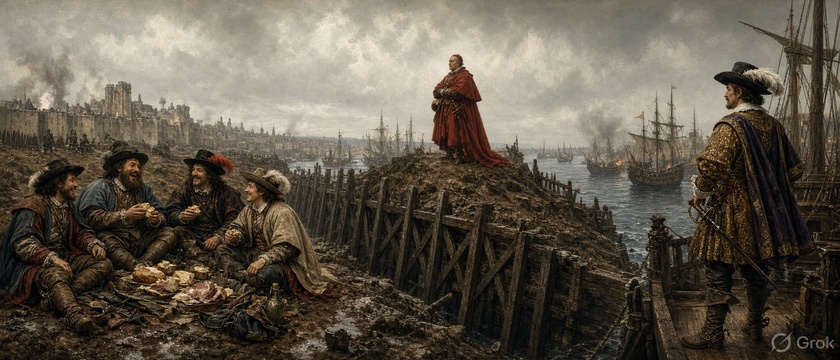
Royal forces under Louis XIII and Richelieu began investing the city in the late summer/early autumn of 1627. Richelieu’s key innovation was the construction of a massive seawall or dyke (digue) across the harbor entrance, sealing La Rochelle off from the sea and blocking English relief.
Three English fleets (including under Buckingham and later the Earl of Lindsey) attempted to break the blockade or relieve the city but failed. Inside the walls, the defenders—led eventually by the energetic mayor and former admiral Jean Guiton—held out through starvation and disease. The population, roughly 27,000–28,000 at the start, fell to about 5,000–5,500 survivors by the end. Guiton is famous for the (possibly legendary) gesture of stabbing a dagger into the council table and declaring he would pierce the heart of anyone who spoke of surrender.
The city surrendered unconditionally on 28 October 1628. Louis XIII and Richelieu entered in triumph shortly afterward. Most inhabitants received clemency, though fortifications were demolished.
After the Siege
The fall of La Rochelle broke the back of organized Huguenot military resistance. The Peace of Alès (also called the Edict of Grace or Edict of Alais), signed on 28 June 1629, confirmed the core religious freedoms of the Edict of Nantes (freedom of conscience and limited worship) but stripped the Huguenots of political assemblies, independent military forces, and all fortified places of safety. They ceased to be a political or military party and became ordinary subjects of the king. This consolidated royal power and advanced Richelieu’s program of strengthening the central state. The long-term vulnerability of French Protestants culminated in Louis XIV’s Revocation of the Edict of Nantes in 1685, which triggered large-scale emigration.
Significant Figures
- Louis XIII (1601–1643): King of France; present at the siege and the political beneficiary of the victory that strengthened the monarchy.
- Cardinal Richelieu (Armand Jean du Plessis, 1585–1642): Chief minister and effective commander of the siege. He directed the engineering of the dyke, managed the campaign, and used the victory to advance royal absolutism. His red-caped figure surveying the works became an iconic image.
- Jean Guiton (1585–1654): Shipowner, Huguenot admiral, and mayor of La Rochelle during the siege. He organized the defense and became a local symbol of resistance (his house and a commemorative statue remain in the city; a table with a dagger mark is displayed at the Hôtel de Ville).
- George Villiers, 1st Duke of Buckingham (1592–1628): English favorite of Charles I; commanded the initial expedition to Île de Ré and later relief attempts. He was assassinated in England in August 1628.
- Other notables included the royal commander Toiras (who held Île de Ré), the Huguenot leader Benjamin de Rohan (Soubise), and various marshals under the king.
Significant Fictional Depictions
The siege is most famous as the historical backdrop of Alexandre Dumas père’s The Three Musketeers (1844). In the novel, d’Artagnan, Athos, Porthos, and Aramis serve with the royal army at the siege; Buckingham’s involvement is woven into the romantic and political intrigue involving Queen Anne of Austria and the villainous Milady de Winter. The book (and its countless stage, film, television, comic, and game adaptations) popularized the episode for generations. Recent examples include the French films The Three Musketeers: D’Artagnan and Milady (2023), which depict the siege (filmed in part at Saint-Malo).
Other literary treatments include:
- Robert Merle’s Fortune de France series (volume 11, La Gloire et les Périls).
- Lawrence Norfolk’s Lemprière’s Dictionary (1991), which uses the siege as a pivotal, fictionalized origin for later events.
- Taylor Caldwell’s The Arm and the Darkness (1943).
Visual depictions are also notable, especially Henri-Paul Motte’s 1881 painting Cardinal Richelieu at the Siege of La Rochelle, showing the cardinal in his red cloak on the dyke amid the fortifications and ships.
In short, the siege was both a brutal military operation that devastated a prosperous Protestant city and a political turning point that ended Huguenot independence and advanced the centralized Bourbon state. Its dramatic setting and cast of characters have kept it alive in literature and popular culture, above all through Dumas.
= October 28th
October 27 (and closely related dates around it) features several notable events across Roman, medieval, early modern, and later history. Many sources list events near this date (sometimes on the 27th or 28th, depending on calendars and exact records). Here is a chronological overview of the ones you listed, with brief context.
Roman and Late Antique Period
- AD 97: Emperor Nerva, under pressure from a Praetorian Guard mutiny (and lacking a natural heir or strong military backing after Domitian’s assassination), adopted the popular general Marcus Ulpius Trajanus (Trajan) as his son and successor. This occurred publicly in October 97. It stabilized the succession and began the pattern of “adoptive” emperors among the “Five Good Emperors.” Nerva died in January 98; Trajan succeeded smoothly and expanded the empire to its greatest extent.
- 306: Maxentius (son of the retired emperor Maximian) was proclaimed emperor by the Praetorian Guard and elements of the Roman Senate and people in Rome, on or around 28 October 306. This was part of the breakdown of Diocletian’s Tetrarchy; he controlled Italy and Africa for several years until defeated by Constantine.
- 312: Constantine I defeated Maxentius at the Battle of the Milvian Bridge (near Rome, over the Tiber) on 28 October 312. Maxentius drowned in the retreat. Constantine became the dominant ruler in the West. The night before (often linked to 27 October), Constantine is traditionally said to have had a vision of a cross or the Chi-Rho symbol with the words “in this sign, conquer.” This event is pivotal in the history of Christianity’s rise within the empire (followed by the Edict of Milan in 313).
- 456: Visigothic forces under Theodoric II sacked Braga (Bracara Augusta), the capital of the Suebi kingdom in Gallaecia (modern Portugal/northern Spain). Contemporary chronicler Hydatius describes the sacking of churches, desecration of altars, and mistreatment of clergy and civilians (though not a full massacre). It followed a Visigothic victory over the Suebi near the Órbigo River; Suebi king Rechiar was later captured and executed. This weakened Suebi power significantly.
Medieval Period
- 969: Byzantine general Michael Bourtzes seized a key wall tower of Antioch (held by the Hamdanids) on or around 28 October. He held it for three days against counterattacks until reinforcements under the stratopedarches Peter arrived and secured the city. This was a major reconquest for the Byzantines under Nikephoros II Phokas (though Bourtzes was later sidelined for disobeying orders and joined the conspiracy that assassinated the emperor).
- 1061: Empress Agnes (regent for the young Henry IV) and an assembly of German/Lombard bishops and notables at Basel elected Bishop Cadalus of Parma as antipope Honorius II (on or around 28 October). This challenged the reformist Pope Alexander II (elected earlier by cardinals under Hildebrand’s influence). The schism lasted into the mid-1060s before Alexander’s position was confirmed.
- 1344: Crusaders of a papal-led Holy League (including forces linked to the papacy, Venice, the Hospitallers, and others) captured the lower town and harbor of Smyrna (modern İzmir) from the Aydinid Turks under Umur Beg on or around 28 October. This was a response to Turkish piracy in the Aegean; the upper citadel remained in Turkish hands for a time. Smyrna stayed in Latin hands until Timur’s conquest in 1402.
- 1420: Beijing was formally designated the primary capital of the Ming dynasty (under the Yongle Emperor), coinciding with the completion of the Forbidden City as the imperial seat. The capital had been moved from Nanjing; this consolidated power closer to the northern frontier.
- 1449: Christian I (of the House of Oldenburg) was crowned King of Denmark in Copenhagen (Church of Our Lady), typically dated 28 October. He was the first Oldenburg king of Denmark (and later Norway and briefly Sweden under the Kalmar Union).
- 1453: Ladislaus the Posthumous (Habsburg, born after his father’s death) was crowned King of Bohemia in Prague on or around 28 October. Actual power remained largely with regents (notably George of Poděbrady in Bohemia and earlier figures in Hungary); he died young in 1457.
- 1492: Christopher Columbus’s fleet reached Cuba on his first voyage (sighted/landed around 27–28 October). He named it Juana (after the Spanish prince) and initially believed it related to Asia/Cipango (Japan) or the Asian mainland. This followed his Bahamas landfall on 12 October.
Early Modern Period
- 1516: At the Battle of Yaunis Khan (near Khan Yunis/Gaza), Ottoman forces under Grand Vizier Hadım Sinan Pasha defeated a Mamluk force under Janbirdi al-Ghazali. This was part of the Ottoman–Mamluk War; it helped clear the way for the Ottoman advance into Egypt after the earlier victory at Marj Dabiq.
- 1531: At the Battle of Amba Sel, forces of Imam Ahmad ibn Ibrahim al-Ghazi (of the Adal Sultanate) again defeated the army of Ethiopian Emperor Lebna Dengel (Dawit II). This allowed Adal control over southern Ethiopia during the Ethiopian–Adal War.
- 1538: The Universidad Santo Tomás de Aquino (in Santo Domingo, present-day Dominican Republic) was established by papal bull In Apostolatus Culmine of Pope Paul III (dated 28 October). Run by Dominicans, it is often cited as the first university in the Americas (with later royal recognition). It operated with interruptions until the 19th century.
- 1628: The long Siege of La Rochelle (a major Huguenot stronghold during the French Wars of Religion) ended with the city’s surrender on 28 October after ~14 months. Cardinal Richelieu’s royal forces (under Louis XIII) had built a blockade/seawall; English relief efforts failed. The Huguenots lost pol