


Tragic end of Maurice
The execution of Emperor Maurice on 27 November 602 was a brutal dynastic massacre that ended the Justinian dynasty, installed the usurper Phocas, and triggered the devastating Byzantine–Sasanian War of 602–628. It is one of the clearest turning points in late antiquity: a capable if austere reign gave way to chaos that left both the Eastern Roman (Byzantine) and Sasanian empires exhausted and vulnerable to the later Arab conquests.
Before: Maurice’s Reign and the Path to Revolt (582–602)
Maurice (Mauricius/Maurikios, born c. 539 in Cappadocia) became emperor on 13/14 August 582 as the last ruler of the Justinian dynasty. He was a capable administrator and military leader who had earlier served as a general. Key achievements included:
- Ending the long war with Persia in 591 by restoring Khosrow II to the Sasanian throne after the revolt of Bahram Chobin. In return, the Romans gained territory in Armenia and Mesopotamia and stopped paying annual tribute to Persia.
- Campaigning successfully against the Avars and Slavs in the Balkans in the 590s, pushing them back toward the Danube.
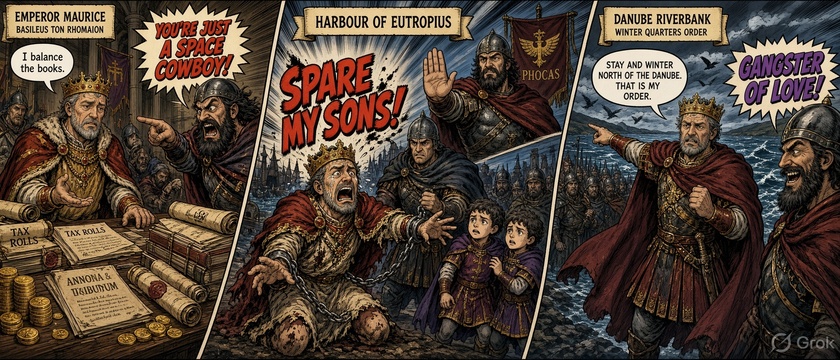
However, Maurice faced chronic financial strain and was austere to the point of unpopularity. He cut army pay, restricted booty, and refused to ransom thousands of captured soldiers (leading to their massacre by the Avars). In 602, he ordered the exhausted Balkan army to winter north of the Danube living off the land rather than returning to winter quarters. This final order sparked mutiny.
Earlier tensions had already surfaced: Phocas (a middle-ranking officer/centurion, probably from Thrace or Cappadocia) had been sent as a spokesman for the troops to complain about general Comentiolus and was publicly humiliated at court (his beard was pulled). Maurice’s perceived nepotism (favoring relatives) and failure to cultivate popularity in Constantinople further alienated both the army and the urban populace. Circus factions (especially the Greens) and food shortages had already produced unrest earlier in 602.
The Coup and the Execution (November 602)
In autumn 602 the Balkan army mutinied, first demanding to return inside the frontier. When refused, they raised Phocas on a shield in the traditional acclamation ritual and marched on Constantinople. Maurice had no reliable field army nearby. He tried to arm the circus factions and arrest the potential rival Germanus (father-in-law of his eldest son Theodosius), but this provoked riots. On the night of 22 November, Maurice, Empress Constantina, and their children fled by ship across the Bosporus toward Bithynia/Asia, seeking refuge near the shrine of St Autonomos.
Phocas was crowned emperor on 23 November by Patriarch Cyriacus in the church of St John the Baptist at the Hebdomon (outside the walls). He entered Constantinople on 25 November to popular acclamation, with no serious resistance.
Maurice and most of his family were captured. On 27 November (a Tuesday) at the Harbour of Eutropius near Chalcedon, Phocas’s men (notably Lilius) executed Maurice’s younger sons first while he was forced to watch. Maurice then recited “Thou art just, O Lord, and thy judgement is just” before being beheaded. Sources differ slightly on the exact number of sons present (five or six; the eldest, Theodosius, was recalled from Nicaea and killed nearby shortly afterward). Bodies were thrown into the sea; heads were displayed. Empress Constantina and their three daughters were initially spared and sent to a monastery.
After: Phocas, War with Persia, and Long-Term Consequences
Phocas (ruled 602–610) was a low-born military usurper deeply distrusted by the Constantinopolitan elite. He ruled tyrannically, executed potential rivals (including later Constantina, Germanus, and others around 605–606 after a conspiracy involving rumors that Theodosius had survived), and persecuted Miaphysites and Jews. He made peace with the Avars by increasing tribute so he could focus on the east, but this proved insufficient.
Khosrow II used Maurice’s murder as a pretext (claiming to avenge his benefactor and, in some accounts, supporting a pretender said to be Theodosius). The Byzantine–Sasanian War of 602–628 began almost immediately. Persian forces overran Mesopotamia (Dara, Amida, Edessa, etc.), reached deep into Anatolia, took Antioch, Damascus, and Jerusalem (614), and later Egypt. Both empires were devastated.
In 610, Heraclius (son of the Exarch of Africa) sailed to Constantinople, overthrew and executed Phocas, and eventually reversed the Persian gains in the 620s. The True Cross was restored to Jerusalem in 630, but both empires were exhausted. This weakness facilitated the rapid Arab-Muslim conquests that followed.
Significant Figures
- Maurice: Last Justinianic emperor; competent but unpopular austerity and military orders triggered the crisis.
- Phocas: Centurion-turned-usurper; spokesman for the mutinous troops who seized power and ordered the executions.
- Constantina: Maurice’s wife (daughter of Tiberius II); survived the initial massacre but was later executed.
- Theodosius: Eldest son and co-emperor (from 590); sent toward Persia for aid, recalled, and killed.
- Germanus: Influential figure and father-in-law of Theodosius; briefly considered as a possible alternative emperor before submitting to Phocas.
- Khosrow II (Khosrau II / Khusro): Sasanian king restored by Maurice in 591; launched the great war after 602 under the banner of avenging Maurice.
- Heraclius: Future emperor who ended Phocas’s reign in 610 and later recovered most lost territories from Persia.
- Lilius: Phocas’s associate who carried out the executions at Chalcedon.
- Supporting sources include Theophylact Simocatta, the Chronicon Paschale, and later chroniclers.
The event was remembered as an act of particular cruelty. It marked the first successful violent deposition of a Roman emperor in the East since the third century and is widely seen as the catalyst for the last great war of antiquity between Rome and Persia.
= November 27th
These events are all traditionally dated to or around 27 November (with some calendar variations), and each marks a notable political, military, religious, or cultural turning point.
AD 25 – Luoyang becomes capital of the Eastern Han
After the collapse of Wang Mang’s short-lived Xin dynasty, Liu Xiu (Emperor Guangwu) proclaimed himself emperor in AD 25 and established his capital at Luoyang, roughly 335 km east of the former Western Han capital of Chang’an. This decision marked the formal start of the Eastern (or Later) Han dynasty (AD 25–220). Guangwu spent the next decade consolidating power, defeating rival claimants and the Red Eyebrows peasant army, and largely reunifying China by AD 36. Choosing Luoyang signalled a deliberate break from the western capital and its associations with the previous regime while remaining in the Chinese heartland.
176 – Marcus Aurelius elevates Commodus
On 27 November 176, Marcus Aurelius granted his son Commodus the title Imperator and effectively made him supreme commander of the legions (and soon co-Augustus). Commodus, born “in the purple,” became the first biological son to succeed a long line of adoptive “Five Good Emperors.” The elevation was celebrated with a joint triumph later that year. It ended the practice of selecting capable adult heirs by adoption and placed a teenager on the path to sole rule. Commodus’s later reign (especially after 180) is widely remembered for extravagance, megalomania, and instability that marked the end of the high imperial peak.
395 – Murder of Rufinus
Flavius Rufinus, Praetorian Prefect of the East and the dominant figure at the court of the young Emperor Arcadius after Theodosius I’s death, was killed on 27 November 395 outside Constantinople. Gothic troops under Gainas (recently recalled from the west) cut him down during a formal reception of the returning army. Contemporary accounts describe him being hacked to pieces and his head paraded. The murder removed a powerful rival to the western general Stilicho and reflected the growing influence of Gothic federate forces inside the Eastern Roman political system.
511 – Death of Clovis I
King Clovis I of the Franks died at Lutetia (Paris) on or about 27 November 511 and was buried in the Abbey of St Genevieve (which he had founded). Clovis had united the Salian Franks, defeated the last Roman authority in northern Gaul (Syagrius), conquered much of Aquitaine from the Visigoths, and converted to Catholic Christianity—cementing an alliance with the Gallo-Roman population and the Church. His death led to the partition of the kingdom among his four sons, establishing the characteristic Merovingian pattern of divided rule that lasted until the mid-eighth century.
602 – Execution of Emperor Maurice
On 27 November 602 the Byzantine emperor Maurice was executed by the usurper Phocas at the Harbour of Eutropius near Chalcedon. Maurice was forced to watch his younger sons killed first; he was then beheaded. (Accounts vary slightly on the exact number of sons present.) The coup ended a capable if austere reign and immediately triggered a major war with Sassanid Persia under Khosrow II, who used the murder of his former patron as a pretext. The subsequent decades of conflict exhausted both empires and left them vulnerable to the later Arab conquests.
1095 – Urban II launches the First Crusade
At the Council of Clermont (17–27 November 1095), Pope Urban II delivered his famous appeal on 27 November, calling on Christian warriors to aid the Byzantine Empire against the Seljuk Turks and to liberate Jerusalem. The speech (preserved in several later accounts) promised spiritual rewards, including remission of sins for those who took the cross. The response was immediate and massive; the First Crusade (1096–1099) followed, culminating in the capture of Jerusalem and the establishment of the Crusader states. The council itself also dealt with church reform and the Truce of God, but the crusading call overshadowed everything else.
1703 – Destruction of the first Eddystone Lighthouse
Henry Winstanley’s pioneering wooden lighthouse on the Eddystone Rocks (southwest of Plymouth) was swept away during the Great Storm of 1703. The storm, one of the most destructive in British history, peaked around 27 November (Old Style; 8 December New Style). Winstanley himself was on the rock completing improvements and perished with the structure; no trace of him or his companions was found. The disaster demonstrated both the extreme exposure of the site and the limits of early timber construction on offshore rocks; later stone towers eventually solved the problem.
1727 – Foundation of the Jerusalem Church, Berlin
The foundation stone of the new Jerusalem Church (Jerusalemkirche) in Berlin’s Friedrichstadt (today Kreuzberg) was laid in the mid-1720s under King Frederick William I; the church was completed and consecrated in 1728 to designs by Philipp Gerlach. It replaced an earlier chapel and smaller church on the same site (first mentioned in 1484). The building served the growing Lutheran and Calvinist population of the expanding city. Later rebuilt and enlarged in the nineteenth century, it was destroyed in the Second World War; its ground plan is still marked in the pavement near the Axel Springer building.
Together the dates illustrate a long arc: the re-founding of a major Chinese dynasty, the shift from adoptive to hereditary succession in Rome, the violent politics of late antiquity, the birth of the Merovingian kingdom, a disastrous Byzantine coup, the launching of the Crusades, the limits of early engineering, and the steady expansion of early-modern Berlin.