



Jean-Sylvain Bailly guillotined moderate
Jean-Sylvain Bailly (15 September 1736 – 12 November 1793) was a leading figure of the early French Revolution who became one of its victims during the radical phase of the Reign of Terror.
Background and rise
Bailly was born in Paris and made his name as an astronomer and mathematician. He calculated an orbit for Halley’s Comet, studied Jupiter’s satellites, and was elected to the Académie des Sciences and the Académie française. He was also a freemason and moved in Enlightenment circles.
When the Estates-General met in 1789, he was elected a deputy for Paris from the Third Estate. He was chosen president of the Third Estate and, on 20 June 1789, led the famous Tennis Court Oath in which the deputies swore not to disperse until they had given France a constitution. After the fall of the Bastille, the electors of Paris chose him as the city’s first mayor (15 July 1789).
Key figures around him
- Marquis de Lafayette – Commander of the National Guard. Bailly and Lafayette worked closely in 1789–1791 to maintain order in Paris. Both were later blamed by radicals for the Champ de Mars events.
- Marie Antoinette – Bailly later refused to testify against her at her trial, which contributed to his downfall.
- Jean-Paul Marat – A persistent enemy. Marat’s newspaper L’Ami du Peuple repeatedly attacked Bailly and helped turn public opinion against him.
- Pierre-Simon Laplace – Fellow scientist and friend. Bailly was on his way to join Laplace at Melun when he was arrested in 1793.
- Maximilien Robespierre and the Committee of Public Safety – Dominant figures by the time of Bailly’s trial and execution, though Bailly was not a personal target of Robespierre in the same way as some other victims.
The turning point: Champ de Mars (17 July 1791)
After Louis XVI’s flight to Varennes, republicans organised a petition on the Champ de Mars demanding the king’s deposition. A crowd gathered; National Guard troops under Bailly’s authority (and Lafayette’s command) opened fire, killing dozens. The event destroyed Bailly’s popularity. He was denounced as a traitor to the people and the red flag of martial law he had used became a symbol of repression.
He resigned as mayor in November 1791 and retired from politics.
Arrest, trial, and execution (1793)
In July 1793, during the escalating Terror, Bailly left Nantes for Melun to stay with Laplace. He was recognised, arrested, and brought back to Paris. In October he was called as a witness at Marie Antoinette’s trial and defended her, refusing to give damaging testimony.
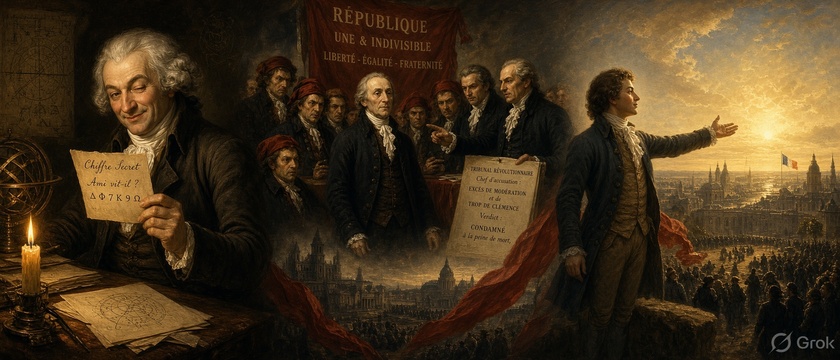
On 10 November 1793 he was brought before the Revolutionary Tribunal, quickly tried, and sentenced to death. The next day (sources vary between 11 and 12 November) he was taken to the Champ de Mars — the exact site of the 1791 massacre — for execution. Revolutionaries insisted on this symbolic location. The guillotine was set up in a ditch so that his blood would not mix with that of the earlier victims. The red flag of martial law was burned in front of him. While waiting in the cold rain he trembled; when a spectator mocked “You tremble, Bailly!”, he replied calmly, “My friend, it is only from the cold.”
He was guillotined amid shouts of “Vive la République!”
Aftermath
Bailly’s execution was part of the broader purge of moderate revolutionaries, former constitutional monarchists, and early leaders of 1789 who were now seen as insufficiently radical. The Terror continued to intensify through the spring of 1794 until the fall of Robespierre in July (Thermidor). After the Terror, Bailly was gradually rehabilitated in historical memory as an honest, if politically naïve, Enlightenment figure who had been destroyed by the revolution he had helped begin.
His scientific reputation survived; his political career is remembered mainly for the Tennis Court Oath, the mayoralty of Paris, and the tragic end on the Champ de Mars.
= November 12th
These are notable events associated with 11–12 November (sources sometimes differ by a day on exact dates for the medieval and early modern ones).
954 – Coronation of the young Lothair
The 13-year-old Lothair (Lothaire; sometimes numbered III or IV), eldest son of Louis IV and Gerberga of Saxony, was crowned king of the West Frankish Kingdom at the Abbey of Saint-Remi in Reims. He had succeeded his father on 10 September 954 (after Louis’s death) and was already associated with the throne from 951. Archbishop Artald of Reims performed the coronation. Lothair was the penultimate Carolingian king of West Francia; he reigned until his death in 986 and was buried at the same abbey.
1028 – Zoe becomes empress consort
Zoe Porphyrogenita (“born in the purple”), daughter of Constantine VIII, married the elderly Romanos Argyros (soon Romanos III) around 10 November. The next day Constantine died, and the couple took the throne, making Zoe empress consort. She was one of the few Byzantine women born to a reigning emperor. Her later career was turbulent: Romanos was found dead in his bath in 1034 (with persistent rumours of involvement by Zoe and her lover Michael); she married Michael the same day (he became Michael IV). She later shared power with her sister Theodora and with Constantine IX. Her portrait survives in the famous Hagia Sophia mosaic.
1330 – Battle of Posada
Basarab I, voivode of Wallachia, ambushed and decisively defeated the much larger Hungarian army of King Charles I (Charles Robert of Anjou) in a narrow mountain pass near the Transylvanian–Wallachian border (exact site still debated). The fighting ran roughly 9–12 November. The Hungarians, caught in difficult terrain, suffered heavy losses from arrows, stones, and hand-to-hand fighting; Charles barely escaped by swapping his royal robes for ordinary clothes. The victory secured Wallachia’s practical independence from Hungarian overlordship and is often treated as a foundational moment for the medieval Wallachian state.
1439 – Plymouth incorporated by Parliament
The market town of Sutton (later Plymouth) was incorporated as a borough and formally renamed Plymouth by Act of Parliament (18 Henry VI). It was the first English town incorporated by Parliament rather than by royal charter alone. The act amalgamated the manors of Sutton Prior, Sutton Vautort, and Sutton Ralf into one free borough with a mayor and perpetual community; a confirmatory royal charter followed in 1440. This gave the town greater autonomy from the Priory of Plympton and neighbouring lords.
1555 – Second Statute of Repeal
Under Queen Mary I (and her husband Philip of Spain), Parliament passed the Second Statute of Repeal (1 & 2 Ph. & M. c. 8, also known as the See of Rome Act). It repealed anti-papal legislation dating back to 1529 (the fall of Wolsey) and restored papal authority in England, building on the First Statute of Repeal (1553) that had undone Edward VI’s Protestant reforms. Crucially, it protected the lay owners of former monastic lands from the Dissolution. Royal assent came in January 1555; the relevant Parliament had opened in November 1554. Elizabeth I’s later Acts of Uniformity reversed the restoration of Rome.
1793 – Execution of Jean-Sylvain Bailly
Jean-Sylvain Bailly, astronomer, mathematician, and the first Mayor of Paris (1789–1791), was guillotined during the Reign of Terror. He had presided over the Tennis Court Oath and was a leading early revolutionary moderate. His popularity collapsed after the Champ de Mars massacre (July 1791), when troops under his authority fired on demonstrators. Arrested in 1793, he refused to testify against Marie Antoinette, was tried by the Revolutionary Tribunal, and executed on the Champ de Mars itself—the symbolic site of the earlier killings. The red flag of martial law was burned in front of him. When a spectator noted that he was trembling, he replied that it was only from the cold.
These span Carolingian succession, Byzantine dynastic politics, the assertion of Wallachian independence, English municipal development, the Marian Catholic restoration, and the radicalisation of the French Revolution.