


Modern states came into being
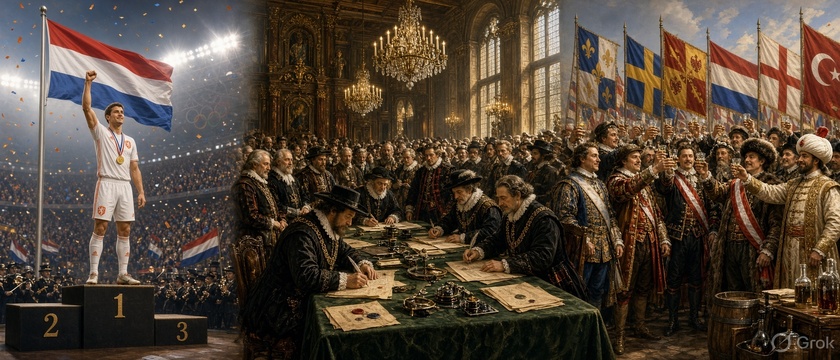
The Peace of Westphalia (24 October 1648) ended the Thirty Years’ War in the Holy Roman Empire and the related phase of the Eighty Years’ War between Spain and the Dutch Republic. It consisted primarily of the Treaty of Münster (between the Emperor and France and their allies) and the Treaty of Osnabrück (between the Emperor and Sweden and their allies), signed the same day in the Westphalian cities of Münster and Osnabrück. A separate Spanish–Dutch treaty had been signed earlier that year (30 January 1648).
Lead-up: The Thirty Years’ War
The war (1618–1648) began as a conflict within the Holy Roman Empire over religion and imperial authority and expanded into a broader European struggle involving dynastic, territorial, and balance-of-power motives.
It was triggered by the Defenestration of Prague (1618), when Protestant Bohemian nobles threw Habsburg officials out of a window in protest against efforts to reverse Protestant gains. This led to the election of the Calvinist Elector Frederick V of the Palatinate as King of Bohemia, which the Catholic Habsburg Emperor Ferdinand II suppressed with Spanish and Bavarian help (Battle of White Mountain, 1620). The war then drew in Denmark (1625–1629), Sweden under Gustavus Adolphus (from 1630; he was killed at Lützen in 1632), and finally Catholic France under Cardinal Richelieu (openly from 1635), which intervened to weaken the Habsburgs despite sharing their religion.
The conflict devastated large parts of Germany through fighting, famine, and disease. Population losses in the Empire are estimated in the millions (modern scholarship often places total deaths in the 4.5–8 million range across the war’s theatres). By the 1640s both sides were exhausted. Preliminary talks and a Franco-Swedish agreement in 1641 set the stage for a general congress; formal negotiations opened in Münster and Osnabrück in 1643–1644, with fighting continuing in parallel to improve bargaining positions. Emperor Ferdinand II had died in 1637; his son Ferdinand III (r. 1637–1657) faced a deteriorating military situation and was forced to negotiate seriously.
The Negotiations and Signing
Talks were complex and protracted. More than 100 delegations represented the Emperor, France, Sweden, Spain, the Dutch, numerous German princes and free cities, and others (England, Poland, Russia, and the Ottomans were not present). Catholic powers largely met in Münster; Protestant ones in Osnabrück. The papal nuncio Fabio Chigi (later Pope Alexander VII) and the Venetian envoy Alvise Contarini acted as mediators.
Key negotiators included:
- Imperial side: Count Maximilian von Trauttmansdorff (chief plenipotentiary, widely credited with driving the process to a conclusion), assisted by figures such as Johann Ludwig von Nassau-Hadamar and Isaak Volmar.
- France: Henri II d’Orléans, Duke of Longueville (nominal head), with Claude de Mesmes, Count d’Avaux, and Abel Servien as the principal diplomats.
- Sweden: Count Johan Oxenstierna (son of the Swedish chancellor Axel Oxenstierna) and Johan Adler Salvius.
- Spain: Gaspar de Bracamonte y Guzmán and others.
- Brandenburg and other German states sent their own envoys; Johann von Sayn-Wittgenstein was prominent among the Protestants.
The treaties were signed on 24 October 1648.
Results and Terms
The settlement combined territorial adjustments, religious arrangements, and constitutional changes within the Empire:
- Territorial gains: Sweden received Western Pomerania (including Stettin), Wismar, and the secularized bishoprics of Bremen and Verden, giving it control of key Baltic and North Sea river mouths and a seat in the Imperial Diet. France gained the Décapole cities in Alsace (with exceptions) and confirmation of Metz, Toul, and Verdun, strengthening its Rhine frontier. Brandenburg obtained Eastern Pomerania and several secularized bishoprics (and the reversion of Magdeburg). Bavaria kept the Upper Palatinate and its electoral title; the Rhenish Palatinate was restored to Frederick V’s son Charles Louis with a new (eighth) electoral vote.
- Religious settlement: The Peace of Augsburg (1555) was reaffirmed and extended. The principle of cuius regio, eius religio continued, but Calvinism was now recognized alongside Catholicism and Lutheranism. The normal year for determining religious possession was set at 1 January 1624. Forced emigration was restricted, and confessional parity was introduced in certain Imperial institutions.
- Independence and sovereignty: The Dutch Republic’s independence from Spain was confirmed, ending the Eighty Years’ War. The Swiss Confederation’s independence from the Empire was recognized. The Imperial estates (German princes and free cities) received greater autonomy, including the right to form alliances (with limits) and more control over their internal affairs; the Emperor’s ability to act unilaterally in the Empire was curtailed.
- Other: Amnesties, restitution rules, and demobilization arrangements were included. France and Sweden became guarantors of the Imperial constitution.
France and Spain continued fighting until the Peace of the Pyrenees (1659). The war’s demographic and economic costs in Germany were severe, though modern estimates are lower than older claims of near-total ruin.
Significance and Legacy
The Peace is traditionally viewed as a landmark in the development of the modern European state system—emphasizing the sovereignty of territorial states, the principle of non-interference in internal affairs, and a shift away from religiously defined universal authority toward a balance-of-power order. Within the Empire it confirmed the fragmentation of authority among hundreds of semi-sovereign entities, limiting Habsburg centralization. Historians debate the precise extent of the “Westphalian system” as a clean break, but the treaties remain a foundational reference point in the history of international relations.
The settlement closed one of the most destructive conflicts in European history and redrew the map of Central Europe for the remainder of the early modern period.
= October 24th
These are all events associated with October 24 in various years.
AD 69 – Second Battle of Bedriacum (also called the Second Battle of Cremona)
During the Year of the Four Emperors, forces loyal to Vespasian (led by Marcus Antonius Primus, commanding Danube/Pannonian and Moesian legions including Legio III Gallica, VII Galbiana, VII Claudia, VIII Augusta, and XIII Gemina) defeated the forces of Emperor Vitellius near Bedriacum (modern Calvatone) in northern Italy, between Bedriacum and Cremona.
Vitellius had sent Aulus Caecina Alienus with a strong army (including XXI Rapax, V Alaudae, I Italica, XXII Primigenia and others), but Caecina’s attempted defection left the Vitellians effectively leaderless. Fighting began on 24 October with a cavalry clash; the main battle raged through the night. At dawn, the III Gallica (which had served in the East) saluted the rising sun in their adopted custom; the Vitellians mistook this for the arrival of eastern reinforcements and broke. The Flavian victory opened the way to Cremona (which was stormed and sacked) and ultimately to Rome, where Vitellius was soon killed. Vespasian became undisputed emperor.
1260 – Dedication of Chartres Cathedral
The Gothic Cathedral of Our Lady of Chartres (Notre-Dame de Chartres) in France was dedicated in the presence of King Louis IX (Saint Louis). The cathedral had been rebuilt after a major fire in 1194 that destroyed most of the previous Romanesque structure (though the west front, Royal Portal, and crypt survived). Construction of the High Gothic building proceeded rapidly; the main fabric was largely complete within about 30 years. It is renowned for its architecture, sculpture, and nearly complete ensemble of 12th- and 13th-century stained glass, and it has been a UNESCO World Heritage Site since 1979.
1360 – Treaty of Brétigny (Treaty of Calais) ratified
The Treaty of Brétigny (drafted 8 May 1360 near Chartres) was ratified at Calais on 24 October 1360 between Edward III of England and John II of France. It ended the first phase of the Hundred Years’ War. Edward renounced his claim to the French throne in exchange for large territories in southwestern France (Aquitaine/Guyenne and associated regions) held in full sovereignty, plus a massive ransom for the captive John II. France later repudiated the treaty under Charles V, and the war resumed.
1590 – John White returns from Roanoke
John White, governor of the second Roanoke Colony (the “Lost Colony”), returned to England (Plymouth) on 24 October after an unsuccessful search. He had left the colonists in 1587 and was delayed by the Spanish Armada crisis. Arriving at Roanoke on 18 August 1590 (his granddaughter Virginia Dare’s third birthday), he found the settlement abandoned. The only clues were “CRO” carved on a tree and “CROATOAN” on a palisade post—indicating, in White’s view, that the settlers had moved to Croatoan (likely modern Hatteras Island) to join the friendly Croatoan people. Bad weather prevented further search, and the fate of the colonists remains a mystery.
1605 – Accession/Coronation of Jahangir
Nur-ud-Din Muhammad Salim, eldest son of Emperor Akbar, ascended the Mughal throne in Agra as Emperor Jahangir (“Conqueror of the World”) after his father’s death. Contemporary sources, including Jahangir’s own memoirs, place the accession around 24 October 1605 (some modern lists give 3 or 24 November depending on calendar conventions). He ruled until 1627 and is noted for his patronage of the arts (especially miniature painting), his memoirs (Jahangirnama), and the cultural flourishing of the Mughal court, despite later political intrigues and his son Khusrau’s rebellion.
1641 – Proclamation of Dungannon
Sir Phelim (Felim) O’Neill of Kinard, a leader of the Irish Rebellion that had begun the previous day, issued the Proclamation of Dungannon. It justified the uprising as a defense of the rights and liberty of the native Irish and of Catholics, while declaring continued loyalty to King Charles I and denying any intent to harm the king or his English and Scottish subjects. O’Neill claimed (falsely, according to later historical consensus) to hold a royal commission authorizing the action against Protestant opponents of the king. The proclamation helped frame the rebellion politically and contributed to its spread into the Irish Confederate Wars.
1648 – Peace of Westphalia signed
The Peace of Westphalia (Treaties of Münster and Osnabrück) was signed on 24 October 1648, ending the Thirty Years’ War (1618–1648) in the Holy Roman Empire and the related phase of the Eighty Years’ War between Spain and the Dutch. Negotiated in the Westphalian cities of Münster and Osnabrück, the settlements involved the Holy Roman Emperor, German princes, France, Sweden, and others. Key outcomes included territorial adjustments, recognition of the independence of the Dutch Republic and Swiss Confederation, and greater autonomy for the states of the Empire (including religious rights under an expanded cuius regio, eius religio principle). It is often cited as a foundational moment in the development of the modern system of sovereign states.
1795 – Third Partition of Poland
Representatives of Austria, Prussia, and Russia agreed on 24 October 1795 to the Third Partition of the Polish–Lithuanian Commonwealth, completely erasing the remaining independent Polish state. This followed the suppression of the Kościuszko Uprising (1794). Russia, Prussia, and Austria divided the residual territory (roughly: Russia took eastern Lithuania and other areas; Prussia gained Warsaw and surrounding districts; Austria received western Galicia and southern Masovia). King Stanisław August Poniatowski was forced to abdicate. Poland did not regain full independence until 1918.
These events span Roman civil war, medieval cathedral building and diplomacy, early English colonization, Mughal succession, the Irish Rebellion, the end of the Thirty Years’ War, and the final erasure of the Polish–Lithuanian Commonwealth.