


Birth of Amsterdam
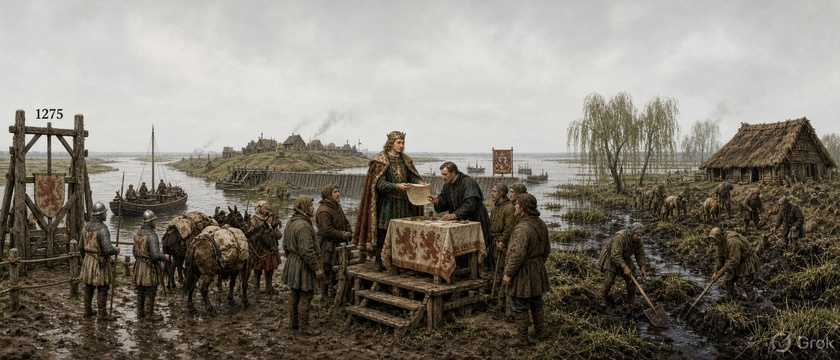
The traditional founding of Amsterdam dates to 27 October 1275, when Count Floris V of Holland issued a toll privilege (the earliest surviving document naming the place) to the people living at the dam in the Amstel River (homines manentes apud Amestelledamme). This granted them exemption from tolls on their own goods throughout his territory. The settlement and dam already existed; the document is the first written reference and is celebrated as the city’s anniversary (Amsterdam marked 750 years in 2025).
Before 1275: From peatland to settlement
The area around the mouth of the Amstel (a river flowing into the IJ estuary, connected to the Zuiderzee) was low-lying peat and marsh, subject to flooding. From roughly the 11th century, people reclaimed land under the authority of the Bishop of Utrecht (the Sticht), building dikes and draining peat. Major storm surges, especially the All Saints’ Flood of 1170, opened the area more fully to the sea and reshaped the landscape, making permanent settlement feasible while also necessitating stronger defenses.
By around 1200, a ribbon-like settlement of farmers, fishermen, craftsmen, and traders had formed along dikes on both banks of the Amstel (roughly the later Nieuwendijk, Warmoesstraat, and Zeedijk areas). A wooden chapel (predecessor of the Oude Kerk) appeared early. Around the 1260s (often dated c. 1260–1270), residents built a dam across the Amstel near its mouth. This was a significant engineering work: a clay-and-earth structure roughly 140 meters long, 25 meters wide, and about 2.5 meters high, with a sluice. It connected the two banks, controlled water (separating fresh river water from tidal/brackish IJ water), created a natural harbor for transferring cargo from larger seagoing ships (koggen) to smaller inland vessels, and provided a central gathering place. The settlement was still small—estimates range from a few hundred to around 500–1,000 people—and fell under the Bishop of Utrecht, administered locally by the Lords of Amstel (a family based around Ouderkerk aan de Amstel). It was not yet a formal city.
The 1275 toll privilege and its context
The document was drawn up in Leiden on Sunday, 27 October 1275 (the Sunday before the feast of Saints Simon and Jude), by Hendrick Allardsz of Middelburg, a clerk in the service of Floris V (likely trained at Egmond Abbey and linked to Middelburg). In Latin, Floris declared that, in compensation for damage done by him and his men to the people living near Amestelledamme, they would henceforth be exempt from his toll when transporting their own goods throughout his lands (roughly modern North and South Holland and parts of Zeeland).
This was not pure generosity or a formal grant of city rights. The area still belonged to the Bishopric of Utrecht, not the County of Holland. Floris was expanding his power against the bishop and local lords such as the Van Amstels. His troops had recently caused damage in the settlement; the privilege was partly compensation and partly a political move to win the loyalty of the inhabitants, encourage trade through Holland, and draw the Amstel area into his sphere of influence. Similar privileges were granted to other places. It gave Amsterdam traders a practical commercial advantage without making the place a free city or transferring sovereignty.
Significant figures
- Floris V (1254–1296): Count of Holland and Zeeland from 1256 (effectively ruling after reaching majority in 1266). Son of William II (King of the Romans). He expanded Holland significantly (including against the West Frisians), promoted trade, and was known as “der keerlen God” (God of the common people) for his relative popularity with peasants and townsfolk versus some nobles. He issued the 1275 privilege. In 1296 he was kidnapped during a falcon hunt by discontented nobles (including Gijsbrecht IV van Amstel, Herman van Woerden, and Gerard van Velsen), held at Muiderslot, and murdered (stabbed multiple times by van Velsen) near Muiderberg when local people tried to free him. The plot involved international intrigue linked to his shifting alliances between England and France. He is a major figure in Dutch medieval history and literature.
- The Lords of Amstel (especially Gijsbrecht IV van Amstel, c. 1230/1235–c. 1303): Local rulers of Amstelland under the Bishop of Utrecht. They sought greater independence between Utrecht and Holland. Gijsbrecht IV opposed Floris, participated in the 1296 conspiracy, lost his lands, and went into exile. His family is immortalized in Joost van den Vondel’s 17th-century play Gijsbrecht van Aemstel (set around the 1304 siege of Amsterdam), which became a long-running Amsterdam theatrical tradition.
- Hendrick Allardsz of Middelburg: The clerk who wrote the privilege document.
- Later: Guy (Gwijde) of Avesnes: Brother of John II of Holland; Bishop of Utrecht from 1301. He held Amstelland (including the settlement) and is credited with granting or confirming urban rights/charters to Amsterdam around 1300–1306.
After 1275: From settlement to city
The privilege helped trade and gradual growth. By around 1300 the population was roughly 1,000. Formal municipal/city rights (rights to markets, local justice, fortification, etc.) came later, traditionally around 1300 or 1306, associated with Guy of Avesnes (while he controlled the area before or as bishop). Amsterdam remained under shifting authority: after Floris’s murder and the fall of the Van Amstels, it passed more firmly into the Holland orbit. Further privileges followed (e.g., a beer staple right in 1323 that boosted its role as a market). By the mid-14th century it was a recognized poorte (town) with growing trade, especially in Baltic grain and other goods. Major floods (including the St. Lucia’s Flood of 1287, which enlarged the Zuiderzee) continued to shape the landscape and opportunities.
The 1275 document was carefully preserved for centuries (in a charter chest in the Oude Kerk, later in the city archives). It is still displayed briefly each year around 27 October. While not a true “founding charter” in the modern sense—settlement predated it, and full city status came decades later—it is the practical starting point for Amsterdam’s documented history and the basis of its traditional birthday celebration. The dam site is today’s Dam Square; the early harbor is the Damrak area.
= October 27th
These are events traditionally associated with October 27.
312 – Constantine the Great’s Vision of the Cross
Roman emperor Constantine is said to have received a vision of a cross (or Chi-Rho symbol) in the sky, often accompanied by the words in hoc signo vinces (“in this sign you will conquer”). Sources differ: Lactantius describes a dream instructing him to mark shields with the Christian monogram, while Eusebius (writing later) reports a public midday vision of a cross of light above the sun, followed by a dream of Christ. Popular accounts place this on the eve of the Battle of the Milvian Bridge (October 28, 312), in which Constantine defeated his rival Maxentius near Rome. The victory made him sole Western emperor and is linked to his increasing favor toward Christianity (culminating later in the Edict of Milan). The precise details and timing remain debated among historians, as the main accounts are not fully independent or contemporaneous.
710 – Saracen invasion of Sardinia
Arab/Muslim (often called Saracen in European sources) forces conducted raids on the Byzantine-controlled island of Sardinia around this time, part of broader early Islamic expansion in the western Mediterranean after the conquest of North Africa and coinciding with the invasion of Iberia. Sources record multiple early raids (from roughly 705–711 onward), involving coastal attacks, pillaging, and captives; some mention large numbers of prisoners taken across several islands. These did not result in permanent occupation of Sardinia, which remained outside lasting Muslim control unlike nearby Sicily or parts of the Iberian Peninsula. Exact details for a single 710 invasion are sparse in surviving chronicles.
939 – Death of Æthelstan and succession of Edmund I
Æthelstan (also Athelstan), widely regarded as the first king of a unified England, died on October 27, 939 (probably at Gloucester), at about age 45. He had ruled as king of the Anglo-Saxons from 924 and of the English from 927, after conquering the Viking kingdom of York. His major victory at Brunanburh (937) against a coalition of Scots, Strathclyde Britons, and Dublin Vikings secured his reputation. Childless, he was succeeded by his half-brother Edmund I (then about 18), who faced renewed Viking challenges in the north but eventually recovered control. Æthelstan was buried at Malmesbury Abbey.
1275 – Traditional founding of Amsterdam
On October 27, 1275, Count Floris V of Holland issued a toll privilege (the earliest surviving document naming the place) granting the people living at the dam in the Amstel River (homines manentes apud Amestelledamme) exemption from tolls on their own goods throughout his territory. A settlement and dam already existed by then (the dam itself dated to roughly the 1260s, connecting earlier riverside habitation after floods); the document marks the first written reference and is treated as the traditional founding date of the city that grew into a major trading port. Amsterdam celebrates this anniversary.
1524 – French siege of Pavia begins (Italian Wars)
King Francis I of France led an army (roughly 26,000–40,000 men, including Swiss and other mercenaries) into northern Italy and invested Pavia, then held by an Imperial garrison under Antonio de Leyva for Charles V. The siege began in late October 1524 (accounts vary slightly on the exact day, often given as October 27/28) and lasted through the winter. French assaults and bombardment failed to take the city quickly. An Imperial relief force later attacked, leading to the decisive Battle of Pavia on February 24, 1525, in which Francis was captured. This was a major setback for French ambitions in Italy.
1553 – Michael Servetus burned at the stake
The Spanish physician and theologian Michael Servetus (Miguel Serveto) was executed by burning just outside Geneva at Champel. He had been condemned for heresy, primarily for rejecting the orthodox doctrine of the Trinity and opposing infant baptism in works such as Christianismi Restitutio. After escaping Catholic authorities in Vienne (who burned him in effigy), he was arrested in Geneva. John Calvin played a prominent role in the proceedings and sought a milder execution (beheading), but the council ordered burning; Servetus went to the stake with a copy of his book chained to him. The case became a lasting point of controversy over religious tolerance among Protestants.
1644 – Second Battle of Newbury
During the First English Civil War, Royalist forces under King Charles I fought an indecisive battle against combined Parliamentarian armies (under the Earl of Manchester, Sir William Waller, and others, with the Earl of Essex ill) near Newbury/Speen in Berkshire. Parliament had a substantial numerical advantage (roughly 17,000–19,000 vs. about 8,500–10,000). A planned pincer attack was poorly coordinated; Royalist positions held, and Charles withdrew toward Oxford overnight. The failure to destroy the smaller Royalist army contributed to later Parliamentarian military reforms, including the creation of the New Model Army.
1682 – Philadelphia established
William Penn (English Quaker) founded the city of Philadelphia in the proprietary colony of Pennsylvania, granted to him by Charles II in 1681. Penn’s ship reached the Delaware area around October 27–28, 1682; he had already sent commissioners to lay out a grid-planned “greene country towne” (City of Brotherly Love) between the Delaware and Schuylkill rivers, emphasizing religious tolerance and orderly settlement. It grew rapidly into a major colonial port and later the temporary U.S. capital.
1795 – Treaty of Madrid (Pinckney’s Treaty / Treaty of San Lorenzo)
The United States and Spain signed the Treaty of Friendship, Limits, and Navigation at San Lorenzo el Real. Negotiated for the U.S. by Thomas Pinckney and for Spain by Manuel de Godoy, it fixed the southern U.S. boundary with Spanish Florida at the 31st parallel, recognized the Mississippi River as the western boundary, and granted Americans free navigation of the Mississippi plus the right of deposit at New Orleans. This resolved long-standing disputes and opened western trade routes. It was later ratified by both sides and proclaimed in 1796.
These events span Roman imperial transition and the spread of Christianity, early medieval raids and English state formation, urban foundations, the Italian Wars, Reformation religious conflict, the English Civil War, colonial American settlement, and early U.S. diplomacy. Sources for the earliest entries (especially 312 and 710) are limited or later, so details can vary by account.