



War of Jenkin's Ear
“Rule, Britannia!”, Admiral Edward Vernon, and the word “grog” are closely linked through the early years of the War of Jenkins’ Ear and the Royal Navy of the 1740s.
Rule, Britannia!
“Rule, Britannia!” began as a poem by the Scottish writer James Thomson (with contributions associated with David Mallet), set to music by the English composer Thomas Arne. It was the finale of Arne’s 1740 masque Alfred, about the Anglo-Saxon king Alfred the Great.
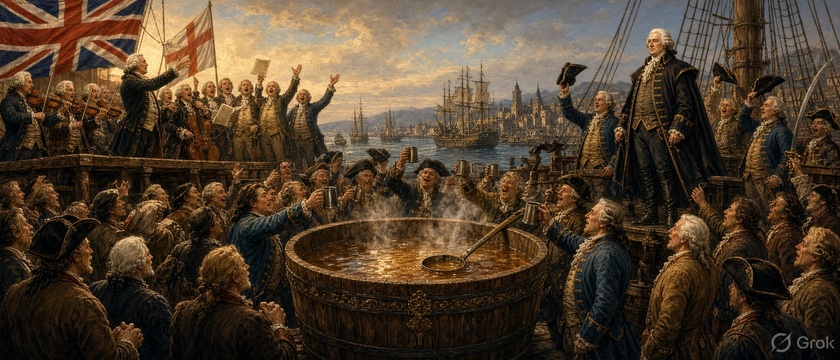
The first performance took place on 1 August 1740 at Cliveden, the country home of Frederick, Prince of Wales. The masque celebrated the anniversary of George I’s accession and the birthday of Princess Augusta, while also reflecting the political atmosphere of the time. Frederick and the “Patriot” opposition to Robert Walpole’s ministry used Alfred’s victories over the Danes as a parallel for contemporary British naval strength and resistance to foreign tyranny. Vernon’s recent capture of Porto Bello (November 1739) was still fresh in public memory and fitted the patriotic mood; some accounts note that the song was later sung at celebrations honouring Vernon.
The famous refrain—“Rule, Britannia! rule the waves; Britons never, never, never will be slaves”—expresses the idea of Britain as a free maritime power that would not submit to foreign rule. It quickly took on a life of its own beyond the masque, becoming a popular patriotic anthem strongly associated with the Royal Navy. It is still performed at events such as the Last Night of the Proms. (Note that the lyrics refer primarily to political or national “slavery” under foreign domination rather than the Atlantic slave trade, though the song later became entangled in broader debates about empire.)
Edward Vernon (“Old Grog”)
Edward Vernon (1684–1757) was a Royal Navy officer best known for his command during the War of Jenkins’ Ear. In November 1739 he led a small squadron that captured the Spanish port of Porto Bello (in present-day Panama) in about a day. The victory made him a national hero; medals were struck in his honour, places were named Portobello after it, and he became a symbol of aggressive naval action against Spain.
He later commanded the much larger expedition against Cartagena de Indias in 1741, which ended in costly failure due to disease, logistical problems, and friction with the army commander. Lawrence Washington (George Washington’s half-brother) served under him and later renamed the family estate Mount Vernon in his honour.
Vernon’s other lasting mark came from his clothing and an order he issued in 1740. He habitually wore a boat-cloak made of grogram (from French gros grain, a coarse, stiff fabric of silk, mohair, or wool, often waterproofed). Sailors nicknamed him “Old Grog” or “Old Grogram.”
Etymology of “grog”
In August 1740, while commanding in the West Indies, Vernon ordered that the sailors’ daily rum ration (then half a pint of neat spirits) be diluted with water—typically four parts water to one of rum—and issued in two servings rather than all at once. The aim was to reduce drunkenness, accidents, and discipline problems; sugar and sometimes citrus were sometimes added to make it more palatable. The watered-down rum was soon called grog, after Vernon’s nickname.
The practice became standard in the Royal Navy (formalised later and continuing, in reduced form, until the “tot” ended in 1970). “Grog” later broadened in popular use to mean any strong drink, and “groggy” came to describe the unsteady state produced by alcohol (and, by extension, any dazed or shaky condition).
In short: Vernon’s Porto Bello success helped fuel the patriotic atmosphere in which “Rule, Britannia!” appeared in 1740; his grogram cloak gave him the nickname that was transferred to the diluted rum he introduced the same year; and both the song and the drink became enduring parts of British naval and popular culture.
=
The War of Jenkins’ Ear (1739–1748) was an Anglo-Spanish colonial conflict driven by commercial rivalry in the Caribbean and Spanish America. It began under intense domestic pressure on Prime Minister Robert Walpole and largely merged into the wider War of the Austrian Succession. Fighting concentrated in the West Indies, with limited action on the Georgia–Florida border; the outcome was essentially a return to the pre-war status quo.
Lead-up and causes
Tensions had built for decades after the 1713 Treaty of Utrecht. Britain held the asiento (the monopoly on supplying enslaved Africans to Spanish colonies) and the limited right to send one annual “permission ship” of goods, but British merchants also engaged extensively in illicit trade. Spanish guarda costas (coast-guard vessels) regularly searched British ships for contraband, sometimes harshly.
The symbolic flashpoint occurred on 9 April 1731, when Spanish sailors boarded Captain Robert Jenkins’s brig Rebecca near Havana. Jenkins later claimed they cut off part of his ear; the incident received little immediate attention. By the later 1730s, Spanish enforcement tightened, merchant complaints multiplied, and the opposition (Tories and elements of the City of London trading interests) used the episode and similar depredations to attack Walpole’s long Whig ministry as weak on commerce and national honour.
Jenkins was called to testify before the House of Commons in March 1738 and is said to have produced the ear (preserved in a jar). Public and parliamentary agitation grew. Walpole, a consistent advocate of peace who preferred commercial profits to the costs of war, sought a negotiated settlement. The Convention of the Pardo (early 1739) offered Britain compensation for seized ships while requiring payment of outstanding duties linked to the asiento. It proved deeply unpopular in Britain and was only narrowly approved by the Commons. Both sides then violated its terms; Spain suspended the asiento. Under mounting pressure from merchants, public opinion, parliamentary opposition, and a divided ministry, Walpole’s government moved to war in October 1739 (formal declaration and hostilities crystallising around 19–23 October).
Course of the war and results
Britain’s main effort was naval and amphibious operations in the Caribbean aimed at Spanish ports and the silver trade.
- Porto Bello (November 1739): Vice Admiral Edward Vernon captured the lightly defended Panamanian port with six ships of the line in about a day. The British destroyed fortifications and facilities before withdrawing. The victory made Vernon a national hero, prompted medals, place-names (including Portobello Road in London), and was linked to the public debut of “Rule, Britannia.”
- Cartagena de Indias (March–May 1741): The war’s largest operation. Vernon commanded a huge expedition (scores of ships and tens of thousands of men, including American colonial troops). Spanish forces under Blas de Lezo, using strong fortifications and exploiting British command friction (especially between Vernon and the army commander) plus tropical disease, repelled the assault. British losses were catastrophic—many thousands dead, mostly from disease—and the expedition withdrew. This was the decisive check on British ambitions.
Other actions included minor engagements in Spanish Florida/Georgia (notably James Oglethorpe’s defence of Georgia and the Battle of Bloody Marsh in 1742), privateering, and Commodore George Anson’s circumnavigation and capture of a Spanish treasure galleon. After the Cartagena failure, major Caribbean offensives largely ceased. From 1740–44 the conflict was absorbed into the War of the Austrian Succession (and its North American counterpart, King George’s War). Formal hostilities between Britain and Spain ended with the 1748 Treaty of Aix-la-Chapelle, which restored the status quo ante bellum in the Americas. Underlying trade grievances were later settled by the 1750 Treaty of Madrid, in which Britain renounced the asiento for a cash payment.
The war achieved little lasting territorial or commercial gain for Britain. It damaged Walpole politically (he resigned in 1742) and illustrated the high cost of Caribbean expeditions in the age of sail and disease. Spain successfully defended its American possessions.
Significant figures
- Robert Walpole (Britain’s leading minister 1721–1742): Reluctantly authorised war under domestic and commercial pressure; his ministry was weakened by the conflict and the Cartagena disaster.
- Edward Vernon (“Old Grog”): Naval commander of the successful Porto Bello raid and the failed Cartagena expedition; a popular hero whose name entered naval lore (and whose grog ration influenced the term “grog”).
- Blas de Lezo: Spanish admiral and defender of Cartagena; severely disabled yet highly effective in the 1741 victory.
- Robert Jenkins: Merchant captain whose 1731 ear injury became the war’s memorable (if secondary) symbol when publicised in 1738.
- James Oglethorpe: Founder of Georgia; led colonial forces that helped secure the Georgia–Florida border against Spanish attack.
- George Anson: Led a Pacific squadron that circumnavigated the globe and captured the Manila galleon, one of the war’s more profitable British successes.
In short, a commercial and prestige dispute that the public and opposition turned into war produced one celebrated naval raid, a costly strategic failure at Cartagena, limited border fighting in North America, and no major permanent changes—while contributing to the end of Walpole’s long dominance and being subsumed into a larger European conflict.
= October 23rd
These are notable events clustered around 21–23 October across centuries (many sources pin the precise day as 23 October). Here is a concise overview of each, with context and significance.
42 BC – Second Battle of Philippi (Liberators’ civil war): Mark Antony and Octavian (of the Second Triumvirate) decisively defeated the remaining army of Brutus after an earlier inconclusive clash on 3 October in which Cassius had already committed suicide. On 23 October Brutus was pressured into fighting again; his forces were broken, he took his own life, and the Republican cause against Caesar’s heirs collapsed. This left the triumvirs dominant and paved the way for the end of the Roman Republic and the rise of the Empire under Octavian (later Augustus).
425 – Elevation of Valentinian III: The six-year-old son of Constantius III and Galla Placidia was installed as Western Roman emperor (Augustus) in Rome on 23 October after the defeat of the usurper Joannes. He reigned until his assassination in 455, but real power rested with regents (notably his mother and later the general Aetius). His long minority and reign coincided with major losses of territory to barbarian groups, including the Vandals in Africa.
501/502 – Synodus Palmaris (Palm Synod): Called under the influence of the Ostrogothic king Theoderic the Great, this session of a Roman synod (held around 23 October) discharged Pope Symmachus of accusations brought by supporters of the antipope Laurentius. The bishops declared they could not judge the pope (leaving the matter to God), restored him fully to office and church property, and effectively ended the schism that had begun with the dual election of 498. It reinforced the principle that the Roman See was not subject to trial by other bishops.
1086 – Battle of Sagrajas (Zallaqa/Zalaca): Near Badajoz, the Almoravid forces under Yusuf ibn Tashfin, reinforced by taifa Muslim allies, crushed the army of Alfonso VI of Castile-León. The battlefield became known as “the slippery place” from the bloodshed. The defeat checked Christian advances after the recent capture of Toledo, brought Almoravid power into al-Andalus, and temporarily stabilized Muslim rule in Iberia during the Reconquista.
1157 – Battle of Grathe Heath: In Jutland this short but decisive fight ended the Danish civil war among claimants Sweyn III, Canute V, and Valdemar I. Valdemar’s forces routed Sweyn’s; Sweyn fled into swampy ground and was killed (by tradition with an axe by peasants). Valdemar I the Great emerged as sole king and began consolidating the realm.
1295 – Auld Alliance treaty: Signed in Paris on 23 October between representatives of John Balliol of Scotland and Philip IV of France. It was a mutual-defence pact against England: if either was attacked by the English, the other would invade English territory. Ratified later in Scotland, it became the foundation of the long-running Franco-Scottish alliance (renewed repeatedly) that shaped relations through the Wars of Scottish Independence, the Hundred Years’ War, and beyond until the 16th century.
1641 – Irish Catholic gentry attempt on Dublin Castle: Ulster and other Catholic gentry (including figures linked to Phelim O’Neill, Rory O’More, and Conor Maguire) planned a coordinated coup for 23 October to seize Dublin Castle and other strongpoints, force concessions on religion and land, and forestall possible English/Scottish action. The Dublin plot was betrayed (notably by Owen O’Connolly); the castle was not taken, but the rising erupted successfully across much of Ulster and spread, igniting the 1641 Rebellion and the broader Irish Confederate Wars within the Wars of the Three Kingdoms.
1642 – Battle of Edgehill: The first major pitched battle of the First English Civil War, fought on 23 October in Warwickshire between the Royalist army under Charles I and the Parliamentarian forces under the Earl of Essex. It was bloody and inconclusive (neither side achieved a clear strategic victory), but it demonstrated that the conflict had moved beyond political crisis into open war and set the pattern for further campaigns.
1690 (listed as 1694) – Sir William Phips fails at Quebec: In October 1690, during King William’s War, New England colonial forces under Sir William Phips attempted to capture Quebec from the French under Governor Frontenac. After a failed or limited landing, bombardment, and skirmishes (including the death of a key French commander), Phips withdrew in late October amid disease, weather, and supply problems. The expedition failed, and Quebec remained French. (Phips later became governor of Massachusetts and is also linked to the Salem witch trials; he died in 1695.)
1707 – First Parliament of Great Britain: Following the Acts of Union that created the Kingdom of Great Britain (effective 1 May 1707), the first united Parliament met at Westminster on 23 October. It incorporated existing English members plus Scottish representatives; John Smith was chosen Speaker of the Commons. This institutionalised the political union of England and Scotland under Queen Anne.
1739 – War of Jenkins’ Ear begins: Prime Minister Robert Walpole’s government, under intense public and parliamentary pressure over Spanish actions against British shipping in the Caribbean (highlighted by the earlier seizure of Captain Robert Jenkins’ ear), formally moved toward war with Spain. Hostilities and declarations crystallised in October 1739 (with naval actions beginning around then and formal parliamentary ratification around 23 October). The conflict, fought mainly in the Caribbean and related theatres, merged into the wider War of the Austrian Succession.
1812 – Malet conspiracy against Napoleon: On the night of 22–23 October, while Napoleon was deep in the disastrous Russian campaign, General Claude François de Malet (a republican opponent) escaped custody, forged documents announcing the emperor’s death, and briefly seized control of parts of Paris and the National Guard. He released other conspirators, arrested some officials, and proclaimed a provisional government before being stopped. The plot collapsed within hours; Malet and key accomplices were tried and executed. It shocked Napoleon and underscored the regime’s dependence on his personal presence.
These episodes range from the final destruction of Republican resistance in Rome, through medieval dynastic and reconquest battles, early-modern coups and civil wars, colonial expeditions, the birth of the British parliamentary union, imperial rivalries, and a near-miss Napoleonic coup. Several (Philippi, Edgehill, the Irish rising, Grathe Heath, Sagrajas) were turning-point military or political moments; others consolidated institutions or alliances that lasted for generations. Dates in pre-modern sources can vary slightly by calendar or tradition, which is why lists often cluster them around 21–23 October.