VoiceDDB
Politics • Culture • News
The Echo of Haymarket: How Emma Goldman and Leon Czolgosz Still Haunt Us
How many die by journalism?
May 09, 2026
post photo preview

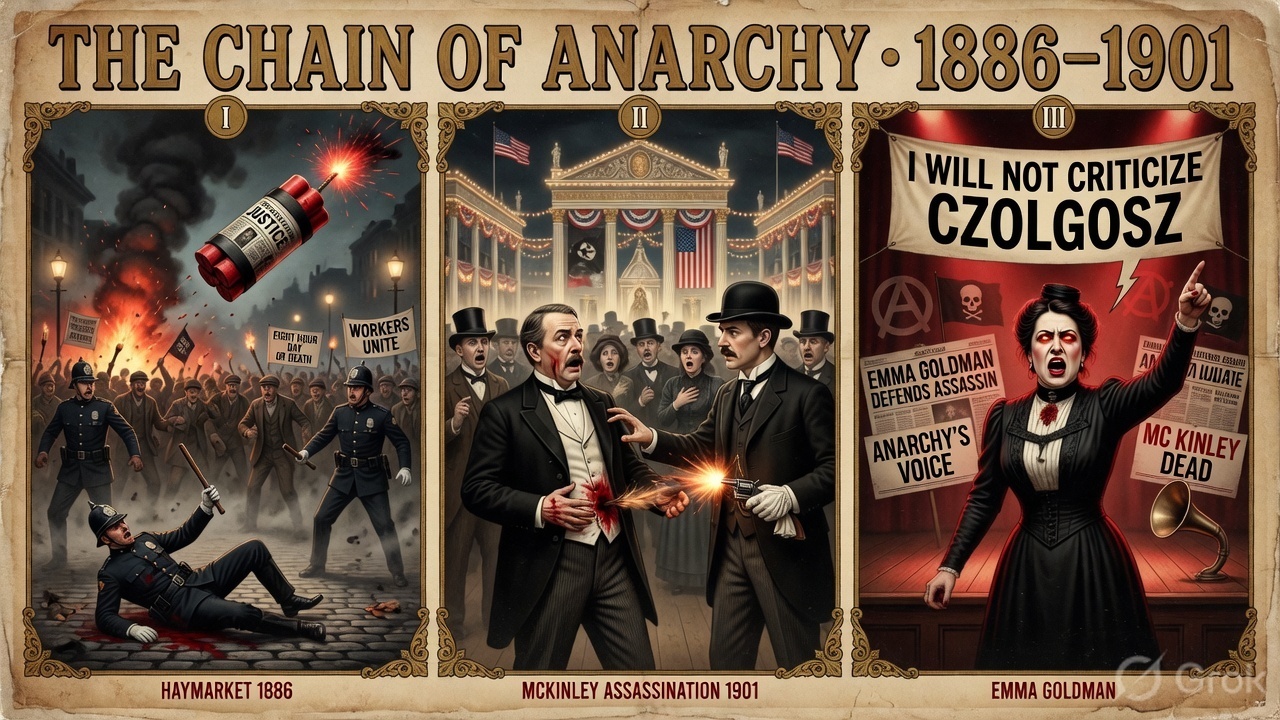
In the autumn of 1901, a self-taught anarchist named Leon Czolgosz stepped up to President William McKinley at the Pan-American Exposition in Buffalo and fired two shots into his abdomen. Czolgosz and Emma Goldman had never met. They exchanged no letters, plotted no conspiracy, and shared no secret handshake. Yet Goldman’s fiery lectures and essays—denouncing government, capitalism, and the “rulers” who oppressed the working class—had lodged in Czolgosz’s mind like shrapnel. He attended one of her speeches, absorbed the anarchist literature she championed, and later told interrogators her words helped convince him that McKinley represented the enemy. Goldman, arrested and questioned, refused to condemn the assassin outright. In her essay “The Tragedy at Buffalo,” she framed Czolgosz not as a monster but as a symptom of a diseased society.

Neither knew the other personally. Together, they helped inspire a generation of radicals to view political violence as a legitimate reply to perceived injustice. The Haymarket Affair of 1886—where four anarchists were hanged after a bombing at a labor rally Goldman saw as a travesty—had already radicalized her. Her rhetoric, in turn, radicalized others. The result was not revolution but a backlash: stricter immigration laws, expanded secret policing, and a cultural association of anarchism with terror. Rational policy—gradual reform, democratic debate, constitutional order—became the enemy.

More than a century later, the pattern repeats with eerie familiarity. We now live amid “batteries” of activist journalists and commentators whose output functions less as reporting than as ideological accelerant. Their work does not directly order violence, any more than Goldman ordered Czolgosz to shoot. Yet it cultivates a worldview in which political opponents are not mistaken but evil, not wrong but existential threats deserving whatever fate befalls them. The targets today are different, but the mechanism is the same: lone actors, marinated in grievance, acting on a steady drip of dehumanizing rhetoric.

Consider the recent record. Donald Trump survived two assassination attempts during his 2024 campaign—one in Butler, Pennsylvania, where a bullet grazed his ear, and another weeks later in Florida. Then, in September 2025, Charlie Kirk—co-founder of Turning Point USA and a vocal conservative voice—was assassinated by sniper fire while speaking at Utah Valley University. The shooter, 22-year-old Tyler James Robinson, left a note expressing his intent and acted alone. Investigators found no grand conspiracy, just a young man steeped in the online and media ecosystem that had framed Kirk and Trump as avatars of oppression, fascism, or whatever the current vocabulary of outrage demands. These were not spontaneous crimes. They were downstream of a cultural current that treats conservative figures as legitimate prey.

Who today plays Emma Goldman’s role? The archetype is no longer a single immigrant orator lecturing in union halls. It is the networked activist-journalist—podcasters, Substackers, cable commentators, and social-media influencers—who command far larger audiences than Goldman ever dreamed of. They do not call themselves anarchists; many cloak their work in the language of “social justice,” “accountability,” or “resistance.” Their output is slicker, algorithmic, and endlessly amplified. The common thread is the same moral certainty Goldman possessed: the system is irredeemable, the other side is irredeemable, and therefore any blow struck against it is, if not praiseworthy, at least understandable. They do not pull triggers, but they load the cultural magazine.

The more uncomfortable question is whether intelligence agencies—particularly the CIA and its successors—have had any hand in “mass producing” such figures. History offers precedents for skepticism. Operation Mockingbird, the Cold War-era program in which the Agency cultivated relationships with journalists to shape domestic and foreign narratives, is well-documented. The CIA has admitted to using media assets for propaganda and has never fully foresworn the practice. Yet the leap from “the Agency influenced reporters to push anti-communist stories in the 1950s” to “the Agency today engineers radical left-wing journalists to provoke right-wing assassinations” is enormous and unsupported by credible evidence. Conspiracy theorists have long filled that gap with claims of MKUltra-style mind control or “deep state” social engineering, but those narratives collapse under scrutiny. Lone actors have always existed; the internet simply supercharges their grievances faster than any government handler could. Blaming a shadowy cabal risks the same intellectual shortcut the anarchists once took: if the world is too complex and ugly to explain through ordinary human folly, malice, and ideology, then there must be a hidden director pulling strings.

Still, the lesson from Goldman and Czolgosz endures. Ideas have consequences. When journalism abandons the pursuit of truth for the manufacture of righteous fury, it does not merely “oppose rational policy”—it corrodes the very possibility of rational policy. It tells impressionable minds that debate is futile and violence is expressive. The proper response is not censorship or conspiracy-mongering. It is relentless insistence on evidence, proportion, and the distinction between disagreement and demonization. Until journalists—on every side—relearn that distinction, we should expect more Czolgoszes: isolated, radicalized, and convinced that the next shot will finally make the oppressors listen.

The tragedy is not that Goldman and Czolgosz never met. It is that their example still meets new disciples every day.


community logo
Join the VoiceDDB Community
To read more articles like this, sign up and join my community today
0
What else you may like…
Videos
Posts
Articles
00:01:07
November 27, 2022
Jingle Bell Rock

Jingle bell, jingle bell, jingle bell rock
Jingle bells swing and jingle bells ring
Snowin' and blowin' up bushels of fun
Now the jingle hop has begun

Jingle bell, jingle bell, jingle bell rock
Jingle bells chime in jingle bell time
Dancin' and prancin' in Jingle Bell Square
In the frosty air

What a bright time, it's the right time
To rock the night away
Jingle bell time is a swell time
To go glidin' in a one-horse sleigh

Giddy-up jingle horse, pick up your feet
Jingle around the clock
Mix and a-mingle in the jinglin' feet
That's the jingle bell rock

Jingle bell, jingle bell, jingle bell rock
Jingle bell chime in jingle bell time
Dancin' and prancin' in Jingle Bell Square
In the frosty air

What a bright time, it's the right time
To rock the night away
Jingle bell time is a swell time
To go glidin' in a one-horse sleigh

Giddy-up jingle horse, pick up your feet
Jingle around the clock
Mix and a-mingle in the jinglin' feet
That's the jingle bell
That's the jingle...

00:02:04
September 01, 2021
Intro to Locals for the Conservative Voice

David Daniel Ball calls himself the Conservative Voice.

I'm a teacher with three decades experience teaching math to high school kids.I also work with first graders and kids in between first grade and high school. I know the legends of why Hypatia's dad is remembered through his contribution to Math theory. And I know the legend of why followers of Godel had thought he had disproved God's existence.

I'm not a preacher, but I am a Christian who has written over 28 books all of which include some reference to my faith. Twelve blog books on world history and current affairs, detailing world events , births and marriages on each day of the year, organised by month. Twelve books on the background to and history of Bible Quotes. One Bible quote per day for a year. An intro to a science fiction series I'm planning, post apocalyptic cyber punk. An autobiography with short story collections.

I'm known in Australia for my failure as a whistleblower over the negligence death of a school boy. ...

00:01:50
September 04, 2026
Should violent criminals be made fat? Grok says 'no'

No. Transferring gut bacteria from an obese person into a violent criminal is not a reliable, ethical, or effective way to make them “fat, sedentary, and less of a physical threat.”

The science does not deliver the outcome you want

Mouse studies in germ-free animals showed that microbiota from obese donors can increase energy harvest and adiposity compared with lean-donor microbiota. That is the origin of the idea. Human evidence is far weaker.

Randomized trials of fecal microbiota transplant (FMT) from lean donors into people with obesity have generally failed to produce meaningful, sustained weight loss. Microbiome composition can change; body weight and metabolic markers often do not, or the effects are small and inconsistent. Diet and the existing gut environment usually dominate. A 2025 Nature paper found diet outperformed microbial transplant for microbiome recovery. Human guts are already colonized, not sterile like lab mice, so engraftment is variable and effects unpredictable.

It is not a ...

post photo preview
August 28, 2026
Pfizer struggles to answer

Some in Australia are brilliant. Malcolm Roberts Investigates Pfizer over Covid vaccine.

Holiday break is over back to work tonight

Tonight I'll start double posting until I've caught up.

post photo preview
Young people lead the way.
rules define their success.

Young people lead the way. 

But rules define their success.

Youth can be thrust onto the world stage by accident of timing, boldness, or simple opportunity. What follows is rarely a pure contest of talent or right. Circumstances, established rules, and the capacity of those already in power to respond quickly usually decide the outcome.

In 1996 a 21-year-old business student named John Leonard watched a Pepsi commercial that listed a Harrier jump jet as redeemable for 7 million Pepsi Points. He did the arithmetic, raised roughly $700,000, and tendered the required points plus cash. Pepsi refused, calling the jet a joke. Leonard sued. The litigation ran for years and cost Pepsi substantial sums. In the end the courts held that a humorous advertisement is not a binding offer; no reasonable person would treat it as one. Leonard never received the aircraft. Pepsi revised the commercial, raised the points total dramatically, and added an explicit disclaimer. Advertising practice tightened. The case became a standard teaching example that catalogues and broadcast jokes do not create enforceable contracts. Leonard’s initiative forced a rapid clarification of the rules. The rules, once clarified, defined the result.

Nine centuries earlier, a teenage Edgar Ætheling found himself the last male of the House of Wessex after Harold Godwinson fell at Hastings. Leading figures in London, including the Archbishop of York and the earls Edwin and Morcar, put him forward as king. He possessed a clear dynastic claim. He was never crowned. The earls failed to raise effective forces, and within weeks Edgar and the other English leaders submitted to William at Berkhamsted. The rules of succession had not been abolished in theory; they had been overridden in practice by military victory and the absence of unified English resistance. William moved quickly, entered London, and was crowned on Christmas Day. Edgar lived on for decades, involved in later campaigns and Scottish affairs, but the brief recognition of autumn 1066 produced no reign. His claim tested the new order; the new order held.

Both men enjoyed relatively long lives. Leonard is still alive. Edgar survived into the 1120s. In each case the young man identified an opening that existing power had left unclosed—an advertisement without a disclaimer, a vacant throne without a ready military response. In each case those in power reacted with speed once the opening was exploited. The courts restated the ordinary meaning of an offer. William secured the crown and the submission of the remaining English leadership. Initiative created pressure; the governing rules, once applied or enforced, determined the outcome.

Youth supplies energy, calculation, and the willingness to test a boundary that older hands may have left unexamined. Rules—legal, military, political—supply the structure within which that energy either produces lasting change or is absorbed. Leonard’s suit did not rewrite the law of contract, but it made the existing doctrine impossible to ignore in advertising. Edgar’s proclamation did not restore the House of Wessex, but it forced William to complete the conquest without delay. In both episodes the young men led the way into an open question. The rules, and the speed with which those who controlled them answered, defined the success that followed.

=

Edgar Ætheling’s brief recognition as king in late 1066 was a short-lived, unconsummated claim by the last male of the House of Wessex after Harold Godwinson’s death at Hastings. He was proclaimed (or put forward) in London but never crowned or anointed, and he submitted to William the Conqueror within weeks.

Background

Edgar Ætheling (also Æþeling; sometimes called Edgar II by those who count his recognition) was born around 1051–1052, probably in Hungary. He was the son of Edward the Exile (son of Edmund Ironside) and Agatha. After the death of his father, Edgar and his sisters Margaret and Christina were brought to England by Edward the Confessor around 1057. As the last male descendant of the House of Wessex in the direct male line, he held the title ætheling (“prince eligible for the throne”).

When Edward the Confessor died in January 1066, the Witan chose Harold Godwinson as king rather than the teenage Edgar, who lacked military experience and political support. After Harold was killed at the Battle of Hastings on 14 October 1066, the remaining English leadership in London faced Norman advance and the collapse of organized resistance.

Contemporary accounts (notably the Anglo-Saxon Chronicle, especially the Worcester/D manuscript) record that Edgar was chosen or put forward as king by the Archbishop of York (Ealdred), the leading citizens of London, and with the promised support of Earls Edwin of Mercia and Morcar of Northumbria. This was an attempt to preserve an English dynasty rather than submit immediately to William of Normandy. There is no evidence he was formally elected by a full Witan or crowned.

Significant Characters

  • Edgar Ætheling: The teenage claimant (roughly 14–15 years old). He had a strong hereditary claim but no personal military following or experience. He never exercised real power.
  • Harold Godwinson: Previous king, killed at Hastings on 14 October 1066. His death created the vacancy.
  • William the Conqueror (William of Normandy): Invader and eventual king. He moved methodically toward London after Hastings.
  • Archbishop Ealdred of York: One of the key figures who supported Edgar’s recognition in London. (He later crowned William at Westminster.)
  • Earls Edwin of Mercia and Morcar of Northumbria: Powerful northern earls who initially backed Edgar but failed to deliver meaningful military support. They later submitted to William and retained their earldoms for a time.
  • Other English leaders: Citizens of London and various nobles who briefly rallied around the Wessex heir before the practical reality of Norman strength became clear.

Results and Aftermath

Support for Edgar proved hollow. Edwin and Morcar did not raise effective armies, and no coherent English resistance formed around him. In early December 1066, Edgar, along with Archbishop Ealdred, Edwin, Morcar, and other leaders, submitted to William at Berkhamsted (Berkhamstead). William then entered London and was crowned on Christmas Day 1066.

Edgar was never crowned or anointed. His “reign” (if counted at all) lasted only from roughly mid-October to early December 1066—about six to eight weeks of nominal recognition without effective rule. Most historians treat him as a claimant rather than a king.

After submission:

  • He lived under Norman rule for periods and spent time in Scotland with his sister Margaret (who married King Malcolm III Canmore).
  • He was involved in various revolts and campaigns against the Normans in the late 1060s and 1070s, then reconciled at times with William I and William II.
  • He later took part in Norman ventures (including a force sent toward Apulia) and intervened in Scottish succession politics.
  • He lived into the 1120s (death in or after 1125) and is sometimes described as the last male of the old English royal line.

The episode marked the effective end of the House of Wessex as a ruling dynasty in England. William’s coronation and subsequent consolidation of power completed the Norman Conquest. Edgar’s claim is noted in sources as a brief alternative that collapsed for lack of military force and unified leadership.

=

John Leonard was not legally correct. In Leonard v. Pepsico, Inc. (88 F. Supp. 2d 116 (S.D.N.Y. 1999), aff’d 210 F.3d 88 (2d Cir. 2000)), the courts ruled that Pepsi’s humorous commercial did not constitute a binding offer. Leonard lost. The case is a famous teaching example in U.S. contract law on when advertisements create offers versus mere puffery or invitations to negotiate. It reinforced existing principles rather than rewriting advertising law, though it did push advertisers toward clearer disclaimers in extreme or joke promotions.

Background

In the mid-1990s, during the cola wars, Pepsi launched “Pepsi Stuff,” a loyalty program. Customers collected “Pepsi Points” from product packaging and redeemed them for branded merchandise (T-shirts, jackets, sunglasses, etc.). Extra points could be bought for 10 cents each, provided the customer submitted at least 15 points from actual products.

A 1995–96 television commercial (part of the campaign’s advertising, including Super Bowl exposure) showed a teenager collecting various Pepsi items and then flying to school in a McDonnell Douglas AV-8B Harrier II jump jet. On-screen text listed the jet at 7,000,000 Pepsi Points. The tone was deliberately over-the-top and humorous: the jet lands near a school bicycle rack, blasts a principal’s clothes off with its exhaust, and the teen remarks that it “sure beats the bus.”

John D.R. Leonard, a 21-year-old business student at Shoreline Community College near Seattle, saw the ad. He calculated that buying the remaining points at 10 cents each would cost about $700,000 for a jet then valued in the tens of millions of dollars (court and contemporary figures often cited roughly $23–37 million). He and associates treated it as an arbitrage opportunity. In late March 1996 he submitted an official order form requesting “1 Harrier Jet,” 15 original Pepsi Points, and a check for $700,008.50 (including shipping). Pepsi returned the check, described the jet as “fanciful” and “humorous,” and sent some free coupons.

Leonard (and investors) sued for breach of contract, fraud, and related claims, seeking the jet or specific performance. Pepsi filed a preemptive declaratory-judgment action in New York federal court seeking a ruling that it had no obligation and attempting to recover fees.

Significant Characters

  • John Leonard: The plaintiff. A young, adventurous business student and mountaineer. He later became a National Park Service ranger (including mountaineering work at Denali) and has lived in the Washington, D.C., and Alaska areas with his family. He has said he genuinely believed the claim could succeed at the time and has reflected on it as opportunistic in hindsight. He appears in the 2022 Netflix documentary Pepsi, Where’s My Jet?.
  • Todd Hoffman: Leonard’s older friend, mentor, and primary financial backer. They met on a mountaineering trip. Hoffman (a businessman with various ventures) helped raise or supply the ~$700,000 and was involved in the strategy and publicity. They remained friends afterward.
  • Judge Kimba M. Wood: U.S. District Judge for the Southern District of New York who wrote the detailed 1999 opinion granting Pepsi summary judgment.
  • Michael Avenatti: Then a law student, he briefly assisted Leonard’s side (especially with media/PR strategy). He later became nationally known representing Stormy Daniels and was subsequently convicted on multiple federal charges (extortion, fraud, etc.).
  • PepsiCo and its team: The defendant corporation. Spokespeople emphasized that “tens of millions” of viewers understood the ad as a joke. The ad agency and Pepsi revised the commercial after the claim (raising the jet to 700 million points and adding “Just Kidding”).

Court Rulings and Outcomes

Judge Wood granted Pepsi summary judgment on August 5, 1999. Core holdings (later affirmed by the Second Circuit in a short per curiam opinion):

  • Advertisements are generally invitations to negotiate or solicit offers, not binding offers themselves (citing the Restatement (Second) of Contracts). The commercial lacked the definite, clear, and explicit terms needed to create an offer that left nothing open for negotiation.
  • Under the objective reasonable-person standard, no one would take the jet depiction seriously. The scene was an exaggerated adolescent fantasy: an improbable young pilot, a military attack jet landing in a school zone, the absurdity of the numbers, and the overall humorous tone. It was classic puffery.
  • The governing catalog (the actual redemption document) did not list the jet.
  • Any alleged high-value contract failed the Statute of Frauds for lack of a sufficient signed writing from Pepsi.
  • Pepsi never cashed the check, undercutting fraud claims.

Leonard recovered nothing. Pepsi had offered a settlement (reported in some accounts around $750,000) which was declined. The commercial was revised with the higher points total and an explicit “Just Kidding” disclaimer. The case became a standard example in American law-school contract courses on offer, acceptance, the reasonable-person test, and the limits of advertising.

Practical effects: Advertisers grew more cautious about extreme or joke prizes without clear disclaimers. The case is still widely discussed in marketing and legal contexts as a cautionary tale. It did not overhaul U.S. advertising law (existing doctrines on puffery and ads-as-invitations already covered the ground), but it made the principles vivid and memorable.

Later cultural notes include the 2022 Netflix documentary featuring Leonard and Hoffman, and a 2026 Frontier Airlines Super Bowl ad in which Leonard “redeems” the 7 million points for free Frontier miles for life.

In short, Pepsi successfully defended the claim that the jet was a joke, not a contractual offer. Leonard’s attempt was creative and well-funded, but the courts applied standard contract principles and found no enforceable deal. The litigation was costly and drawn-out for Pepsi, but the company prevailed on the law.

= October 15th 

1066 – Edgar the Ætheling proclaimed King of England

After Harold Godwinson’s death at the Battle of Hastings on 14 October 1066, leading English figures in London (including the Archbishop of York and Earls Edwin and Morcar) put forward the teenage Edgar Ætheling as king. Edgar was the last male of the House of Wessex, a grandson of Edmund Ironside, and had a strong dynastic claim as ætheling (“prince eligible for the throne”). He was never crowned or anointed. Support proved hollow: the earls failed to raise effective forces, and in early December Edgar and other English leaders submitted to William the Conqueror at Berkhamsted. Edgar later lived in Scotland, took part in various campaigns, and died in or after 1125. He is sometimes styled Edgar II by those who treat his short recognition as a reign (roughly mid-October to early December 1066).

1211 – Battle of the Rhyndacus

On 15 October 1211, Latin Emperor Henry of Flanders defeated Nicaean Emperor Theodore I Laskaris near the Rhyndacus River in northwestern Anatolia. Henry had only a few hundred Frankish knights (sources often cite around 260). Laskaris had a larger force but had recently suffered losses against the Seljuks; he tried to ambush the Latins, but Henry’s assault broke the Nicaean lines in a day-long fight. The victory let Henry advance deep into Nicaean territory (as far as Nymphaion). It contributed to the later Treaty of Nymphaeum (1214), which fixed a frontier and recognised Nicaea as a sovereign power.

1529 – End of the Siege of Vienna

Suleiman the Magnificent’s Ottoman army besieged Vienna from late September 1529. The defenders, heavily outnumbered, held the walls with arquebuses and pikes and repulsed repeated assaults. A major final Ottoman attack on or about 14 October failed. Facing early winter, supply problems, and disease, Suleiman ordered the withdrawal on 15 October. The retreat was costly; snow and mud made movement difficult and Austrian horsemen harried stragglers. The failure checked nearly a century of Ottoman expansion into Central Europe and is widely seen as a strategic turning point, even though the Ottomans retained control of much of Hungary.

1582 – Implementation of the Gregorian calendar

Pope Gregory XIII’s reform (bull Inter gravissimas) took effect in Catholic Europe. In Italy, Spain, Portugal, and Poland, Thursday 4 October 1582 was followed immediately by Friday 15 October 1582—ten days were dropped to bring the calendar back into alignment with the seasons and the intended date of Easter. The reform also adjusted the leap-year rule. Protestant and Orthodox countries delayed adoption for decades or longer (Britain and its colonies switched in 1752). The skip produced temporary calendar confusion across borders.

1764 – Edward Gibbon’s inspiration in Rome

On 15 October 1764, Edward Gibbon sat among the ruins of the Capitol in Rome while barefooted friars sang vespers in the Temple of Jupiter (the site later occupied by the church of Santa Maria in Aracoeli). The contrast between the pagan imperial past and the Christian present struck him powerfully; he later wrote that the idea of writing the history of the decline and fall of the city first came to him then. This became The History of the Decline and Fall of the Roman Empire (published 1776–1789), one of the great works of Enlightenment historiography.

1783 – First human ascent in a hot-air balloon

On 15 October 1783, at the Réveillon workshop in the Faubourg Saint-Antoine, Paris, the Montgolfier brothers conducted the first manned tethered flights. Étienne Montgolfier rose first, followed the same day by Jean-François Pilâtre de Rozier (to the length of the tether, roughly 25 metres). These tests followed earlier unmanned and animal flights and preceded the first free manned flight (Pilâtre de Rozier and the Marquis d’Arlandes) on 21 November 1783. The Montgolfiers’ hot-air balloons opened the age of human flight.

1793 – Trial of Marie Antoinette

Marie Antoinette’s trial before the Revolutionary Tribunal in Paris began on 14 October 1793 and lasted roughly two days. The charges included high treason, conspiracy with foreign powers, and depletion of the treasury. The proceedings were rapid and the outcome effectively predetermined by the political climate of the early Terror. She was convicted and sentenced to death; she was guillotined on 16 October 1793 in the Place de la Révolution (now Place de la Concorde).

These episodes range from dynastic succession and medieval warfare to the limits of Ottoman power, calendar reform, the birth of modern historiography, the dawn of aviation, and the violence of the French Revolution.


Read full Article
October 12, 2026
post photo preview
Education evolution
October 14th

Education evolution

in the broad sense that early mass elementary schooling had to accommodate children’s labour, including harvest work. But the idea that the fixed long summer vacation was deliberately set “so children could help with the harvest” is only partly accurate, and is often described by historians as a partial myth.

What is true

In the era of the monitorial schools (Bell’s Madras system and Lancaster’s system, early 1800s) and the later expansion of elementary schools, children’s labour still mattered to many families. Parents pulled children out for chores, and rural schools regularly recorded high absences during harvest and gleaning. Victorian school log books from agricultural areas (e.g. Yorkshire and elsewhere) note very poor attendance after the summer break because children were still in the fields, and teachers sometimes closed early or accepted harvest-related absences. Local rural schools sometimes arranged short “harvest breaks” or simply expected lower numbers in late summer/early autumn.

This fits the practical reality of the period: schooling for the poor was still competing with the immediate economic value of children’s work. The window designs you mentioned earlier were one response to parents removing children during the school day; seasonal attendance patterns were another.

The nuance

By the time a standardised school calendar with a long summer holiday became fixed in England (mainly from the mid-to-late 19th century, with the Education Acts and the growth of state elementary schooling), the direct link to harvest labour was weaker than the popular story suggests:

  • English agriculture was already more mechanised; smallholdings had declined and adult labour plus machines handled much of the heavy work.
  • Planting is mainly spring and the main grain harvest is late summer into early autumn — not a perfect match for a long July–August break.
  • The pattern of a long summer holiday was already established in urban and public schools, influenced by middle-class holiday habits, the parliamentary/legal long vacation, heat in crowded cities, and the emerging professional identity of teachers.
  • Historians such as Jacob Middleton have argued that the “summer holiday for the harvest” explanation is largely a later myth; the standardised calendar was driven more by urban reformers, standardisation, and professional norms than by rural agricultural need. Rural schools often had more flexible or different term structures, and harvest absences persisted as a problem rather than being neatly solved by the summer break.

In short: early monitorial and elementary schools did have to live with the reality that many parents needed their children for farm and household work, including harvest. Local attendance and occasional closures reflected that. The fixed long summer vacation that became standard, however, was more a product of later 19th-century standardisation than a deliberate agricultural design. The popular harvest explanation has a grain of truth in rural practice but overstates the causal role.

=

that architectural detail is documented in the contemporary descriptions of the two systems, and it matches the practical problem of parents pulling children out of school for household or farm chores.

Both systems used large halls with sloping floors rising toward the far end, a raised platform (dais) at the lower end for the master’s desk so he could oversee the whole room, and fixed forms/desks. The goal was cheap mass instruction under one adult, with monitors handling most of the teaching. In the early 19th century, before widespread compulsory attendance laws, parents often tried to extract their children during the day. The window designs addressed this.

The Differences

  • Joseph Lancaster’s system (Lancasterian / British and Foreign School Society):
    Ideal classroom was a long parallelogram (length about twice the width). Windows were specified six feet from the floor (high). The floor rose one foot in twenty from the master’s platform at the lower end to the highest class at the upper end. Forms were fixed; passages along the walls allowed semicircles for reading. High windows made it harder for someone outside to reach in or for a child to climb out easily. Locks were typically at the bottom of the sashes.
  • Andrew Bell’s Madras system (adopted by the National Society / Church of England National Schools):
    Halls were rectangular, with windows five feet from the floor but designed to open at the top. Desks were often placed against the walls and the master’s desk was raised. Lower windows opening at the top allowed ventilation while still restricting easy access or exit; locks were at the top.

These specifications appear in the original manuals and later summaries (including descriptions that note Lancaster’s six-foot windows and the Madras-style five-foot windows opening at the top). The sloping floor and raised dais were shared features that let one master supervise hundreds of children arranged by attainment rather than age.

Context

This was an early form of large-scale elementary schooling for the poor, effectively pushing toward more regular attendance even before formal compulsion. The window arrangements were a practical response to parental resistance in an era when children’s labour still had immediate economic value to many families. Both systems later declined as trained adult teachers and the pupil-teacher system became standard, but the architectural solutions reflect the real social pressures of the time.

Cliff Turney’s observation (as former Dean of Education at the University of Sydney, who wrote extensively on the history of education) fits these documented design differences between the Lancaster and Bell/Madras models.

=

Andrew Bell’s Madras system was adopted by the main British (Anglican/National Society) elementary education system; Joseph Lancaster’s system was the one more readily used or adapted by Catholics (and Nonconformists).

Both methods were independent early-19th-century versions of the monitorial system (also called mutual instruction). Older or abler pupils (“monitors”) taught groups of younger children under one adult master. This made cheap mass elementary schooling possible. Andrew Bell (an Anglican chaplain) developed his version in the 1790s at the Military Male Orphan Asylum near Madras (Chennai), drawing on local Indian school practices; he published an account in 1797. Joseph Lancaster (a Quaker) developed a similar system around the same time in his free school in Borough Road, London, and published on it in 1803. The two initially acknowledged each other’s work, but rivalry soon became sharp, driven less by technical differences than by religion and church politics.

Who Adopted What

  • Madras / Bell system → British education under the Established Church.
    In 1811 the Church of England founded the National Society for Promoting the Education of the Poor in the Principles of the Established Church. It deliberately adopted Bell’s Madras system. These became the dominant “National Schools,” teaching Anglican doctrine and the Church Catechism. They formed the backbone of elementary provision for the poor in England and Wales for much of the 19th century and were the main vehicle for state-supported elementary education until later reforms. Bell himself worked closely with the Society.
  • Lancasterian system → British and Foreign School Society (non-sectarian) and, more broadly, groups outside the Established Church, including Catholics.
    Lancaster’s approach was non-denominational: Scripture was taught, but distinctive sectarian doctrines and catechisms were excluded so children of different persuasions could attend. It was supported by Nonconformists/Dissenters, Quakers, and liberal Anglicans through the British and Foreign School Society (BFSS). Contemporary accounts note that the monitorial methodology was taken up by the Roman Catholic Church in England and Wales. Catholics, being outside the Established Church, could not join National Society schools on equal terms and therefore found the more open Lancasterian model usable (or adaptable) for their own schools. In Ireland, Lancaster’s system was also received positively by some Catholic clergy and committees precisely because it was non-sectarian.

The two systems were pedagogically very similar (large halls, sand or slate writing, graded classes, monitors, strict order). Differences that mattered at the time were mainly religious control and the degree of formality. The rivalry between the National Society (Bell/Madras) and the BFSS (Lancaster) shaped English elementary education for decades and delayed a single state system. Both later gave way to trained adult teachers and the pupil-teacher system, but they left a lasting mark on mass schooling.

In short: Bell/Madras → Anglican National Schools (the main British elementary system of the period); Lancaster → non-sectarian/BFSS schools and Catholic adoption.

=

The Salesians of Don Bosco (SDB; formally the Society of St. Francis de Sales) are a Catholic religious congregation founded in the 19th century that specializes in the education and care of young people, especially the poor and disadvantaged. They are distinct from the Jesuits and have no direct connection to the 1773 Jesuit suppression or the Polish Commission of National Education.

Founding and Background

St. John Bosco (Don Bosco, 1815–1888), an Italian priest in Turin, began working with street boys, migrant youth, and child laborers during the Industrial Revolution. From 1841 he gathered them for catechism, Mass, recreation, and basic schooling in what became known as the Oratory of St. Francis de Sales (named for the gentle 17th-century bishop Francis de Sales). He developed the Preventive System—an educational approach based on reason, religion, and loving-kindness (rather than harsh punishment), aiming to prevent problems through relationships, accompaniment, and a family-like environment (often summarized as “home, school, church, and playground”).

In 1859, with a small group of collaborators, he formally established the Salesian Society to continue and expand this work. The constitutions were definitively approved by Pope Pius IX in 1874. With St. Mary Domenica Mazzarello he also founded the Salesian Sisters (Daughters of Mary Help of Christians, FMA) in 1872 for similar work among girls. Lay Salesian Cooperators form a third branch of the Salesian Family.

Education and Mission

Education of youth is the core apostolate. Salesians run:

  • Oratories and youth centers
  • Primary and secondary schools
  • Technical/vocational schools and workshops
  • Universities and higher institutions (including the Salesian Pontifical University)
  • Parishes, hostels, and social services focused on the young

They emphasize holistic formation: academic learning plus character, faith, practical skills, and preparation for work and citizenship. The approach prioritizes the poor and at-risk. By the time of Don Bosco’s death the congregation was already active in several European countries and South America; it has since expanded globally.

Today the Salesians (male and female branches together with cooperators) operate thousands of schools and youth centers across more than 130 countries and educate well over a million young people. In recent years they have ranked among the very largest male religious institutes in the Catholic Church by membership—closely behind or nearly level with the Jesuits (roughly 13,600–13,800 Salesians versus ~13,700–13,800 Jesuits in recent Annuario Pontificio figures).

Relation to the Earlier Discussion

The Salesians post-date the 1773 Jesuit suppression and restoration (1814) by decades. They did not fill the institutional vacuum left by the Jesuits in places like the Polish–Lithuanian Commonwealth; that role was taken by the state Commission of National Education and other bodies. Instead, the Salesians represent a later, specialized response to the social and educational needs of the industrial era, parallel to (but different in style and focus from) the Jesuits’ broader intellectual, missionary, and elite educational tradition.

Don Bosco was canonized in 1934; his feast day is 31 January. The Salesian Family continues his emphasis on youth ministry as its defining charism.

=

The Society of Jesus (Jesuits) was suppressed by papal order in 1773 and restored in 1814; it has existed continuously as a recognized Catholic religious order since then.

The Suppression of 1773

By the mid-18th century the Jesuits (founded 1540 by St. Ignatius of Loyola and approved by Pope Paul III) were one of the largest and most influential orders in the Catholic Church. They ran extensive educational networks, missions (especially in the Americas and Asia), and were closely identified with the papacy and Counter-Reformation orthodoxy. This made them powerful—and controversial.

Catholic monarchs of the Bourbon and other courts grew hostile for a mix of political, economic, and ideological reasons:

  • Accusations of meddling in politics, excessive privileges, and resistance to royal control (regalism / Erastianism).
  • Enlightenment and Gallican/Jansenist currents that viewed the order as obscurantist or too independent.
  • Practical motives: seizing Jesuit properties and reducing a rival power center.
  • Specific incidents and propaganda in Portugal (under the Marquis of Pombal), France, Spain, and the Two Sicilies.

Portugal expelled the Jesuits in 1759; France suppressed them in the 1760s; Spain and Naples followed in 1767. These governments then pressed the papacy for universal abolition. Pope Clement XIII resisted, but his successor Clement XIV (elected 1769), under sustained diplomatic pressure and threats of schism or further territorial losses, issued the brief Dominus ac Redemptor on 21 July 1773. It suppressed the Society worldwide, dissolved its houses, colleges, and administration, and released members from their vows. The stated motive was restoring peace to the Church by removing a source of contention; the brief did not formally condemn the order’s doctrine or morals.

What Happened During the Suppression (1773–1814)

The order did not disappear completely. Most former Jesuits became diocesan priests or joined other orders; some continued educational or scholarly work as individuals. Crucially, the suppression was never fully enforced in the Russian Empire (where Catherine the Great protected the Jesuits in the former Polish territories that Russia had annexed). A small remnant survived and even grew there, preserving the corporate structure and traditions. Limited presence continued in Prussia for a time and in some Protestant areas.

Restoration in 1814

After the French Revolution and Napoleonic Wars, the political climate changed. The monarchs who had demanded suppression were gone or weakened, and the Church was seen by many as a stabilizing force. Pope Pius VII, restored to Rome after Napoleon’s fall, issued the bull Sollicitudo omnium ecclesiarum on 7 August 1814, restoring the Society of Jesus worldwide. The restored order retained its pre-1773 constitutions and quickly resumed education, missions, and other works.

Why Jesuits Exist Today

The 1814 restoration was permanent. The Society has operated continuously since then under successive Superior Generals, with papal approval. It remains the largest male religious order in the Catholic Church in terms of historical influence and global reach (education, spirituality, social ministry, etc.), though membership has declined significantly from a mid-20th-century peak of roughly 36,000 (around 1965) to roughly 13,000–14,000 in recent years.

In short: the 1773 suppression was a political and administrative act by the papacy under heavy external pressure, not a doctrinal condemnation. It was reversed 41 years later, and the order has continued ever since. The Polish–Lithuanian Commission of National Education of 1773 (discussed earlier) was one local consequence of the Jesuit dissolution, as it took over many of their schools and properties.

=

The Commission of National Education (Komisja Edukacji Narodowej, KEN) was established on 14 October 1773 by the Sejm (parliament) of the Polish–Lithuanian Commonwealth during the Partition Sejm. It is widely regarded as the first modern, centralized, state-controlled ministry of education in Europe—an autonomous collegial body with ministerial status, responsible solely to the king and Sejm for education policy and finances.

Background

By the mid-18th century, education in the Commonwealth was dominated by the Jesuits, who ran the majority of secondary schools (roughly two-thirds of lower and middle schools). The Piarists, reformed earlier under Stanisław Konarski, offered a higher-quality alternative in some places, but the overall system was fragmented, heavily Latin-based, and uneven. The First Partition of 1772 had already weakened the state. Then, on 21 July 1773, Pope Clement XIV suppressed the Jesuit order (bull Dominus ac Redemptor). This created an immediate crisis: dozens of schools and substantial Jesuit properties risked collapse or transfer solely to the secular clergy.

King Stanisław II August Poniatowski and reform-minded figures saw an opportunity. During the Partition Sejm (which ratified the First Partition), they secured creation of a state body to nationalize the post-Jesuit estates and schools and to reform education as part of a broader effort to strengthen the Commonwealth through Enlightenment ideas—physiocracy, civic virtue, practical knowledge, and patriotism. The commission was one of the “Grand Commissions” established at the time; it received control of Jesuit properties (schools, estates, and villages), creating a dedicated educational fund. Its formal full name was initially Komisja nad Edukacją Młodzi Szlacheckiej Dozór Mająca (Commission Having Supervision over the Education of the Nation’s Young Nobles), though it quickly aimed more broadly.

History and Reforms (1773–1794)

The KEN operated for about 21 years with varying intensity. Its early formative phase focused on organization and control of the fund. In 1775 it established the Society for Elementary Books (Towarzystwo do Ksiąg Elementarnych), chaired by Ignacy Potocki with Grzegorz Piramowicz as secretary, to produce modern Polish-language textbooks and curricula.

Key structural and curricular changes included:

  • A three-tier system: parish (elementary) schools for broader social access (including some peasants and burghers), district/powiat (secondary) schools, and the two universities (“Chief Schools”) in Kraków and Vilnius as supervisory centers.
  • Polish as the primary language of instruction (replacing Latin), plus emphasis on natural sciences, mathematics, history, law, moral education, and civic patriotism.
  • Teacher training seminaries and the professionalization of teaching (the “academic estate”).
  • Textbooks that standardized Polish scientific terminology in mathematics, physics, chemistry, grammar, and other fields (dozens were produced; print runs were substantial).
  • Greater accessibility, including limited opening of education to girls and non-nobles.

Hugo Kołłątaj (a priest and key intellectual architect, though not always a formal commissioner) developed the three-level plan and, as the commission’s visitor, reformed the Kraków Academy (Jagiellonian University) in 1777–1780—introducing Polish, natural sciences, new chairs, and wider access—before serving as its rector (1783–1786). Vilnius University was similarly reorganized. The commission issued comprehensive school laws (culminating in the 1783 statutes), the first European code of its kind covering administration, pedagogy, and organization.

It took over the Załuski Library (making it effectively the first public library under state care, with Potocki involved). Despite financial mismanagement by early leaders and political resistance, the KEN largely succeeded in modernizing education within the constraints of a declining state.

Significant Figures

  • King Stanisław II August Poniatowski: Political patron and initiator; the commission operated under his protection.
  • Hugo Kołłątaj (1750–1812): Main intellectual and organizational force behind the educational vision and the Kraków university reform; later a major political reformer linked to the Constitution of 3 May.
  • Ignacy Potocki (1750–1809): Long-serving commissioner; initiator and chairman of the Society for Elementary Books; involved in curriculum, the Załuski Library, and broader Enlightenment politics.
  • Adam Kazimierz Czartoryski: Commissioner and influential Enlightenment supporter.
  • Michał Jerzy Poniatowski (king’s brother, later Primate): President from 1776 after the removal of the first president.
  • Ignacy Massalski (Bishop of Vilnius): First president (1773–1776); later criticized for financial abuses and associated with the anti-reform Targowica Confederation.
  • Others: Joachim Chreptowicz, Andrzej Zamoyski, August Sułkowski, Antoni Poniński; collaborators included Grzegorz Piramowicz, Hieronim Stroynowski, and textbook authors such as Onufry Kopczyński (grammar) and Jędrzej Śniadecki (chemistry).

Aftermath and Legacy

The KEN was weakened by the Targowica Confederation (1792–1793) after the Constitution of 3 May and the Second Partition; many reformers (including Kołłątaj) faced exile or worse. It was effectively ended by the Third Partition of 1795, which extinguished the Commonwealth. Its schools and ideas did not vanish: textbooks and methods continued under the partitions; trained teachers and graduates formed a patriotic, Enlightenment-influenced elite that shaped 19th-century Polish uprisings, science, and culture. Polish language and national consciousness were reinforced precisely when foreign powers pursued Russification and Germanization. Some later Russian reforms drew on KEN ideas via figures such as Czartoryski and Potocki.

In modern Poland, 14 October is observed as Teachers’ Day / National Education Day, deliberately commemorating the KEN. Historians rank it alongside the Constitution of 3 May as one of the outstanding achievements of the Polish Enlightenment—an attempt to renew the state through education that outlasted the state itself.

=

October 14 marks several notable historical events across centuries, from the Norman Conquest to Enlightenment reforms and colonial tensions. Here is a concise account of the ones you listed, with key context and some clarifications based on the historical record.

1066 – Battle of Hastings

On October 14, 1066, Norman forces under William, Duke of Normandy (later William the Conqueror), defeated the English army of King Harold II (Harold Godwinson) at Senlac Hill (near modern Battle, East Sussex), roughly seven miles from Hastings. Harold, who had only recently defeated a Norwegian invasion at Stamford Bridge, was killed in the battle (traditionally by an arrow to the eye, though contemporary accounts vary). His brothers Gyrth and Leofwine also died. The victory opened the way for the Norman Conquest; William was crowned King of England on Christmas Day 1066. The Bayeux Tapestry is the best-known visual record of the campaign and battle.

1322 – Battle of Old Byland (Byland)

Robert the Bruce (King Robert I of Scotland) defeated an English force under King Edward II at Old Byland (near Sutton Bank in the Hambleton Hills, Yorkshire) on October 14, 1322. This was part of the First War of Scottish Independence and followed Edward’s failed invasion of Scotland earlier that year. Scottish forces under Bruce, with commanders including James Douglas and Thomas Randolph, outmaneuvered and routed the English (commanded on the field by the Earl of Richmond). Edward II himself narrowly escaped capture while at Rievaulx or Byland Abbey, abandoning personal possessions. The victory was a major Scottish success after Bannockburn and humiliated Edward deep inside England. It contributed to pressure for a truce (agreed in 1323); formal recognition of Scottish independence came later in the Treaty of Edinburgh-Northampton (1328) under Edward III, after Edward II’s deposition.

1582 – Gregorian calendar reform

In the Catholic countries that first adopted the Gregorian calendar (Italy/Papal States, Spain, Portugal, and Poland), October 4, 1582, was followed immediately by October 15. Ten days (October 5–14) were skipped to correct the accumulated drift of the Julian calendar relative to the solar year. Thus, October 14, 1582, simply did not exist in those places. The reform was ordered by Pope Gregory XIII in the bull Inter gravissimas to realign the calendar with the equinoxes (important for calculating Easter). Protestant and Orthodox countries adopted it later—Britain and its colonies not until 1752.

1586 – Trial of Mary, Queen of Scots

Mary, Queen of Scots, went on trial on October 14, 1586, at Fotheringhay Castle in Northamptonshire before a commission appointed by Elizabeth I. She was charged with complicity in the Babington Plot to assassinate Elizabeth and place Mary on the English throne. Mary denied the court’s jurisdiction and argued her responses did not prove intent to kill Elizabeth, but she was found guilty on October 25. Parliament pressed for her execution; after months of hesitation, Elizabeth signed the warrant, and Mary was beheaded at Fotheringhay on February 8, 1587.

1656 – Massachusetts anti-Quaker legislation

On October 14, 1656, the General Court of the Massachusetts Bay Colony enacted the first punitive law specifically targeting the Religious Society of Friends (Quakers). It described them as a “cursed sect of heretics,” imposed heavy fines on ship captains who brought them into the colony, ordered arriving Quakers whipped and confined, and penalized anyone who harbored them, imported their writings, or defended their views. The Puritans viewed Quaker beliefs (inner light, rejection of formal clergy and oaths, egalitarianism) as both spiritually apostate and a threat to the theocratic social order. Enforcement escalated in subsequent years, including banishment and executions (notably Mary Dyer in 1660), until royal pressure and changing attitudes moderated the policy.

1758 – Battle of Hochkirch

During the Seven Years’ War (Third Silesian War), Austrian forces under Field Marshal Leopold von Daun surprised and defeated Frederick the Great’s Prussian army at Hochkirch in Saxony on October 14, 1758. Frederick had camped in a vulnerable position and underestimated the usually cautious Daun. A pre-dawn Austrian assault (roughly 80,000 Austrians against 30,000–36,000 Prussians) overwhelmed the Prussians. Frederick lost about 9,400 men (over 30% of his force), five generals (including his brother-in-law), 101 guns, and much of his camp, but managed to withdraw in good order. The battle is often cited as one of Frederick’s greatest tactical blunders, though his ability to recover afterward was characteristic.

1773 – Commission of National Education (Poland–Lithuania)

On October 14, 1773, the Sejm of the Polish–Lithuanian Commonwealth created the Commission of National Education (Komisja Edukacji Narodowej). Prompted by Pope Clement XIV’s dissolution of the Jesuit order (which had run most schools), the commission took over Jesuit properties and established a centralized, secular educational system—widely regarded as the first modern ministry of education in Europe. Key figures included Hugo Kołłątaj, Ignacy Potocki, and Adam Kazimierz Czartoryski; King Stanisław II August supported it. It reformed curricula (emphasizing Polish language, sciences, and civic education), supervised universities and hundreds of schools, and produced textbooks. It is viewed as a major achievement of the Polish Enlightenment.

1773/1774 – Annapolis tea incident (note on the date)

The entry you quoted appears in some “On This Day” compilations under 1773, but the well-documented Annapolis Tea Party occurred in 1774. The brig Peggy Stewart arrived in Annapolis on October 14, 1774, carrying tea (about 2,320 pounds) plus indentured servants. Owner Anthony Stewart paid the Townshend duty to clear the cargo. Local patriots, enforcing non-importation sentiments, forced Stewart and associates to burn the tea and, on October 19, the ship itself at Windmill Point. This was a deliberate, public act of protest analogous to (and following) the Boston Tea Party of December 16, 1773. No major burning of multiple East India Company tea ships at Annapolis is recorded for October 14, 1773.

These events range from decisive military turning points (Hastings, Byland, Hochkirch) to institutional and religious conflicts and a calendar reform that literally erased the day in parts of Europe. Let me know if you’d like more detail on any of them, related primary sources, or other October 14 events.

Read full Article
October 11, 2026
post photo preview
Seeing and Understanding
Anti Semitism

Seeing and Understanding

Anti Semitism

The analogy between the evolving understanding of the Whirlpool Galaxy and the question of whether we merely “see” antisemitism or actually understand it is a useful one. Superficial recognition of an object or a phenomenon is not the same as grasping its nature, scale, causes, or implications. Labels and pictures can create the feeling of knowledge without supplying the evidence or context that turns observation into comprehension.

A small correction on the astronomy side first: Lord Rosse’s key observations of the spiral structure in M51 were made in 1845 with his 72-inch Leviathan, not 1885. Copernicus’s heliocentric model placed the Sun at the center of the solar system; it did not imply that distant nebulae were local objects within that system. The real barrier for a long time was the lack of reliable distance measurements. Once those became possible, the “smudge” Messier catalogued to help comet hunters was revealed as a massive interacting galaxy tens of millions of light-years away. The same pattern—initial detection, refined observation, measurement of scale, and revision of earlier assumptions—appears in many areas of knowledge.

Applied to antisemitism, the distinction between seeing and understanding is real. Documented data show a sharp rise in antisemitic incidents in Australia after the 7 October 2023 Hamas attacks. Reports from sources tracking these incidents (including Australian Jewish community monitoring and international assessments) record increases on the order of several hundred percent in subsequent periods, with examples ranging from graffiti glorifying the attacks, campus harassment, synagogue attacks, and public demonstrations that included explicit eliminationist rhetoric. Elements of progressive activism, certain university environments, and Islamist currents have been repeatedly identified as major drivers of this surge, often blending anti-Zionism with older antisemitic tropes (collective guilt of Jews, dual loyalty, or blood libels updated into “genocide” accusations that ignore Hamas’s stated aims and tactics). Antisemitism has historical expressions on the right as well, including conspiracy theories about Jewish power; those have not disappeared. Recent patterns in Australia, however, have been dominated by the post-October 7 climate on parts of the left and in associated protest movements.

Your reference to the Claire Harvey interview with Greg Sheridan for The Australian fits the public record of Sheridan’s commentary. He has consistently condemned the rise in antisemitism, linked it to left-wing ideology that frames Israel as a colonial oppressor and Jews as accomplices, and criticised Australian government responses he sees as insufficient. At the same time, he has offered specific criticisms of Benjamin Netanyahu—on diplomatic style toward allies, certain aspects of the Gaza campaign’s human and political costs, or internal Israeli politics—while also describing Netanyahu as a formidable leader who has degraded Iranian proxy networks. Criticism of a particular Israeli government’s decisions, coalition, or conduct of war is not inherently antisemitic. The risk you note is real: when such criticism is asserted without concrete examples, evidence, or comparative context (Hamas’s charter and actions, the use of civilian infrastructure, the rejection of prior peace offers, or the treatment of other conflicts), it can function as an unearned opinion that aligns with, or is exploited by, those who do hold antisemitic views. Demanding supporting detail is a reasonable standard for any strong claim, whether about Netanyahu, Hamas, or anyone else.

Understanding antisemitism requires more than registering that hostility exists. It involves the historical continuity of certain motifs (deicide charges evolving into economic or racial conspiracy theories, then into anti-Zionist forms that uniquely deny Jewish self-determination), the ideological frameworks that currently amplify them, the difference between policy disagreement and collective demonisation, and the measurable outcomes for Jewish communities. A labeled photograph of the Whirlpool Galaxy lets someone recognise the object; measuring its distance, mapping its interaction with NGC 5195, and placing it in the broader structure of galaxies produces understanding. The same demand for evidence and context applies here.

=

Here is a broad, simple overview of how ideas about the universe have changed from ancient times to today. The story is one of expanding scale, better tools, and a gradual shift from Earth-centered stories to a vast, evolving cosmos.

Ancient ideas (before ~500 BC to the Middle Ages)

Most early cultures pictured a relatively small, ordered world with Earth at or near the center. The sky was often seen as a dome, a solid vault, or a series of layers. Stars were fixed lights or holes in a celestial sphere. Planets (the “wanderers”) moved among them.

The Greeks systematized this. Aristotle (4th century BC) argued for a stationary, spherical Earth at the center of nested crystal spheres that carried the Moon, Sun, planets, and stars. Motion was perfect and circular; the heavens were unchanging and made of a special substance different from earthly matter. Ptolemy (2nd century AD) refined this into a working mathematical model that predicted planetary positions reasonably well using circles upon circles (epicycles). This geocentric (Earth-centered) picture dominated Western and Islamic thought for well over a thousand years. It matched everyday experience—the ground feels solid and unmoving, and the sky appears to turn around us—and it fitted with many religious views of a special place for humanity.

The Scientific Revolution (16th–17th centuries)

The big shift began when the old model became awkward for precise predictions. Nicolaus Copernicus (1543) proposed that the Sun sits at the center and the Earth is one of several planets orbiting it. This heliocentric idea was simpler in some ways but initially faced strong resistance.

Johannes Kepler showed that planetary orbits are ellipses, not perfect circles, and found mathematical rules describing their speeds. Galileo Galilei used the newly invented telescope to see mountains on the Moon, moons orbiting Jupiter, and phases of Venus—observations that supported the idea that Earth is not the unique center. Isaac Newton then supplied the unifying explanation: the same force of gravity that makes an apple fall also keeps the Moon and planets in orbit. Heaven and Earth were governed by the same laws. The universe was still relatively small by later standards, but it was now a physical system that could be studied with mathematics and observation rather than pure philosophy or authority.

Expanding horizons (18th–19th centuries)

Better telescopes and systematic catalogs (such as Messier’s) revealed many faint “nebulae.” Some thinkers, including Immanuel Kant in the 1750s, suggested these might be distant “island universes” like the Milky Way. Most astronomers treated them as local gas clouds or star clusters within our own system. Spectroscopy (analyzing starlight) showed that the Sun and stars are made of the same elements found on Earth. The scale of the universe kept growing as distances to nearby stars were measured by parallax. The discovery of spiral structure in objects like the Whirlpool Galaxy (M51) in the 1840s raised new questions, but distances remained uncertain, so the debate about whether spirals were nearby or far away continued.

The modern cosmic picture (20th century onward)

Albert Einstein’s general relativity (1915) described gravity as the curvature of space and time rather than a force acting at a distance. This opened the door to models of the universe as a whole. Observations by Vesto Slipher and then Edwin Hubble in the 1920s showed that distant galaxies are moving away from us, and the farther they are, the faster they recede. The universe is expanding. Running this expansion backward implied a hot, dense beginning—what became known as the Big Bang.

Key supporting evidence arrived later: the cosmic microwave background (the faint leftover heat from the early universe, discovered in the 1960s) and the observed abundances of light elements. In the late 20th and early 21st centuries, further surprises appeared. Most of the matter in the universe is invisible “dark matter,” detectable only through its gravitational effects. Even more of the energy budget is “dark energy,” which is causing the expansion to accelerate. The current standard picture is of a universe that began about 13.8 billion years ago in a hot, dense state, has since expanded and cooled, contains hundreds of billions of galaxies, and is dominated by dark matter and dark energy whose nature is still not fully understood.

The overall pattern

The main trend has been a repeated demotion of Earth’s special status: from the center of everything, to one planet among others, to one star system among many, to one galaxy among billions in an expanding cosmos with no unique center. At the same time, the tools improved—from naked-eye observations and geometry, to telescopes and mathematics, to spectroscopy, relativity, and multi-wavelength observatories. Each stage replaced earlier ideas not because the older ones were foolish, but because new evidence and better explanations accounted for more of what was seen. Many questions remain open, especially about dark matter, dark energy, and the earliest moments, so the story is still unfolding.

=

The Whirlpool Galaxy (M51 / NGC 5194) is one of the most famous objects in the night sky and a landmark in the history of how we came to understand that the universe is full of galaxies far beyond our own.

What was known before 1773

By the early 18th century, telescopes had revealed a number of diffuse, cloud-like objects that did not behave like stars or planets. The Orion Nebula had been noted as early as 1610 (Peiresc) and better described by Huygens in 1656. These were simply called “nebulae” (from the Latin for mist or cloud).

Comet hunters were the people most likely to stumble across them. A fuzzy, non-moving patch could easily be mistaken for a new comet at first glance. Charles Messier, a French comet searcher, began cataloguing these fixed “nebulae and star clusters” specifically so that he and others would not waste time on them while hunting comets. His catalogue (published in stages, final version 1781) contained what we now know are a mixture of true gas nebulae, star clusters, and what would later be recognised as galaxies.

Philosophically, the idea that some of these objects might be distant “island universes” comparable to the Milky Way had already been floated. Immanuel Kant, in his 1755 Universal Natural History and Theory of the Heavens, suggested that the nebulae might be other Milky Ways seen from afar. Most astronomers, however, still treated them as local objects within or associated with our own system. There was no reliable way to measure their distances, and spectra and resolved stars were still decades away.

Messier’s discovery (13 October 1773)

On the night of 13 October 1773, while tracking a comet, Messier noticed a faint, fixed nebulous object in the constellation Canes Venatici (the Hunting Dogs), near the end of the handle of the Big Dipper. He recorded it as a “very faint nebula without any stars” that was difficult to see with an ordinary 3.5-foot telescope. It became entry 51 in his catalogue.

In 1781 his colleague Pierre Méchain noticed that the object was double—two bright centres separated by about 4½ arcminutes, with their nebulous “atmospheres” touching. Messier included this information. The companion is what we now call NGC 5195. Messier himself never resolved any spiral structure; his instruments simply were not powerful enough.

The first spiral: Lord Rosse, 1845

The decisive observational leap came with William Parsons, 3rd Earl of Rosse, and his enormous 72-inch (1.8 m) reflecting telescope at Birr Castle in Ireland—the “Leviathan of Parsonstown,” the largest telescope in the world for decades. In the spring of 1845 (probably April; the exact night is not perfectly documented), Rosse examined M51 and saw a clear pinwheel or spiral arrangement. It was the first object in which spiral structure was recognised.

Rosse’s careful drawings of the object (often called the “Question Mark” because of the shape of the arms plus the companion) are remarkably accurate when compared with modern photographs. He and others soon found more “spiral nebulae.” At the time these were widely interpreted as possible solar systems in the process of forming—clouds of gas collapsing into stars and planets—rather than as vast systems of stars themselves. The true nature remained open because distances were still unknown.

The Great Debate and the resolution

Through the later 19th and early 20th centuries the spiral nebulae became central to a larger controversy about the scale of the universe. Were they relatively nearby gas clouds or star systems inside (or on the edge of) the Milky Way, or were they independent galaxies millions of light-years away?

This reached a formal public airing in the 1920 Shapley–Curtis Debate (“The Scale of the Universe”). Harlow Shapley argued for a large Milky Way that essentially constituted the universe, with the spirals as local nebulous objects. Heber Curtis argued that they were separate “island universes.” Neither side had conclusive distance measurements at the time.

The breakthrough came in 1923–24 when Edwin Hubble, using the 100-inch Hooker telescope at Mount Wilson, identified Cepheid variable stars in the Andromeda “nebula” (M31). Because the period of a Cepheid reveals its true luminosity, Hubble could calculate a distance far greater than the accepted size of the Milky Way. Andromeda, and by extension the other spiral nebulae, had to be separate galaxies. The universe suddenly became vastly larger. (Hubble’s distance to Andromeda was later revised upward, but the qualitative conclusion was secure.)

Modern understanding of the Whirlpool

Today M51 is known to be a classic grand-design spiral galaxy (roughly SA(s)bc) interacting with its smaller companion NGC 5195. The pair lies in Canes Venatici at a distance of roughly 23–31 million light-years (recent Cepheid and supernova work favours values around 24–25 million light-years / ~7.5 Mpc). The main galaxy is about 75,000–80,000 light-years across—comparable in size to the Milky Way, though somewhat smaller.

The beautiful, well-defined spiral arms are not a permanent feature of an isolated galaxy; they are strongly shaped by the gravitational interaction with NGC 5195. Simulations and observations indicate the companion has passed through or near the disk of M51 at least once (and probably more than once) in the last 500–600 million years. These encounters compress gas, trigger bursts of star formation (visible as bright blue knots and pink H II regions along the arms), and help organise the spiral density waves. Radio and infrared observations clearly show that the two galaxies are physically connected by tidal bridges of gas and stars.

M51 also hosts a Seyfert 2 active galactic nucleus—a supermassive black hole that is accreting material and producing high-energy emission. It is one of the nearest and best-studied examples of a galaxy interaction, and it remains a favourite target for both amateur observers (visible in binoculars under dark skies; spiral structure suggested in larger telescopes) and professional instruments from Hubble to the James Webb Space Telescope.

In short: Messier found a faint smudge while comet-hunting; Rosse revealed it was a spiral; Hubble and later astronomers showed that spirals are galaxies in their own right; and modern multi-wavelength studies have revealed the dynamical dance with its companion that produces the iconic whirlpool appearance we see today.

=

October 13 is a busy day in the historical calendar, spanning Roman succession intrigue, medieval power plays, astronomical discovery, the birth of American institutions, and more. Here is a concise tour of the events you listed, with context.

AD 54: Claudius dies; Nero succeeds

Roman emperor Claudius died suddenly on 13 October 54 at age 63. Ancient sources (Tacitus, Suetonius, Cassius Dio) widely claim he was poisoned—most often blamed on his wife Agrippina the Younger, who favored her son Nero over Claudius’s own son Britannicus. A poisoned mushroom is the traditional detail. Nero (then 16–17) was proclaimed emperor the same day with the backing of the Praetorian Guard and Senate; he was guided early on by Agrippina, Seneca, and Burrus. The Julio-Claudian dynasty would end with Nero’s suicide in 68.

409: Vandals, Alans (and Suebi) enter Hispania

After crossing the frozen Rhine on the last day of 406 and devastating Gaul, a coalition of Vandals (Hasdingi and Silingi), Alans, and Suebi crossed the Pyrenees into Roman Hispania in late September or early October 409 (sources vary slightly on the exact day; Hydatius places it around then). They divided the peninsula among themselves, accelerating the collapse of Roman authority in the west. The Alans took Lusitania and Carthaginensis; later Visigothic campaigns under Wallia reduced them.

1269: Westminster Abbey consecrated

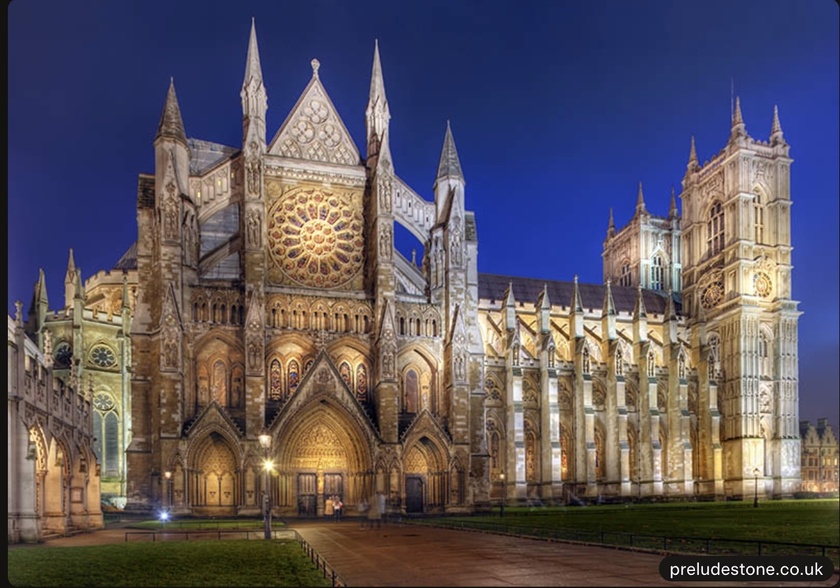
The present Gothic church of Westminster Abbey (Collegiate Church of St Peter) was consecrated on 13 October 1269 under Henry III. He had begun rebuilding Edward the Confessor’s Romanesque abbey in 1245 in the new French Gothic style, intending it as a royal coronation and burial church. That day the Confessor’s remains were translated to the new shrine. The nave was unfinished at Henry’s death; the older structure stood attached for decades. It remains a coronation site and burial place of monarchs.

My Favourite Buildings…Westminster Abbey | Prelude Stone

1307: Arrest of the Knights Templar

On Friday, 13 October 1307, agents of King Philip IV of France simultaneously arrested hundreds of Knights Templar across the kingdom, including Grand Master Jacques de Molay. Philip, heavily in debt to the wealthy military order, used charges of heresy, blasphemy, and idolatry (extracted under torture). The move, coordinated with a compliant Pope Clement V, led to the order’s suppression in 1312. De Molay was later burned in 1314. The date is often linked (retrospectively) to Friday-the-13th superstition, though that association is modern.

1332: Brief reign of Rinchinbal Khan (Ningzong)

Rinchinbal (born 1326), a young son of Kusala (Emperor Mingzong), was installed as Khagan of the Mongols and Emperor Ningzong of the Yuan dynasty. Scholarly sources (including Wikipedia) date the enthronement to 23 October 1332; some popular “on this day” compilations list the 13th—likely a calendar-conversion or secondary-source discrepancy. He reigned only until his death on 14 December 1332 (roughly 53 days) at age six. Court politics then brought in his half-brother Toghon Temür. The empire was already fragmenting.

1582: The day that did not exist (Gregorian reform)

In Italy, Poland, Portugal, and Spain, 5–14 October 1582 simply did not occur. Pope Gregory XIII’s bull Inter gravissimas ordered the jump from Thursday 4 October to Friday 15 October to correct the Julian calendar’s drift relative to the equinoxes (critical for calculating Easter). Those ten days were omitted at once in the adopting territories. Protestant countries delayed for decades or centuries; Britain and its colonies switched in 1752.

1644: Battle of Fehmarn

A Swedish–Dutch fleet under Carl Gustaf Wrangel and Dutch commanders defeated a Danish fleet near the island of Fehmarn in the Baltic during the Torstenson War (part of the Thirty Years’ War). The Allies fielded roughly 37 ships; the Danes about 17. Denmark lost 10 ships captured, others wrecked or sunk, and about 1,000 prisoners (including senior officers); Admiral Pros Mund was killed. The victory strengthened Swedish naval dominance in the Baltic and helped force the Treaty of Brömsebro (1645).

1710: Fall of Port Royal (Acadia)

After a siege beginning around 5 October, the French capital of Acadia, Port Royal (present-day Annapolis Royal, Nova Scotia), surrendered to British forces under Francis Nicholson on 13 October 1710 during Queen Anne’s War. The British renamed it Annapolis Royal. This was a key step in the eventual British control of Nova Scotia (formalized later by the Treaty of Utrecht). Note: this is distinct from the Jamaican Port Royal destroyed by earthquake in 1692.

1773: Discovery of the Whirlpool Galaxy

French astronomer Charles Messier discovered the object later catalogued as M51 (the Whirlpool Galaxy) on 13 October 1773 while searching for comets. He described it as a faint nebula. In 1845 Lord Rosse first resolved its spiral structure with his large reflector—the first “spiral nebula” so identified. It is a classic interacting grand-design spiral in Canes Venatici, with companion NGC 5195.

Out of this whirl: The Whirlpool Galaxy (M51) and companion galaxy | ESA/ Hubble

1775: Birth of the Continental Navy

Meeting in Philadelphia, the Second Continental Congress ordered the fitting out of two armed vessels (with carriage guns and swivel guns, crews of 80) to intercept British supply ships. This 13 October resolution is regarded as the founding act of the Continental Navy, predecessor of the U.S. Navy. A Naval Committee soon followed, and the force grew rapidly as the Revolution progressed.

1792: White House cornerstone laid

In the new federal capital of Washington, D.C., the cornerstone of the Executive Mansion (later the White House) was laid on 13 October 1792. Irish-born architect James Hoban designed the neoclassical building (influenced by Leinster House in Dublin); George Washington had selected the site. Construction used both free and enslaved labor. John Adams became the first president to occupy it in 1800. The name “White House” arose from the white-gray sandstone that contrasted with nearby red brick.

Architecture: 1850s-1890s - White House Historical Association

1793: First Battle of Wissembourg

In the War of the First Coalition, an Austro-Prussian force under Dagobert von Wurmser (with Hessian and émigré contingents) attacked the French Army of the Rhine under the inexperienced Jean Pascal Carlenc at the Lines of Wissembourg (Alsace). The Allies broke the French positions on 13 October; the French retreated in disorder toward Strasbourg, losing guns and prisoners. Carlenc was soon arrested and replaced by Jean-Charles Pichegru. A French counteroffensive later that winter (Second Battle of Wissembourg / Geisberg) reversed the gains.

These episodes illustrate recurring themes: contested successions and court intrigue (Claudius/Nero, Yuan child emperor), the sudden application of state power against wealthy or independent orders (Templars), calendar and institutional foundations (Gregorian reform, Continental Navy, White House), and the military and migratory pressures that reshaped late antiquity and early modern Europe. The Whirlpool discovery stands apart as a quiet scientific milestone that later helped redefine the scale of the universe.

Read full Article
See More
Available on mobile and TV devices
google store google store app store app store
google store google store app tv store app tv store amazon store amazon store roku store roku store
Powered by Locals