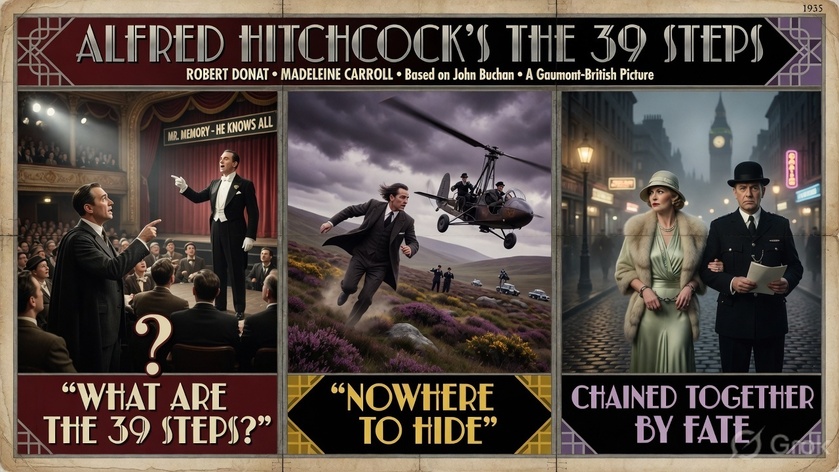
Alfred Hitchcock’s 1935 adaptation of John Buchan’s novel remains one of the most delightful and influential thrillers ever made — a perfect showcase of the director’s emerging “Hitchcockian” artifice. With economical editing, sly visual wit, and a relentless forward momentum, Hitchcock turns a straightforward spy chase into a sparkling entertainment that blends suspense, romance, and dry British humour. Robert Donat’s portrayal of Richard Hannay anchors the film with effortless charisma that never overwhelms the story.
Hannay is the quintessential capable innocent: a decent, resourceful everyman thrust into a world of jaded, cynical spies and double-crossers. Fresh from the colonies (reimagined as Canadian in the film), he stumbles into intrigue after a beautiful, dark-haired woman — Annabella Smith (Lucie Mannheim) — bursts into his life with urgent secrets, only to die in his apartment, leaving him framed for her murder. From there, Hannay is propelled on a breathless journey northward, eventually handcuffed (literally and figuratively) to a cool, elegant blonde, Pamela (Madeleine Carroll). Their reluctant partnership crackles with sexual tension and witty banter, one of the film’s greatest pleasures.
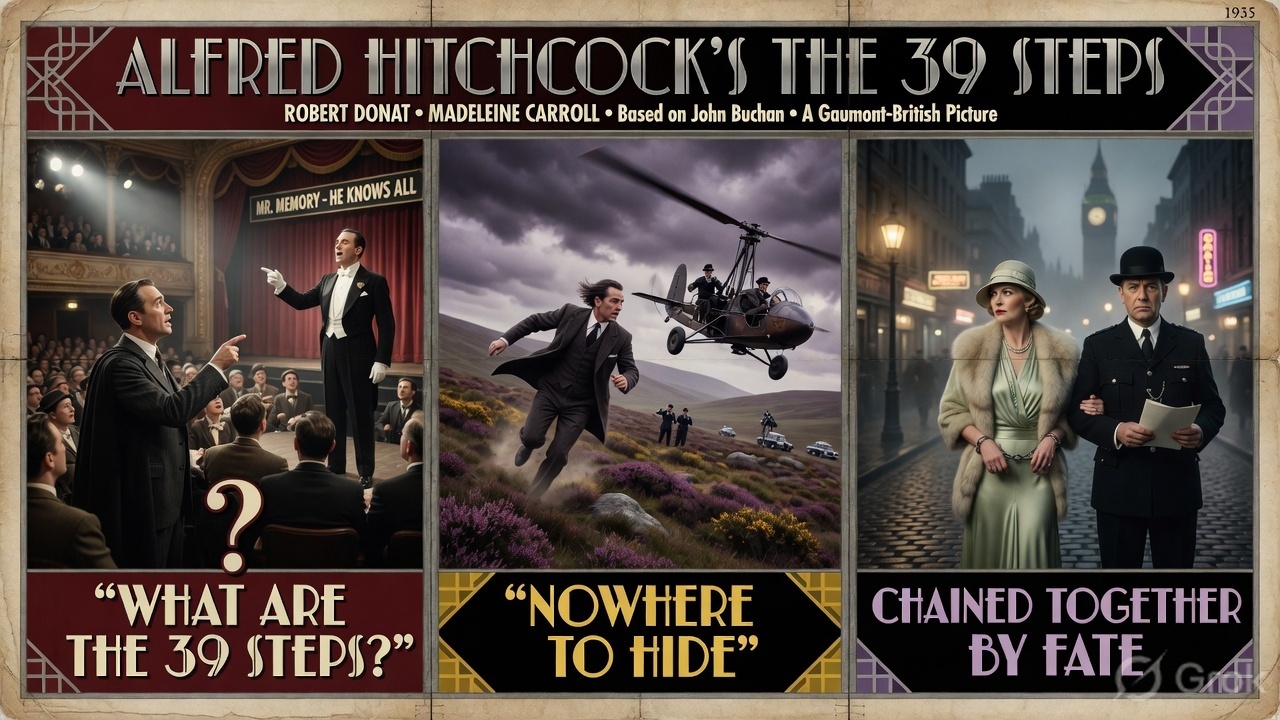
Hitchcock’s directorial touches shine throughout. He employs his signature MacGuffin (the secret of the 39 Steps), rapid montage, and clever visual puns. One inspired inclusion is the autogyro (gyrocopter) sequence over the Scottish moors. Hitchcock had heard that Scottish industrialist and aviation pioneer James G. Weir commuted daily in his own autogyro, and he couldn’t resist working the novel machine into the police pursuit of Hannay. It adds a flash of futuristic flair to the 1935 landscape — a brief, memorable moment that feels both playful and cutting-edge for its time.
Another standout sequence involves the lonely young wife (Peggy Ashcroft) of a dour, elderly crofter (John Laurie) in the remote Scottish Highlands. Married to a jealous, pious older man, she finds a fleeting connection with the courteous Hannay. In 1935, her isolation felt tragically believable — farms were genuinely cut off from communities, with no easy escape. Today’s viewers might instinctively wonder why she didn’t just catch a bus, train, or Zoom her friends for support. That cultural shift only underscores how effectively Hitchcock captured a vanishing world of quiet desperation.
What makes Donat’s Hannay so enduring is how lightly he wears his stardom. Unlike more bombastic leading men who might dominate every frame, Donat’s presence feels natural and unintrusive. He is charming without smugness, heroic without arrogance. Hannay fights to survive, knows right from wrong, and remains decent even in victory. He isn’t mean-spirited in success. In our current era of cynicism and moral ambiguity, one can’t help wishing for more figures like him quietly serving British (or any nation’s) interests — principled, competent, and quietly patriotic.
The 39 Steps is more than a thriller; it’s a blueprint for the modern chase film and a testament to Hitchcock’s genius for making the ordinary extraordinary. Tight, witty, visually inventive, and still remarkably fresh after ninety years, it rewards repeated viewings. If you haven’t seen it lately, remedy that immediately. Donat’s Hannay is the kind of hero we still need.