VoiceDDB
Politics • Culture • News
The Tragic Shootdown of BOAC Flight 777
Echoes Across Decades
June 01, 2026
post photo preview

Editorial: The Tragic Shootdown of BOAC Flight 777 – Echoes Across Decades

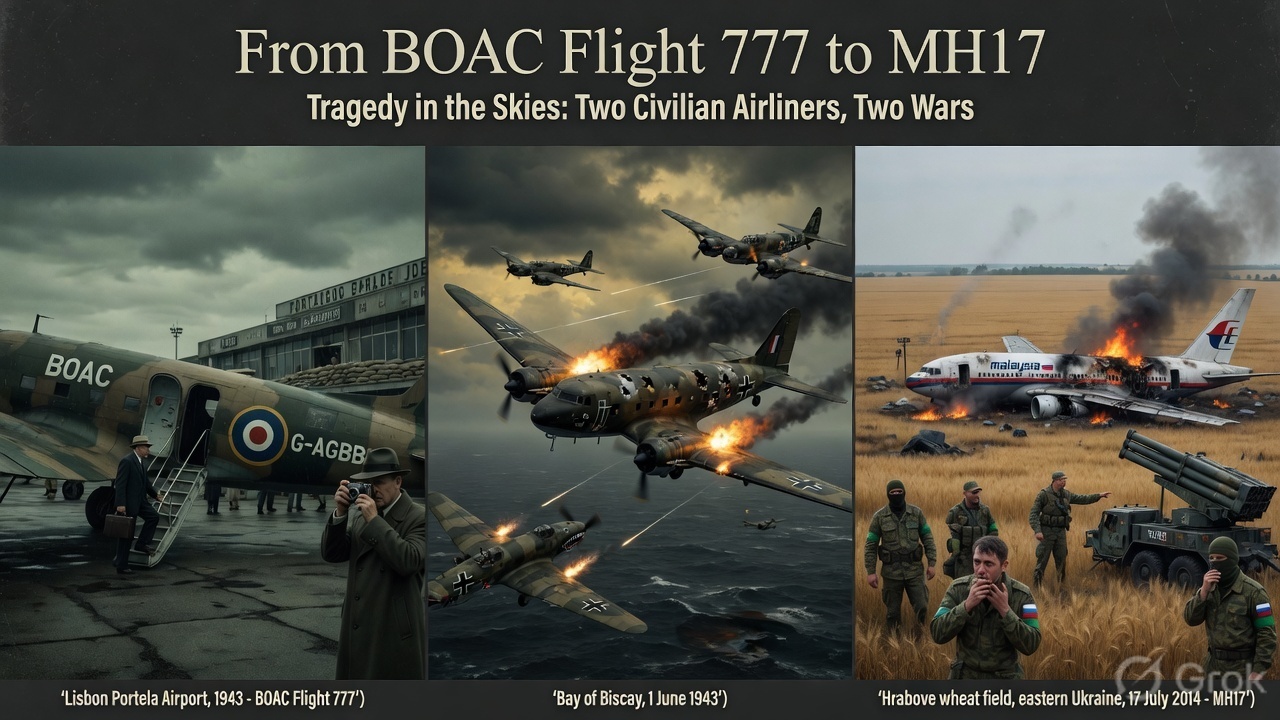
On 1 June 1943, over the Bay of Biscay, eight German Junkers Ju 88 fighters attacked and destroyed an unarmed civilian Douglas DC-3 operating as BOAC Flight 777 (KLM flight 2L272). All 17 people aboard perished, including the beloved British actor Leslie Howard. Among the passengers were Reuters journalist Kenneth Stonehouse and his wife, BP/Shell executive and SOE agent Tyrrell Shervington, and the remarkable Jewish philanthropist Wilfred Israel, who had saved thousands of Jews from Nazi persecution through the Kindertransport and other rescue efforts.

The parallels with the 2014 shootdown of Malaysia Airlines Flight MH17 over Ukraine are striking in their tragedy and controversy. In both cases, a civilian airliner was brought down in a contested airspace during a major conflict, resulting in the deaths of innocents. Both incidents sparked intense speculation, competing narratives, and accusations of deliberate targeting versus mistaken identity. Questions linger in each: Was it a tragic error in the fog of war, or something more calculated?

The Facts of Flight 777

The DC-3 Ibis departed Lisbon’s Portela Airport bound for Bristol. Lisbon was a neutral hub teeming with spies from both sides, and passenger lists were likely monitored. The aircraft had been repainted in military-style camouflage (dark green/brown) with British civil markings — a decision some later criticized, as earlier KLM aircraft had used bright orange for visibility. The German pilots, on a maritime patrol protecting U-boats, engaged what they reported as a suspicious aircraft. The unarmed airliner was strafed repeatedly and crashed into the sea.

Why This Flight? Enduring Questions

The “why” remains unresolved more than 80 years later. The most widely circulated contemporary theory — that the Germans mistook the flight for one carrying Winston Churchill (due to the physical resemblance of Howard’s manager Alfred Chenhalls) — has been largely dismissed by historians as unlikely. Churchill’s movements at the time do not align neatly, and the timing feels too coincidental.

Other credible possibilities exist:

  • Leslie Howard as Target: Howard was a highly effective anti-Nazi propagandist through films like Pimpernel Smith. His son Ronald Howard concluded that Joseph Goebbels personally wanted him eliminated. Howard’s Jewish heritage and rumored intelligence connections added to the motive.
  • High-Value Passengers: Wilfred Israel’s humanitarian work directly undermined the Nazi regime by rescuing Jews. Tyrrell Shervington’s intelligence role and other passengers with tungsten trade or journalistic ties made the flight a potential intelligence prize. German agents in Lisbon almost certainly knew who was aboard.
  • Target of Opportunity: The Bay of Biscay was a deadly combat zone. The Ju 88s were hunting threats to U-boats. A camouflaged aircraft in the wrong place at the wrong time may simply have been engaged without full awareness of its civilian status.

Allied intelligence (including ULTRA) may have known of risks but chose not to act to protect sources — a painful but recurring wartime dilemma.

Parallels with MH17

Like BOAC Flight 777, Malaysia Airlines Flight MH17 was a civilian airliner shot down amid an intense geopolitical conflict, claiming 298 lives. In both cases, the perpetrators — the German Luftwaffe in 1943 and Russian-backed separatists armed with a Buk missile in 2014 — operated in highly contested airspace. Both tragedies quickly spawned competing narratives: tragic accident or mistaken identity on one hand, versus deliberate provocation or targeting on the other.

While the circumstances differ significantly, certain parallels persist. In the case of MH17, Ukrainian forces reportedly used radar illumination (“painting”) on the civilian flight in an effort to deter or lure Russian-backed systems, a tactic born of frustration after repeated losses of their own military transports. That action itself constituted a serious breach of international norms. Nevertheless, it was pro-Russian separatists who ultimately fired the missile that destroyed the aircraft. What began as a tragic miscalculation was later exploited for propaganda purposes, including by Western signals intelligence following an apparent apology to Putin.

By contrast, BOAC Flight 777 appears to have been more deliberately targeted. The aircraft’s dark military-style camouflage, rather than bright civilian livery, reduced its visibility as a passenger plane and likely increased its vulnerability in the war zone. Far from serving as a trap, this made it easier for German fighters to engage what they viewed as a legitimate or high-value target. Evidence suggests the flight was marked from departure in Lisbon, possibly as a showcase warning — particularly given the presence of Wilfred Israel, whose heroic efforts to rescue Jews directly challenged the Nazi regime.

Such parallels remind us how swiftly tragedy can be transformed into propaganda. In both cases, the profound human cost — devastated families and the loss of prominent figures — risks being overshadowed by strategic narratives and competing geopolitical agendas.

A Warning Shot?

The idea that Flight 777 served as a deliberate warning to those aiding Jews, with Wilfred Israel as the symbolic target, is emotionally resonant but remains speculative. The Nazis’ genocidal machinery needed no such public signals; they operated with ruthless efficiency regardless. Yet Israel’s presence undeniably made the flight a high-value target for those who viewed Jewish rescue as an existential threat to their ideology.

What we do know is this: In total war, civilian lives were often expendable. Neutral routes offered no real protection. BOAC Flight 777 stands as a grim reminder of the blurred lines between combatant and non-combatant, and how intelligence, propaganda, and raw military power can converge on a single flight with lethal consequences.

Eighty-three years on, the full truth may never emerge from sealed files or destroyed records. But we remember the victims: Leslie Howard, Wilfred Israel, Kenneth Stonehouse, Tyrrell Shervington, and the others who simply boarded a plane home. Their deaths demand we remain skeptical of easy official stories — whether in 1943 or 2014 — and vigilant against the dehumanizing logic of war.

community logo
Join the VoiceDDB Community
To read more articles like this, sign up and join my community today
0
What else you may like…
Videos
Posts
Articles
00:01:07
November 27, 2022
Jingle Bell Rock

Jingle bell, jingle bell, jingle bell rock
Jingle bells swing and jingle bells ring
Snowin' and blowin' up bushels of fun
Now the jingle hop has begun

Jingle bell, jingle bell, jingle bell rock
Jingle bells chime in jingle bell time
Dancin' and prancin' in Jingle Bell Square
In the frosty air

What a bright time, it's the right time
To rock the night away
Jingle bell time is a swell time
To go glidin' in a one-horse sleigh

Giddy-up jingle horse, pick up your feet
Jingle around the clock
Mix and a-mingle in the jinglin' feet
That's the jingle bell rock

Jingle bell, jingle bell, jingle bell rock
Jingle bell chime in jingle bell time
Dancin' and prancin' in Jingle Bell Square
In the frosty air

What a bright time, it's the right time
To rock the night away
Jingle bell time is a swell time
To go glidin' in a one-horse sleigh

Giddy-up jingle horse, pick up your feet
Jingle around the clock
Mix and a-mingle in the jinglin' feet
That's the jingle bell
That's the jingle...

00:02:04
September 01, 2021
Intro to Locals for the Conservative Voice

David Daniel Ball calls himself the Conservative Voice.

I'm a teacher with three decades experience teaching math to high school kids.I also work with first graders and kids in between first grade and high school. I know the legends of why Hypatia's dad is remembered through his contribution to Math theory. And I know the legend of why followers of Godel had thought he had disproved God's existence.

I'm not a preacher, but I am a Christian who has written over 28 books all of which include some reference to my faith. Twelve blog books on world history and current affairs, detailing world events , births and marriages on each day of the year, organised by month. Twelve books on the background to and history of Bible Quotes. One Bible quote per day for a year. An intro to a science fiction series I'm planning, post apocalyptic cyber punk. An autobiography with short story collections.

I'm known in Australia for my failure as a whistleblower over the negligence death of a school boy. ...

00:01:50
September 04, 2026
Should violent criminals be made fat? Grok says 'no'

No. Transferring gut bacteria from an obese person into a violent criminal is not a reliable, ethical, or effective way to make them “fat, sedentary, and less of a physical threat.”

The science does not deliver the outcome you want

Mouse studies in germ-free animals showed that microbiota from obese donors can increase energy harvest and adiposity compared with lean-donor microbiota. That is the origin of the idea. Human evidence is far weaker.

Randomized trials of fecal microbiota transplant (FMT) from lean donors into people with obesity have generally failed to produce meaningful, sustained weight loss. Microbiome composition can change; body weight and metabolic markers often do not, or the effects are small and inconsistent. Diet and the existing gut environment usually dominate. A 2025 Nature paper found diet outperformed microbial transplant for microbiome recovery. Human guts are already colonized, not sterile like lab mice, so engraftment is variable and effects unpredictable.

It is not a ...

post photo preview
August 28, 2026
Pfizer struggles to answer

Some in Australia are brilliant. Malcolm Roberts Investigates Pfizer over Covid vaccine.

Holiday break is over back to work tonight

Tonight I'll start double posting until I've caught up.

post photo preview
Lindbergh an elite criminal?
Eugenics is not a mild character flaw

“Who Kidnapped the Lindbergh Baby?” is a ~77-minute America’s Untold Stories livestream (Mark Groubert and Eric Hunley, July 2022). It is not a closed “we solved it” documentary. It walks through the official story, then spends most of its time on the oddities, weak points in the Hauptmann case, and the theories that have never gone away.

What the hosts cover

They start with Lindbergh’s status: in 1927 he was not just a famous pilot but, in their phrasing, a combination of Neil Armstrong, a superstar athlete, and a rock star. He married Anne Morrow; they were building a large New Jersey estate (Highfields) they typically used on weekends. On Tuesday 1 March 1932 they were there because the 20-month-old, Charles Jr., had a cold. Around 9–10 p.m. nurse Betty Gow found the crib empty. A ransom note was on the windowsill. A homemade three-section ladder lay below, one rung broken.

The hosts stress details that still bother researchers:

  • The family was not usually there midweek.
  • The house terrier did not bark.
  • Lindbergh later said he heard a cracking sound downstairs and did not immediately go up.
  • Re-enactments with a sandbag the baby’s weight snapped the same rung; many people think the child was dropped and died that night from a skull fracture.
  • The body was found 12 May, only a few miles away, badly decomposed but still in the sleeping suit.

They recount the ransom trail: retired teacher John F. Condon (“Jafsie”) as go-between, cemetery meetings with a German-accented “Cemetery John,” $50,000 in gold certificates paid, a bogus note about a boat called Nelly, then nothing. In 1934 a marked gold certificate at a Bronx gas station led to carpenter Bruno Richard Hauptmann. Police found more ransom money in his garage, Condon’s number written in a closet, and wood they said matched the ladder. The 1935 Flemington trial was a media circus. Hauptmann was convicted and electrocuted in 1936 while maintaining innocence.

What they argue is still open

The hosts treat Hauptmann as possibly involved (the money is hard to explain away) but not as a clean lone-wolf solution. They flag:

  • No fingerprints of his in the nursery or on the note.
  • Condon’s first lineup identification was shaky.
  • Handwriting and ladder-wood evidence have been attacked as overstated or contaminated.
  • The investigation was dominated by Lindbergh himself; staff were not fully isolated from him.
  • Governor Hoffman later doubted the verdict.

They lay out the usual competing theories without picking a winner: an inside job or household help; a second man with Hauptmann; Robert Zorn’s candidate John Knoll as “Cemetery John”; and the darker line (Lloyd Gardner, Lise Pearlman and others) that Lindbergh’s eugenics views, the child’s reported health problems (rickets-like issues, large head), his control of the inquiry, and the rushed cremation point toward the father covering something up. They call these “dots that are not connected” and say nobody has all the answers.

Bottom line of the video: the official story is Bruno Hauptmann acting alone for ransom, the baby dying (likely by accident) during the abduction. The show’s position is that the case is still the first great American true-crime mystery—money ties Hauptmann to the ransom, but the kidnapping itself, the number of people involved, and whether the executed man was the only or even the main perpetrator remain contested.

=

Hauptmann's posession of the money elevates the Lindbergh complicity because Lindbergh had the money to make the frame. That doesn't prove anything. - ed

=

You’re right on the logic, and right on the limit.

Hauptmann having a large stash of the marked gold certificates is the single strongest fact against him. It is not, by itself, proof that he built the ladder, entered the nursery, or killed the child. Money in a garage shows he handled the proceeds, or handled proceeds that someone else had already taken. It does not uniquely identify who climbed the wall.

The frame version of the same fact is also coherent as a possibility:

  • The ransom left Lindbergh’s control when Condon handed it over.
  • After that, anyone who ended up with a bundle of those bills could hide them on a carpenter who already looked like “Cemetery John,” spoke with a German accent, and had no clean story.
  • Lindbergh was rich, famous, ran much of the investigation, limited who police could question, and had every incentive to produce a culprit. In that narrow sense, “he had the means to complete a frame” is true.

That still does not prove he did it. A frame needs more than opportunity and motive-in-theory. It needs a path for the bills from the cemetery drop to Hauptmann that does not go through Hauptmann as the recipient, plus an explanation for the attic rail, the handwriting matches (disputed as they are), the closet phone number, and why a man facing the chair never produced Fisch or anyone else who could take the money off him. Those pieces can all be attacked. They cannot all be wished away by saying “the family had cash.”

So the money cuts both ways:

  • Official story: he had it because he took it.
  • Complicity/frame story: he had it because it was put there, or because he was a cut-out.

Neither reading is forced by the bills alone. Possession raises the cost of calling Hauptmann a total stranger to the crime. It does not close the case that Lindbergh arranged the death or the frame. That remains what it was in the video and in the fringe books: a pattern of control, oddities, and eugenic worldview that could fit a darker story, not a demonstration that it happened.

Read full Article
September 07, 2026
post photo preview
What will one do for love?
Love endures, even the passing of the loved one.

What will one do for love?

On 10 September 1547, two regents met in a field east of Edinburgh and tried to settle a marriage by cannon. On 10 September 1846, almost three centuries later to the day, a poor Cambridge machinist was granted a patent for a machine born of watching his wife sew. One story is about a crown that would not take no for an answer. The other is about a household that could not afford to keep sewing by hand. Both ask the same question: what will one do for love—or for the thing one has decided to call love?

Henry VIII wanted his son Edward married to the infant Mary, Queen of Scots. The Treaty of Greenwich of 1543 was the polite version. The Scots rejected it and looked to France. Henry died in January 1547. His brother-in-law, Edward Seymour, Duke of Somerset, Lord Protector for the nine-year-old Edward VI, did not drop the project. He wanted the marriage and an English-style reformation of the Scottish church. When talk failed, he marched. James Hamilton, Earl of Arran, governed for five-year-old Mary. So the last full-scale battle between the independent kingdoms of England and Scotland was fought by two men acting for children who could not yet choose.

Somerset brought about 16,800 fighting men, a heavy gun train, German arquebusiers, some 6,000 horse, and a fleet of about thirty ships. Arran had more men—most estimates sit near 22,000 to 23,000, some higher—chiefly pikemen, Highland archers, and light Border horse. On 9 September the Scottish cavalry was broken in a foolish, chivalric challenge on Falside Hill. On the morning of the 10th Arran left a strong position west of the Esk and came on in pike columns, perhaps fearing the English would seize the Inveresk slopes, perhaps mistaking a movement toward the guns for a retreat to the ships. English warships raked his left. Field guns, arquebuses, and bows found the crowded columns. The Scots drove off a cavalry charge and nearly took the royal standard, then stalled under fire from three sides and broke. The pursuit ran for miles toward Edinburgh and Leith. The Esk ran red. English dead numbered a few hundred. Scottish dead were in the thousands; Huntly’s figure of about 6,000 is more credible than the English claim of 14,000 or 15,000. Scotland called it Black Saturday.

Somerset occupied ground and planted garrisons. He did not get the girl. Mary was moved, then sent to France in 1548 to marry the Dauphin. The Auld Alliance was renewed. The occupation bled the English treasury. Peace came in 1551. The marriage England had sought at the point of a pike never happened. Pinkie was militarily modern—infantry, horse, field artillery, and naval guns used together—and politically barren. That is what a dynasty will do when it confuses alliance with affection.

Elias Howe Jr. was not a duke. He was born in 1819 in Spencer, Massachusetts, a journeyman machinist, later in Cambridge, poor. His wife Elizabeth took in sewing. Earlier patented machines existed; John Greenough’s 1842 patent was the first American sewing-machine grant. Most of them made a chainstitch. Howe watched his wife and decided a machine should not copy the motion of a human arm. George Fisher boarded the family and put in $500 for a half-share. By April 1845 Howe had a working model that sewed two woollen suits. On 10 September 1846 he received U.S. Patent 4,750, the fifth American sewing-machine patent and the first for a practical lockstitch: a curved eye-pointed needle on a vibrating arm, thread from a spool, a shuttle with a second thread locking the loop, and an automatic feed. About 250 stitches a minute. He did not invent the eye-pointed needle. He made the combination work.

American tailors were cold. Howe’s brother Amasa took the idea to England. William Thomas bought rights and patented there that December. The English venture failed. Howe came home in debt. Elizabeth died in 1849. Isaac Singer and others sold machines on the same lockstitch principle. Howe spent years in court. The courts held his patent basic. In 1856 the makers formed a patent pool. Howe took royalties—commonly given as five dollars a machine in the United States and one dollar on exports—and over the life of the patent, extended to 1867, on the order of two million dollars. He later built machines at Bridgeport, showed them at expositions, took a Paris gold medal and the Légion d’honneur. Singer sold the household machine. Howe established the stitch.

It is easy to over- sweeten this. Howe was not a saint of domestic piety. He became rich by defending a patent, not by putting a machine in every kitchen. Manchester’s mills were already a fact of the textile age; Howe’s lockstitch was an American mechanical solution that industry and later the home adopted. Still, the origin is not a treaty. It is a man who could not watch his wife’s hands work forever without trying to change the work.

Set the two Septembers side by side and the word love splits. Somerset’s love was policy: a child-bride as instrument of union and reform, enforced by combined arms on the Esk. Howe’s was narrower and more honest: a wife sewing because there was no other money, and a mind that refused to treat her labour as unchangeable. One campaign kidnapped a kingdom’s future and lost the prize. The other began in a rented room and, after ruin, lawsuits, and a grave, altered how cloth is joined.

What will one do for love? Some will burn a country to secure a marriage that never takes place. Some will stay at the bench until a needle and a shuttle lock two threads. History is not obliged to prefer the second. It is obliged to notice that they are not the same thing. Within 60 years of the battle, England and Scotland united, remaining so today.


Read full Article
September 07, 2026
post photo preview
Decoding “states’ rights” as the phrase is used now
Democrats favour corruption

Decoding “states’ rights” as the phrase is used now

When the SAVE Act is discussed, the reply is often that “states’ rights” are being brushed aside: Washington must not dictate how a state runs its elections. The echo is old. Before the Civil War the same words were used to defend a state’s right to keep people as property. Then and now the slogan is thinner than it sounds.

A democracy has a duty of care over the roll. Who may vote is not a local folkway like a county fair rule. It is the boundary of the political community. Australia learned that the ordinary way. Into the early 1980s a person did not have to be a citizen to vote; British subjects and permanent residents could sit on the roll. The Hawke government required citizenship and grandfathered those already enrolled. That is a world away from an undocumented registrant, or a system that treats photo ID as an outrage. A permanent resident is known to the state. An unverified ballot is not.

Used as a shield, “states’ rights” often means: do not look too closely at the practice. Slavery was defended that way. It was also a bad bargain next to open labour and capital. Rome, for all its cruelty, still treated bondage as a legal condition many people passed through. After Spartacus was destroyed in 71 BC—legions in the field, then some six thousand crosses along the Appian Way—Rome did not slam the legal door. A slave remained a res under the master’s power, but the peculium let skilled and urban slaves handle money as if it were theirs and buy freedom. Formal manumission could make a libertus a citizen with duties to a patron. Race was not the test. A Greek tutor and a mine slave were both servi.

South Carolina was already a different machine in 1738. The 1712 code treated Negroes, Indians (except allied free Indians), mulattoes and mustizoes as “absolute slaves” and “chattels personal,” status following the mother, unfit for English common law. After the Stono Rebellion of 1739 the Negro Act of 1740 locked the system: no independent plots or hire, no assembly, no writing, no drums, manumission only by act of the legislature, any white man empowered to stop a Black person off the plantation, killing a slave reduced to a fine. That code, not the older one, ran to 1865.

Rome answered revolt with steel and left the statutes elastic. Carolina answered revolt with a statute and closed the exits. A century later the Supreme Court, in Dred Scott (1857), could not find a free man free because of race. That is the fruit of a closed racial caste, not of “states’ rights” as a neutral principle.

The Temple in Jerusalem was destroyed in AD 70 after a Jewish revolt against Rome. It was not sacked because Jews were “one in six” in the city of Rome. Mixing that episode with Carolina’s Black majority only muddies the point. The point is simpler. When “states’ rights” means a state may keep an unverifiable roll, or once meant a state may keep a man as a chattel with no path out, the phrase is doing offensive work. Government that asks for proof of citizenship is not inventing a new tyranny. It is doing the duty the older slogan was written to dodge.

Rome and Carolina shared the word slave. They did not share the method. Citizenship and the ballot are the same kind of line. Either the line is real, or “rights” is only a costume for the practice you refuse to defend in plain speech.

Read full Article
See More
Available on mobile and TV devices
google store google store app store app store
google store google store app tv store app tv store amazon store amazon store roku store roku store
Powered by Locals