



Toby or not Toby
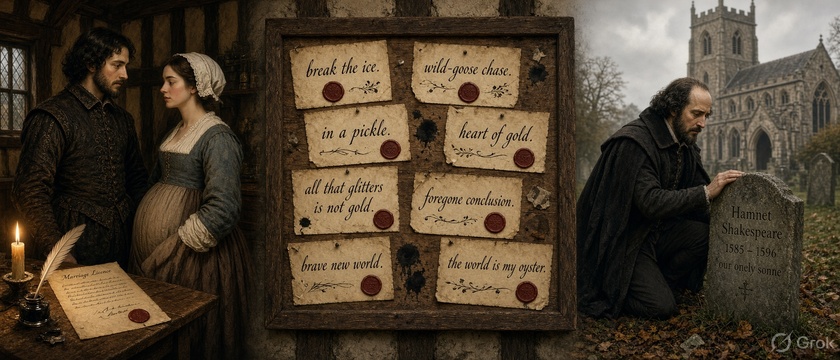
On 28 November 1582, two Stratford farmers posted a £40 bond in the Worcester diocese guaranteeing there was no lawful impediment to the marriage of William Shakespeare (about 18) and Anne Hathaway (about 26). This allowed them to marry after the banns had been asked only once, rather than the usual three times.
Before the bond
William Shakespeare was baptized on 26 April 1564 at Holy Trinity Church, Stratford-upon-Avon, the son of John Shakespeare (a glover, wool dealer, and former town bailiff/alderman) and Mary Arden. He almost certainly attended the local grammar school. By the late 1570s his father’s finances had declined—he fell behind on taxes, mortgaged property, and stepped back from public life.
Anne Hathaway (also referred to as Agnes in some records) was born around 1556 in Shottery, a hamlet about a mile west of Stratford. She was the daughter of Richard Hathaway, a yeoman farmer who held Hewlands Farm (now known as Anne Hathaway’s Cottage). Richard died in September 1581; his will left Anne a dowry of ten marks (£6 13s 4d) to be paid on her wedding day and named Fulk Sandells as a supervisor. In the will she appears as “Agnes,” but Agnes and Anne were often used interchangeably at the time.
The couple were already expecting a child. Anne’s pregnancy made a quick marriage necessary: Advent began on 2 December 1582, and marriages were customarily prohibited during Advent until after Epiphany. A special licence was therefore required so the banns could be read only once. On 27 November 1582 the Bishop of Worcester’s register recorded a licence for “Wm Shaxpere et Annam Whateley de Temple Grafton.” Most scholars treat “Whateley” and the place-name as a clerical error for Hathaway of Stratford (or Shottery); no other contemporary evidence supports a different bride. The exact church where the ceremony took place is unknown—it was not recorded in the Stratford parish register, and several nearby registers for the period do not survive.
The bond itself (28 November 1582)
The next day, Fulk Sandells and John Richardson—both described as husbandmen (farmers) of Stratford and friends/neighbours of the Hathaway family—entered into a £40 bond. They guaranteed to the bishop’s officials that:
- there was no pre-existing contract, consanguinity, affinity, or other lawful impediment;
- no lawsuit alleging such an impediment was pending;
- Shakespeare would not marry without the consent of Anne’s friends; and
- the couple could marry after the banns had been asked only once.
Shakespeare, being under 21, could not act as his own surety, and his father did not. Anne’s father was already dead. The sureties came from the Hathaway side (Sandells had been named in Richard Hathaway’s will). The bond protected the bishop from liability if the marriage later proved invalid. This procedure was common when a licence was used to shorten the banns period.
After the marriage
Their daughter Susanna was baptized at Holy Trinity Church, Stratford, on 26 May 1583—roughly six months later, confirming that Anne was pregnant at the time of the wedding. Twins Hamnet and Judith were baptized on 2 February 1585. The family initially lived in John Shakespeare’s house on Henley Street (the building now known as Shakespeare’s Birthplace).
Sometime after the birth of the twins, Shakespeare left for London (the so-called “lost years” until he appears in the London theatrical world by 1592). He became a leading member and shareholder of the Lord Chamberlain’s Men (later the King’s Men), wrote the bulk of his plays and sonnets, and in 1597 bought New Place, one of the largest houses in Stratford. Anne and the children remained primarily in Stratford. Their only son, Hamnet, died in August 1596 at the age of 11.
Shakespeare died on 23 April 1616. In his will he left Anne the “second-best bed”—a bequest that has attracted much later commentary. Anne died on 6 August 1623 (aged about 67) and was buried beside him in Holy Trinity Church.
Significant figures
- William Shakespeare (1564–1616) — the groom; future playwright and actor.
- Anne Hathaway (c. 1556–1623) — the bride; daughter of Richard Hathaway of Shottery.
- John Shakespeare (d. 1601) and Mary Arden — William’s parents.
- Richard Hathaway (d. 1581) — Anne’s father; left her a marriage portion.
- Fulk Sandells and John Richardson — Stratford farmers who posted the £40 bond; trusted friends of the Hathaway family.
- John Whitgift, Bishop of Worcester — the official whose registry issued the licence.
- Children: Susanna (1583–1649, later Hall), Hamnet (1585–1596), and Judith (1585–1662, later Quiney).
The surviving documents are fragmentary, and the precise date and location of the wedding ceremony itself are not recorded. What is clear is that the marriage was arranged quickly because of Anne’s pregnancy, that the legal formalities were completed on 27–28 November 1582, and that the couple went on to have three children while Shakespeare pursued his career in London.
= November 28th
These are all events that occurred on November 28 in their respective years. Here is a concise overview of each, drawn from historical records.
587 – Treaty of Andelot
On 28 November 587 at Andelot-Blancheville, King Guntram of Burgundy and Queen Brunhilda (acting for her son, King Childebert II of Austrasia) signed the Treaty of Andelot. Guntram, who was childless, formally recognized Childebert II as his heir and ally against rebellious Frankish nobles (leudes). The agreement settled territorial disputes (including cession of Tours and other areas to Childebert) and was recorded by Gregory of Tours in his Historia Francorum. It helped stabilize the Merovingian kingdoms of Burgundy and Austrasia.
936 – Shi Jingtang enthroned as emperor of Later Jin
On 28 November 936, Shi Jingtang (a Shatuo Turkic general and son-in-law of a prior Later Tang ruler) was proclaimed Emperor Gaozu of the Later Jin dynasty by Emperor Taizong of the Liao (Khitan) dynasty. This followed Shi’s revolt against Emperor Fei (Li Congke) of Later Tang. In exchange for Liao military support, Shi acknowledged Taizong as a father figure, paid annual tribute, and ceded the strategically vital Sixteen Prefectures of Yanyun. This founded the short-lived Later Jin (936–947) during China’s Five Dynasties and Ten Kingdoms period.
1443 – Skanderbeg liberates Kruja
On 28 November 1443, Gjergj Kastrioti (Skanderbeg), after deserting the Ottoman army following the Battle of Niš, seized the fortress of Krujë (Kruja) in central Albania with roughly 300 men. Using a forged order (firman) from the sultan, his forces entered the castle, overcame the Ottoman garrison overnight, and raised the Kastrioti double-headed eagle flag. This marked the start of his 25-year resistance against Ottoman rule and the formation of the League of Lezhë.
1470 – Lê Thánh Tông launches campaign against Champa
On 28 November 1470, Emperor Lê Thánh Tông of Đại Việt (Vietnam) formally launched a large-scale attack on the kingdom of Champa. In response to Cham raids (including a reported force of around 100,000 that had besieged a Vietnamese garrison), he led a major naval expedition (with subsequent land forces bringing total strength into the hundreds of thousands). The campaign culminated in early 1471 with the fall of the Cham capital Vijaya, heavy Cham casualties and captives, and the effective end of Champa as a major power, enabling Vietnamese southward expansion.
1520 – Magellan’s expedition completes the Strait of Magellan
On 28 November 1520, Ferdinand Magellan’s fleet finished navigating the strait (entered around 21 October) that now bears his name and emerged into the Pacific Ocean—the first Europeans known to do so via this route. The passage was hazardous; one ship (San Antonio) deserted and returned to Spain. Magellan named the ocean Mar Pacifico (“peaceful sea”) because it appeared calm after the difficult strait. This was a key stage in the first circumnavigation of the globe (completed by survivors of the Victoria in 1522).
1582 – Shakespeare and Anne Hathaway’s marriage bond
On 28 November 1582, a £40 bond was posted (in the Worcester diocese) guaranteeing that there was no lawful impediment to the marriage of William Shakespeare (then about 18) and Anne Hathaway of Stratford (about 26). A licence had been recorded the previous day (with a possible clerical discrepancy naming “Anne Whateley”). The bond allowed a quicker marriage outside the normal banns process; Anne was pregnant, and their daughter Susanna was baptized about six months later. The exact date and place of the ceremony are not recorded in surviving parish registers.
1627 – Battle of Oliwa
On 28 November 1627, the Polish–Lithuanian Commonwealth Navy under Arend Dickmann won its greatest (and last major) victory in the Battle of Oliwa (near Gdańsk/Danzig) during the Polish–Swedish War. A Polish squadron of about 10 vessels broke a Swedish blockade, captured the Swedish flagship Tigern, and sank or damaged other ships. Swedish losses were heavy (hundreds killed or captured); both admirals died (Dickmann from a late shot). The battle briefly lifted the blockade of Gdańsk and boosted Polish prestige, though it did not alter the wider war’s outcome.
1660 – Decision to found the Royal Society
On 28 November 1660, after a lecture by Christopher Wren at Gresham College in London, twelve men—including Wren, Robert Boyle, John Wilkins, and Sir Robert Moray—agreed to establish “a Colledge for the Promoting of Physico-Mathematicall Experimentall Learning.” This meeting is regarded as the founding moment of what became the Royal Society of London. Earlier informal “invisible college” discussions had occurred; the group soon gained royal approval from Charles II, and formal charters followed in 1662–1663. It became a leading institution for experimental science.
1666 – Battle of Rullion Green
On 28 November 1666, roughly 2,000–3,000 men of the Royal Scots Army under Tam Dalyell of the Binns defeated about 900 Covenanter rebels led by James Wallace at Rullion Green in the Pentland Hills near Edinburgh. This ended the short-lived Pentland Rising, sparked by opposition to the restoration of episcopacy in the Church of Scotland. Government losses were light; Covenanter casualties included dozens killed, many captured (with subsequent executions and transportations), and a period of intensified repression followed.
1785 – First Treaty of Hopewell
On 28 November 1785, at Hopewell on the Keowee River (South Carolina), U.S. commissioners (including Benjamin Hawkins, Andrew Pickens, Joseph Martin, and Lachlan McIntosh) signed the first Treaty of Hopewell with Cherokee leaders. It established peace, returned prisoners and property from the Revolutionary War, and defined Cherokee hunting grounds and boundaries (including territory in what is now East Tennessee). It was part of a series of treaties with southern tribes under the Confederation Congress, asserting U.S. authority after independence while addressing land and security issues.
These span Frankish politics, Chinese dynastic transitions, Albanian and Vietnamese resistance/expansion, the Age of Exploration, English literary history, Baltic naval warfare, the birth of modern science, Scottish religious conflict, and early U.S.–Native American relations. All share the same calendar date.