VoiceDDB
Politics • Culture • News
The Jackson-Van Buren Echoes in the Obama-Biden Era
Incompetence Reaps Horror
July 16, 2026
post photo preview

Incompetence Reaps Horror – The Jackson-Van Buren Echoes in the Obama-Biden Era

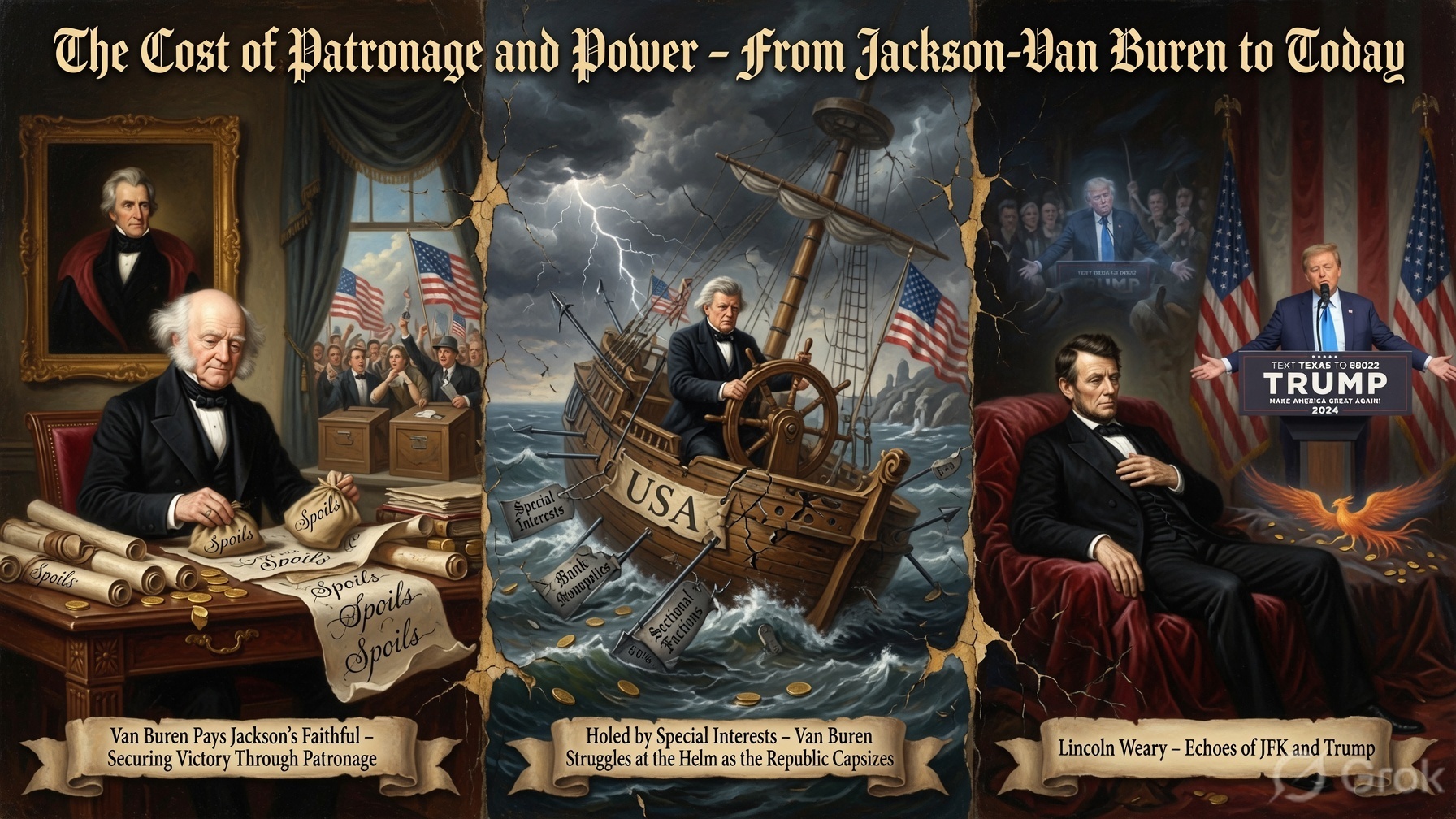
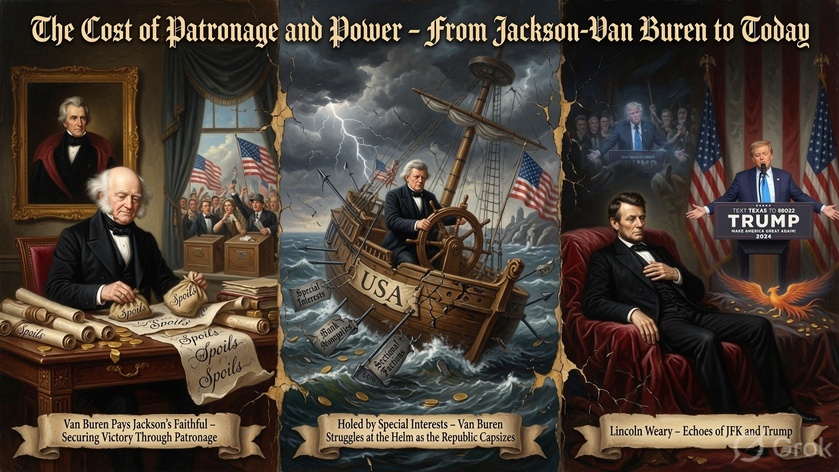
History does not repeat exactly, but it often rhymes with devastating clarity. The transition from Andrew Jackson’s populist strongman rule to Martin Van Buren’s continuation exposed the dangers of hollowing out institutions with loyalists and evading accountability. A similar pattern unfolded from Barack Obama’s transformative administration to Joe Biden’s tenure. In both cases, foundational weaknesses—economic mismanagement, institutional capture, and a protective press corps—produced prolonged hardship. The press deflected blame onto political opponents while shielding the architects, much as it does today. The long arc led to national crisis, resolved only through determined renewal.

Jackson, the hero of New Orleans, revolutionized American politics by expanding participation for the common (white) man while centralizing executive power. He dismantled what he saw as elite strongholds, notably waging war on the Second Bank of the United States. Yet his spoils system—replacing experienced officials with political loyalists—weakened the civil service. Jackson’s policies, including the Specie Circular and aggressive removal of federal deposits, fueled speculative bubbles. When the music stopped under his successor, the result was catastrophe.

Van Buren, Jackson’s chosen heir and organizational genius (the “Little Magician”), inherited and extended this legacy. Entering office in 1837, he faced the Panic of 1837 — one of America’s worst depressions, marked by bank failures, unemployment, and widespread suffering. Van Buren’s adherence to limited-government orthodoxy and the Independent Treasury system offered little immediate relief. Critics rightly noted that Jackson-era excesses had sowed the seeds. The administration struggled to adapt, locking the nation into a tailspin that contributed to deepening sectional divides and, ultimately, the path toward civil conflict. Van Buren’s single term ended in decisive rejection, though the party machinery he helped build endured.

The press of the era, rooted in Jeffersonian traditions of partisan advocacy, often shielded Democratic administrations while excoriating opponents. Established outlets and emerging voices frequently operated with a double standard — decrying “corruption” selectively while downplaying failures within their camp. This echoes modern patterns where major networks and publications frame narratives to protect one side.

Fast forward to the 21st century. Barack Obama’s administration emphasized transformation — expansive government, institutional shifts, and a new coalition. Like Jackson, it cultivated loyalty. Joe Biden, a longtime insider and Obama’s vice president, assumed the presidency amid promises of stability. Yet the results included record inflation, border challenges, supply-chain breakdowns, and the chaotic Afghanistan withdrawal. The latter saw blame redirected toward the previous administration’s negotiated framework, despite clear differences in execution. Much of the press corps amplified this deflection, treating scrutiny of the sitting administration as partisan attack while highlighting opposition shortcomings.

The parallel is striking: a charismatic predecessor installs mechanisms and loyalists; the successor inherits systemic strains and faces crisis. In Jackson-Van Buren’s time, economic pain from prior policies contributed to hardship. In the modern case, critics argue that expansive spending, regulatory approaches, and institutional changes under Obama laid groundwork for vulnerabilities exposed under Biden. In both eras, media mastheads claiming balance or conservative leanings sometimes softened edges or promoted establishment alternatives (RINOs in today’s terms), much as some 19th-century outlets balanced Jeffersonian sympathies with Adams-era standards while advancing a prevailing narrative.

The consequences stretched far. The Jackson-Van Buren era’s unresolved tensions helped set the stage for the Civil War. America found renewal through the Republican Party’s rise under Abraham Lincoln, who confronted existential threats with moral clarity and unionism — only for that leadership to be cut short by assassination. Echoes appear in later traumas: John F. Kennedy, and persistent questions around threats to Donald Trump. These are not mere coincidences of violence but reminders of how power struggles and institutional failures invite intrigue. The audacity of election-related controversies — interference claims dismissed or reframed by much of the press — has eroded trust, turning democratic processes into sources of division rather than resolution.

The antidote lies in vigilance and structural correction. Efforts like SAVE (Securing America’s Vote through Election integrity measures) represent attempts to restore confidence where skepticism has grown from repeated discrepancies and institutional opacity. Just as Lincoln’s GOP offered a course correction after earlier failures, today’s emphasis on accountability, institutional reform, and rejecting sycophantic capture aims to break cycles of hollowed governance.

Leaders who prioritize loyalty over competence, and administrations shielded by narrative control, invite hardship. Jackson’s vigor produced short-term triumphs but sowed long-term fragility. Van Buren’s continuity amplified the cost. The lesson for our time is clear: competence and institutional health matter more than inherited charisma. Ignoring that invites horror — economic, social, and constitutional. Americans would do well to study these echoes and demand better.

community logo
Join the VoiceDDB Community
To read more articles like this, sign up and join my community today
0
What else you may like…
Videos
Posts
Articles
00:01:07
November 27, 2022
Jingle Bell Rock

Jingle bell, jingle bell, jingle bell rock
Jingle bells swing and jingle bells ring
Snowin' and blowin' up bushels of fun
Now the jingle hop has begun

Jingle bell, jingle bell, jingle bell rock
Jingle bells chime in jingle bell time
Dancin' and prancin' in Jingle Bell Square
In the frosty air

What a bright time, it's the right time
To rock the night away
Jingle bell time is a swell time
To go glidin' in a one-horse sleigh

Giddy-up jingle horse, pick up your feet
Jingle around the clock
Mix and a-mingle in the jinglin' feet
That's the jingle bell rock

Jingle bell, jingle bell, jingle bell rock
Jingle bell chime in jingle bell time
Dancin' and prancin' in Jingle Bell Square
In the frosty air

What a bright time, it's the right time
To rock the night away
Jingle bell time is a swell time
To go glidin' in a one-horse sleigh

Giddy-up jingle horse, pick up your feet
Jingle around the clock
Mix and a-mingle in the jinglin' feet
That's the jingle bell
That's the jingle...

00:02:04
September 01, 2021
Intro to Locals for the Conservative Voice

David Daniel Ball calls himself the Conservative Voice.

I'm a teacher with three decades experience teaching math to high school kids.I also work with first graders and kids in between first grade and high school. I know the legends of why Hypatia's dad is remembered through his contribution to Math theory. And I know the legend of why followers of Godel had thought he had disproved God's existence.

I'm not a preacher, but I am a Christian who has written over 28 books all of which include some reference to my faith. Twelve blog books on world history and current affairs, detailing world events , births and marriages on each day of the year, organised by month. Twelve books on the background to and history of Bible Quotes. One Bible quote per day for a year. An intro to a science fiction series I'm planning, post apocalyptic cyber punk. An autobiography with short story collections.

I'm known in Australia for my failure as a whistleblower over the negligence death of a school boy. ...

00:01:50
September 04, 2026
Should violent criminals be made fat? Grok says 'no'

No. Transferring gut bacteria from an obese person into a violent criminal is not a reliable, ethical, or effective way to make them “fat, sedentary, and less of a physical threat.”

The science does not deliver the outcome you want

Mouse studies in germ-free animals showed that microbiota from obese donors can increase energy harvest and adiposity compared with lean-donor microbiota. That is the origin of the idea. Human evidence is far weaker.

Randomized trials of fecal microbiota transplant (FMT) from lean donors into people with obesity have generally failed to produce meaningful, sustained weight loss. Microbiome composition can change; body weight and metabolic markers often do not, or the effects are small and inconsistent. Diet and the existing gut environment usually dominate. A 2025 Nature paper found diet outperformed microbial transplant for microbiome recovery. Human guts are already colonized, not sterile like lab mice, so engraftment is variable and effects unpredictable.

It is not a ...

post photo preview
August 28, 2026
Pfizer struggles to answer

Some in Australia are brilliant. Malcolm Roberts Investigates Pfizer over Covid vaccine.

Holiday break is over back to work tonight

Tonight I'll start double posting until I've caught up.

post photo preview
Faith Fiction and the Failure of News
Truth in faith, not in news

Faith Fiction and the Failure of News

Faith fiction often tells more truth than a modern newspaper. That is not a slogan. It is a diagnosis.

What is sold as news is usually opinion with a byline and a lighting package. The product is not a record of what happened. It is a mood, a faction, and a set of permitted conclusions. Even outlets that market themselves as a correction — Fox among them — train their audiences to mistake loyalty for verification. They betray listeners the same way the rest of the pack does: by deciding first what the story must mean, then arranging the facts to fit. For that reason alone, Daily Wire is not to be trusted as a newsroom. Trust is not the same thing as usefulness. A house can be wrong about the day’s politics and still make something that is actually made.

The Pendragon Cycle: Rise of the Merlin is that sort of thing. Season 1 is a tremendous offering. It does not pretend to be a bulletin from Westminster or Washington. It walks into cultural mythology and Christian populism and treats both as serious. It adapts mainly Stephen R. Lawhead’s Taliesin and Merlin. Arthur is not born. The last image is the door into him. Merlin has risen. Aurelius is High King. Uther is the wounded spare. Ygerna is in play. Morgian is not finished. The sword is in the stone. That is not “content.” That is a story that knows where it is going.

The Chosen is doing related work across seven seasons and spinoffs: putting flesh on people the culture had turned into stained glass. Not all faith fiction is biblical, and it does not have to be. Individual faith should be answerable to Scripture. Cultural offerings can diverge. A bard cycle set in the wreck of Roman Britain is allowed to use Atlantis, Hill Folk, and a Fisher King without becoming a sermon outline. What it must not do is sneer at the possibility that the old stories were about something real.

Archaeology keeps complicating the sneer. Biblical faith standards have more historical grain than the lecture circuit admits. We sort of know who Job was, in the sense that the figure sits in a world that was not invented last Tuesday. There are claims about mummies and patriarchs — Moses, Joseph — that, if ever confirmed, would not make the Bible a field manual. They would make it what serious readers already knew it was: a witness, not a trench report. If those identifications fail, the Bible is still not a newspaper. An imperfect source of archaeology is not the same thing as a lie.

Faith is not science. Truth is not news media. Science measures what it can touch. Faith names what a people will die for and what they will not become. News media, as presently practised, does neither. It sells the feeling of being informed to people who are being managed.

That is why a seven-episode Arthurian season on a platform you do not have to baptise can still matter more than a week of panels. Pendragon is not reporting the Saxon Shore. It is asking whether a broken island can be held together by anything stronger than a warlord’s fear. The Chosen is not excavating Galilee. It is asking whether the men in the text were men. Those are older questions than the chyron.

A culture that cannot tell a myth without apology will not tell the news without a handler. Better a sword in the stone than another hour of someone explaining what you are allowed to notice.


Read full Article
September 12, 2026
post photo preview
In seeking power, one shows who one is
Power is hard to grasp. It flows, fills, overfills, and bursts

In seeking power, one shows who one is

Power is hard to grasp. It flows, fills, overfills, and bursts. The man who reaches for it rarely conceals himself for long. Ambition leaks. The stories he tells about himself, the waiting he claims is humility, the crises he rides — these are the inventory of character.

Joe Biden sought power all his adult life. He played the humble waiting game poorly. The early presidential run collapsed when the stories about his life and credentials fell apart under ordinary checking. He became vice-president as a compromise because Barack Obama would not accept the more openly ambitious Hillary Clinton. Then, in the vacuum that followed the departure of both, COVID arrived. Hysteria, already being questioned internationally, produced the astounding polling fact that Biden looked more popular than Obama had ever been. The garage became a stage. The crisis did what decades of ordinary politics had not: it delivered the office.

That is one way power arrives — not by conquest or dynasty, but by a panic that no one in the room quite believed they would have to account for later.

Canada’s Allison Inquiry, held 8–11 September 2026 on Parliament Hill, is part of that later accounting. Conservative MP Dean Allison convened four days of sworn testimony from people who say they were injured by COVID vaccination. More than 1,400 applied; about fifty were heard. The inquiry has no power to compel witnesses or force government action. It is unofficial. Official Canadian figures still record more than 59,000 adverse-event reports after COVID vaccination, more than 11,000 classified as serious. A physician testified that fourteen reports he submitted were rejected as coincidence. The forum exists because Canada never held the kind of official inquiry other democracies eventually did.

U.S. Senator Ron Johnson was the first witness. He used the platform to return to February 2020: Fauci’s private estimate of a case-fatality rate like a bad influenza (0.2–0.3 percent) against the public figure of 2–3 percent that justified lockdowns and mandates. Johnson’s argument was not merely epidemiological. Fear expanded control. Lockdowns struck blue-collar workers and small businesses far harder than white-collar employees or large retailers. Billionaire wealth rose sharply in 2020. A cases-versus-vaccination chart was shown to argue that the wave had already peaked before high coverage. The virologist Geert Vanden Bossche’s early warning that mass vaccination during a pandemic could select for immune-escape variants was cited again. Mainstream Canadian coverage treated the same days more narrowly — personal stories plus attacks on Fauci — and noted that the inquiry makes no formal findings. That is how power prefers the record: testimony without consequence.

The fourteenth of September has seen other watersheds. Power changes hands in different styles, and each style is a portrait.

In AD 81 Titus, popular, the conqueror of Jerusalem, died of fever on 13 September at the Sabine villa where his father Vespasian had died two years earlier. He was forty-one and had ruled barely two years. His younger brother Domitian, kept in the background under both father and brother, was proclaimed emperor by the Praetorian Guard the same day; the Senate confirmed him on the 14th. Ancient writers alleged Domitian left Titus for dead and later slighted his memory. There is no proof of poison. What is clear is the character that emerged once the waiting ended: fifteen years of autocracy, building and campaigning, then assassination and senatorial damnatio. The man who had been denied a share of power took all of it.

In 629 (some sources 628) Heraclius entered Constantinople after six years of campaigning that broke the Sasanian Empire. Nineveh in December 627, Khosrow II overthrown in early 628, the frontiers restored, the True Cross recovered. The ceremonial entry — Hiereia, prostration by son and patriarch, elephants, standards, relics — was the triumph of a commander who had led in person. He was hailed as a new Scipio. Within a few years the Arab conquests would undo much of the recovery. Military restoration is another face of power: costly, visible, and temporary.

On the night of 13–14 September 786 three things happened in the Abbasid court. Caliph al-Hadi died after fourteen months — ulcer, or smothered on his mother’s orders because he meant to cut her out of the succession. His brother Harun, in his early twenties, was proclaimed caliph. That same night a Persian concubine gave birth to the son who would become al-Ma'mun, and then died. The night of the three caliphs: the dying, the new, and the infant who would rule. Harun’s twenty-three years became the high-water mark of the dynasty and the backdrop of the Nights. He later divided the empire between two sons and thereby prepared the civil war that followed his death. Court intrigue and dynastic accident are a third style.

Three mid-September hinges, three revelations. Fever and the Guard. A hard-won procession with the Cross. A night of death, accession, and birth. In each case the man who takes power is already visible in how he takes it — in what he does with the waiting, the crisis, the vacuum, the mother, the army, the story he tells about the dead brother or the recovered relic.

Biden’s long search showed a man who needed the extraordinary to finish what ordinary competition would not allow. The vaccine-injury testimonies of September 2026 are the overflow of that same period: the reports that did not fit the story, the coincidences that were not accepted as coincidence, the unofficial hearing because the official one never came. Power filled, overfilled, and is now leaking in sworn statements that still have no legal force.

The seekers are known by the means they accept and the accounts they later refuse. The fourteenth of September keeps returning the same lesson in different costumes. Power does not hide the man. It displays him.

Read full Article
September 11, 2026
post photo preview
Press Dog-whistling at Trump may have killed Charlie Kirk
and it still endangers conservatives everywhere

Dog-whistling Trump may have killed Charlie Kirk — and it still endangers conservatives everywhere

A year on from Charlie Kirk’s murder, the trial proceeds and the facts have not become kinder to the people who spent years describing him as a machine of hate. The shooter did not need a treatise. He needed a permission structure: Kirk as “hatred,” Kirk as a danger to people like his partner, Kirk as someone who could be “taken out.” That structure was not invented in a lone bedroom in Utah. It was supplied, daily, by a media and political class that treats conservative argument as moral contamination.

The claim that Trump — and by extension Kirk, Turning Point, MAGA — is “fascist” is not a careful historian’s term. In public use it is isometric with Nazism. It does not mean “I dislike his tariffs.” It means this man is the next Hitler, his voters are the next brownshirts, and resistance is therefore not politics but emergency. Harris said yes, she thought Trump a fascist. Biden’s White House agreed. Clinton, AOC, Clyburn, Crockett, Tlaib, Warren, Pressley and a DNC chair used the same family of words. Generals and chiefs of staff were quoted as oracles. Cable opinion treated the question as settled. That is not “holding power to account.” That is sacralising one side and profaning the other.

Kirk was fitted to the same template. He was said to be manipulating students into the GOP. In fact his method was the opposite of a closed shop: a hard opening line, then “change my mind.” He said he was content if a student voted Democrat provided they understood what they were voting for. He was painted as a reflex anti-trans ideologue seething at gay and trans people. He was a Christian who put God, not gender, at the centre, and warned that standing before God with gender as the idol was dangerous. That is theology and argument, not a hunting licence. The coverage promoted the accusation and starved the defence. The “balanced” paragraph arrived as a mumbled “Kirk claims,” after the smear had already done its work. The audience was left with a feeling, not a record: this man hates; this man would not tolerate a Democrat; this man is a stooge of reaction. Footage of wit, patience and faith was treated as a curiosity, not the story.

Once a conservative is placed outside the moral community, the public takes the hint. Brett Kavanaugh was doxed; his family was threatened. His televised “defence of character,” in the circus that passed for confirmation theatre, was reduced in the popular mind to beer. The method is the same: collapse a life into a cartoon, then act shocked when someone treats the cartoon as a target.

Australia is not innocent. We did not match Harris’s on-camera “yes, I do.” Our leaders, in office, mostly protected the alliance and talked tariffs, AUKUS and “no running commentary.” That caution is real. It is also not the whole climate. Albanese, before he needed the White House, said Trump scared the shit out of him, that Jan. 6 was incitement and violent insurrection, that Morrison had gone too far by sharing a stage. Penny Wong said Trump trashed alliances for personal interest and undermined American democracy. Turnbull, out of office, called him a bully. News.com.au’s political class, Malcolm Farr among them, spent years treating anti-Trump as the default setting of seriousness. Kevin Rudd dumped on a Republican president, then as ambassador discovered on camera that the man he had disparaged could run rings around the self-certified genius. The press here still talks as if MAGA spokespeople get a “free pass,” while the same outlets have spent a decade defining conservatism as a pathology.

Two timelines are constantly mashed together to keep the story neat. Yes, “fascist” talk about Trump began in 2015–16, before George Floyd. Yes, it spiked after Jan. 6 and during impeachments and prosecutions, because “threat to democracy” makes a legal case feel like a crusade. That is mobilisation. It does not follow that Trump endorsed BLM or Antifa. He denounced both. The street violence of 2020 — riots, occupations, Antifa assaults — was not his crowd. If fascism is to mean anything, it cannot mean “the side that lost the newsroom.” Classical fascism had party militias, a war cult and a one-party state. MAGA is a noisy electoral coalition. Calling it Nazism while treating actual left violence as “mostly peaceful” or as a response to “hate” is not analysis. It is a defence of illiberal behaviour by people who still get called the adults.

Foreign leaders almost never used the F-word to Trump’s face. They talked trade, NATO and Ukraine. The fever is American media and American party rhetoric, exported through the same English-language feed that reaches a campus in Orem and a school staffroom in the Territory.

None of this requires a conspiracy minute. You do not need a memo that says “kill Kirk.” You need years of language that says Kirk is hate, Trump is Hitler, conservatives are an “enemy within,” and then a young man who already thinks some hate “can’t be negotiated out.” Journalists will reply that they did not pull the trigger. Correct. They built the weather. A year later the trial will argue DNA, texts, a rifle and a rooftop. It will not try the adjective. The adjective has already done what adjectives do when they are allowed to mean untermensch.

Kirk’s own standard remains the rebuke. Say the hard thing. Invite the reply. Let the student walk away a Democrat if the argument fails. That is liberalism. The other thing — the endless fascist brand, the weakened defence, the cartoon of Christian hatred — is what gets people hurt. Conservatives in every English-speaking country now live under that weather. Pretending it is only “robust debate” is how the next rooftop gets its moral alibi.

Read full Article
See More
Available on mobile and TV devices
google store google store app store app store
google store google store app tv store app tv store amazon store amazon store roku store roku store
Powered by Locals