VoiceDDB
Politics • Culture • News
Insights into Nineteenth-Century American Politics
From Operative Masonry to Freemasonry
July 29, 2026
post photo preview

From Operative Masonry to Freemasonry: Insights into Nineteenth-Century American Politics

The present owes much to the past, yet not everything. A predisposition does not compel an outcome. Institutions, like individuals, can change character while retaining forms and symbols.

What is often called “Masonry” stretches back in human practice to the craft of working stone—guilds of skilled builders who guarded trade knowledge through apprenticeship, oaths, and exclusive association. In medieval Europe these operative masons formed professional brotherhoods that regulated training, quality, and mutual support. Speculative Freemasonry, the fraternal order that became prominent in the eighteenth and nineteenth centuries, emerged from that tradition. By the early 1700s in Britain, lodges began admitting non-operatives—“accepted” or “speculative” members—who used the language of the builder’s craft, the tools of the trade, and legends centered on Solomon’s Temple as moral allegory rather than literal history. The formal organization of modern Freemasonry is conventionally dated to the formation of the Grand Lodge of England in 1717. The Temple story and the figure of Hiram Abiff are powerful ritual mythology, not documentary origin.

In the nineteenth-century United States, Freemasonry was one of several friendly societies, yet it stood out for its antiquity of form, its national reach, its elaborate degrees of induction and instruction, and its appeal among ambitious men of business, the professions, and politics. Its structure of secrecy, hierarchy, mutual obligation, and ritual left marks on later American associations. College fraternities borrowed elements of initiation and symbolism. Certain later fraternal and quasi-fraternal movements, including iterations of the Ku Klux Klan, also drew on the broader American tradition of lodge organization, graded membership, and secret signs—though Freemasonry as an institution repeatedly distanced itself from the Klan’s racial terrorism and lawlessness.

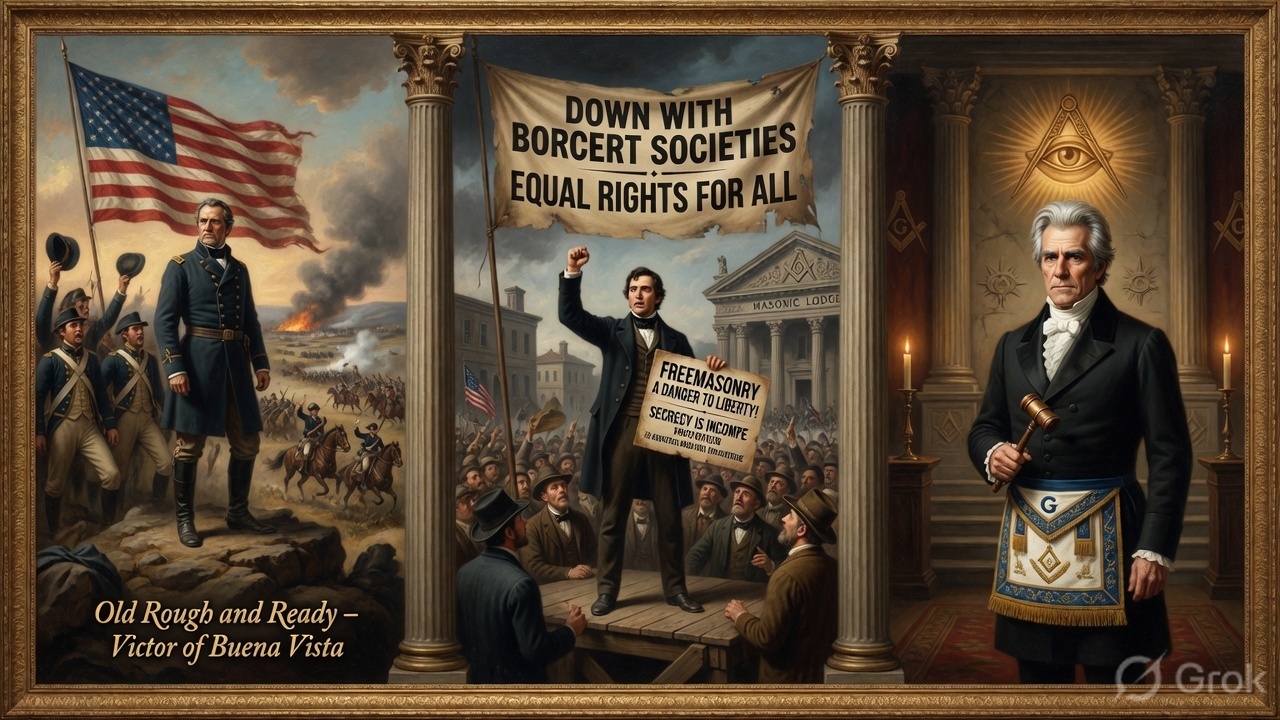
What began as a craft society had long since become a network for social capital, mutual aid, and discreet communication. Presidents and other public men who were Masons could, in theory, speak to fellow members in a register different from the open political arena. Andrew Jackson, a prominent Mason who served as Grand Master of the Grand Lodge of Tennessee, embodied that dual identity. His rise and the style of Jacksonian Democracy helped polarize feelings about the Craft.

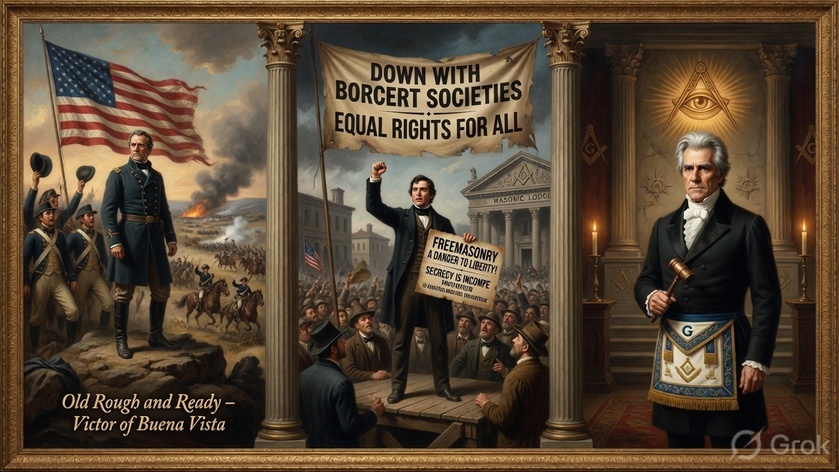
The disappearance of William Morgan in 1826 crystallized those feelings into a political force. Morgan, a bricklayer of uneven reputation in Batavia, New York, was preparing an exposé of Masonic secrets. Before his final vanishing, he was subjected to what can fairly be called legal harassment: arrest on a petty larceny charge involving a shirt and cravat he had borrowed, rapid discharge of that charge, and immediate re-arrest on a minor debt of roughly two dollars. He was then removed from the Canandaigua jail area under cover of night, conveyed by carriage through western New York to the vicinity of Fort Niagara, and never reliably seen again. Contemporary belief—and much subsequent evidence of conspiracy among certain local Masons—held that he was murdered, most probably by drowning in the Niagara River. Multiple grand juries and trials followed; a number of Masons were convicted of abduction or related offenses and received relatively light sentences. The episode exposed how easily the ordinary machinery of debt process and minor criminal complaint could be bent to silence a troublesome individual. It also revealed the limits of early-nineteenth-century investigation. What appears today as coordinated “lawfare” followed by extrajudicial removal looked, to many contemporaries, like the dark workings of a secret order beyond the reach of ordinary law.

The outrage over Morgan’s fate produced the Anti-Masonic movement and, soon after, the Anti-Masonic Party—the first significant third party in American history, the first to hold a national nominating convention, and the first to issue a formal platform. It condemned Freemasonry for secrecy, exclusivity, and alleged undemocratic influence. Because Jackson was a conspicuous Mason, the movement became an early vehicle of opposition to Jacksonian Democracy. In New York and elsewhere it drew ambitious young men, among them Millard Fillmore, who entered the New York Assembly as an Anti-Mason. As the pure anti-Masonic impulse faded, most of its politicians and reform energy flowed into the new Whig Party.

The Whigs eventually produced the last two presidents of their party: Zachary Taylor, the professional soldier and Mexican War hero who had little prior political experience, and, after Taylor’s sudden death in 1850, Millard Fillmore, the self-made lawyer who had begun in the Anti-Masonic ranks. Their brief administrations sat athwart the intensifying sectional crisis. Fillmore’s support for the Compromise of 1850, including the strengthened Fugitive Slave Act, temporarily postponed rupture but further alienated northern opinion.

When the Union finally fractured, the central dividing issue was slavery. Claims that the conflict was primarily about abstract “states’ rights” overlook the concrete reality that the rights most hotly defended by the seceding states were those protecting the institution of human bondage and its expansion. The struggle was fought in legislatures, in the economy, across battlefields, and through the slow transformation of political parties. Freemasonry as an organization did not cause the war. Yet many of the men who led armies, cabinets, and state governments on both sides were or had been Masons. Institutions do not act; individuals do. The same networks that offered mutual recognition and private channels of communication could, in moments of crisis, either restrain or fail to restrain the passions of the age.

The Morgan affair and the brief career of the Anti-Masonic Party remain instructive. They show how a single act of apparent private violence, compounded by the appearance of official complicity, can generate a mass political movement. They illustrate the ease with which secrecy breeds suspicion and the difficulty of proving—or disproving—conspiracy when the ordinary instruments of law are themselves compromised. And they remind us that fraternal bonds, useful for business and social advancement in ordinary times, become politically charged the moment the public concludes that loyalty to the lodge has displaced loyalty to the republic.

The past does not dictate the present. Yet the forms of association, the habits of secrecy, and the recurring tension between private obligation and public accountability continue to shape how Americans organize themselves and how they argue about power.

community logo
Join the VoiceDDB Community
To read more articles like this, sign up and join my community today
0
What else you may like…
Videos
Posts
Articles
00:01:07
November 27, 2022
Jingle Bell Rock

Jingle bell, jingle bell, jingle bell rock
Jingle bells swing and jingle bells ring
Snowin' and blowin' up bushels of fun
Now the jingle hop has begun

Jingle bell, jingle bell, jingle bell rock
Jingle bells chime in jingle bell time
Dancin' and prancin' in Jingle Bell Square
In the frosty air

What a bright time, it's the right time
To rock the night away
Jingle bell time is a swell time
To go glidin' in a one-horse sleigh

Giddy-up jingle horse, pick up your feet
Jingle around the clock
Mix and a-mingle in the jinglin' feet
That's the jingle bell rock

Jingle bell, jingle bell, jingle bell rock
Jingle bell chime in jingle bell time
Dancin' and prancin' in Jingle Bell Square
In the frosty air

What a bright time, it's the right time
To rock the night away
Jingle bell time is a swell time
To go glidin' in a one-horse sleigh

Giddy-up jingle horse, pick up your feet
Jingle around the clock
Mix and a-mingle in the jinglin' feet
That's the jingle bell
That's the jingle...

00:02:04
September 01, 2021
Intro to Locals for the Conservative Voice

David Daniel Ball calls himself the Conservative Voice.

I'm a teacher with three decades experience teaching math to high school kids.I also work with first graders and kids in between first grade and high school. I know the legends of why Hypatia's dad is remembered through his contribution to Math theory. And I know the legend of why followers of Godel had thought he had disproved God's existence.

I'm not a preacher, but I am a Christian who has written over 28 books all of which include some reference to my faith. Twelve blog books on world history and current affairs, detailing world events , births and marriages on each day of the year, organised by month. Twelve books on the background to and history of Bible Quotes. One Bible quote per day for a year. An intro to a science fiction series I'm planning, post apocalyptic cyber punk. An autobiography with short story collections.

I'm known in Australia for my failure as a whistleblower over the negligence death of a school boy. ...

00:01:50
Holiday break is over back to work tonight

Tonight I'll start double posting until I've caught up.

Chinese Space Bio Labs

While Elon Musk is busy landing reusable rockets and building robot swarms on Earth, the CCP has gone full 'Musk but make it bioweapons': they're launching fleets of Starship-inspired rockets crewed by copycat Optimus robots, blasting 'Fau Chi' biolabs straight into Low Earth Orbit.

These gleaming orbital stations, proudly emblazoned with the Chinese characters 福奇 (Fú Qí — sounding suspiciously like 'Fau Chi'), are officially designated as The Science™ Research Facilities. Perfect for safe, ethical gain-of-function experiments on exciting new pathogens like TDS (Trump Derangement Syndrome), 'Last Millennia' nostalgia plagues, and the deadly 'We Are Living in 2026' variant.

The endgame? A billion trusting parents worldwide voluntarily neutering their own children on expert 'Fau Chi' advice from the heavens — because nothing says 'public health' like taking guidance from a floating Chinese biolab with reusable re-entry capabilities.

post photo preview
Editorial from 2018 for June 9th

Don't give up on hope. Western Civilisation is on the nose of universities in Australia. Sydney University collapsed in 1990, and her upper executive got replaced by ALP managerialists as Keating fought a culture war which the Liberal Party have not effectively engaged. Dame Kramer had been made Chancellor, but the Chancellor's position is not executive at Sydney University. Kramer fought effectively for Western Values, but the University, now, is as partisan left as the ABC is now. Kramer had been a powerful presence in charge of the ABC too. 

In 1990, Sydney University lost her Chancellor and Vice Chancellor. The Chancellor, Hermann David Black, died after a long illness. James Anthony Rowland, a former governor of NSW took the chancellor's position for a few years, before passing it to Kramer in 1991. She held on to 2001. From 1981 to 1990, John Manning Ward was the executive head of Sydney University as Vice Chancellor. He had been writing a trilogy on Australian conservative leaders ...

post photo preview
post photo preview
On and after the first of August
two commanders faced the reckoning of empires.

On and after the first of August, two commanders faced the reckoning of empires.

Separated by fifteen centuries, Marcus Antonius and Elizabeth Tudor both stood at the hinge of history in the heat of late summer. One ended in blood and silence. The other in fireworks and legend. The fighting they directed shared a recognisable shape—naval pressure, land forces held in reserve, personal resolve under extreme political strain—yet the technology, the tactics, and the final choices diverged so sharply that the same calendar date produces opposite myths.

Antony: a minor victory, then the end

On 31 July 30 BC, outside Alexandria, Antony still possessed enough fight to scatter Octavian’s advancing cavalry. It was a small, sharp success—the last flash of the old soldier. The next morning the structure collapsed. His remaining cavalry defected. What was left of his fleet surrendered. The infantry followed. Alexandria opened its gates.

Months earlier, at Actium, he had already made the hard calculation. When the larger battle turned against him, Antony and Cleopatra broke out with a portion of the fleet and, crucially, the treasure. The rest of the navy was sacrificed; the great land army was left behind to negotiate its own terms. The gold and the queen were preserved. Everything else—reputation, legions, the eastern alliance system—was lost.

On 1 August, believing Cleopatra already dead, Antony fell on his sword. The wound was not immediately fatal. He was carried to her mausoleum and died in her arms. The suicide was not pure despair. It was Roman, calculated, and protective. By dying, he removed himself as a living prize and reduced the incentive for further exemplary punishment of those still linked to him. His eldest son by Fulvia was executed. The younger children by Cleopatra were taken to Rome and raised under Octavia’s care. His two daughters by Octavia—Antonia Major and Antonia Minor—survived and prospered. Through Antonia Minor the blood of Antony entered the Julio-Claudian line. Caligula, Claudius, and Nero all carried it. In the end the man who lost the world became, by a bitter irony, one of the ancestors of the very emperors who ruled it. Revenge of a sort.

Elizabeth: captains, fire, and a speech

Elizabeth’s crisis came in the same season, 1,618 years later. The Spanish Armada of 1588 was intended to clear the Channel, link with Parma’s army in Flanders, and deliver a Catholic invasion force onto English soil. The English response was built on men who understood ships the way Antony had once understood legions.

Charles Howard of Effingham held overall command. Francis Drake, the most famous of the sea dogs, brought aggression and local knowledge. John Hawkins had reformed the navy’s ships and gunnery. Martin Frobisher and others filled out a cadre of captains who knew how to fight under sail with long-range cannon rather than the boarding actions preferred by Mediterranean galley fleets. Their vessels were smaller, faster, and better armed for stand-off combat. They harried the Armada up the Channel, refused close engagement on Spanish terms, and waited for the moment of vulnerability.

That moment came off Calais. On the night of 7–8 August the English sent fireships into the anchored Spanish formation. The Armada cut cables and scattered. The following day’s fighting at Gravelines damaged more ships. Then the wind shifted and drove the Spanish north. The link with Parma was broken. The long, lethal voyage home around Scotland and Ireland finished what English guns had begun. Storms, starvation, disease, and shipwreck did the rest.

Elizabeth herself never commanded a ship. Her decisive act was political and theatrical. On 8 or 9 August she rode to the camp at Tilbury, where the land army waited against the possibility that Parma might still cross. There she delivered the speech that still echoes:

“I know I have the body of a weak and feeble woman; but I have the heart and stomach of a king, and of a king of England too, and think foul scorn that Parma or Spain, or any prince of Europe, should dare to invade the borders of my realm… I myself will take up arms, I myself will be your general, judge, and rewarder of every one of your virtues in the field.”

By the time she spoke, the naval danger had already largely passed. The speech was therefore not a last stand but a consolidation of victory—an assertion of personal courage, Protestant legitimacy, and national solidarity. She celebrated. Medals were struck. “God blew and they were scattered” became the official gloss. The Virgin Queen remained unmarried and childless by deliberate policy, preserving her independence and the fiction that she was wedded only to the realm.

Similarities and the long divergence

Both confrontations turned on the control of narrow waters and the coordination of sea and land forces. Both leaders faced the risk that a single misjudgement would end their political existence. Both used personal presence—Antony among his remaining troops, Elizabeth at Tilbury—to steady morale. Both understood that treasure and political capital mattered as much as ships and soldiers.

The differences were decisive. Antony fought with heavy, oar-powered vessels designed for ramming and boarding; Elizabeth’s captains fought under sail with broadside artillery. Antony’s coalition was brittle and Eastern; Elizabeth’s was national and increasingly professional. Antony, once the army deserted, had no institutional base left. Elizabeth’s captains and her council of war continued to function after the Armada fled.

One chose the sword and left a bloodline that later wore the purple. The other chose the virgin crown and left no direct heir at all. One’s final act was private and fatal. The other’s was public and triumphant.

The calendar brought them into strange proximity. The outcomes could not have been more different.

Read full Article
post photo preview
Victoria ALP Shuffles Leadership
But Won’t Address the Issues

Victoria ALP Shuffles Leadership: But Won’t Address the Issues

Victoria’s Labor Party has performed its familiar ritual. Jacinta Allan is gone. Ben Carroll is Premier. The faces change; the record does not. After years of accumulated failure, the party has chosen continuity dressed up as renewal. Victorians should not be fooled.

The problems did not begin with Allan. They date to the moment Labor regained office by promising responsible policing, disciplined spending and practical infrastructure. What followed was the opposite. Police numbers were constrained while crime rose. Budgets expanded through debt and pork-barrelling. Major projects became vehicles for political favour rather than efficient delivery. Energy policy deliberately constrained the carbon economy, including natural gas, leaving households and industry exposed to higher costs and less reliability.

The COVID years crystallised the approach. Victoria endured some of the world’s longest lockdowns. Oversight of union power on construction sites was weakened. A drug consumption facility was placed near a primary school. Longstanding, properly used medications were effectively restricted: chemists moved them behind the counter to prescription-only status and doctors were counselled against prescribing them. These were not minor administrative adjustments. They reflected a governing culture that preferred control and ideology over evidence and proportion.

School standards have declined in reading, writing and mathematics. Private tutoring has expanded to fill the gap the system created. Health services have been stretched and politicised. Corruption allegations around the Big Build and construction unions accumulated under Daniel Andrews. He resigned and moved into profitable private engagement. Allan inherited the same machine and ultimately resigned under internal pressure. Labor now needs a scapegoat if it is to pretend at competence. The more likely path is the familiar one: double down, rebrand, and insist the real problem is the opposition or the media.

The Liberals have not filled the vacuum. For years they have run a lite version of Labor’s agenda, staying close enough to avoid sharp differentiation until the final stretch of an election campaign. That strategy has starved the opposition of distinct support. Voters who want genuine change see little reason to switch. Media coverage compounds the difficulty. Double standards are routine. A Liberal leader can be denounced for “lobster with a mobster” while far more consequential failures—security contracts, lockdown enforcement, procurement scandals—receive softer treatment when Labor is responsible.

One Nation has absorbed frustrated Liberal and conservative voters. Yet it carries its own limitations. An emphasis on cultural flashpoints, particularly around Islam, has often substituted for detailed policy on cost of living, energy, education and institutional reform. That focus narrows its appeal and hands Labor and the media an easy line of attack.

The result, heading into the November election, is a narrowed field. Labor offers continuity under a new name. The Liberals offer cautious proximity. One Nation offers protest without a fully developed governing alternative. No clear conservative or populist figure has yet emerged who can convert widespread dissatisfaction into a coherent governing project. Victorians face another election in which real choice is constrained by the options on the ballot.

Leadership changes are easy. Addressing the record is harder. So far, Victorian Labor has shown little interest in the harder task.

Read full Article
post photo preview
I have decided to follow Jesus
The Song That Refused to Die

Editorial: The Song That Refused to Die

Brutal times are not unique to any single century. In the hills of nineteenth-century Assam a Garo convert named Nokseng was ordered to recant. When he would not, the cost fell first on his children, then on his wife, and finally on himself. Centuries earlier, in the Colosseum of Rome, a sixteen-year-old Christian girl was given the same choice: deny Christ or die. She refused. Tradition remembers her calm resolve even as the sword was raised.

Yet the brutality is not the song.

What survived from Nokseng’s final stand was not a catalogue of violence but a clear, almost stark, declaration of direction: the cross before him, the world behind him, and no turning back. Those words were remembered among local believers and, over time, shaped into sung verse. They were set to an Indian folk melody later known as the tune “Assam.” Some traditions credit the Indian missionary Sadhu Sundar Singh with forming the testimony into a hymn. More recent research points to Simon Kara Marak (1877–1975), a Garo pastor, schoolteacher and missionary in the Jorhat area, who composed or regularised the song in the mid-to-late 1930s and sang it daily until it spread through his family and ministry.

For decades the hymn remained largely within Indian Christian circles. Its wider journey began when American hymn editor William Jensen Reynolds encountered it in the late 1950s, arranged the melody, and published it in the Assembly Songbook in 1959. Through Billy Graham’s crusades the song entered the mainstream repertoire of English-speaking churches and travelled across continents. Hymnals began printing it, often simply as “Anonymous” or “Traditional (Indian).” Additional stanzas were sometimes added, especially for use in baptismal and invitational settings.

Its power has always lain in the refusal to treat setbacks as the final word. Every life knows loss, pressure, disappointment, and the quiet temptation to reverse course. The hymn does not deny those realities. It simply places them behind the believer and fixes the eyes forward. The cross remains ahead. The decision remains in force.

That is why the song continues to be applied so widely. It is sung at baptisms and youth camps, in ordinary Sunday services and in places of open pressure. Persecuted believers have found in its refrain a concise statement of perseverance. Ordinary disciples facing quieter costs — family opposition, personal failure, weariness — have found the same steady direction: keep walking, do not turn back. Some traditions have valued its strong emphasis on personal resolve; others have noted the risk of sounding as though faith rests chiefly on human will. Yet the song endures, translated into many languages, still carrying the weight of that first irreversible choice.

What began as remembered words spoken under extreme pressure in a remote Garo village has become a shared confession for millions. The song is not a memorial to cruelty. It is a call to perseverance — steady, costly, and still available to anyone willing to keep the cross before them and refuse to turn back.

Read full Article
See More
Available on mobile and TV devices
google store google store app store app store
google store google store app tv store app tv store amazon store amazon store roku store roku store
Powered by Locals