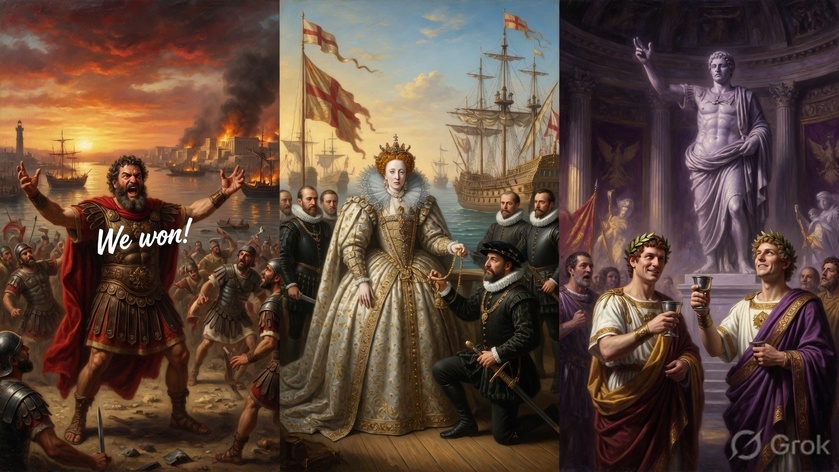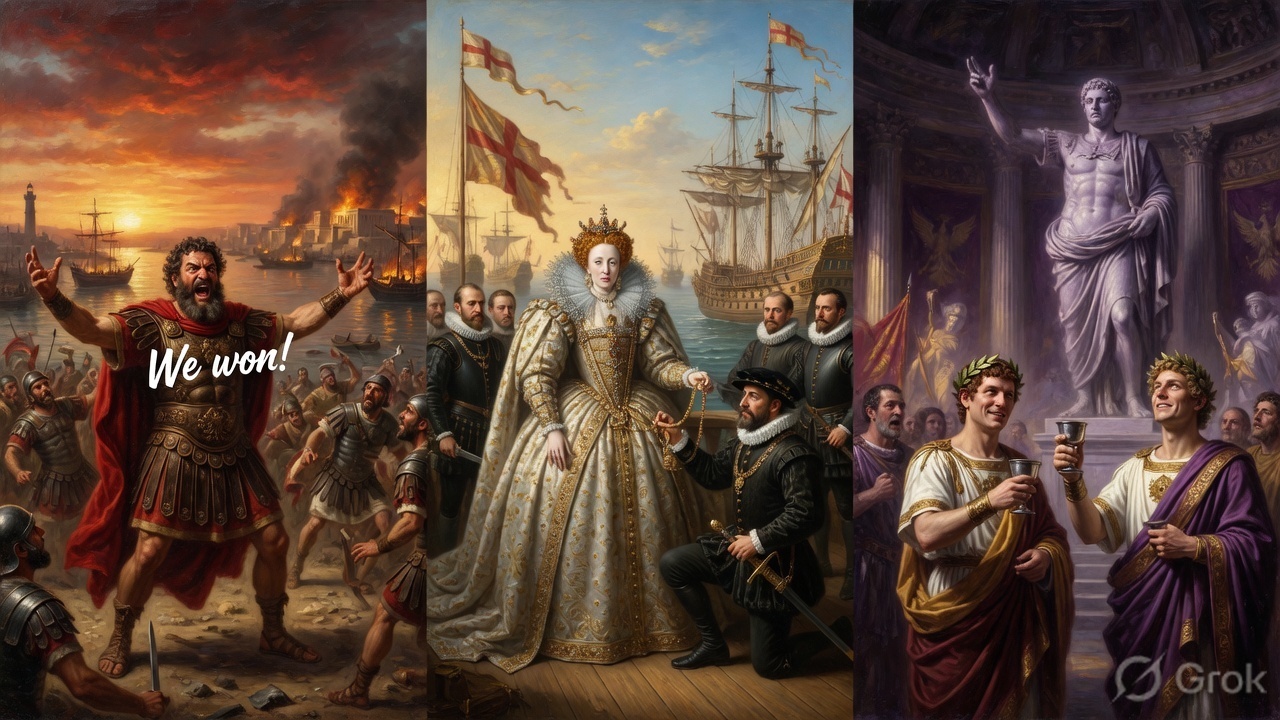
On and after the first of August, two commanders faced the reckoning of empires.
Separated by fifteen centuries, Marcus Antonius and Elizabeth Tudor both stood at the hinge of history in the heat of late summer. One ended in blood and silence. The other in fireworks and legend. The fighting they directed shared a recognisable shape—naval pressure, land forces held in reserve, personal resolve under extreme political strain—yet the technology, the tactics, and the final choices diverged so sharply that the same calendar date produces opposite myths.
Antony: a minor victory, then the end
On 31 July 30 BC, outside Alexandria, Antony still possessed enough fight to scatter Octavian’s advancing cavalry. It was a small, sharp success—the last flash of the old soldier. The next morning the structure collapsed. His remaining cavalry defected. What was left of his fleet surrendered. The infantry followed. Alexandria opened its gates.
Months earlier, at Actium, he had already made the hard calculation. When the larger battle turned against him, Antony and Cleopatra broke out with a portion of the fleet and, crucially, the treasure. The rest of the navy was sacrificed; the great land army was left behind to negotiate its own terms. The gold and the queen were preserved. Everything else—reputation, legions, the eastern alliance system—was lost.
On 1 August, believing Cleopatra already dead, Antony fell on his sword. The wound was not immediately fatal. He was carried to her mausoleum and died in her arms. The suicide was not pure despair. It was Roman, calculated, and protective. By dying, he removed himself as a living prize and reduced the incentive for further exemplary punishment of those still linked to him. His eldest son by Fulvia was executed. The younger children by Cleopatra were taken to Rome and raised under Octavia’s care. His two daughters by Octavia—Antonia Major and Antonia Minor—survived and prospered. Through Antonia Minor the blood of Antony entered the Julio-Claudian line. Caligula, Claudius, and Nero all carried it. In the end the man who lost the world became, by a bitter irony, one of the ancestors of the very emperors who ruled it. Revenge of a sort.
Elizabeth: captains, fire, and a speech
Elizabeth’s crisis came in the same season, 1,618 years later. The Spanish Armada of 1588 was intended to clear the Channel, link with Parma’s army in Flanders, and deliver a Catholic invasion force onto English soil. The English response was built on men who understood ships the way Antony had once understood legions.
Charles Howard of Effingham held overall command. Francis Drake, the most famous of the sea dogs, brought aggression and local knowledge. John Hawkins had reformed the navy’s ships and gunnery. Martin Frobisher and others filled out a cadre of captains who knew how to fight under sail with long-range cannon rather than the boarding actions preferred by Mediterranean galley fleets. Their vessels were smaller, faster, and better armed for stand-off combat. They harried the Armada up the Channel, refused close engagement on Spanish terms, and waited for the moment of vulnerability.
That moment came off Calais. On the night of 7–8 August the English sent fireships into the anchored Spanish formation. The Armada cut cables and scattered. The following day’s fighting at Gravelines damaged more ships. Then the wind shifted and drove the Spanish north. The link with Parma was broken. The long, lethal voyage home around Scotland and Ireland finished what English guns had begun. Storms, starvation, disease, and shipwreck did the rest.
Elizabeth herself never commanded a ship. Her decisive act was political and theatrical. On 8 or 9 August she rode to the camp at Tilbury, where the land army waited against the possibility that Parma might still cross. There she delivered the speech that still echoes:
“I know I have the body of a weak and feeble woman; but I have the heart and stomach of a king, and of a king of England too, and think foul scorn that Parma or Spain, or any prince of Europe, should dare to invade the borders of my realm… I myself will take up arms, I myself will be your general, judge, and rewarder of every one of your virtues in the field.”
By the time she spoke, the naval danger had already largely passed. The speech was therefore not a last stand but a consolidation of victory—an assertion of personal courage, Protestant legitimacy, and national solidarity. She celebrated. Medals were struck. “God blew and they were scattered” became the official gloss. The Virgin Queen remained unmarried and childless by deliberate policy, preserving her independence and the fiction that she was wedded only to the realm.
Similarities and the long divergence
Both confrontations turned on the control of narrow waters and the coordination of sea and land forces. Both leaders faced the risk that a single misjudgement would end their political existence. Both used personal presence—Antony among his remaining troops, Elizabeth at Tilbury—to steady morale. Both understood that treasure and political capital mattered as much as ships and soldiers.
The differences were decisive. Antony fought with heavy, oar-powered vessels designed for ramming and boarding; Elizabeth’s captains fought under sail with broadside artillery. Antony’s coalition was brittle and Eastern; Elizabeth’s was national and increasingly professional. Antony, once the army deserted, had no institutional base left. Elizabeth’s captains and her council of war continued to function after the Armada fled.
One chose the sword and left a bloodline that later wore the purple. The other chose the virgin crown and left no direct heir at all. One’s final act was private and fatal. The other’s was public and triumphant.
The calendar brought them into strange proximity. The outcomes could not have been more different.