From personal difficulties in challenging times, the US Civil War became certain.
Franklin Pierce and James Buchanan, successive Democratic presidents in the 1850s, governed amid rising sectional fury over slavery. Both men carried heavy personal burdens into office. Both operated inside partisan media environments that amplified their worst instincts and muted dissent. Neither proved equal to the crisis. The result was not merely policy failure but the progressive collapse of the Union’s political center.
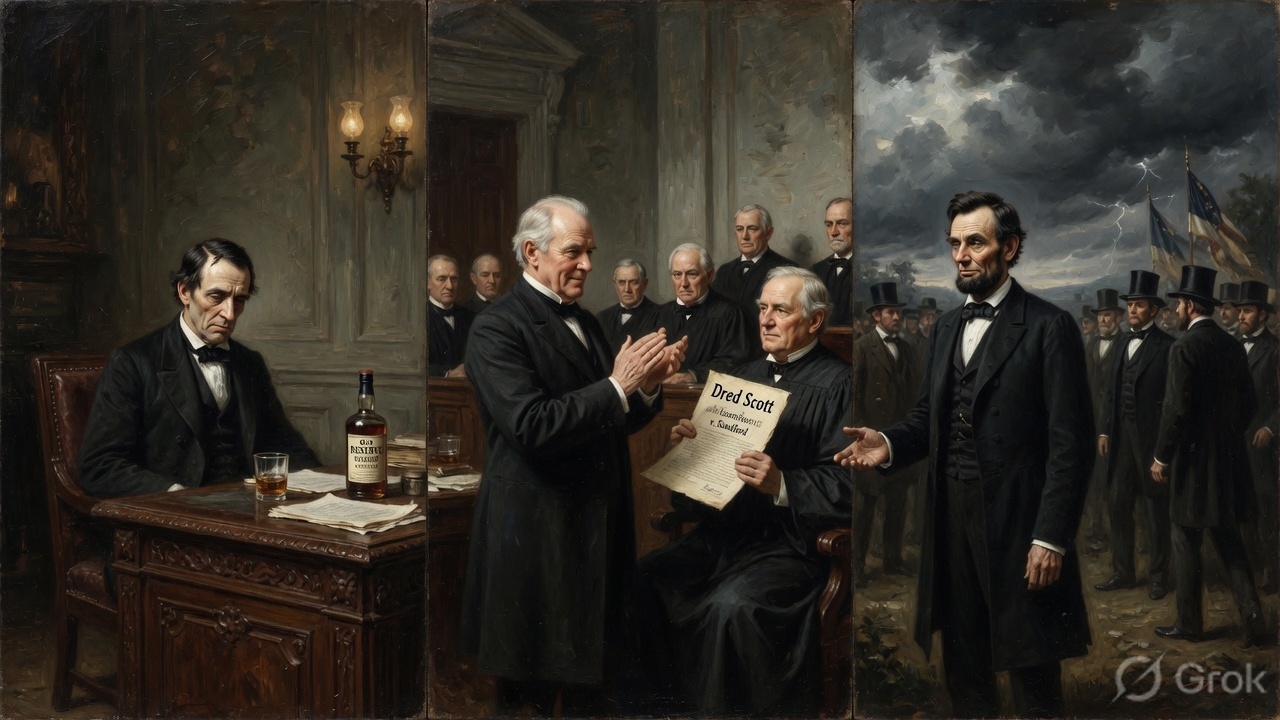
Pierce arrived as “Young Hickory,” the handsome New Hampshire Democrat who had ridden Andrew Jackson’s coattails from private to brigadier general in the Mexican War. His private life was already marked by grief and frailty. His wife Jane, religious and committed to temperance, disliked the political world. Their three sons all died young; the last, Benjamin, was killed in a train wreck weeks before the inauguration. Pierce himself was often unwell and later died of cirrhosis. These private sorrows did not prevent him from making a decisive public error. By signing the Kansas-Nebraska Act in 1854, he repealed the Missouri Compromise’s prohibition on slavery north of 36°30′ and substituted “popular sovereignty.” The predictable consequence was Bleeding Kansas—armed conflict between pro- and anti-slavery settlers—and the rapid emergence of the Republican Party. For a time the partisan press cheered the move as democratic principle and Western expansion. Only when the violence became undeniable did his own party refuse him renomination.
Buchanan, the only lifelong bachelor president, carried a different private wound: the broken engagement and sudden death of his fiancée Anne Coleman in 1819, long rumored to have been suicide. He spent decades as a skilled politician and diplomat, serving in Congress, as minister to Russia and Britain, and as Polk’s Secretary of State during the era of continental expansion. He entered the White House in 1857 intending to quiet the storm. Instead the Supreme Court’s Dred Scott decision—rendered by a Court shaped in large part by Democratic appointments—declared that Congress lacked power to ban slavery in the territories and that Black people had no rights the white man was bound to respect. Buchanan’s subsequent push to admit Kansas under the pro-slavery Lecompton Constitution further split his party. The doctrine of states’ rights, combined with the formal denial of citizenship to people of color, rendered the Union’s constitutional order increasingly untenable for large parts of the North. When Abraham Lincoln won the 1860 election and offered a careful, limited compromise on the extension of slavery, Southern states seceded. Buchanan denied both the right of secession and the federal power to coerce the seceding states. He left office with the country fracturing. He later supported the Union cause during the war, but the damage of the preceding four years was already irreversible.
Then, as now, partisan media functioned as an echo chamber. Democratic papers defended Pierce’s Kansas-Nebraska Act as fidelity to local self-government and later portrayed Buchanan’s acquiescence in Dred Scott as respect for judicial authority and constitutional restraint. Opposition voices were dismissed as agitators or sectional extremists. The presidents, operating inside that closed information loop, found it easier to continue along the path of least resistance than to confront the moral and political reality that slavery’s expansion was no longer compatible with a durable Union.
Would either man have governed differently if the headlines had been less forgiving? Possibly at the margins. Public pressure can force recalculation. Yet both men’s records suggest deeper limits: personal grief and temperament in Pierce’s case, a lifelong preference for legalistic compromise and Southern constitutional arguments in Buchanan’s. The more fundamental failure was institutional and cultural. A political system that could not produce leaders capable of recognizing when compromise had become capitulation, and a media culture that rewarded tribal affirmation over hard truth, left the country without the resources to negotiate its deepest division.
The Civil War was not inevitable in 1850. By the time Lincoln took the oath in 1861, after eight years of Democratic stewardship under Pierce and Buchanan, it had become nearly certain. Personal misfortune does not excuse public failure. Nor does a partisan press absolve presidents of the duty to see beyond their own side’s applause.