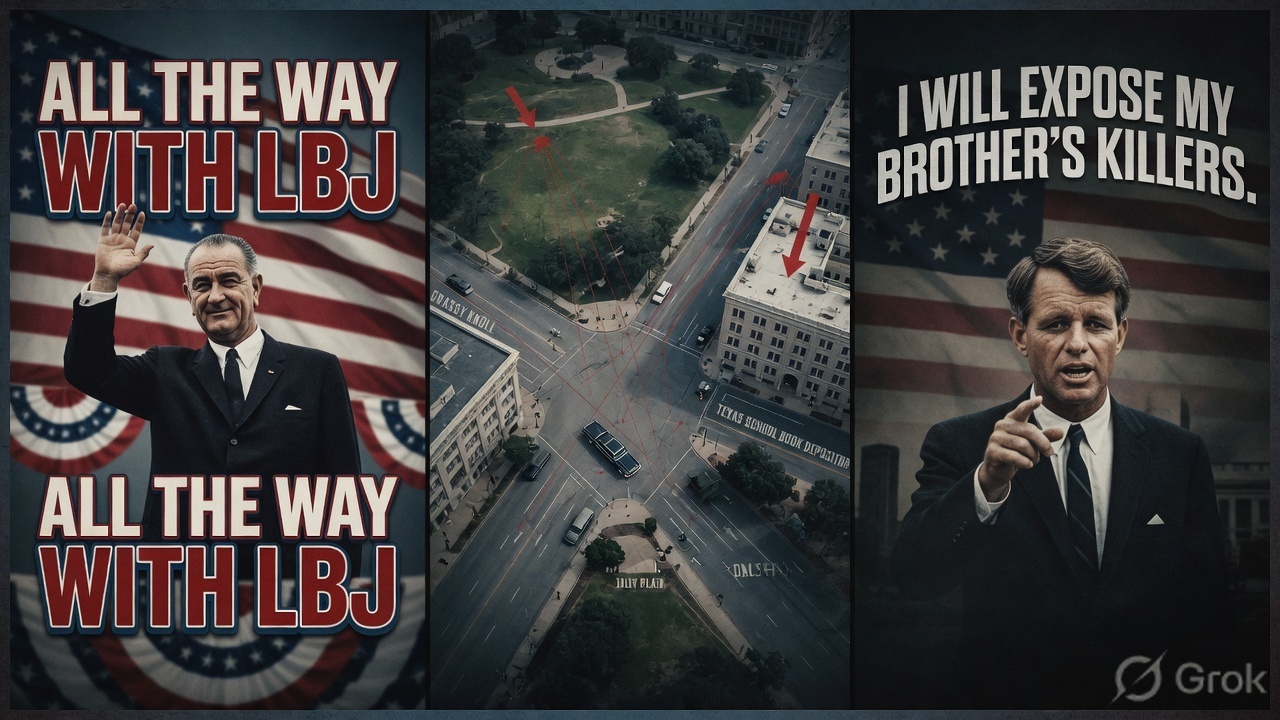
JFK’s Legacy, Reframed: A President Constrained, Then Removed
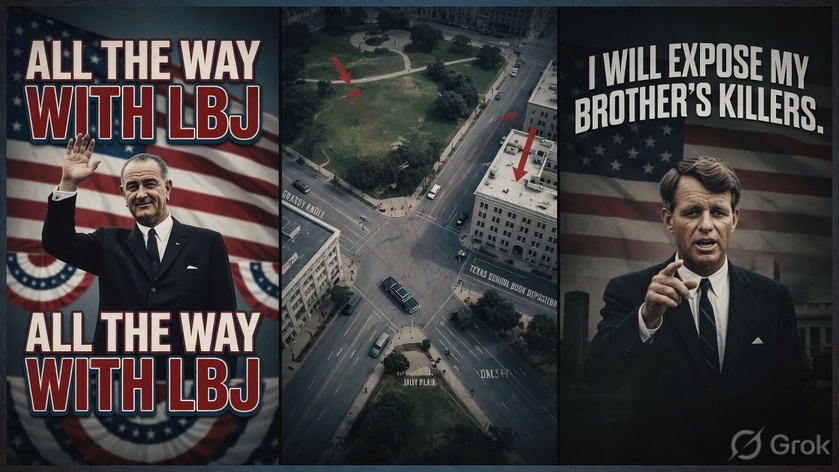
Under the working assumption that John F. Kennedy was eliminated by a conspiracy involving Lyndon Johnson and senior military command, with Lee Harvey Oswald as the designated patsy, the standard media narrative of his presidency collapses into something sharper and more revealing. The familiar list of achievements and failures remains, but the causal weight shifts. What looks like personal weakness or half-measures becomes evidence of a man pushing against entrenched institutional power that ultimately decided he had to go.
Kennedy’s strongest moments look, in this light, like deliberate resistance rather than mere competence. The Cuban Missile Crisis was not simply calibrated brinkmanship; it was a president overriding the loudest voices in the military and intelligence apparatus that preferred immediate strikes. The secret Turkey missile trade, kept quiet at the time, bought a temporary partner in Khrushchev. The Limited Test Ban Treaty and the American University speech that preceded it signalled a genuine desire to dial back nuclear confrontation. The Peace Corps and the Moon commitment projected soft power and technological ambition rather than pure kinetic force. These were not the priorities of a military establishment already eyeing deeper involvement in Southeast Asia.
The failures and compromises take on a different colour under the same assumption. Bay of Pigs was a CIA operation Kennedy inherited and only partially controlled; withholding air support may have been the least-worst decision available once the plan’s flaws became clear. Vietnam is more damning in the official record—advisers rising toward 16,000, the green light for the Diem coup—yet the numbers and the timing can be read as a forced compromise rather than enthusiastic escalation. A president who had already been burned by the intelligence community at the Bay of Pigs was not in a position to simply refuse the entire apparatus. Direction from the Oval Office is not the same as control of the machinery. The later claim that Kennedy would have withdrawn after 1964 sits more comfortably if one believes the same machinery preferred a president who would deliver the larger war.
Civil rights fits the same pattern of constrained action. Kennedy moved when the street pressure and the optics became unavoidable, not when the moral case was first made. He allowed Southern Democratic governors room to manoeuvre because the congressional arithmetic demanded it. That is ordinary political calculation; under the conspiracy frame it also becomes another instance of a president who could not fully impose his will on the party and institutional structures around him.
The personal and medical material functions, in this reading, as useful post-assassination narrative management. Chronic illness, heavy medication, and extramarital affairs were real. Once the man was dead they became instruments for diminishing the administration while leaving the martyr’s charisma intact. A drug-addled, Mafia-tangled, Cuba-obsessed president is easier to isolate from the policy choices that threatened larger interests. The same interests that preferred a steady escalation in Vietnam under Johnson had every reason to shift retrospective blame onto the predecessor whose death cleared the path. JFK becomes the flawed operator; LBJ the practical successor who simply finished the job.
This framing requires accepting that the assassination was not the work of a lone misfit. It requires senior military figures, operational capacity for multiple shooters, a controlled narrative after the fact, the replacement of inconvenient physical evidence, and the subsequent elevation of at least one participant in the official inquiry. It is, as the premise itself notes, a conspiracy theory. Yet once the assumption is granted, the legacy coheres differently. Kennedy’s reputation was not merely enhanced by death; it was selectively curated. The Camelot myth preserved the inspirational surface while the deeper institutional conflict—over nuclear restraint, over the scale of commitment in Asia, over who ultimately directed American power—was papered over by focusing on personal failings and incomplete domestic legislation.
The result is a presidency whose direction is more interesting than its completed statutes. Kennedy’s short term left few permanent legislative monuments of his own, yet the direction he tried to set—toward arms control, toward limits on covert overreach, toward a less purely military definition of American leadership—collided with structures that preferred otherwise. If those structures removed him, the unfinished quality of his record is not simply the accident of an assassin’s bullet. It is the visible scar of a contest he did not win.
That contest continues to shape how the record is taught and remembered. The official story keeps the focus on Oswald, on personal scandal, and on the tragedy of lost potential. The alternative assumption keeps the focus on power: who held it, who resisted it, and who decided the resistance had gone far enough.