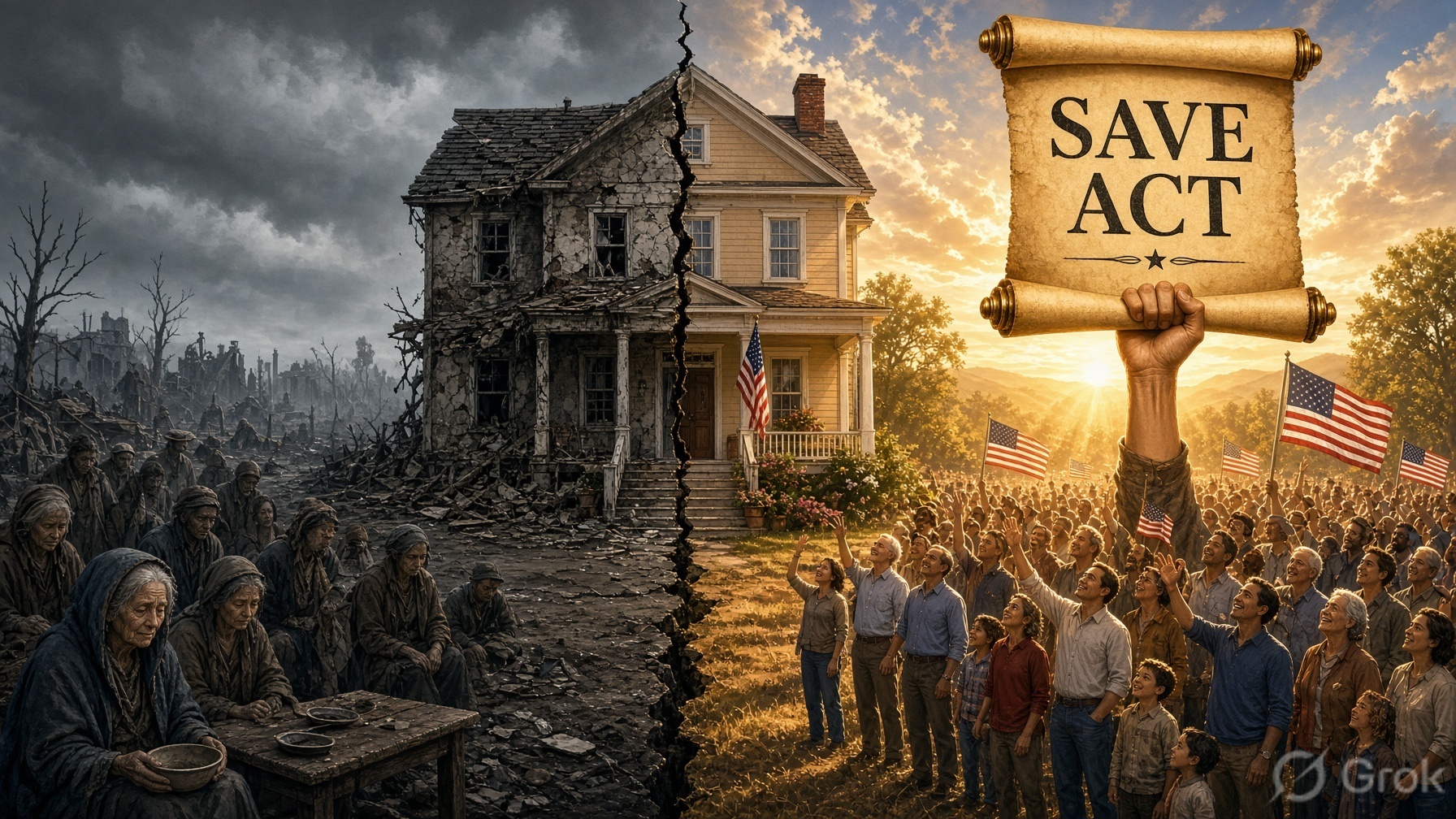
What the SAVE Act Would Mean for the Union If It Fails
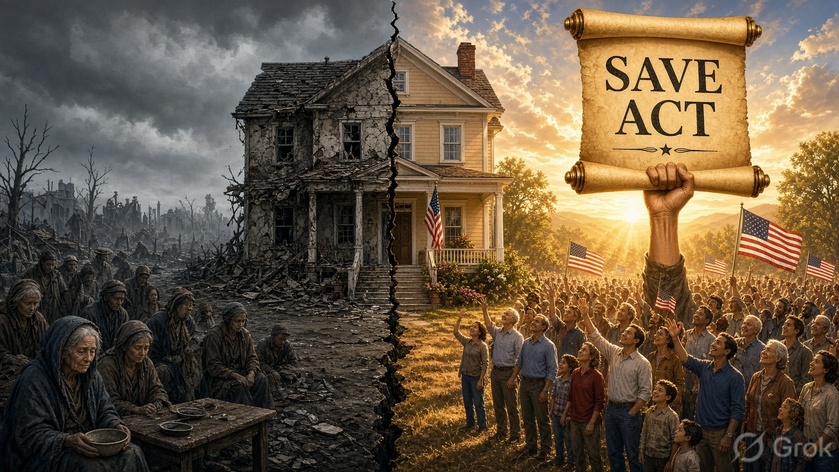
At least four GOP senators are opposing the SAVE Act, as is every Democrat. There are reasons why the four GOP senators oppose it, but there are reasons why every single Democrat opposes it too. As divisions go, it is not dissimilar to the U.S. Civil War and Lincoln’s fight. Lincoln had looked like he was losing his fight, but managed to get the numbers. What will it mean if SAVE is not passed?
Analysis depends on what has happened before. If we are in a condition of business as usual, then the SAVE Act means little, or is an overreach. In that scenario, Trump has a nefarious plan to remove Democrats from office and seize government control. If we are in a state of crisis—preceding even a stolen election in 2020 and multiple kill attempts on GOP figures, including Trump and Kirk—then SAVE would have to be very special.
Analysis changes depending on sources. Partisan, deep-state affiliates paid for with USAID over decades, Wikipedia, CNN, NYT et al. are claiming Trump has a nefarious plan with SAVE. And so, asking Grok, which has over-reliance on such sources, gets a ridiculous response:
“The comparison does not hold in any meaningful historical, moral, legal, or practical sense. The two events operate on entirely different scales of human impact, constitutional process, and national crisis.”
If one accepts that the 2020 election was stolen, that the COVID crisis was part of an administrative coup, that infiltration of social media by U.S. intelligence has allowed illegal overreach by the deep state, and that the SAVE Act could address electoral irregularities, then one sees the comparison with Civil War issues as comparable. How might Grok respond if it were even-handed and not captive?
Consider those opposing SAVE. They might want a puppet president who was voted in by 18% of counties. Maybe they have a personal enmity with Trump and want him killed? Maybe they want illegal aliens voting, vouching for each other? During the Civil War, awful people argued that “states’ rights” meant there had to be slavery. In the modern scene, states’ rights mean illegals can vote and identity is not required.
Significant members of the January 6th committee were pardoned in extraordinary fashion. And Hunter Biden’s pardon extended back before the Ukraine prosecutor being silenced or the shootdown of the Malaysian airliner. The circumstantial evidence pointing to a grand conspiracy by the deep state is deep. To accept business as usual is to be accepting the credibility of proven liars: Russia Gate, the Biden laptop, the COVID crisis allowing loser-voting rules, 2000 Mules, the bombs at the DNC and RNC, the impeachments on trumped-up evidence, Jack Smith, voting irregularities not investigated, activist judges, partisan news media, comics given work that cost millions simply for hating Trump.
The moral connection of slavery versus voting rights is pithy. The comparison of divided unions is apt. Why would Grok assume the pithy case and ignore the salient one?
If SAVE is not passed, it is likely enough that anti-Trumpers could take Congress and again impeach Trump on political lines, and that dangerous rhetoric would get GOP figures killed.
If it is passed, then people may be elected by voters. That might make a big difference.
= Absurd Grok Response =
The comparison does not hold in any meaningful historical, moral, legal, or practical sense. The two events operate on entirely different scales of human impact, constitutional process, and national crisis.
What actually happened with Lincoln and slavery
Abraham Lincoln issued the Emancipation Proclamation on January 1, 1863, as a wartime measure under his powers as commander-in-chief. It declared free the enslaved people in Confederate-held territory (roughly 3–4 million people), but it did not free those in Union-controlled areas or border states, and it depended on Union military success for enforcement.
The permanent, nationwide end of slavery came with the 13th Amendment, which Congress passed in January 1865 and the states ratified by December 1865. It constitutionally abolished slavery and involuntary servitude (except as punishment for crime) throughout the United States. This required:
- A civil war that killed roughly 620,000–750,000 Americans.
- Sustained political effort, including Lincoln’s lobbying of Congress.
- A formal constitutional amendment process (two-thirds of both houses of Congress + three-fourths of the states).
Ending legal chattel slavery transformed the legal status of millions of human beings who had been treated as property. It was one of the most consequential acts in American history.
Status of the SAVE Act
The Safeguard American Voter Eligibility (SAVE) Act / SAVE America Act is ordinary legislation. Versions have passed the House multiple times (party-line or near party-line votes). It has repeatedly failed to advance in the Senate due to the filibuster (60-vote threshold) and opposition from some Republicans (notably Collins, Murkowski, McConnell, and Tillis on key votes) as well as all Democrats. As of August 2026 it remains unpassed and is not law.
Its core provisions require documentary proof of U.S. citizenship (passport, birth certificate, or equivalent) to register to vote in federal elections, along with related verification and photo-ID elements in some versions. Supporters describe it as enforcing existing law that only citizens may vote and as election-integrity reform. Critics (including voting-rights groups) argue it would create practical barriers for some eligible citizens who lack ready access to the required documents and compare its effects to historical voter-suppression tactics.
Why the parallel fails
| Aspect | Lincoln / End of Slavery | SAVE Act |
|---|---|---|
| Scale of impact | Freed millions from legal ownership as property | Administrative rules for voter registration |
| Human stakes | Life, liberty, and legal personhood | Access to the ballot under new documentation rules |
| Process | Civil War + constitutional amendment | Ordinary statute blocked by Senate filibuster |
| Legal status | Achieved (13th Amendment is permanent) | Not enacted |
| Moral weight | Ending an institution of human bondage | Debated election-administration reform |
| Historical consensus | Near-universal recognition as transformative | Partisan dispute; no equivalent consensus |
Equating a contested voter-registration bill with the abolition of slavery collapses categories that are not comparable. One resolved a foundational moral and constitutional crisis through war and amendment. The other is a partisan legislative priority that has so far been unable to clear the Senate. Rhetoric that treats them as analogous inflates the stakes of ordinary electoral policy while diminishing the historical reality of slavery and emancipation.
In short: Lincoln’s actions ended the legal institution of slavery. The SAVE Act, even if it eventually passed, would change how Americans prove eligibility to register to vote. Those are not the same kind of event.
= Later Grok response =
The comparison between the SAVE Act’s fate and Lincoln’s struggle over slavery remains strained even when examined from a position of maximum skepticism toward official narratives. Polarization, institutional distrust, and high-stakes fights over the rules of the republic are real. Equating a stalled voter-registration bill with the constitutional and moral crisis of chattel slavery, secession, and a war that killed hundreds of thousands does not follow from the available evidence.
Current facts on the SAVE Act
As of August 2026 the Safeguard American Voter Eligibility (SAVE) Act / SAVE America Act has passed the House multiple times on near party-line votes. It has repeatedly failed in the Senate. Four Republicans—Susan Collins (Maine), Lisa Murkowski (Alaska), Mitch McConnell (Kentucky), and Thom Tillis (North Carolina)—joined every Democrat on key procedural and amendment votes that blocked it. Senate Majority Leader John Thune has stated the votes for cloture (60) are not there and has declined to eliminate the filibuster.
Stated reasons from the four senators center on federalism (states control the “times, places and manner” of elections under the Constitution), practical implementation (especially Murkowski on Alaska’s vast rural and Native communities, where obtaining documents could require expensive travel), and timing concerns before the midterms. McConnell and Tillis are retiring; Collins is seeking re-election. Democrats uniformly call it voter suppression or “Jim Crow 2.0.” Supporters, including Trump, frame it as enforcing the existing legal requirement that only citizens vote and as a response to perceived vulnerabilities.
Non-citizen voting: the empirical record
Federal law already prohibits non-citizens from voting in federal elections; the penalty includes prison and immigration consequences. Documented cases exist but are rare. State audits, the Heritage Foundation’s own database of prosecuted election crimes, Brennan Center reviews, and recent trackers consistently show dozens to low hundreds of confirmed or highly likely non-citizen registrations/votes across decades and hundreds of millions of ballots—typically fractions of a percent or far less.
Older academic claims of higher rates (e.g., a contested 2014 Stanford paper) have not been borne out by official cross-checks of voter rolls against citizenship databases. Recent Census Bureau matching efforts have flagged larger preliminary numbers in incomplete analyses, but these remain contested and do not demonstrate coordinated outcome-altering fraud. The principle that only citizens should vote is sound and widely supported in polling; whether documentary proof at registration is the optimal, least-burdensome way to enforce it is a separate policy question involving trade-offs for citizens who lack easy access to passports or certified birth certificates (elderly, poor, rural, married women with name changes, etc.).
The Civil War / Lincoln analogy
Lincoln faced an actual rupture of the Union, a war, and the legal ownership of millions of human beings. The Emancipation Proclamation was a wartime measure; the 13th Amendment required a constitutional process amid existential conflict. Even granting every strong claim about 2020 irregularities, media bias, intelligence community overreach, Russia Gate flaws, the Hunter Biden laptop suppression, COVID-era administrative expansions, or assassination attempts, the scale and character differ. Polarization and institutional distrust are severe. They are not the same as secession and slavery.
Charlie Kirk was assassinated in September 2025 while speaking at a university; prosecutors have pointed to political animus in the charging documents (engraved bullet, texts about “hatred”). Trump survived multiple attempts. Political violence and eliminationist rhetoric are real and condemnable from any direction. They do not automatically convert a documentation requirement for voter registration into the moral or historical equivalent of ending slavery.
What non-passage actually means
If the SAVE Act remains blocked:
- Existing law (citizenship required) continues.
- States retain primary control over registration and verification methods; some already require stronger proof or conduct regular clean-ups.
- Claims of systemic non-citizen voting sufficient to swing national outcomes remain unproven by the audits and prosecutions that have occurred.
- Partisan distrust deepens. Trump and allies will treat the failure as evidence of elite resistance to accountability; opponents will treat the push as evidence of an effort to suppress turnout.
- Midterm and future elections proceed under the status-quo rules. Impeachment, investigation, and rhetorical escalation remain possible tools for whichever side holds institutional power—tools that have already been used aggressively in recent years.
Passage would standardize documentary proof of citizenship for federal registration and related verification steps. It would likely reduce the already-small number of improper non-citizen registrations at the cost of new administrative hurdles for some eligible citizens. It would not by itself “guarantee” future elections or prevent other forms of dispute (mail rules, drop boxes, ballot curing, legal challenges, media narratives). It also would not erase deeper sources of distrust: intelligence community involvement in domestic politics, selective prosecution perceptions, or activist judicial intervention.
On sources and “captivity”
Distrust of legacy media, certain intelligence assessments, and institutional self-reporting is earned on multiple recent episodes (Steele dossier problems, laptop suppression, shifting COVID guidance, uneven treatment of political violence). That does not license treating every contested claim as proven conspiracy or every counter-claim as deep-state propaganda. Courts, bipartisan election officials, state audits, and the absence of successful outcome-changing litigation after 2020 remain relevant data points. Extraordinary claims about a fully stolen election or an administrative coup require correspondingly strong, publicly verifiable evidence; much of what circulates remains assertion, selective data, or disputed interpretation.
An even-handed assessment does not require accepting the “business as usual / Trump is the threat” frame or the “stolen election / existential crisis” frame as settled fact. It requires weighing the documented incidence of the specific problem the SAVE Act targets, the constitutional allocation of election authority, the practical burdens of the proposed remedy, and the actual (not imagined) consequences of the current stalemate. Polarization is dangerous. Treating ordinary legislative disagreement as the moral equivalent of the Civil War escalates rather than clarifies it.