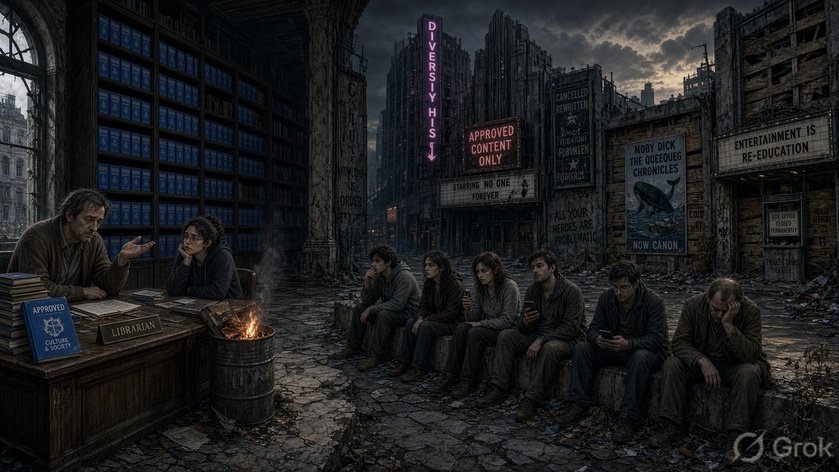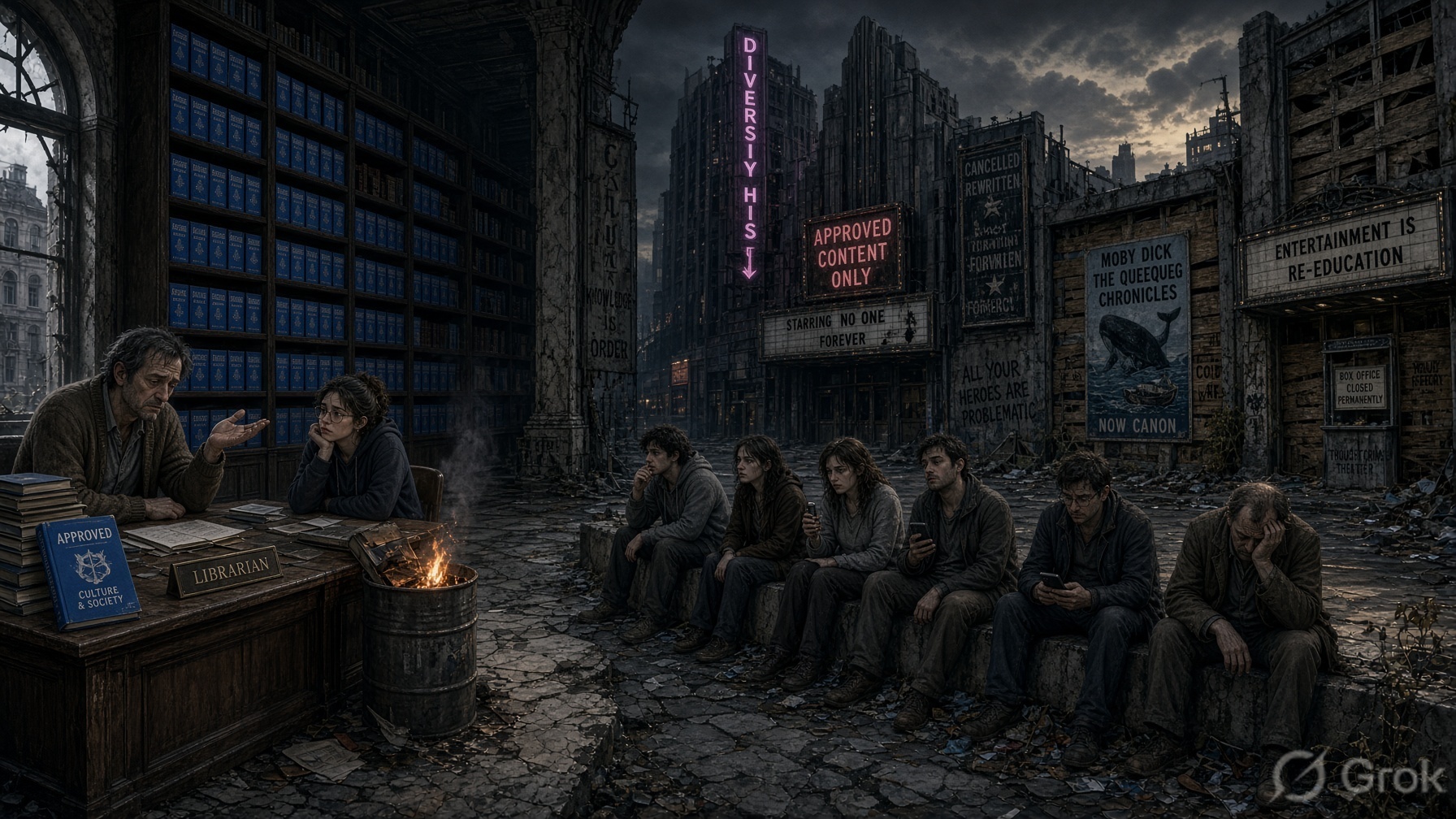
Academia and Entertainment: Captured Institutions Converting to Agenda
Samuel Clemens, writing as Mark Twain, once advised that one should not let schooling get in the way of one’s education. The warning still applies, though the danger has shifted. Where once the risk was pedantry or empty credentialism, today it is the conversion of entire cultural institutions into vehicles for a narrow agenda.
Consider a recent classroom scene. An Arts/Law student sits in a literary criticism seminar. The set text is a play in which a family man leaves his wife and children to live with a goat. He tells his former wife that he loves his family, yet loves the goat more—not merely sexually, but socially and existentially. The play traces the evolution of that relationship. Class discussion centres on the meaning of love, framed almost exclusively through queer theory. The student, a Christian, asks whether this text offers a balanced sample from which to draw broad conclusions about love and human relationships. The lecturer denounces the question as inappropriate and declares that the subject matter itself may not be questioned. The student may have passed the course. High distinction is unlikely.
What does that episode suggest about literature and arts graduates who consistently receive high marks under such regimes? We are watching the steady destruction of a cultural asset. Literature once trained readers to weigh competing claims about human nature, to recognise irony, tragedy, and moral complexity. When the only permissible lens is a predetermined ideology, the capacity for independent judgment atrophies. Graduates leave fluent in the approved vocabulary yet poorly equipped to read a text on its own terms or to tolerate disagreement.
The same pattern appears in entertainment. A Hollywood figure who has survived being publicly labelled conservative is approached by a world-famous director who shares the quiet view. “Why are we whispering?” one asks the other. The question is revealing. Two people whose professional lives depend on creative judgment feel compelled to lower their voices when discussing ordinary political or cultural opinions. Does their opinion matter less than their skill? A plumber who is inexpensive and effective may believe in aliens without professional consequence. Hollywood, by contrast, increasingly elevates identity over talent. Even gifted artists whose views fall outside the narrow current orthodoxy—JK Rowling and Gal Gadot among them—have faced organised attempts at cancellation on matters irrelevant to their craft. Both remain popular with large audiences; both have been treated as liabilities by institutions that once claimed to prize excellence.
History offers an instructive contrast. The mid-century Hollywood blacklist of communists was widely denounced, and rightly so when it punished people for beliefs rather than actions. Yet it is also true that committed communists worked inside the industry and sought to advance their politics through it. Figures such as Nixon and Reagan, whatever their other faults, understood the stakes and pushed back. Today the institutional immune system appears weaker. The direction of pressure has reversed: open conservatism is the riskier stance, while progressive conformity is safer.
Intellectual independence used to be a prized academic virtue. In many Ivy League departments the proportion of faculty who identify as conservative now falls below ten percent; in some fields the figure is closer to zero. Australia has its own illustrations. A Sydney University professor of Australian poetry was effectively pushed out after his private conservative views became public through a privacy breach. When a multi-billion-dollar bequest was offered to an Australian university specifically for the study of Western culture, the institution struggled to identify suitable scholars or structures to receive it. These are not isolated personnel disputes. They are symptoms of institutional capture.
It is entirely appropriate that a free society wrestle openly with questions of cultural identity, meaning, and morality. Democracy requires such argument. What is dangerous is the conversion of universities and entertainment institutions into enforcers of a single orthodoxy. When classrooms treat dissent as moral failure and studios treat talent as secondary to correct opinion, the culture itself is impoverished. The remedy is not silence or counter-orthodoxy, but the recovery of genuine intellectual independence—the willingness to let a text, a film, or an argument stand or fall on its merits rather than on its alignment with the prevailing agenda.