VoiceDDB
Politics • Culture • News
Hagiography of Turnbull doesn't cover flaws.
When republicans turn traitor
August 28, 2026
post photo preview

Hagiography of Turnbull doesn't cover flaws.

Turnbull was not a modest boy who stumbled into the Lodge. He was a man who learned early that rooms open to money, persistence and a well-placed leak. The authorised version sells loneliness, a scholarship and a Rhodes. The political version is succession, division, and a Liberal Party still paying for the method.

Early life

Malcolm Bligh Turnbull was born in Sydney on 24 October 1954, only child of Bruce Bligh Turnbull, a hotel broker, and Coral Magnolia Lansbury, actor, writer and academic — third cousin of Angela Lansbury. They married after he was born. The marriage was sour. When he was about nine Coral left for New Zealand with the academic John Salmon. Bruce raised him in Vaucluse and Double Bay, later Point Piper when the business improved. Bruce died in a plane crash in 1982.

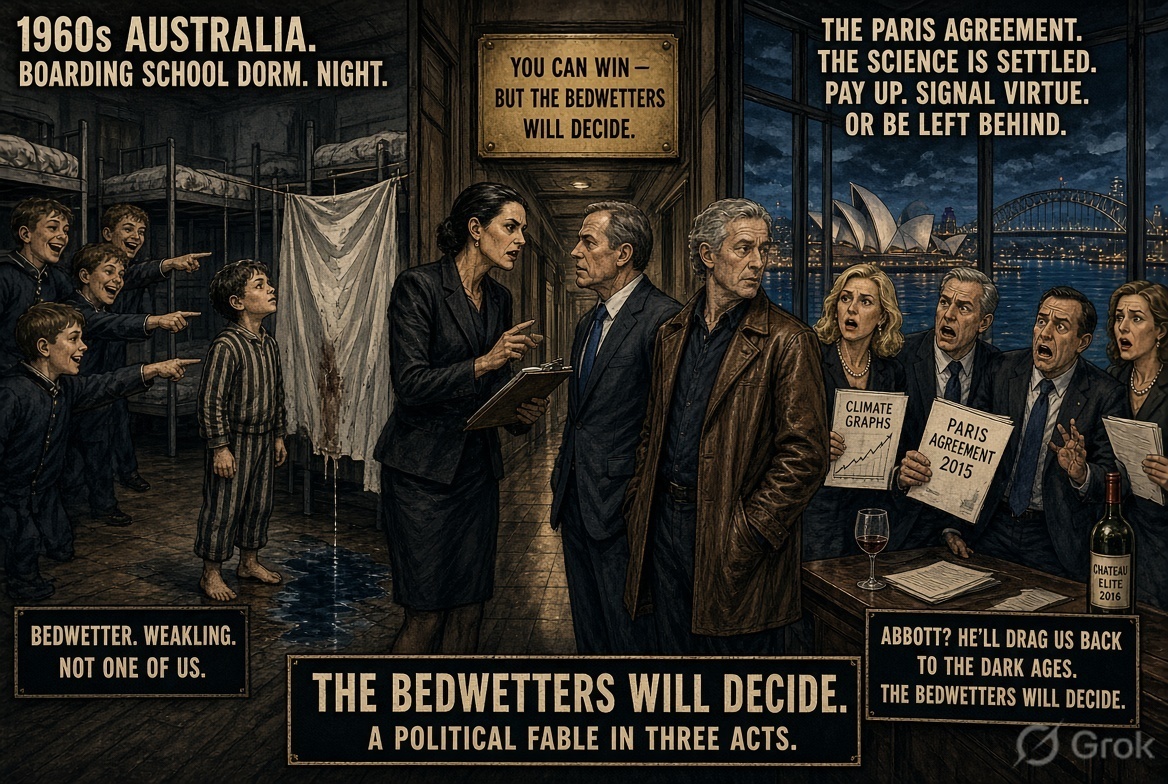
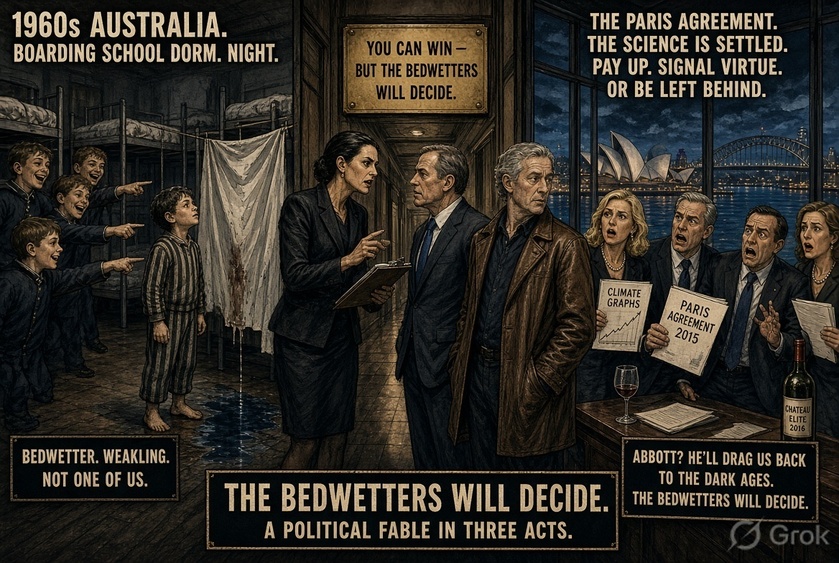
That hurt was real. Boarding at Sydney Grammar’s prep school meant bullying over bed-wetting. Fees were a problem. He went on through Grammar on a partial scholarship, shone at debating and history, co-captained the school in 1972, and later paid for a means-tested scholarship in his father’s name. An ancestor, John Turnbull, arrived in 1802. The middle name Bligh, after the Governor, is a family habit he passed to his son.

Do not confuse that with being locked out. This was still the eastern suburbs and a selective private school. Lonely is not the same as powerless.

Family

He married Lucy Hughes at Oxford in 1980. She is Tom Hughes’s daughter — former Attorney-General, Liberal legal nobility. Lucy became Lord Mayor of Sydney and later Chief Commissioner of the Greater Sydney Commission. Two children, Alex and Daisy. Four grandchildren. Raised Presbyterian, a stretch of agnosticism, Catholic by about 2002 with her family’s faith. The marriage put him inside respectable Liberal Sydney before he held a seat.

The ticket

Arts and law at Sydney, journalism on the side, Rhodes Scholar, civil law at Oxford, Sunday Times under Harold Evans. Then the bar: Spycatcher against the British government, Packer in the Costigan circus. In 1987 a merchant bank around media and technology — Packer, Murdoch, Conrad Black, Robert Maxwell. OzEmail, NASDAQ, a stake sold for about $57 million before the crash. Goldman Sachs partner, head of Australia, then politics.

He chaired the Australian Republican Movement and lost the 1999 referendum. He blamed Howard for “breaking the nation’s heart.” That is how he entered the Liberal Party: famous, rich, republican, already talking down the conservative base.

Howard, Costello, and the man they let in

Conservative leadership in this country is seized when it works. Howard had given Costello reason to believe there would be a handover — the 1994 conversation, one and a half terms, then Peter. Howard stayed. Costello would not take him out. Costello believed a modern party needed an orderly succession. Howard refused to step aside.

So Howard brought Turnbull in. Not as a gift to Costello. As another ambitious man in the room for Costello to fight. Wentworth in 2004 was a brawl. Peter King was dumped. Both sides stacked. King ran independent. Costello gave King a reference and said he wished there were two seats. Howard praised the recruit and said he would not be rushed to the frontbench. Turnbull took the seat anyway.

Turnbull did what he was good at. He destabilised leadership, leaked to the press, and kept the party divided while Labor took government. Howard lost his own seat. Costello tanked and walked. Turnbull lost the first ballot to Brendan Nelson — a wet — and then kept leaking until the leadership was his.

Climate, numbers, and the brief he accepted

To lock the leadership he needed backers. Those contacts put him on the same climate track the Americans were pushing through the aid-and-policy world — the USAID line on global warming as settled business. He adopted a scheme close enough to Labor’s that the Coalition could be told to sit still and be a small target. Conservatives were not a small target. They were the people who were supposed to notice the difference.

Joe Hockey campaigned against it. Turnbull called that disloyal. Turnbull declared a spill. Hockey folded on the morning. Abbott ran too, on a conservative policy against the climate scheme. Abbott won by one vote.

Turnbull did not accept the result. He leaked and undermined the new leadership the way he had undermined the last. Abbott almost had the Lodge, then took it in 2013. Turnbull used channels that run through foreign policy and the foreign ministry world to keep pressure on. American journalists called Abbott a misogynist. His wife, daughters and closest staff were women. That did not matter to the line.

Polling was used inside the party to finish the job. Turnbull’s operation tested Abbott on women and put about that no woman would wear him. That story was fed to insiders who already wanted a change. There was a sandwich-board man in the street naming Abbott with a swear word, and the press was there to cover it. That is how a leadership is softened before the ballot.

In 2015 he rolled Abbott 54–44.

Prime Minister

Once he had the job he signed Australia onto Paris. He had told the IPA world he believed in freedom of speech. He reneged. As Communications Minister under Abbott he had already confected a free-speech fight over 18C to weaken the leader. As Prime Minister he would not deliver the repeal.

What his government can put on a card: same-sex marriage after the postal survey; personal tax cuts; an innovation package; Snowy 2.0; TPP-11 after Trump walked; the US refugee swap; Gonski 2.0; City Deals and Western Sydney Airport moving; foreign-interference laws; a bigger defence spend. Jobs were strong in that stretch.

What he would not hold: company tax for larger firms, blocked then dumped; a legislated energy policy — the NEG died in his own room; a fibre NBN he had already replaced with the cheaper mix, then copped the blowout; a banking royal commission he resisted until politics forced him. The 2016 double dissolution was meant to clear the Senate. He came back with one seat and a worse upper house. Mediscare worked.

Then section 44, Joyce out, the affair, the “bonk ban.” Joyce speaks for the country the party pretends to represent. Turnbull’s government turned that into farce and a lecture. “Harbourside mansion” stuck because the tone was the man.

The landing

When he finally lost the Lodge he did not leave clean air. He called the spill, lost the room, and Morrison came through the middle — not as a man who had won the leadership in a straight fight, but as the beneficiary of Turnbull’s wreckage. Costello’s dream of a modern party with an orderly handover failed again.

Since then: the AC, the memoir, the speeches, climate, China, AUKUS called “stark staring bonkers,” kind words for teals, and a running brief that the Liberal Party betrayed him. The method was his. The bill is still ours.


Readers who want the newspaper version will be told the women-polling, the sandwich board and the USAID brief are “not on the public record.” Party workers who were in the building at the time know how leadership numbers were worked. This piece is written from that side of the door. The Howard–Costello tension, the leaking against Nelson, Utegate, the 2009 ETS split, the 2015 ballot and the 2018 mess are also on the open record. Believe the official silence if you prefer it. Do not pretend silence is the same as absence.
community logo
Join the VoiceDDB Community
To read more articles like this, sign up and join my community today
0
What else you may like…
Videos
Posts
Articles
00:01:07
November 27, 2022
Jingle Bell Rock

Jingle bell, jingle bell, jingle bell rock
Jingle bells swing and jingle bells ring
Snowin' and blowin' up bushels of fun
Now the jingle hop has begun

Jingle bell, jingle bell, jingle bell rock
Jingle bells chime in jingle bell time
Dancin' and prancin' in Jingle Bell Square
In the frosty air

What a bright time, it's the right time
To rock the night away
Jingle bell time is a swell time
To go glidin' in a one-horse sleigh

Giddy-up jingle horse, pick up your feet
Jingle around the clock
Mix and a-mingle in the jinglin' feet
That's the jingle bell rock

Jingle bell, jingle bell, jingle bell rock
Jingle bell chime in jingle bell time
Dancin' and prancin' in Jingle Bell Square
In the frosty air

What a bright time, it's the right time
To rock the night away
Jingle bell time is a swell time
To go glidin' in a one-horse sleigh

Giddy-up jingle horse, pick up your feet
Jingle around the clock
Mix and a-mingle in the jinglin' feet
That's the jingle bell
That's the jingle...

00:02:04
September 01, 2021
Intro to Locals for the Conservative Voice

David Daniel Ball calls himself the Conservative Voice.

I'm a teacher with three decades experience teaching math to high school kids.I also work with first graders and kids in between first grade and high school. I know the legends of why Hypatia's dad is remembered through his contribution to Math theory. And I know the legend of why followers of Godel had thought he had disproved God's existence.

I'm not a preacher, but I am a Christian who has written over 28 books all of which include some reference to my faith. Twelve blog books on world history and current affairs, detailing world events , births and marriages on each day of the year, organised by month. Twelve books on the background to and history of Bible Quotes. One Bible quote per day for a year. An intro to a science fiction series I'm planning, post apocalyptic cyber punk. An autobiography with short story collections.

I'm known in Australia for my failure as a whistleblower over the negligence death of a school boy. ...

00:01:50
September 04, 2026
Should violent criminals be made fat? Grok says 'no'

No. Transferring gut bacteria from an obese person into a violent criminal is not a reliable, ethical, or effective way to make them “fat, sedentary, and less of a physical threat.”

The science does not deliver the outcome you want

Mouse studies in germ-free animals showed that microbiota from obese donors can increase energy harvest and adiposity compared with lean-donor microbiota. That is the origin of the idea. Human evidence is far weaker.

Randomized trials of fecal microbiota transplant (FMT) from lean donors into people with obesity have generally failed to produce meaningful, sustained weight loss. Microbiome composition can change; body weight and metabolic markers often do not, or the effects are small and inconsistent. Diet and the existing gut environment usually dominate. A 2025 Nature paper found diet outperformed microbial transplant for microbiome recovery. Human guts are already colonized, not sterile like lab mice, so engraftment is variable and effects unpredictable.

It is not a ...

post photo preview
August 28, 2026
Pfizer struggles to answer

Some in Australia are brilliant. Malcolm Roberts Investigates Pfizer over Covid vaccine.

Holiday break is over back to work tonight

Tonight I'll start double posting until I've caught up.

post photo preview
Catholic Orthodox Schism
Shades of christianity

Catholic Orthodox Schism

Shades of christianity

The Catholic and Orthodox churches did not divide on one day. They grew apart for centuries, healed more than once, and only later treated the breach as permanent. The council of 869 is one of the early fractures, and it did not hold.

For the first centuries there was one church with several chief sees. Rome, Constantinople, Alexandria, Antioch and Jerusalem were the five patriarchates. Rome had a primacy of honour as the see of Peter and Paul, and the only apostolic see in the West. Constantinople had the emperor, the court, and from the sixth century the title “ecumenical patriarch.” Greek in the East, Latin in the West, different liturgies, and two ideas of authority were already in place before anyone spoke of a schism. The East thought of Rome as the senior patriarch, whose voice mattered most in a council. The popes of the ninth century were already claiming a jurisdiction that could judge other patriarchs.

Photius sat in the middle of that argument. In 858 the emperor Michael III deposed Patriarch Ignatius and replaced him with Photius, a lay scholar and head of the imperial chancery. He was elected, tonsured and ordained through the grades to the patriarchate within about a week. Ignatius’s party appealed to Rome. Pope Nicholas I refused to recognise the appointment. Canon law, as Rome read it, did not allow a layman to be rushed to the highest see, and it did not allow an emperor to depose a patriarch and have Rome rubber-stamp the result.

The fight then moved to Bulgaria. Both Rome and Constantinople wanted the new Bulgarian church. Nicholas wrote to the Bulgars attacking Greek customs: married clergy, the leavened bread of the Eucharist, and other rites. Photius answered in 867 with a council in Constantinople that deposed and anathematised Nicholas and the Western church. The charge that lasted was the Filioque. The Nicene-Constantinopolitan Creed says the Holy Spirit proceeds from the Father. In Spain, and then more widely in the Latin West, churches had added “and from the Son” — Filioque — to stress the Son’s full divinity against Arianism. Rome itself adopted the addition later. Photius called the addition a corruption of the creed and a theological error. The East’s objection was twofold: that the Spirit proceeds from the Father alone, the Son being involved in the Spirit’s sending but not in his eternal origin; and that no one see had the right to alter a creed fixed by an ecumenical council.

That council of 867 did not last the year. Basil I murdered Michael III, took the throne, and restored Ignatius. Nicholas died in November 867. His successor, Adrian II, condemned Photius, and Basil called the council that opened in Constantinople on 5 October 869. It sat until 28 February 870. It restored Ignatius, anathematised Photius, burned the acts of the 867 synod, and issued 27 canons. The papal legates pressed for a clear submission to Roman judgment. Attendance was poor: about a dozen bishops at the opening, never more than about a hundred. The West later counted this as the Fourth Council of Constantinople and the eighth ecumenical council. The East never did.

It also failed on the ground. Ignatius died in 877. Photius became patriarch again, with Basil’s support, and Pope John VIII recognised him in return for concessions on Bulgaria and a promise not to press the Filioque quarrel. A much larger council in Constantinople in 879–80 rehabilitated Photius, annulled the council of 869–70, and was accepted at the time by John VIII’s legates. Rome later repudiated that acceptance. Photius died in communion with Rome, or near enough to it that the breach closed. The Orthodox Church venerates him as a saint. The Catholic Church does not count his rehabilitating council.

What survived was the pair of questions. Does the Spirit proceed from the Father and the Son, or from the Father alone? And is the pope the monarch of the whole church, or the first among patriarchs who cannot rewrite a council’s creed or depose an eastern bishop on his own? Those questions were quiet for long stretches. They were not settled.

The date everyone remembers is 16 July 1054. Patriarch Michael Cerularius had closed Latin churches in Constantinople and attacked Western rites, especially unleavened bread. Pope Leo IX sent Cardinal Humbert. Humbert was abrasive, Leo had in fact already died, and on 16 July Humbert laid a bull of excommunication on the altar of Hagia Sophia. It named Cerularius and his supporters, and it condemned the Greek doctrine of the Spirit, married priests, and leavened bread. Cerularius excommunicated the legates in return. The two bulls did not excommunicate whole churches. Most bishops, east and west, never heard of them. Communion had already been patchy; it continued, in places, afterwards.

The split became a fact in the crusading era. The massacre of Latins in Constantinople in 1182, and then the Fourth Crusade’s sack of the city in 1204, turned a quarrel of theologians and patriarchs into a wound ordinary people remembered. A Latin patriarch was set up in Constantinople. Reunion was signed at the Second Council of Lyon in 1274 and again at Florence in 1439, both times under political pressure — the second time with the Ottoman siege already in view. Neither union survived contact with the eastern clergy and people. After 1453 Constantinople was Ottoman, and Moscow came to call itself the Third Rome. The anathemas of 1054 were lifted by Pope Paul VI and Patriarch Athenagoras in 1965. That removed a symbol. It did not restore communion.

So the council of 869 matters as a rehearsal. A pope and an emperor deposed a patriarch; a thin council ratified it; a fuller council undid it; Rome and Constantinople kept different memories of which council had spoken for the church. The later schism grew from that disagreement about authority, from the Filioque, and from the political rupture of 1204, not from a single anathema in 869 or 1054.

=

These are the standard “on this day” entries for 5 October. A few of the ancient dates are calendar conversions, and one revolutionary claim is looser than the list makes it sound.

539 BC — Babylon falls to Cyrus. The Nabonidus Chronicle puts the entry into the city on the 16th of Tašrītu in the 17th year of Nabonidus. Sippar had fallen two days earlier without a fight; Nabonidus fled, then was taken when he returned. The man who entered was Ugbaru (Gobryas), governor of Gutium, with Cyrus’s army. Cyrus himself came in about a fortnight later, in Arahsamna. Parker and Dubberstein’s Babylonian chronology converts the 16th of Tašrītu to 12 October Julian, which is about 5–6 October on the proleptic Gregorian calendar — hence the date on modern lists. The Cyrus Cylinder presents the takeover as peaceful and as the choice of Marduk; Herodotus and the book of Daniel remember a festival night and a breached river defence. What is solid is the political result: the Neo-Babylonian empire ended, and Cyrus’s edict let the Judean exiles go home. That is the hinge Second Isaiah and the book of Ezra both hang on.

456 — the Suebi broken on the Órbigo. Theodoric II, king of the Visigoths, moved into Iberia on the orders of the short-lived western emperor Avitus. With him were Burgundian forces under Chilperic I and Gundioc, and Frankish contingents. On the river Urbicus (the Órbigo), near Astorga in Gallaecia, they defeated the Suebi under Rechiar. Rechiar was captured and later executed. Suebic power in the north-west did not vanish at once, but the battle ended their bid to dominate the peninsula and left the Visigoths as the coming power in Hispania.

610 — Heraclius crowned. Heraclius, son of the exarch of Africa, sailed on Constantinople against the usurper Phocas. The Excubitors deserted, the city opened, and Phocas was killed — by Heraclius’s own hand in some accounts, after the exchange “Is this how you have ruled?” / “And will you rule better?” On 5 October, in the chapel of St Stephen in the Great Palace, Patriarch Sergius crowned him, and he married Fabia, who took the name Eudocia. He inherited a wreck: Avars in the Balkans, Khosrow II already using Maurice’s murder as a pretext for war. Syria, Palestine and Egypt would fall; the True Cross would be carried off. Heraclius’s answer was personal command, a rebuilt army, and the campaign that ended at Nineveh in 627. The peace he won was brief. Within a decade the same provinces were lost again, this time to the Arabs.

816 — Louis the Pious crowned at Reims. Louis was already emperor. Charlemagne had crowned him co-emperor at Aachen on 11 September 813, and he had ruled alone since his father’s death in 814. Pope Stephen IV came north anyway. On Sunday 5 October, during Mass at Reims, Stephen anointed him and set on his head a crown said to have been Constantine’s. Ermengarde was crowned with him and hailed Augusta. Louis had prostrated himself before the pope. The act did not make him emperor; it reattached the imperial title to a papal coronation, which Charlemagne’s 813 ceremony had sidestepped. Reims became the place where French kings were crowned.

869 — the council that deposed Photius. The Fourth Council of Constantinople, counted in the West as the eighth ecumenical council, opened on 5 October 869 and sat until 28 February 870. Emperor Basil I and Pope Adrian II wanted Photius out. Photius, a lay scholar raised abruptly to the patriarchate in 858, had been deposed once, restored, and had anathematised Pope Nicholas I in 867. The council restored Ignatius, anathematised Photius, burned the acts of his 867 synod, and issued 27 canons. Attendance was thin — a dozen bishops at the start, never more than about a hundred. The East does not receive it. Photius was patriarch again from 877, and the council of 879–80, far better attended, rehabilitated him. This is one of the fractures that later hardened into the schism.

1143 — Portugal recognised at Zamora. On 5 October, at Zamora, with the papal legate Cardinal Guido de Vico present, Alfonso VII of León and Castile — who styled himself emperor of the Spains — acknowledged his cousin Afonso Henriques as king of Portugal. Afonso had already won the field against his mother at São Mamede in 1128 and had used the royal title after Ourique in 1139. The text of the treaty is lost. What survived is the political fact: the Leonese crown stopped contesting the title, and Afonso signed as rex Portugallensis. Full papal recognition waited until Alexander III’s bull Manifestis Probatum in 1179. Portugal still marks 5 October, though the modern national holiday is the republic of 1910, not Zamora.

1450 — Jews expelled from Lower Bavaria. Louis IX, Duke of Bavaria-Landshut, called Louis the Rich, ordered the Jews out of his part of Bavaria. This sits in the long fifteenth-century squeeze on German Jewish communities — debt cancellation dressed as piety, local expulsions before the larger ones of the 1490s. It was not the end of Jewish life in all Bavaria; Regensburg’s community lasted until 1519. It was a ducal clearance of Lower Bavaria.

1550 — Concepción founded. Pedro de Valdivia founded the city on 5 October 1550, at Penco on the Bay of Concepción, as a southern anchor of Spanish Chile against the Mapuche frontier. Earthquakes and Araucanian war forced later moves; the modern city stands inland of that first site. The date is the official foundation.

1582 — a day that did not happen. Pope Gregory XIII’s bull cut ten days from October so that the spring equinox, and therefore Easter, would fall where the Council of Nicaea had put it. In Italy, Spain, Portugal and the Polish–Lithuanian lands, 4 October was followed by 15 October. The 5th through the 14th do not exist in those countries for that year. France waited until December; Protestant states longer; Britain until 1752.

1607 — the knives and Paolo Sarpi. Sarpi, a Servite friar and Venice’s theological adviser in the Interdict fight with Paul V, was attacked on the night of 5 October as he came down the bridge by Santa Fosca toward his convent. Five men; fifteen thrusts by the count of holes in hat, hood and collar; three wounds that landed, one stiletto left in the cheekbone. He lived. Asked who had done it, he said Agnosco stylum Romanae Curiae — “I recognise the style of the Roman Curia,” with stilus also meaning dagger. The attackers fled toward the papal nuncio’s house and on to Rome. Venice gave him a safer lodging. He went back to his work on the history of the Council of Trent.

1665 — Kiel. Christian Albert, Duke of Holstein-Gottorp, founded the university on 5 October. It still bears his name: Christian-Albrechts-Universität.

1789 — the women march to Versailles. On the morning of 5 October, women from the Paris markets, after days of bread shortage and rumour, set off for Versailles. They wanted grain, and they wanted the king to sanction the August decrees and the Declaration of the Rights of Man. The National Guard followed under Lafayette, partly to lead the march and partly to keep it from becoming a sack. That night and the next morning the palace was invaded; two guards were killed. On the 6th Louis XVI agreed to move to Paris. The court came back to the Tuileries in the train of the crowd. The revolution ceased to be something that happened at a safe distance from the king.

1793 — the calendar, not a single act of abolition. Lists often say Christianity was disestablished in France on this day. What the Convention actually did on 5 October 1793 was accept Gilbert Romme’s scheme for a republican era beginning on 22 September 1792, the day the Republic had been proclaimed. The calendar itself was decreed on 24 October and backdated. Sunday disappeared; saints’ days were replaced by the names of plants, tools and weather; the aim was to take Christian time out of ordinary life. Dechristianisation was already a campaign — closed churches, the Cult of Reason, death for non-juring priests and those who hid them — not a statute passed on the 5th that ended the faith by decree. The Republican calendar lasted until 1806.

The day runs from a change of empire in Babylon to a change of calendar in Paris, with coronations, a council, a new kingdom and a failed killing in between.

Read full Article
post photo preview
The Great Game was not fought in Europe.
And yet Great Britain and Russia faced off.

The Great Game was not fought in Europe.

And yet Great Britain and Russia faced off.

The Crimean War was not a campaign of the Great Game. It was the one moment when the same rivalry was fought in Europe, with fleets and allies, instead of by envoys, subsidies and buffer states on the road to India.
The Game was the Anglo-Russian contest for the land between the two empires: Persia, Afghanistan, the khanates of Central Asia, and the passes that led down to the Indus. Britain’s fear, stated from the 1830s on, was simple. A Russia that kept marching south would one day stand on the Hindu Kush, or turn Persia into a dependency, and threaten India without ever fighting a European war. Russia’s interest was the reverse: warm water, a compliant neighbour on its southern frontier, and room to expand once the Ottomans and the steppe khanates weakened. The instruments were familiar long before 1853. The First Anglo-Afghan War of 1839–42 had already been fought to put a friendly ruler in Kabul. Herat, the western gate of Afghanistan, was watched every time Persia, with Russian encouragement, moved against it. Treaties with Tehran and St Petersburg drew lines that neither side trusted.
What happened on 4 October 1853 sat on the other end of the same map. Nicholas I was not marching on the Khyber. He had occupied the Danubian Principalities and was demanding a protectorate over the sultan’s Orthodox subjects, with Constantinople and the Straits as the prize if the empire broke. For Britain that was the western door of the same problem. A Russian fleet in the Black Sea, and a Russian say over the passage into the Mediterranean, threatened the sea route toward India as surely as Cossacks on the Oxus threatened the land route. Palmerston and the men around him did not treat the two theatres as separate quarrels. The “sick man” and the buffer states were one strategic question: where Russia would be stopped.
That is why Britain entered a war whose battlefield was the Crimea and whose formal cause was a dispute over churches in Palestine. France had its own reasons, Napoleon III among them. Austria feared Russian possession of the lower Danube. The Ottomans were fighting for the principalities and for the claim that the sultan, not the tsar, protected the Christians of the empire. Britain was fighting to keep Russia out of Constantinople and the Straits, and to show that the check could be made to hold. The Treaty of Paris in March 1856 did that for a generation. Russia lost southern Bessarabia, accepted the neutralisation of the Black Sea, and saw the Ottoman Empire placed under a European guarantee.
The Game did not end with that treaty. It sharpened, because the Black Sea door had been shut. Unable to push through the Straits, Russia turned east. Tashkent fell in 1865, Samarkand in 1868, Khiva in 1873, Kokand in 1876, Merv in 1884. Each advance shortened the distance to Herat and to India, and each produced a British answer: a forward policy on the north-west frontier, the Second Anglo-Afghan War of 1878–80, the Penjdeh crisis of 1885, when Russian and Afghan troops clashed and Britain and Russia came close to war again. The men who had beaten Russia at Sevastopol spent the next thirty years arguing over how far the Indian garrison should go to meet the next Russian column.
So the October declaration belongs at the hinge, not inside the Game itself. It was the Eastern Question fought to a decision, by coalition, in sight of the European capitals. The Great Game was what remained when that decision closed the sea and left the land. The rivalry that produced Sinope and the Alma is the same rivalry that produced the Afghan wars and the race for Merv. Only the ground changed.
=
On 4 October 1853 the Sublime Porte declared war on Russia. The manifesto was read in the mosques of Constantinople that day, the first of the Ottoman year, and published in the official paper Takvim-i Vekayi. Notes went to the British, French, Austrian and Prussian embassies. The text was deliberately calm. It said Russia had occupied Ottoman territory and had refused to leave, so the sultan was forced to fight. It also gave the Russian commander on the Danube fifteen days to evacuate. Hostilities did not legally begin until that grace expired and the answer came back no.
The quarrel had been building for a year, and the holy places were only the match. In Palestine, French-backed Latins and Russian-backed Orthodox monks had disputed keys, a silver star, and precedence at the Church of the Nativity and the Holy Sepulchre. Napoleon III wanted a Catholic victory he could show at home. Tsar Nicholas I treated the Orthodox claim as a right of protection over some twelve million Ottoman Christians. In the spring of 1853 Prince Menshikov arrived in Constantinople demanding a formal protectorate. Sultan Abdülmecid, stiffened by the British ambassador Stratford Canning, refused. Nicholas had already called the empire “the sick man of Europe” and sounded Vienna and London on a partition. Neither would bite. In July his troops crossed the Prut and occupied the Danubian Principalities, Moldavia and Wallachia, still under Ottoman suzerainty. Britain ordered its fleet toward Constantinople on 23 September. With French and British promises in hand, the Porte chose war rather than accept the occupation as a fact.
Ömer Pasha, the Austrian-born convert who commanded the army of Rumelia, sent the ultimatum to Prince Mikhail Gorchakov on 8 October. Gorchakov answered on the 10th that his master was not at war with Turkey, but that he had orders not to leave until the emperor received “moral satisfaction,” and that if attacked he would stand on the defensive. From that refusal the war was open. Turkish troops crossed the Danube later in the month. They fought a holding campaign and checked the Russian advance at Silistra. On 30 November a Russian squadron under Nakhimov destroyed an Ottoman fleet at anchor in Sinope. That shock, more than the October manifesto, pulled Britain and France across the line. Their fleets entered the Black Sea on 3 January 1854. They declared war on 28 March.
What followed is remembered as the Crimean War, though the fighting ran from the Danube to the Caucasus to the Baltic. Britain, France and, from January 1855, Piedmont-Sardinia joined the Ottomans. The allies landed in Crimea in September 1854, won the Alma, endured the siege of Sevastopol through a winter that killed more men by disease than by shot, and took the city in September 1855. Nicholas died in March 1855. His son Alexander II accepted preliminary terms in February 1856. The Treaty of Paris, 30 March 1856, restored the principalities, stripped Russia of southern Bessarabia and the right to keep a fleet on the Black Sea, and put the integrity of the Ottoman Empire under a European guarantee.
The October declaration did not save the empire. It postponed a partition and bought a generation under that guarantee. The same war broke the Concert of Europe that had held since 1815, made Florence Nightingale and the telegraph part of how battles were seen at home, and left Russia determined to undo the Black Sea clauses, which it did in 1871. The quarrel over a star in Bethlehem had become a war about who would inherit the Ottoman south and the Black Sea shore.
=
October 4 is a day of fallen capitals, broken calendars, and men who seized a city or a fleet and found the throne still one fight away. The entries you listed sit mostly on that date. Two of them spill onto the 5th: Heraclius was crowned the morning after he landed, and Napoleon’s grapeshot fell on 13 Vendémiaire, which is 5 October 1795, after the sections had already declared themselves in revolt on the 4th.
Chang’an, AD 23. Wang Mang had taken the Han throne in AD 9 and called his dynasty the Xin, the New. Famine, debased coin, and land edicts that never quite worked fed two peasant armies, the Lulin in the south and the Red Eyebrows on the plain. In spring 23 the Lulin put a Han prince, Liu Xuan, on a throne of their own. By early October their columns and a rising inside the walls had Chang’an. On 4 October rebels broke an eastern gate. Wang Mang, in purple, still holding the imperial seals, tried ritual defence rather than flight. At dawn on 6 October his last attendants made a stand on the Terrace Bathed by Water. A merchant, Du Wu, killed him. His head was cut off and shown. The Xin died with him. The Han restoration that followed was not the one the Lulin had planned: within two years Liu Xiu, the future Guangwu, had outlasted both them and the Red Eyebrows.
Constantinople, 610. Phocas had murdered Maurice in 602 and spent eight years losing the east to the Persians. Heraclius, son of the exarch of Africa, sailed from Carthage, entered the Golden Horn, and was received as the alternative the city had already half-chosen. He reached Constantinople on 3–4 October. On 5 October Patriarch Sergius crowned him in the chapel of St Stephen inside the Great Palace. Phocas was dragged out and killed. The reign that began that week would last until 641, lose Syria and Egypt to the Arabs, and still be remembered for the counter-stroke that broke Khosrow II.
Marrakesh, 1227. Abdallah al-Adil was an Almohad prince who had already had his predecessor strangled in 1224. The coup split the dynasty. Andalusian rivals and Castile picked at the edges. On 4 October 1227 he was drowned in a palace bath in Marrakesh, and his nephew Yahya al-Mutasim was put up in his place. The murder settled nothing. Within a generation the Almohad caliphate was gone from Spain and failing in the Maghreb.
Venice and the lake, 1302 and 1363. On 4 October 1302 Byzantium and Venice closed the war that had run since 1296. Andronikos II bought peace: Venetian prisoners released, trading rights restored, a war indemnity. It was a truce in a rivalry that would outlast both signatories. Sixty-one years later, on the same date, the Battle of Lake Poyang ended. From late August, Zhu Yuanzhang’s smaller, faster craft had harried Chen Youliang’s tower-ships on the great lake in Jiangxi. On 4 October an arrow killed Chen. His Han state collapsed with him. Zhu, once a novice monk, was five years from founding the Ming.
Rome, London, and the Georgia coast. On 4 October 1511 Ferdinand of Aragon, Pope Julius II, and Venice formed the Holy League against Louis XII’s France. England and the Swiss joined later. Julius’s slogan was “out with the barbarians.” The league drove the French from Milan in 1512 and then fell apart, Venice changing sides again in 1513. On 4 October 1535 the first complete printed English Bible, Miles Coverdale’s, came off the press in Antwerp or Cologne, depending on the imprint one trusts. Coverdale worked from Latin and German where he lacked Hebrew and Greek, and folded in William Tyndale’s banned New Testament and Pentateuch. Henry VIII’s England was not yet ready to own it; the book still fixed the shape of what English readers would call Scripture. On 4 October 1582 Pope Gregory XIII’s reform took effect in Italy, Spain, Portugal, and Poland. Thursday the 4th was followed by Friday the 15th. Ten dates, including a 5 October, never happened there. The Julian calendar had drifted about ten days from the sun. Britain waited until 1752. On 4 October 1597 the Guale of the Georgia coast rose against the Spanish Franciscan missions. The spark was a quarrel over chiefly succession and mission interference at Tolomato; friars were killed, Santa Catalina and other stations abandoned. Spain reimposed the missions within a year. The rising is read now as a faction fight among Guale elites as much as a simple rejection of the cross.
Wittstock and Marsaglia. On 4 October 1636 Johan Banér’s Swedes, outnumbered, beat a Saxon–Imperial army at Wittstock in Brandenburg. Banér refused the frontal slope, hooked the allied right through woods, and turned a defensive position into a rout. It kept Sweden in the German war after the disaster at Nördlingen. On 4 October 1693 Marshal Catinat beat Victor Amadeus II of Savoy on the plain near Orbassano, the fight named Marsaglia after the farm where Catinat wrote his report. French line infantry went in with bayonets; Irish Brigade regiments fought in the French ranks. Allied losses ran near 10,000 and the guns. Piedmont stayed in the war, but the siege of Pinerolo was broken.
Philadelphia twice, and Paris. On 4 October 1777 Washington attacked Howe’s camp at Germantown in fog. The plan was a convergent strike by four columns. It broke down in the mist, at the stone Chew House, and in friendly fire. The British held. The attack still showed Congress and France that the Continental Army could strike a field army in the open. On 4 October 1779 militia in Philadelphia, angry at price controls lifted and at lawyers who had defended accused Loyalists, marched on the house of James Wilson, signer of the Declaration. Wilson and friends barricaded “Fort Wilson” and fired. Captain Campbell was killed inside; several militia died in the street. Joseph Reed’s cavalry broke it up. Radical militia and conservative merchants had been allies in 1776. Fort Wilson showed they no longer were. On 4 October 1795 Paris sections were already repudiating the National Convention; the next morning, 5 October, about 25,000 royalists moved on the Tuileries. Paul Barras had the defence. He handed the guns to Napoleon Bonaparte, who had spent the previous evening at the theatre. Grapeshot in the rue Saint-Honoré, in front of Saint-Roch, ended the rising in an afternoon. Bonaparte’s reward was command of the Army of Italy.
The day keeps returning to the same bargain: a capital taken, a fleet sunk, a treaty signed, a bible printed, ten days deleted from the year. None of those acts finished the argument. Wang Mang’s head did not restore the Han he had displaced. Heraclius inherited a war he would spend thirty years fighting. Zhu’s arrow on the lake opened the Ming and did not close China’s civil wars. Coverdale’s book and Gregory’s missing fortnight both tried to fix what people believed and when they believed the sun stood, and both took centuries to settle.
Read full Article
October 01, 2026
post photo preview
Edgar Poe, murdered on election
October 3rd shenanigans

Edgar Poe, murdered on election

October 3rd shenanigans

Poe’s life was short, unsettled, and more productive than the legend of the drunken wreck allows. The Baltimore episode is the last four days of it, and most of what people “know” about those days was written later, often by people with a story to sell.

Life

Edgar Poe was born in Boston on 19 January 1809, the second child of travelling actors. His father, David Poe Jr., was from a Baltimore family and had already drifted away; his mother, the English-born actress Elizabeth Arnold Hopkins Poe, died of tuberculosis in Richmond on 8 December 1811. The children were split. The elder brother, William Henry Leonard Poe, went to the paternal grandparents in Baltimore and died young in 1831. The infant sister, Rosalie, was taken by the Mackenzie family in Richmond. Edgar, not quite three, was taken into the childless household of John Allan, a Richmond tobacco merchant, and his wife Frances. He was never formally adopted. The middle name “Allan” was a claim, not a legal fact.

From 1815 to 1820 the Allans lived in Britain, and Edgar was schooled in London and Stoke Newington. Back in Richmond he was a capable student and a strong swimmer, already writing verse. In 1826 he entered the University of Virginia, ran up gambling debts Allan refused to pay, and left after one term. He quarrelled with Allan, went to Boston, and in 1827 published Tamerlane and Other Poems anonymously, “by a Bostonian.” Poverty pushed him into the army under the name Edgar A. Perry. He rose to sergeant-major. Frances Allan’s death in 1829 brought a brief reconciliation; Allan bought his release and helped him into West Point in 1830. Allan remarried, the breach reopened, and Poe engineered his own court-martial in 1831 so he could leave.

He settled in Baltimore with his aunt Maria Clemm and her daughter Virginia. A prize from the Baltimore Saturday Visiter in 1833 for “MS. Found in a Bottle” got him noticed. In 1835 he became assistant editor, then editor, of the Southern Literary Messenger in Richmond, where his slashing reviews raised the magazine’s circulation and made him enemies. On 16 May 1836, aged 27, he married Virginia Eliza Clemm, his first cousin, then 13. The ceremony was public and legal under Virginia law. Her mother kept house for them for the rest of his life. Biographers still disagree about how sexual the marriage was; the household was plainly devoted, and Poe’s letters treat Virginia as wife, companion, and the centre of the only stable home he ever had.

The pattern after that was editorial jobs, quarrels, and moves: New York in 1837, Philadelphia from 1838, Burton’s Gentleman’s Magazine, then Graham’s Magazine, where circulation rose sharply under him. Virginia began coughing blood in January 1842. They moved to New York in 1844 and, from 1846, to a cottage at Fordham. She died of tuberculosis on 30 January 1847, aged 24. Poe’s collapse afterwards was real: illness, poverty, and drinking bouts between stretches of hard work. In 1848 he pursued the poet Sarah Helen Whitman in Providence; the engagement collapsed. In the summer of 1849 he was in Richmond, lecturing, trying to raise money for a magazine to be called The Stylus, and engaged again to his childhood sweetheart Elmira Royster Shelton, now a widow. He left Richmond on 27 September, apparently in good spirits, meaning to go via Baltimore and Philadelphia to New York, collect Maria Clemm, and return to marry.

What he actually did

The popular picture — opium fiend, perpetual drunk, failure — comes largely from Rufus Wilmot Griswold, the anthologist Poe had named as literary executor and who published a poisonous obituary and memoir. The working record is different.

He professionalised the American short story and the magazine review. “The Fall of the House of Usher” (1839), “The Tell-Tale Heart” (1843), “The Black Cat,” “The Pit and the Pendulum,” and “The Cask of Amontillado” (1846) fixed a model of tight, single-effect horror. “The Murders in the Rue Morgue” (1841), followed by “The Mystery of Marie Rogêt” and “The Purloined Letter,” invented the detective story: a closed puzzle, an amateur reasoner (C. Auguste Dupin), and a narrator who cannot quite keep up. “The Gold-Bug” was a prize-winning hit. The Narrative of Arthur Gordon Pym (1838) is his only finished novel, a sea nightmare that later mattered to Melville and to French symbolists. Eureka (1848) is a cosmological prose-poem, half science, half metaphysics.

The poem that made him famous was “The Raven,” published in the New York Evening Mirror in January 1845. It did not make him rich — he was paid about nine dollars for the first printing — but it made him a name. “The Bells,” “Ulalume,” and “Annabel Lee” (written 1849, published after his death) belong to the same late lyric period. “The Philosophy of Composition” and “The Poetic Principle” are still read as craft arguments: a poem should be short enough to hold one effect, and beauty, not truth, is its province.

His influence outran his sales. Baudelaire’s translations made him a founder of French modernism. Doyle took Dupin as a starting point for Holmes. The locked-room story, the unreliable narrator, and the tale built to one shock are all partly his.

The last days

The six days between Richmond and the tavern are blank. No reliable sighting places him in Baltimore before 3 October.

That day was a Baltimore election. Joseph W. Walker, a printer, found him at Ryan’s Tavern, also called Gunner’s Hall, on Lombard Street, a Fourth Ward polling place. Walker’s note to Joseph E. Snodgrass, a magazine editor Poe knew, is the only contemporary document of the discovery: a gentleman “rather the worse for wear,” going by the name Edgar A. Poe, “in great distress,” and in need of immediate help. Snodgrass later upgraded this to “beastly intoxication.” Snodgrass was a temperance man, and the upgrade matters.

What both Snodgrass and the attending doctor, John J. Moran, agree on is the appearance. Poe was in clothes that were not his and did not fit: a stained, faded old coat of bombazine, similar trousers, a dirty shirt, no waistcoat, down-at-heel shoes, an old straw hat. He was usually careful, almost dandyish, about dress. He was semi-conscious, haggard, and unable to say where he had been.

Snodgrass and Poe’s uncle by marriage, Henry Herring, took him to Washington College Hospital (also called the Baltimore City and Marine Hospital). He had no visitors who could get an account from him. Moran’s later retellings grew more theatrical with each decade, so the November 1849 letter to Maria Clemm is worth more than the 1885 memoir. The stable points are these: he was restless and sweating, lucid in short bursts, then delirious; he spoke to figures on the walls; in one interval he said the best thing a friend could do was to blow his brains out; through the last night he called repeatedly for “Reynolds,” a name never identified (a Baltimore judge, a polar explorer, and a newspaper editor have all been guessed). He died about five in the morning on Sunday 7 October. He was 40. The Reverend W. T. D. Clemm, a cousin of Virginia, read the funeral. He was buried in his grandfather David Poe’s lot at Westminster Burying Ground. The stone there now was paid for later; the body was moved to the front of the churchyard in 1875.

There was no autopsy. No death certificate survives. Newspapers said “congestion of the brain” or “cerebral inflammation,” phrases that covered everything from stroke to a death the paper did not want to call drunkenness. Moran at one time cited delirium tremens and later denied any smell of liquor.

What can be said about the cause

The theories are not equally good.

Alcohol is the least exotic and the best supported. Poe’s intolerance was notorious — a small amount could floor him — and the pattern of binge and collapse is documented across the 1840s. David Gaylin, of the Edgar Allan Poe Society of Baltimore, argues the hospital course fits delirium tremens, withdrawal after a prolonged bout, better than simple intoxication. That still does not explain the missing days or the clothes.

Cooping was real in Baltimore. Gangs seized men, held them in a “coop,” dosed them, changed their clothes, and walked them round the polls to vote repeatedly. The wrong clothes, the polling-place tavern, and the election are why the theory has lasted since the 1870s, when William Hand Browne told a biographer it was the local belief. It explains the wardrobe better than it explains the death. A man as recognisable as Poe was an awkward tool for a repeating-voter fraud, and cooping would be a circumstance, not a diagnosis.

Rabies was proposed in 1996 by the cardiologist R. Michael Benitez, from the alternating delirium, agitation, and apparent trouble drinking water. It is medically neat and historically thin: no bite, no known exposure, and the hydrophobia detail depends on Moran.

Other nominations — brain tumour, diabetes, heart failure, syphilis, cholera (he thought he had had it in Philadelphia earlier in 1849), murder arranged by Elmira Shelton’s brothers — each grab one symptom and ignore the rest. Suicide is sometimes inferred from the remark to Moran; it is not evidence of a plan, and he did not die by his own hand in the hospital.

The honest summary is two gaps, not one. Nobody knows where he was from 28 September to 3 October. Nobody knows the disease that killed him, because nobody examined the body and the witnesses disagreed. The Gothic biography wrote itself into that silence. The man who invented the detective story left a case with no reliable witness to the crime, if there was a crime at all.

These are further 3 October entries. One of them, Bloomingdale’s opening, is usually dated April rather than October.

1835 — Staedtler founded in Nuremberg Johann Sebastian Staedtler opened a pencil factory in Nuremberg on 3 October 1835, after the city council licensed him to make black-lead, red-chalk and pastel pencils. The year before, he had worked out a wood-cased coloured pencil that could be sharpened to a point like graphite. The family trade was already old: Friedrich Staedtler is recorded as a pencil-maker in the city books in 1662. By 1866 the works employed 54 people and turned out about 2.16 million pencils a year. The Mars head logo came later, in 1908; Noris and Lumocolor followed in the twentieth century. The firm is still based in Nuremberg.

1849 — Edgar Allan Poe found in Baltimore On 3 October 1849, election day, printer Joseph W. Walker found Poe delirious outside Ryan’s Tavern (also called Gunner’s Hall) on Lombard Street, a tavern used as a Fourth Ward polling place. Poe was in shabby clothes that did not fit him — a stained old coat, worn shoes, a straw hat — and asked for magazine editor Joseph E. Snodgrass. The “gutter” detail is a later flourish; Walker’s note says only that he was “rather the worse for wear” and “in great distress.” Snodgrass and Poe’s uncle took him to Washington College Hospital. He drifted in and out of delirium, calling for someone named Reynolds, and died early on 7 October, aged 40. He had last been seen leaving Richmond on 27 September, apparently well, bound for Philadelphia and New York. Alcohol, cooping (election-day kidnapping of voters), rabies, and a brain lesion have all been proposed; none is settled.

1863 — Lincoln’s Thanksgiving proclamation On 3 October 1863 Lincoln invited Americans “to set apart and observe the last Thursday of November next” as a day of thanksgiving — 26 November 1863. The text was drafted by Secretary of State William Seward, after years of lobbying by Sarah Josepha Hale, editor of Godey’s Lady’s Book. Washington had proclaimed occasional days of thanksgiving; Lincoln’s was the first to fix a recurring national date. Later presidents kept the last Thursday through 1865 (30 November) and 1866 (29 November) and on until 1939, when Franklin Roosevelt shifted it earlier to lengthen the Christmas shopping season. Congress settled the fourth Thursday in 1941.

1872 — Bloomingdale’s first store (date is disputed) Lyman and Joseph Bloomingdale did open “Bloomingdale’s Great East Side Bazaar” at 938 Third Avenue, between 56th and 57th Streets. Company timelines and a later bronze plaque put the opening on 17 April 1872, not 3 October; first-day sales are said to have been $3.68. Lyman and his wife lived above the shop. The brothers had sold hoop skirts on the Lower East Side from 1861. The store moved a few doors south in 1877 and, in 1886, to the 59th Street and Third Avenue site that grew into the flagship. The 3 October date appears on some “on this day” lists and looks like a calendar error.

1873 — Captain Jack and three others hanged Kintpuash, known to settlers as Captain Jack, led a Modoc band that left the Klamath reservation and held the lava beds of northern California through the winter of 1872–73. On 11 April 1873, during a truce, he shot Brigadier General Edward Canby; others killed the Reverend Eleazer Thomas. Canby was the only regular U.S. general killed in the Indian wars. After the band split, Captain Jack surrendered on 1 June. On 3 October, at Fort Klamath, he was hanged with Schonchin John, Black Jim and Boston Charley. Nearly 2,000 people watched; the remaining Modoc were required to attend. President Grant commuted the sentences of Barncho and Slolux, who went to Alcatraz. Twelve days later, 163 Modoc were sent as prisoners to the Quapaw Agency in Indian Territory.

These are the October 3 entries that usually sit together on “this day in history” lists: a Korean foundation myth, two Roman turning points, a late-imperial foedus, a grim English conquest, a Nasrid succession, a Dutch relief, and the Qing absorption of Taiwan.

2457 BC — Gaecheonjeol (“the day Heaven opened”)
The name means the day the sky opened. In the Dangun founding myth, Hwanung, son of the heavenly lord Hwanin, came down to Mount Taebaek with three thousand followers to live among humans and “widely benefit mankind.” A bear and a tiger asked to become human; only the bear endured the cave ordeal of mugwort and garlic and became a woman, later the mother of Dangun. Dangun is then said to have founded Gojoseon in 2333 BC. Modern South Korea keeps 3 October as National Foundation Day, a public holiday that commemorates the myth rather than a datable state. The year 2457 BC is traditional, not archaeological.

52 BC — Vercingetorix surrenders at Alesia
After uniting much of Gaul against Julius Caesar, Vercingetorix was bottled up in the hill-fort of Alesia. Caesar built a double ring of siege works: one facing inward to starve the garrison, one facing outward against a huge Gallic relief army. When the relief force broke, Vercingetorix offered himself so his people might live. Ancient lists put the surrender on 3 October; most modern accounts place the last fighting in late September. He was paraded in Caesar’s triumph in 46 BC and then executed. The campaign ended effective Gallic independence.

42 BC — First Battle of Philippi
Two years after Caesar’s murder, the Second Triumvirate (Mark Antony and Octavian) met the “Liberators” Brutus and Cassius near Philippi in Macedonia. On 3 October Antony smashed Cassius’s camp; Cassius, thinking the whole battle lost, killed himself. On the other wing Brutus overran Octavian’s camp. The day was a bloody draw. Three weeks later, on 23 October, Brutus was beaten and also took his own life. The Republic’s last serious army was gone.

382 — Theodosius I’s treaty with the Goths
After the disaster at Adrianople (378) and years of raiding in the Balkans, Emperor Theodosius settled the Goths inside the empire, mainly in Thrace and Moesia, as farmers who owed military service. The foedus of 3 October 382 ended the Gothic War of 376–382. It bought quiet in Theodosius’s lifetime and Gothic troops for his later civil wars; after his death in 395 it became the framework Alaric would break.

1283 — Dafydd ap Gruffydd executed at Shrewsbury
Younger brother of Llywelyn ap Gruffudd, Dafydd was the last native Prince of Wales to hold out against Edward I. Captured in June 1283, he was condemned for high treason and on 3 October became the first prominent noble known to have been hanged, drawn and quartered: dragged through Shrewsbury, hanged, revived, disembowelled, then quartered. His head went to London; the limbs were sent to English cities. Independent Gwynedd ended with him.

1392 — Muhammad VII becomes sultan of Granada
On 3 October 1392 Yusuf II of the Nasrid Emirate of Granada died. His younger son Muhammad VII, about fifteen, took the throne and locked his elder brother Yusuf (later Yusuf III) in Salobreña. He ruled until 1408, mixing truces with Castile and opportunistic raids, until war flared again under Ferdinand of Antequera. Granada would last another century, but the pattern of succession crisis and frontier war was already set.

1574 — Relief of Leiden
In the Dutch Revolt, Spanish troops had starved Leiden through a second siege. William of Orange ordered the dykes cut. A storm on the night of 2 October flooded the Spanish camps; the Watergeuzen (“Sea Beggars”) sailed in on 3 October with herring and white bread. Leiden still marks 3 October as a civic holiday: hutspot, herring, and a parade. The university was founded the next year as the city’s reward.

1683 — Shi Lang receives Taiwan’s surrender
After crushing the Zheng fleet at Penghu in July, Qing admiral Shi Lang reached Taiwan on 3 October and took the formal surrender of Zheng Keshuang, teenage king of the Ming-loyal Kingdom of Tungning, and admiral Liu Guoxuan. The Zhengs shaved their heads in the Manchu style. Taiwan became a prefecture of Fujian in 1684. Shi Lang, once a Zheng officer whose family the Zhengs had killed, had waited decades for that landing.

Taken together, the day runs from a founding story to the closing of two islands’ independence, with Rome’s last republican army and Gaul’s last general in between.

Read full Article
See More
Available on mobile and TV devices
google store google store app store app store
google store google store app tv store app tv store amazon store amazon store roku store roku store
Powered by Locals