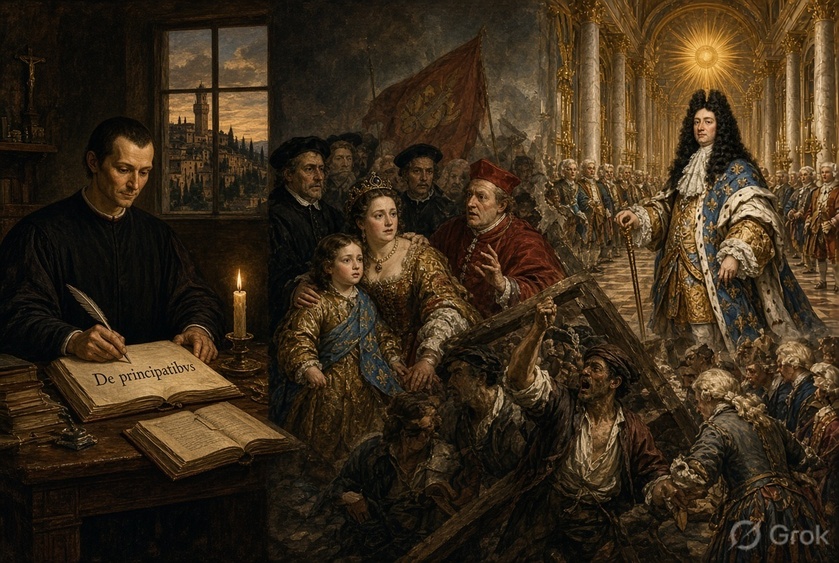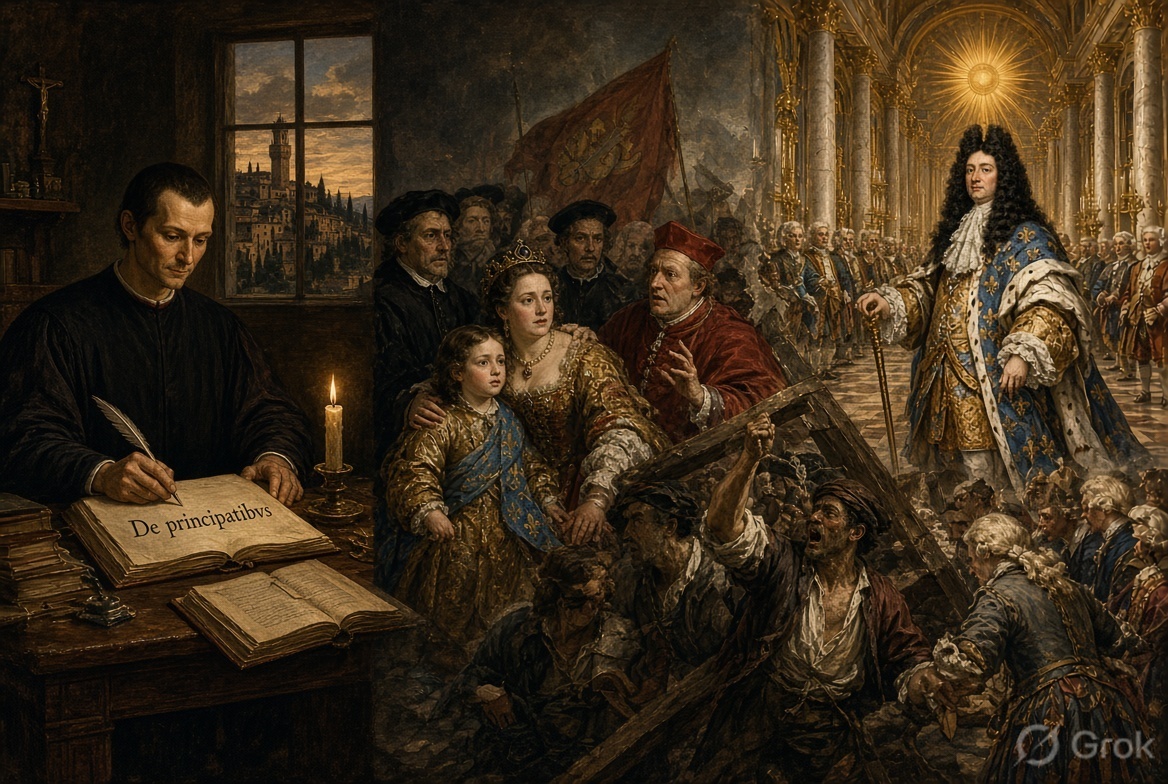
Machiavelli wrote the prince long before Louis XIV, but Louis exercised authority as if he understood it.
Machiavelli wrote The Prince in 1513. Louis XIV was not born for another 125 years. The two men never met. Yet the Sun King’s reign reads like a long demonstration of what Machiavelli had already described: how a prince keeps power after disorder, how appearance and ceremony can do the work of armies, and why a ruler who lets the great live apart from him will one day find them in arms.
The Regency taught the lesson first. Anne of Austria and Cardinal Mazarin inherited Richelieu’s war and Richelieu’s methods without Richelieu’s authority. They spent because spending looked like strength. They sold offices, created taxes, used intendants, and forced edicts through the Parlement of Paris. The result was not glory. It was the Fronde. Magistrates, princes, and the streets of Paris separated themselves from the crown. The royal family fled. A child-king nearly drowned in a pond because no one was watching him. That memory did not fade.
Dumas later turned the same years into theatre. In The Vicomte of Bragelonne (the cycle that ends with The Man in the Iron Mask), Mazarin is a dying minister who has grown rich at the state’s expense and must face the young king. The confession and the lesson Dumas gives Louis—that he must become the state—are fiction. The famous sentence “L’État, c’est moi” is almost certainly apocryphal as well. On his deathbed Louis said something closer to the opposite: he was leaving, but the state would remain. The novel is useful as a story about a boy learning that ministers and nobles are not the kingdom. History is stricter. Louis did not need a deathbed speech. He had already lived the Fronde.
What he did after 1661 was to reverse the separation that had produced the revolt. He did not abolish the nobility. He brought it to Versailles, wrapped it in etiquette, and made royal favour the only currency that mattered. He worked long hours through councils and intendants. Colbert rebuilt revenue and manufactures; Louvois built an army; Vauban drew a frontier. France took Franche-Comté, parts of Flanders, Alsace, Strasbourg. The court became the instrument of rule. That is closer to Machiavelli than any invented confession: fortune had given him a ruined childhood; virtù was the patient construction of a machine in which no great man could easily stand apart from the prince.
The cost appeared later. Wars after 1688 emptied the treasury. The revocation of the Edict of Nantes drove out skilled Protestants. Famine and debt followed the splendour. Critics then and since have said the same thing in different words: the prince who mastered the Fronde also taught the state to live beyond its means and to treat opposition as disloyalty. When he died in 1715 the throne passed to a five-year-old. The structure he built lasted; the solvency did not.
Louis XIV was not a reader of The Prince in any documented sense that made him a disciple. He was a king who had seen what happens when authority looks weak and the great live for themselves. He answered that experience with ceremony, centralisation, and war. For a generation France was the measure of Europe. That is why the comparison still holds. Machiavelli described the problem. Louis spent seventy-two years trying to solve it.