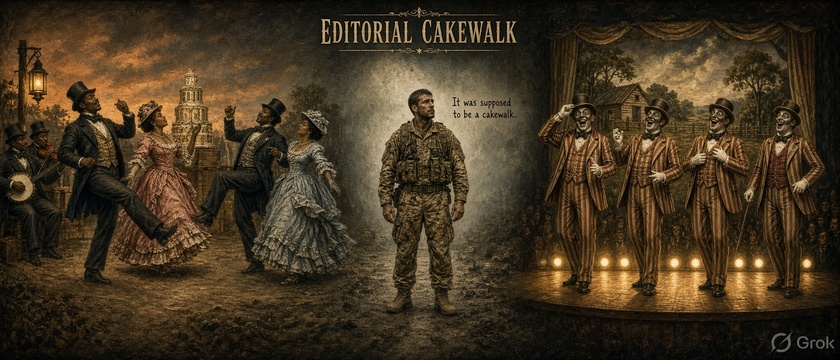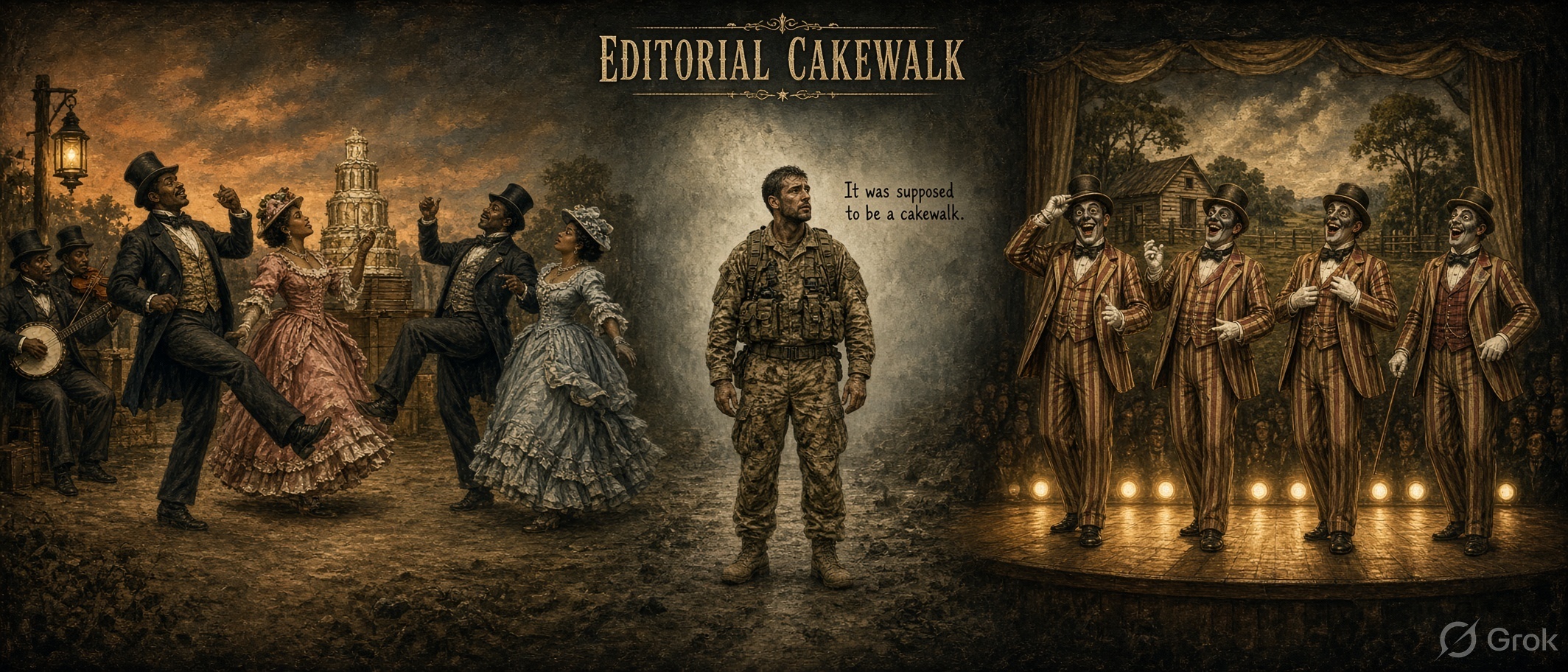
Cakewalk, where did the expression come from? 'It was supposed to be a cakewalk' a soldier might complain, feeling a simple mission wasn't. But the word is not from war.
The soldier’s complaint is the modern meaning. The word is older, and it is not military.
A cakewalk was a dance. Enslaved African Americans in the antebellum South created it. They did not import it from Africa as a finished form. They took the European grand promenade they saw in the big house — the Grand March, the minuet, the stiff carriage of formal wear — and turned it into a high-stepping, backward-leaning, inventively comic parody. Couples dressed in borrowed or handed-down finery. They added shuffles, kicks and African-derived movement. The couple judged most elegant or most inventive won a decorated cake. That prize is why we still say someone “takes the cake.”
Exact dates and places are lost. Oral histories collected from formerly enslaved people describe Sunday “prize walks” in the quarters. Owners often watched and even judged. Many missed the joke. The ragtime musician Shepard Edmonds, whose parents had been enslaved, put it plainly: they “did a take-off on the high manners of the white folks… but their masters… missed the point.”
After emancipation the dance moved into Black community gatherings, then onto the minstrel stage. White performers in blackface inverted the satire into caricature. African American professionals later reclaimed it. Bert Williams and George Walker (with Aida Overton Walker) made it a theatrical specialty and took it to Broadway. Championship contests filled Madison Square Garden in the 1890s. The dance reached Europe; Paris had a brief “folie du cake-walk.” John Philip Sousa’s band carried cakewalk numbers abroad. The music — 2/4 march bass under a syncopated strut — fed directly into ragtime. Kerry Mills’s “At a Georgia Camp Meeting,” Abe Holzmann’s “Smoky Mokes,” Scott Joplin’s “Swipesy Cakewalk,” and Debussy’s joking “Golliwogg’s Cake-Walk” all sit on that line.
The idiom “it was a cakewalk” did not arise because the dance was simple. The strut demanded skill and stamina. What spectators saw was ease. That impression of effortless elegance is what the phrase kept. “Piece of cake” is a later cousin of the same prize-and-leisure association.
The craze faded after about 1905 as the one-step, tango and foxtrot arrived. Fragments survived in later vernacular dance. The circular “cakewalk” still played at school fairs is a distant, sanitized game that has almost nothing to do with the original promenade.
The history is layered: enslaved people mocking their owners, white minstrels mocking those dancers, Black professionals reclaiming the form, white composers and socialites adopting it in turn. One historian’s summary still holds: Blacks imitating whites who were imitating Blacks who were imitating whites.
That is where the expression comes from. Not from a battlefield that looked easy. From a dance that looked easy while it was doing something else.