TV, after a powerful century, is fading.
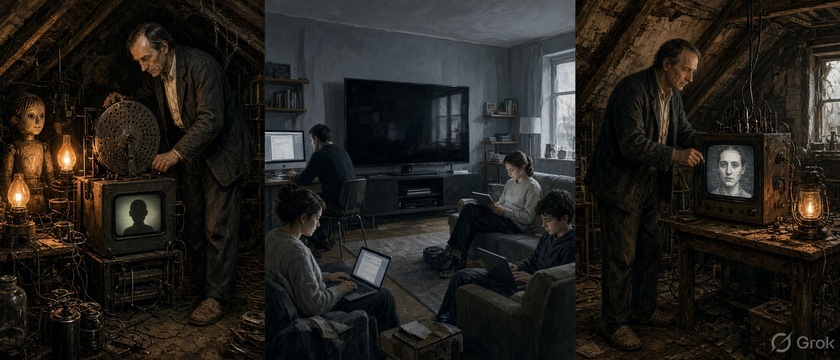
2 October 1925 is the private breakthrough, not the public unveiling. In an attic workshop at 22 Frith Street, Soho, John Logie Baird got a moving picture with real light and shade — not a silhouette — of a ventriloquist’s dummy, then of a living face. That is what “first test of a working television system” usually means.
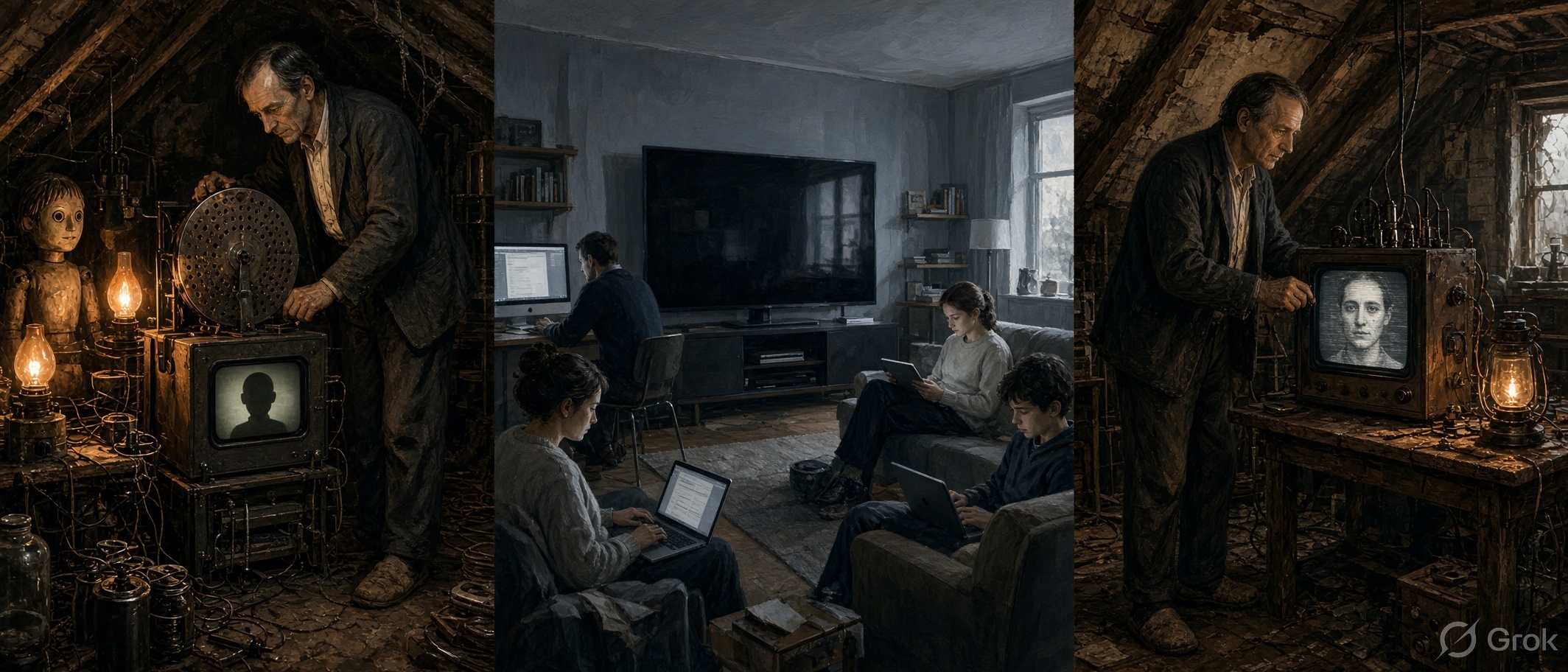
Baird was 37, Scottish, chronically ill, and already known as a slightly alarming inventor. After a workshop explosion in Hastings he had been evicted and moved to London. His machine was mechanical: a spinning Nipkow disc with a spiral of holes or lenses scanned the subject line by line; a photocell turned the light into an electrical signal; a second disc and a neon lamp rebuilt the picture at the other end. Early cells were so insensitive that a human face was a pale blob. He therefore used a dummy with a painted, high-contrast face. He called it Stooky Bill (Scots stookie: plaster). The lamps were so hot they scorched Bill’s hair and cracked the paint. No person could have sat in that heat for long.
On Friday 2 October the dummy’s face suddenly appeared with greyscale — “proper tones and detail,” not black-and-white outlines. Sources give a 30-line (sometimes 32-line) vertically scanned image at about five pictures a second. Baird ran downstairs, grabbed the office boy from the floor below, William Edward Taynton, aged 20, paid him half a crown, and put him in front of the scanner. Taynton later said the heat was unbearable and that Baird shouted to hang on a few seconds more. Then Baird came round from the receiver: he had seen him. Taynton looked down a viewing tunnel at a picture a couple of inches across — crude, lined, moving. He was the first person televised in a full tonal range.
What this was not: the first public show. In March 1925 at Selfridges Baird had already shown moving silhouettes — letters, a waving hand — which he himself did not count as “true television.” The demonstration that made the papers was 26 January 1926, when members of the Royal Institution and a Times reporter saw Stooky Bill and a living speaker on a receiver in the same room and then in another. By then the frame rate was about 12.5 pictures a second. The Times called the image faint and often blurred, but granted the claim: movement and expression could be sent and seen at once.
Baird went to a newspaper the day of the October test. The editor treated him as a possible lunatic with a razor. Credibility had to wait for the Royal Institution visit. After that the firsts stacked up: colour transmission (1928), a transatlantic picture the same year, experimental BBC 30-line broadcasts from 1929. Electronic scanning (Zworykin, Farnsworth, EMI–Marconi) soon outran the spinning disc. Baird kept working on colour and large-screen systems until his death in 1946. The attic is now remembered as the site of Bar Italia.
The sequence that matters is simple. Spring 1925: shadows in a shop window. 2 October 1925: greyscale of a dummy, then of Taynton, across a room. 26 January 1926: the same principle shown to people who could not be dismissed as office boys. Television as a public fact begins in January. Television as a working machine begins with Stooky Bill on a Friday in October.
These ten items sit on the same hinge of the year: 2 October (with Edward IV’s flight spilling across 29 September–2 October). Taken together they are a map of succession, rebellion, holy cities, translation, and paper constitutions.
829 — Theophilos succeeds Michael II. Michael II the Stammerer, founder of the Amorian dynasty, died of kidney failure on 2 October. His son Theophilos, already co-emperor since 821, became sole ruler at about seventeen. He was the last emperor to prosecute official iconoclasm with real energy, rebuilt palaces and walls in Constantinople, and personally led campaigns against the Abbasids. The great disaster of his reign was the sack of his hometown Amorion in 838. He died of dysentery in 842; his widow Theodora ended iconoclasm as regent for Michael III.
939 — Battle of Andernach. Otto I was still a young king when Duke Eberhard of Franconia and Duke Giselbert of Lotharingia rose against him, with Otto’s own brother Henry in the plot. After Otto’s earlier stand at Birten, a smaller royal force under the Conradines Udo and Konrad Kurzbold caught the rebel dukes crossing the Rhine at Andernach. Eberhard was cut down; Giselbert drowned trying to swim. The rebellion collapsed. Otto kept Franconia under the crown and later bound the duchies more tightly to the king — a step on the road from East Francia toward a German kingdom.
1187 — Saladin takes Jerusalem. After Hattin in July, the field army of the Kingdom of Jerusalem was gone. Saladin arrived before the walls on 20 September. Balian of Ibelin, who had entered the city to rescue his family and then stayed to command, knighted burgesses and bargained hard. On 2 October the city surrendered. Unlike the Crusader massacre of 1099, the handover was negotiated: ransoms for those who could pay, thousands more released, the Church of the Holy Sepulchre left standing. Saladin entered on a Friday that also marked the Islamic anniversary of the Night Journey. The shock in the West produced the Third Crusade.
1263 — Battle of Largs. Haakon IV of Norway brought a great fleet into the Clyde to hold the Hebrides against Alexander III of Scotland. A storm on the night of 1–2 October drove ships onto the Ayrshire shore near Largs. While the Norwegians tried to salvage them, a Scottish force under Alexander Stewart of Dundonald attacked. The fighting was messy and indecisive on the day, but Haakon withdrew, sickened, and died in Orkney that December. Within three years the Treaty of Perth transferred the Western Isles to Scotland. The last serious Viking claim on the Scottish mainland ended in weather and a beach fight.
1470 — Warwick restores Henry VI. Richard Neville, Earl of Warwick — the Kingmaker — had broken with Edward IV and allied with Margaret of Anjou. Landing in the West Country in September, he flipped enough of the realm that Edward, abandoned even by John Neville, rode for King’s Lynn. He sailed for the Low Countries around 2 October with a few hundred men, including Richard of Gloucester and Anthony Woodville, and fetched up under the protection of Louis de Gruuthuse and Charles the Bold. Henry VI was brought out of the Tower for the brief “Readeption.” Edward would return in March 1471 and win Barnet and Tewkesbury.
1528 — Tyndale’s Obedience of a Christian Man. Printed in Antwerp on 2 October by Merten de Keyser (colophon: “Marlborow… seconde daye of October”). Tyndale argued that the king, not the pope, was head of the national church and that Scripture in the vernacular was the ordinary Christian’s right. Anne Boleyn is said to have put a copy in Henry VIII’s hands; the king liked the parts that exalted royal authority. Tyndale later opposed the divorce and was executed in 1536. The book remains one of the founding political texts of the English Reformation.
1535 — Cartier at Hochelaga. On his second voyage Cartier left the winter base near Stadacona (Québec) and, on 2 October, reached the palisaded Iroquoian town of Hochelaga on the island now called Montreal. He named the mountain Mont Royal. The visit lasted hours; rapids blocked any further west. The encounter fed French claims on the St. Lawrence and the later myth of a passage to Asia. The town itself was gone by Champlain’s day.
1552 — Fall of Kazan. Ivan IV’s third campaign closed a month-long siege. Mines and artillery breached the walls; the assault on 2 October (Julian) ended the Khanate of Kazan. The middle Volga passed to Muscovy, opening the road toward the Urals and Siberia. Contemporary Russian sources treat the day as a national turning point; Tatar memory treats it as catastrophe. Both are right.
1780 — John André hanged. Benedict Arnold’s British contact, Major John André, was caught in civilian clothes with the West Point papers in his boot. A board of Continental officers sentenced him as a spy. He asked to be shot; Washington ordered hanging. On 2 October at Tappan he placed the noose himself. Even his enemies admired his composure. Arnold escaped; André became the martyr of a plot that nearly gave the Hudson to Clinton.
1789 — Washington transmits the amendments. Congress had agreed twelve articles on 25 September. On 2 October Washington sent them to the state legislatures. Ten became the Bill of Rights in December 1791; one waited until 1992 (the 27th Amendment); one on House size never passed. The covering letter is the quiet administrative act that put the first amendments into the ratification machinery.
The pattern is not coincidence of a calendar page. It is the same problem repeating: who may succeed, who may rebel, who may hold a holy city, who may speak Scripture in the common tongue, who may bind a king on paper. October 2 keeps answering it in different languages.