VoiceDDB
Politics • Culture • News
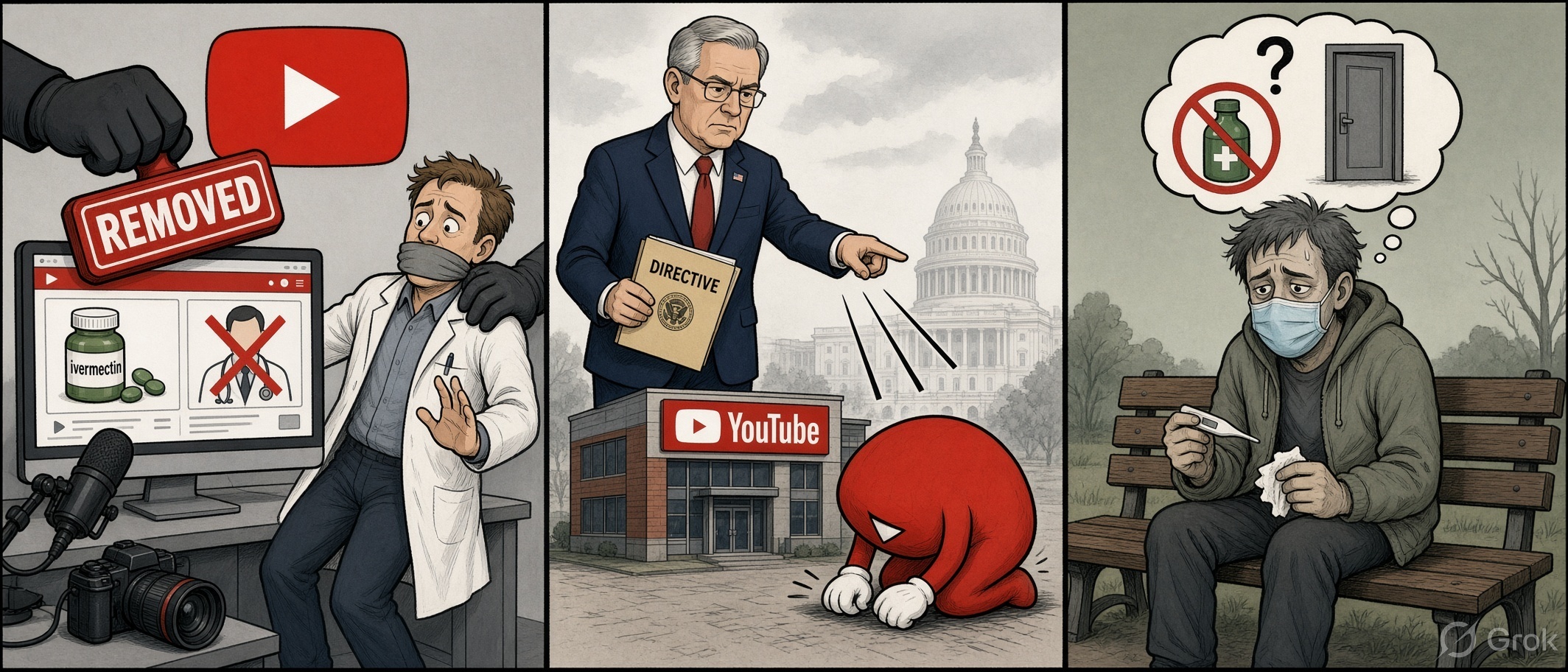
How Covid got Biden elected
October 8th news too
October 06, 2026
post photo preview

How Covid got Biden elected

October 8th news too

This is a roughly 29-minute interview from the Dan Bongino podcast, posted 4 October 2026 on Peter McCullough’s channel. Bongino asks why some people who took an mRNA COVID vaccine appear harmed and most do not, and whether people with no symptoms should still worry. McCullough’s answers are his own claims; several are contested by mainstream regulators and researchers.

Why some are injured and others are not. McCullough says about 81% of Americans were vaccinated and about 94% of those received Pfizer or Moderna. He treats the products as genetic: synthetic mRNA that, he says, can persist for years and keep making spike protein. He cites CDC v-safe and puts the split at about 98% apparently fine and about 2% with ongoing problems.

He gives three reasons for that split:

  1. Batch variability. He says doses were not uniform. Of about 4,500 Pfizer lots, he says roughly 75% showed essentially no serious side effects, which he reads as very little active mRNA.
  2. Antibody neutralization. If antibodies fully neutralize the spike, he says there are no side effects. If the antibody response is slightly off, spike can circulate and cause syndromes.
  3. Baseline susceptibility. In his cardiology practice, people with mutations in heart-muscle proteins are at higher risk of myocarditis, and people with genetic clotting tendencies are at higher risk of a vaccine-associated clot.

What he tells the injured to do. Get a spike-antibody blood test (he mentions Labcorp, self-ordered, about $79). Above 1,000 units/ml he calls a significant spike exposure; levels of 10,000–25,000 he associates with being very sick. He recommends clearing spike with nattokinase and bromelain on an empty stomach, taken for a couple of years, and promotes The Wellness Company’s “Ultimate Spike Detox” (nattokinase, bromelain and other ingredients). He also takes nattokinase himself for atherosclerosis and says these enzymes may dissolve microclots. He claims patients who sweat a lot — exercise or sauna — seem to clear the material better, and cites studies reporting mRNA in breast milk.

Why he says spike is dangerous. He describes it as an engineered, unnatural protein from Wuhan work that human enzymes do not break down. He says it has been found in the heart (myocarditis), inside clots, rupturing brain vessels, driving autoimmunity, and that fragments of its genetic code have been found in cancers.

On the mRNA design. Bongino thought the intent was a short, local burst of spike. McCullough says the mRNA is synthetic and chemically modified (pseudouridine) so it does not dissolve in minutes to hours the way natural mRNA does, and that there is no known off-switch.

Other topics in the interview.

  • Cancer vaccines. He says mRNA was originally aimed at cancer. Moderna’s melanoma product, used with Keytruda, is worth trials in late-stage disease, but targeting and on/off control are still unsolved, and it would sit inside toxic combination therapy, not as a simple preventive.
  • COVID deaths. He repeats Senate testimony that about 85% of deaths were avoidable, blames hospital protocols (ventilation, remdesivir, no early outpatient treatment), cites an ICON study in Florida in which he says ivermectin cut in-hospital mortality by about half, and says WHO advised against remdesivir in November 2020 while the US still uses it.
  • AI and future threats. He uses AI as a clinical assistant and supports it for drug discovery, but warns against “Dr AI” replacing physicians and against AI-designed viruses. He says Stanford has already shown that capability and that controls and defensive AI are needed.
  • Masks and PPE. Both treat community surgical masks and hospital hazmat use as ineffective and wasteful.

Bongino closes by saying McCullough was attacked early for opposing lockdowns, mandates and the official vaccine line, and that those critics have not apologized.

= For October 8th

The Rainhill Trials were a public test, not a race for its own sake. The Liverpool and Manchester Railway was nearly finished in 1829, and its directors were still split on how to move the trains. George Stephenson wanted locomotives. A strong party, backed by engineers who had looked at the line, wanted fixed steam engines hauling wagons by rope. The company offered £500 to the locomotive that could do the work of a Liverpool–Manchester journey and the return, under rules written so that a showy sprint would not win.

The trials ran from 6 to 14 October 1829 on a level stretch at Rainhill, about nine miles from Liverpool. The judges were John Urpeth Rastrick, Nicholas Wood and John Kennedy. Ten engines were entered. Five appeared.

The rules, in the form finally used, were strict. The engine, with water in the boiler, was not to exceed six tons; above four and a half tons it had to run on six wheels. It had to be sprung, stand under fifteen feet to the chimney top, burn its own smoke, and work at no more than 50 pounds per square inch. It had to draw three times its own weight at an average of at least ten miles an hour. The course stood in for the real road: one and three-quarter miles each way, of which one and a half miles was at full speed, ten trips making thirty-five miles, then fuel and water renewed and ten trips more. Seventy miles, the equivalent of Liverpool to Manchester and back, with the boiler starting cold and the fuel weighed.

Cycloped, built by Thomas Shaw Brandreth of Liverpool, was not a steam engine at all. A horse walked on a moving platform geared to the wheels. It was the first to go. The horse put a foot through the floor and the machine was withdrawn. It had never met the rule that the engine be a locomotive consuming its own smoke.

Perseverance, by Timothy Burstall of Edinburgh, was damaged on the road to Rainhill. Burstall repaired it on the spot and it ran late in the week, but it could not hold much above five or six miles an hour and was taken out. The judges noted that its boiler was little more than a large copper.

Novelty was the crowd’s engine. John Braithwaite and John Ericsson built it in London in about seven weeks. It was a light tank locomotive, roughly two tons fifteen hundredweight, copper and blue, with a vertical boiler and bellows blowing the fire. On the first day, running light, it reached about twenty-eight miles an hour, faster than anything most of the ten thousand spectators had seen. It was also the most fragile. A feed pipe failed, then a boiler joint blew, and repeated repairs never got it through the weighed course. It was withdrawn without completing the trial. Ericsson later took the same inventive streak to the screw propeller and, in the American Civil War, to USS Monitor.

Sans Pareil was Timothy Hackworth’s bid, from the Stockton and Darlington. It was an 0-4-0 with vertical cylinders and a return-flue boiler, the type that had worked well on his Royal George. It arrived overweight for a four-wheeled engine, at about four and a half tons, and the judges let it run anyway. One cylinder, cast at Robert Stephenson’s works in Newcastle, cracked. Hackworth improvised and the engine did complete a long part of the course, averaging about fourteen miles an hour with a load near nineteen tons. The cost was coke. It burned on the order of 700 pounds an hour against the Rocket’s roughly 200. Power it had; economy and a sound boiler it did not. Hackworth’s friends later claimed the cracked cylinder was sabotage. The casts were Stephenson’s, and Henry Booth, treasurer of the railway, had suggested the multitubular boiler used on the winning engine, so the suspicion stuck. The evidence is the failure itself, not a plot.

Rocket, entered by Robert Stephenson of Newcastle, was painted yellow and black with a white chimney and weighed about four tons three hundredweight. The decisive ideas were Booth’s multitubular boiler — twenty-five copper tubes carrying the fire through the water — and the blast pipe, which threw exhaust steam up the chimney and pulled air through the fire. George Stephenson drove it. On 8 October it finished the first thirty-five miles in about three hours twelve minutes with a load of about thirteen tons, averaging a little over twelve miles an hour, with bursts near twenty-five. Light, it later touched about twenty-nine or thirty. It was the only engine that completed both halves of the trial without a breakdown that ended its run. On 14 October the judges gave it the prize: it alone had met every condition, and it was the best engine shown.

The immediate result was that the Liverpool and Manchester chose locomotives. Robert Stephenson and Company received the order. The line opened on 15 September 1830, with Rocket among the engines in the procession; William Huskisson, MP for Liverpool, was struck by it at Parkside and died that night, the first widely reported railway passenger fatality. The railway itself was a success, and the argument for rope haulage on a level inter-city line was over.

The design consequence mattered more than the £500. Within a year Stephenson had moved the cylinders inside the frames on the Planet type, and that layout, with the multitubular boiler and blast pipe, became the pattern of the British steam locomotive. Sans Pareil was bought by the Liverpool and Manchester, used on construction trains, and sold in 1832 to the Bolton and Leigh, where it worked into the 1840s. Novelty was repaired and tried again on the line, without changing the verdict. Hackworth went on building engines at Shildon and remained a major figure on the Stockton and Darlington; he did not forgive the result.

Rainhill did not invent the locomotive. Colliery engines had been hauling coal for a quarter of a century. It did settle, in front of engineers from Britain and abroad, that a locomotive could keep time, keep steam and pay its way on a passenger railway. Within a decade the same conclusion was being built into lines from Manchester to Birmingham and from Albany toward the Great Lakes.

=

These are the October 8 entries. A few of the older dates are traditional rather than secure, and those caveats are marked where they matter.

314 (more likely 316) — Battle of Cibalae. Constantine I and Licinius, colleagues since the collapse of the Tetrarchy and joint authors of the Edict of Milan in 313, went to war over the Balkans. The spark was political: Constantine had raised his brother-in-law Bassianus as Caesar; Bassianus was caught intriguing, and Licinius refused to hand over the man behind him. Constantine invaded Licinius’s territory and met him on the plain between the Sava and the Drava, near Cibalae (modern Vinkovci in Croatia), about 350 kilometres inside Licinius’s domain. Constantine had roughly 20,000 men against about 35,000. The fight lasted all day. Late in the afternoon Constantine led a cavalry charge from the right wing, broke the line, and killed as many as 20,000 of Licinius’s troops. Licinius fled by night toward Sirmium and then Thrace. A later clash at Mardia was indecisive, but the peace that followed stripped Licinius of most of the Balkan peninsula and raised Constantine’s sons Crispus and Constantine II, with Licinius’s own son, to the rank of Caesar. Hydatius’s chronicle gives 8 October 314; consular lists and coinage point to 316. Either way, it was the first decisive step toward Constantine’s sole rule, completed at Chrysopolis in 324.

451 — Council of Chalcedon opens. The first session of the fourth ecumenical council began at Chalcedon, opposite Constantinople, on 8 October and ran until 1 November. Empress Pulcheria and Emperor Marcian had called it to settle the quarrel left by the “Robber Council” of Ephesus in 449, which had backed Eutyches’s claim that Christ had one nature after the Incarnation. About 500 bishops attended, almost all eastern. The council deposed Dioscorus of Alexandria, condemned both Nestorianism and Eutychian monophysitism, and issued the Chalcedonian Definition: Christ is one person in two natures, divine and human, “without confusion, without change, without division, without separation.” Rome accepted it. Alexandria and much of Syria and Egypt did not. The split is the origin of the Oriental Orthodox churches.

876 — Battle of Andernach. Louis the German had died in 876. His brother, the emperor Charles the Bald, king of West Francia, tried to seize East Francia before Louis’s sons could settle the inheritance. At Andernach on the Rhine, Louis the Younger caught him. Charles’s larger army was routed; he escaped across the Rhine and died the next year on another Italian expedition. East Francia held, and the line that became Germany stayed separate from the line that became France.

1075 — Dmitar Zvonimir crowned King of Croatia. Zvonimir, already ban and de facto ruler, was crowned at Solin near Split, with a crown sent by Pope Gregory VII and the papal legate present. The date is traditional (some place it in 1076). He was the last native king to exercise real power over the whole Croatian kingdom. His death without an heir in 1089 opened the succession crisis that ended with the union of Croatia and Hungary under the Árpád kings.

1200 — Isabella of Angoulême crowned. Isabella, about twelve, had married King John of England at Bordeaux on 24 August. On 8 October she was crowned queen consort at Westminster. John had taken her from her fiancé, Hugh IX of Lusignan, which gave Philip II of France the pretext to confiscate John’s continental lands. Within a few years John had lost Normandy, Anjou and most of Aquitaine.

1322 — Mladen II Šubić arrested. The Šubić family of Bribir had dominated Croatia and Bosnia for a generation, Mladen II as ban. A coalition of Croatian nobles beat him at the Battle of Bliska. The Sabor then arrested him and he was sent to Hungary. Angevin royal authority replaced the quasi-independent Šubić banate.

1480 — The Great Stand on the Ugra. Ivan III of Moscow had stopped paying tribute to the Great Horde. Akhmat Khan marched to restore it, aiming to join his ally Casimir IV of Poland-Lithuania. On 8 October his army reached the Ugra, a tributary of the Oka, and found Ivan’s son Ivan the Young and his brother Andrey the Less already on the far bank. Attempts to cross failed over four days, Russian missile fire keeping the Tatars off the fords. Casimir never came: a revolt in Lithuania held him. The two armies faced each other for weeks. Akhmat began to withdraw on 8 November; news of the retreat reached Ivan on 11 November. No pitched battle decided it. Russian tradition treats the stand as the end of the “Tatar yoke,” about 240 years after Batu’s conquest. The Great Horde itself broke up soon after; Akhmat was killed in 1481.

1573 — Siege of Alkmaar ends. Alba’s Spanish army had invested Alkmaar in late August. The defenders opened the dikes, flooded the approaches, and a relief attempt by sea failed. On 8 October the Spanish lifted the siege. It was the first clear rebel success of the Dutch Revolt, and it fixed the slogan “Victory begins at Alkmaar.”

1582 — This day does not exist. Pope Gregory XIII’s bull dropped ten days to correct the Julian drift. In Italy, Poland, Portugal and Spain, 4 October 1582 was followed by 15 October. The 5th through the 14th, including this day, were skipped. Protestant states adopted the reform later; Britain and its colonies not until 1752.

1645 — Hôtel-Dieu de Montréal. Jeanne Mance, a laywoman from Langres who had come to New France with the Société Notre-Dame de Montréal, opened the Hôtel-Dieu in the settlement that became Montreal. It was the first hospital in North America run by lay founders rather than a religious order already established in the colony, though nursing sisters from La Flèche arrived later to staff it. It is still a working hospital.

1806 — Congreve rockets at Boulogne. During the Napoleonic Wars a British squadron under Commodore Edward Owen bombarded the French invasion flotilla in Boulogne with Sir William Congreve’s rockets, iron-cased weapons derived from Indian war rockets and fired from boats. The attack on the night of 8 October did limited damage and did not destroy the flotilla, but it was the first serious combat use of Congreve rockets and the start of modern military rocketry in Europe.

1813 — Treaty of Ried. Bavaria, Napoleon’s largest German ally, changed sides. At Ried in Upper Austria, Maximilian I Joseph signed with Austria: Bavaria joined the Sixth Coalition, and Austria guaranteed Bavaria’s sovereignty and territory. Ten days later Bavarian troops fought the French at Hanau. The treaty is a hinge of the War of the Sixth Coalition, between Leipzig and the invasion of France.

1821 — Peruvian Navy. José de San Martín, protector of Peru after the declaration of independence in July, created the Peruvian Navy by decree on 8 October, built around ships captured or bought from the Spanish Pacific squadron, notably the frigate Protector. Peru marks 8 October as Navy Day. (Croatian Independence Day, once linked to this date in some lists, is 25 June.)

1829 — Rainhill Trials. The Liverpool and Manchester Railway offered £500 for the best locomotive. Trials ran from 6 to 14 October on a level mile-and-a-half stretch at Rainhill. On 8 October George and Robert Stephenson’s Rocket completed its runs at an average of about 12 miles an hour with a full load, and later showed bursts near 30. Novelty broke down; Sans Pareil failed on a cracked cylinder. Rocket won, and the multi-tube boiler with a separate firebox became the pattern for steam locomotives.

community logo
Join the VoiceDDB Community
To read more articles like this, sign up and join my community today
0
What else you may like…
Videos
Posts
Articles
00:01:07
November 27, 2022
Jingle Bell Rock

Jingle bell, jingle bell, jingle bell rock
Jingle bells swing and jingle bells ring
Snowin' and blowin' up bushels of fun
Now the jingle hop has begun

Jingle bell, jingle bell, jingle bell rock
Jingle bells chime in jingle bell time
Dancin' and prancin' in Jingle Bell Square
In the frosty air

What a bright time, it's the right time
To rock the night away
Jingle bell time is a swell time
To go glidin' in a one-horse sleigh

Giddy-up jingle horse, pick up your feet
Jingle around the clock
Mix and a-mingle in the jinglin' feet
That's the jingle bell rock

Jingle bell, jingle bell, jingle bell rock
Jingle bell chime in jingle bell time
Dancin' and prancin' in Jingle Bell Square
In the frosty air

What a bright time, it's the right time
To rock the night away
Jingle bell time is a swell time
To go glidin' in a one-horse sleigh

Giddy-up jingle horse, pick up your feet
Jingle around the clock
Mix and a-mingle in the jinglin' feet
That's the jingle bell
That's the jingle...

00:02:04
September 01, 2021
Intro to Locals for the Conservative Voice

David Daniel Ball calls himself the Conservative Voice.

I'm a teacher with three decades experience teaching math to high school kids.I also work with first graders and kids in between first grade and high school. I know the legends of why Hypatia's dad is remembered through his contribution to Math theory. And I know the legend of why followers of Godel had thought he had disproved God's existence.

I'm not a preacher, but I am a Christian who has written over 28 books all of which include some reference to my faith. Twelve blog books on world history and current affairs, detailing world events , births and marriages on each day of the year, organised by month. Twelve books on the background to and history of Bible Quotes. One Bible quote per day for a year. An intro to a science fiction series I'm planning, post apocalyptic cyber punk. An autobiography with short story collections.

I'm known in Australia for my failure as a whistleblower over the negligence death of a school boy. ...

00:01:50
September 04, 2026
Should violent criminals be made fat? Grok says 'no'

No. Transferring gut bacteria from an obese person into a violent criminal is not a reliable, ethical, or effective way to make them “fat, sedentary, and less of a physical threat.”

The science does not deliver the outcome you want

Mouse studies in germ-free animals showed that microbiota from obese donors can increase energy harvest and adiposity compared with lean-donor microbiota. That is the origin of the idea. Human evidence is far weaker.

Randomized trials of fecal microbiota transplant (FMT) from lean donors into people with obesity have generally failed to produce meaningful, sustained weight loss. Microbiome composition can change; body weight and metabolic markers often do not, or the effects are small and inconsistent. Diet and the existing gut environment usually dominate. A 2025 Nature paper found diet outperformed microbial transplant for microbiome recovery. Human guts are already colonized, not sterile like lab mice, so engraftment is variable and effects unpredictable.

It is not a ...

post photo preview
August 28, 2026
Pfizer struggles to answer

Some in Australia are brilliant. Malcolm Roberts Investigates Pfizer over Covid vaccine.

Holiday break is over back to work tonight

Tonight I'll start double posting until I've caught up.

post photo preview
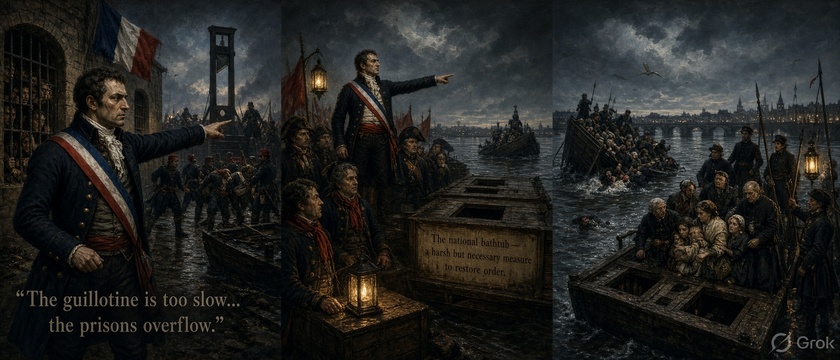
The Guillotine was too slow?
November 16th

The Guillotine was too slow?

The Drownings at Nantes (noyades de Nantes) were a series of mass executions by drowning carried out in the Loire River at Nantes, France, from mid-November 1793 to late February 1794. They occurred during the Reign of Terror as part of the Republican effort to crush the War in the Vendée (the Catholic and Royalist uprising in western France).

Before the Drownings

By late 1793 the Vendée rebellion had produced large numbers of prisoners. Nantes’s jails (including the Bouffay, the Coffee Warehouse/Entrepôt, and floating prison ships) were overcrowded with refractory (non-juring) Catholic clergy, Vendéan combatants and civilians, suspected royalists, and others arrested under the Law of Suspects (17 September 1793). Disease (especially typhus) and food shortages were acute.

Jean-Baptiste Carrier (1756–1794), a Montagnard/Jacobin deputy from the Cantal to the National Convention and member of the Cordeliers and Jacobin clubs, was sent as representative-on-mission to Brittany and then to Nantes (arriving around mid-October 1793). The Committee of Public Safety charged him with restoring order, securing supplies, and suppressing counter-revolution. He reorganized the local Revolutionary Committee of Nantes, established or reinforced a revolutionary tribunal, and relied on radical local forces, especially the Compagnie Marat (Marat Company).

Prisons were already full when Carrier arrived. Earlier methods (shootings, guillotine) could not keep pace with arrivals. Carrier and his subordinates began planning mass disposal of prisoners; he referred to drowning as “vertical deportation” or the “national bathtub.”

The Drownings and Key Figures

The first major operation took place on the night of 16–17 November 1793 (26 Brumaire Year II). Roughly 90–160 refractory priests (held for months after refusing the oath to the Civil Constitution of the Clergy) were transferred onto specially modified flat-bottomed barges (gabares or sapines) with openings cut in the hulls. These were taken into the Loire (near the Sécherie or toward Chantenay) and sunk. A few survivors were later recovered and re-executed. Guillaume Lamberty (or Lambertye; 1754–1794), an adjutant-general and former carriage-maker whom Carrier made his close lieutenant, directed this first drowning, assisted by men from the Compagnie Marat and others such as Fouquet.

Subsequent operations followed a similar pattern:

  • Further drownings of priests (including groups brought from Angers).
  • Larger “Bouffay” and other night-time operations in December 1793 that included hundreds of mixed prisoners (Vendéans, civilians, women, and children).
  • Later “galiote” drownings into January–February 1794 using larger vessels.

Bodies often washed ashore or floated visibly, drawing local attention. Estimates of total drowned range from about 1,800 to 4,800–5,000 (some higher contemporary or later claims exist; modern scholarship typically clusters in the 1,800–4,800 range for the noyades themselves). Additional thousands died from shootings (including at the Gigant quarry), starvation, or disease in the prisons. Carrier and the Nantes committee also ordered other repressive measures. The “republican marriages” (tying naked male and female prisoners together before drowning) are mentioned in some accounts but are often treated by historians as exaggerated or propagandistic.

Key supporting figures included members of the Revolutionary Committee of Nantes (such as Jean-Jacques Goullin and others) and local radicals who supplied lists of victims and carried out the operations. Carrier’s actions were initially endorsed or tolerated by the Committee of Public Safety in Paris.

After the Drownings

Word of the scale of the killings reached Paris. Carrier was recalled in February 1794 (he left Nantes around 16 February). He continued to justify harsh measures against the Vendée and briefly held office in the Convention. After the fall of Robespierre on 9 Thermidor (27 July 1794), the Thermidorian reaction turned against the most extreme Terrorists. Carrier was arrested in early September 1794, tried by the Revolutionary Tribunal for mass murder (including the drownings and shootings of non-combatants), convicted, and guillotined in Paris on 16 December 1794. Lamberty was also arrested after Carrier’s departure, tried by a local commission, and executed in Nantes in April 1794 (officially on other charges, though his role in the drownings was well known).

The noyades became one of the most notorious symbols of the excesses of the Terror. Contemporary and later writers (including Gracchus Babeuf and historians such as Jules Michelet) condemned them; they continue to feature in accounts of revolutionary violence, the Vendée war, and the limits of the Terror. Exact victim counts remain debated because many operations were semi-clandestine and records incomplete, but the events are firmly attested by contemporary testimony, trial evidence, and local archives.

= November 16th

These are notable historical events traditionally associated with mid-November (most commonly listed under 16 November). Here is a concise account of each.

951 – Conquest of Chu by Southern Tang

During the Five Dynasties and Ten Kingdoms period, Emperor Li Jing of the Southern Tang sent an expeditionary force of about 10,000 men under the general Bian Hao against the neighbouring state of Chu (Ma Chu). Chu had been weakened by civil war among the ruling Ma brothers. Bian Hao accepted the surrender of the capital (Changsha/Tan Prefecture), the Ma ruling family was removed to the Southern Tang capital at Nanjing (Jinling), and the Chu kingdom was formally ended.

Southern Tang control proved fragile; local Chu generals soon rebelled and largely expelled the occupiers the following year. The campaign still marked a clear territorial expansion for Li Jing before later pressures from the Later Zhou and Song.

1272 – Edward becomes King of England while on Crusade

Prince Edward (later Edward I “Longshanks”) was in the Holy Land leading the Ninth Crusade when he received news of the death of his father, Henry III of England (16 November 1272). He therefore became king while still abroad.

Edward was in no hurry to return. He recovered from an assassination attempt (a poisoned dagger), travelled through Sicily, Italy, Gascony and France, and only reached England in 1274, where he was crowned at Westminster Abbey on 19 August. The Ninth Crusade is generally regarded as the last major Western expedition to the Holy Land before the final fall of Acre in 1291.

1491 – Auto-da-fé of the Holy Child of La Guardia

On 16 November 1491 an auto-da-fé was held in the Brasero de la Dehesa outside Ávila. It concluded the case of the “Holy Child of La Guardia,” a blood-libel accusation that a group of Jews and conversos had kidnapped and ritually murdered a Christian child (whose heart was supposedly used for sorcery).

Several Jews and conversos were burned (sources commonly cite around six conversos and two or three Jews). No body was ever found, the confessions were obtained under torture, and the details were inconsistent. The case occurred just months before the 1492 Alhambra Decree expelling the Jews from Spain and is widely regarded by historians as one of the most infamous Spanish blood libels.

1532 – Capture of Atahualpa at Cajamarca

On 16 November 1532 Francisco Pizarro and a force of roughly 168 Spanish soldiers and auxiliaries ambushed the Inca emperor Atahualpa in the plaza of Cajamarca (in present-day Peru). Atahualpa had entered the town with a large, largely unarmed retinue while tens of thousands of his troops camped nearby.

The Spanish opened fire with guns and cannons, charged with cavalry, and killed thousands of attendants in a short, one-sided action. Atahualpa was seized alive. The capture paralysed Inca resistance, opened the way for the Spanish conquest of the Inca Empire, and led (after a massive gold-and-silver ransom) to Atahualpa’s execution in 1533.

1776 – Capture of Fort Washington

British and Hessian forces under General William Howe attacked Fort Washington (near the northern end of Manhattan) on 16 November 1776. After fighting on the outer lines, the American garrison under Colonel Robert Magaw surrendered.

The Patriots lost roughly 2,800 men as prisoners (plus killed and wounded). Most of the prisoners were confined on British prison ships in New York harbour, where disease and harsh conditions killed a large majority. It was one of the worst American defeats of the Revolutionary War and left the British in control of Manhattan.

1776 – “First Salute” by the Dutch (St. Eustatius)

On the same day (16 November 1776) the American brig Andrew Doria, flying the Grand Union flag, entered the harbour of the Dutch Caribbean island of St. Eustatius. Governor Johannes de Graaff ordered Fort Oranje to return the ship’s salute with an 11-gun volley.

This is widely remembered as the First Salute—the first formal acknowledgement of American sovereignty by an official of a foreign power. Formal diplomatic recognition by the Dutch Republic itself came later (1782), but the gesture was treated by Britain as a provocative act and contributed to rising Anglo-Dutch tensions.

1793 – Drownings at Nantes begin

During the Reign of Terror, the Convention’s representative-on-mission Jean-Baptiste Carrier began the mass drownings (noyades) in Nantes. On the night of 16 November 1793 the first large group—approximately 90–160 refractory (non-juring) Catholic priests—was loaded onto barges and sunk in the Loire.

Carrier called the method “the national bathtub.” The drownings continued until early 1794 and claimed thousands of victims (estimates range from roughly 1,800 to 4,800 or more), including priests, nuns, Vendéan prisoners, and other “suspects.” They remain one of the most notorious atrocities of the Revolution.

1797 – Accession of Frederick William III of Prussia

On 16 November 1797 the Prussian heir apparent became King of Prussia as Frederick William III upon the death of his father, Frederick William II. He reigned until 1840.

Early in his reign he pursued neutrality, austerity, and limited reform. Prussia later entered the Napoleonic Wars (disastrously in 1806), then played a major role in the final coalition that defeated Napoleon. His queen, Louise of Mecklenburg-Strelitz, was especially popular and became a symbol of Prussian resistance and recovery.

These episodes range from dynastic conquest and crusading kingship to blood libel, the fall of the Inca Empire, the American Revolution, revolutionary terror, and the start of a long Prussian reign.

Read full Article
November 13, 2026
post photo preview
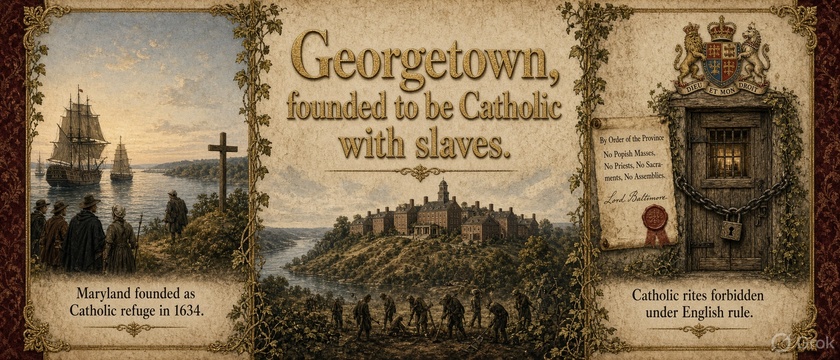
Georgetown, founded to be Catholic, with slaves 1791`
November 15th

Georgetown, founded to be Catholic, with slaves 1791`

Georgetown University’s 1791 opening marked the start of the first Catholic institution of higher learning in the United States, made possible by the American Revolution’s removal of colonial restrictions on Catholic education and public worship.

Before 1791: Background and Planning

Under English colonial rule, especially after the Glorious Revolution and penal laws, Catholics in Maryland and elsewhere faced severe restrictions: public celebration of Mass was limited or banned, Catholic schools were forbidden, and political rights were curtailed. Maryland had been founded as a Catholic refuge in 1634, but by the 18th century those freedoms had largely eroded. Families seeking a Catholic education often sent sons abroad.

John Carroll (1735–1815) was the central figure. Born in Upper Marlboro, Maryland, into a prominent Catholic family (his cousin Charles Carroll of Carrollton signed the Declaration of Independence; his brother Daniel signed both the Articles of Confederation and the Constitution), he was educated at a small local Jesuit school then at St. Omer in French Flanders. He entered the Society of Jesus in 1753, was ordained in 1761, and taught in Europe. When Pope Clement XIV suppressed the Jesuits in 1773, Carroll returned to Maryland in 1774.

He supported the Revolution (joining a 1776 diplomatic mission to Canada with Benjamin Franklin and others) and, after independence, became the organizational leader of the American Catholic Church. In 1784 Rome appointed him Superior of the American Missions (Apostolic Prefect); in 1790 he was consecrated the first Bishop of Baltimore, with a diocese covering the entire United States. Carroll saw education as essential for the Church’s survival and growth in the new republic. From at least 1783 he planned an academy that would combine classical liberal-arts training in the Jesuit tradition with the values of the American experiment. He wanted it “open to students of every religious profession.”

In 1786–87 clergy meetings at White Marsh appointed directors (including Carroll, Robert Molyneux, and John Ashton). Carroll issued a prospectus, “Proposals for Establishing an Academy at George-Town, Patowmack-River, Maryland.” Construction of the first building (later called Old South or the South Building) began in 1788 on a hilltop overlooking the tobacco port of Georgetown (then in Maryland). On 23 January 1789, Carroll and colleagues secured the deed to the initial land (roughly one to one-and-a-half acres) from William Deakins Jr. and John Threlkeld for £75—the date the university traditionally treats as its founding. The site’s proximity to the emerging federal capital (selected nearby in 1790) was an unexpected advantage.

The 1791 Opening and Early Figures

The academy formally began receiving students in late 1791. William Gaston (1778–1844) of New Bern, North Carolina—then 13—became the first enrolled student on 22 November 1791. His father, a doctor and Revolutionary patriot, had been killed by Tories in 1781; his Catholic mother, Margaret Sharpe, arranged his education. Gaston stayed only briefly (health issues led him to leave by spring 1793), later graduated first in his class from the College of New Jersey (Princeton), became a lawyer, Federalist congressman (1813–1817), and Chief Justice of the North Carolina Supreme Court. As a congressman he helped secure Georgetown’s federal charter. Gaston Hall is named for him. (He was also a large slaveholder—research has identified at least 163 enslaved people in his estate.)

Rev. Robert Plunkett (1752–1815), an English priest educated at St. Omer, Bruges, and Douai who arrived as a missionary in 1790, was persuaded by Carroll to serve as the first president (1791–1793). He oversaw the division into elementary, preparatory, and college levels and the admission of the first students. The first teacher was Jean-Edouard de Mondésir. Classes proper began on campus in January 1792. The second student was Philemon Charles Wederstrandt (enrolled December 1791). Early enrollment reached roughly 40–70 students in the first year or so, including non-Catholics and early international students (e.g., from the West Indies). The first prospectus was issued in English, French, and Spanish. Early faculty included former Jesuits and Sulpician refugees from the French Revolution.

The vision was deliberately ecumenical and republican: a place that would give consistency to Catholic life in America while educating citizens of the new nation.

After 1791: Growth, Challenges, and Transformation

President George Washington visited in August 1797. In 1805, after partial restoration of the Jesuits, the Society assumed fuller direction. On 1 March 1815, President James Madison signed the congressional charter empowering the college to grant degrees (Gaston helped steer it). The first Bachelor of Arts degrees were awarded in 1817. Carroll, elevated to Archbishop of Baltimore in 1808, died in December 1815.

The college relied on enslaved labor from its earliest years. In June 1838, the Maryland Jesuits (under figures including Thomas Mulledy) sold approximately 272 enslaved men, women, and children (the “GU272,” with some counts higher) to Louisiana planters Henry Johnson and Jesse Batey for $115,000 to pay debts and stabilize the college. Families were separated; many were transported south. This episode, and the broader reliance on slavery until the 13th Amendment, has been the subject of extensive modern research, apologies by the university and Jesuits, and efforts involving descendants.

The Civil War nearly emptied the campus (enrollment fell from over 300 to 17); buildings served as a temporary hospital, and more than 1,100 students and alumni served on both sides. In 1876 the school adopted blue and gray as official colors to symbolize post-war reconciliation.

Patrick Francis Healy, S.J. (president 1873–1882), a Jesuit of mixed African and Irish ancestry (legally enslaved at birth in Georgia), was the first African American to earn a Ph.D. and the first to head a major predominantly white U.S. university. He modernized the curriculum (emphasizing history and sciences), expanded facilities, and began construction of the landmark Healy Hall. Medical and law schools had already opened (1851 and 1870). Later expansions included the School of Foreign Service (1919). Women entered the College in 1969. The university became a major research institution with international reach; notable alumni include U.S. Presidents Bill Clinton and Lyndon B. Johnson, Supreme Court Justice Antonin Scalia, and many diplomats, politicians, and scholars.

From a modest academy on a Maryland hillside, open by design to students of every faith and shaped by the revolutionary generation, Georgetown grew into the oldest Catholic and Jesuit university in the United States, still headquartered on the same hilltop in Washington, D.C.

Significant early figures also include early presidents such as Robert Molyneux and Louis William Valentine DuBourg (who helped start the library), and the network of Carroll family members and Maryland clergy who supplied the institutional foundation.

= November 15th

These events cluster around mid-November (primarily 14–15 November in the sources), spanning imperial succession, decisive medieval battles, the Spanish conquest of the Inca Empire, early modern conflicts, institutional openings, and the founding documents of the United States.

565 – Justin II succeeds Justinian I

Justinian I (r. 527–565), the emperor who reconquered much of the western Mediterranean, codified Roman law, and built Hagia Sophia, died childless on the night of 14/15 November 565. His nephew Justin II (son of Justinian’s sister Vigilantia and husband of Sophia, niece of Empress Theodora) was proclaimed emperor. The chamberlain Callinicus claimed a deathbed designation; modern historians note the succession was managed by palace officials amid potential rival claims from another nephew. Justin II’s reign (565–578) faced fiscal strain from Justinian’s wars and building, Persian and Avar pressures, and his own later mental illness; he elevated Tiberius as co-emperor before dying in 578.

655 – Battle of the Winwaed

On 15 November 655, King Oswiu of Bernicia (Northumbria) defeated and killed the powerful pagan Mercian king Penda near a river called the Winwaed (possibly Cock Beck near Leeds). Penda had previously killed Oswald of Northumbria at Maserfield (642) and dominated much of England. Oswiu’s smaller force caught the larger Mercian-led army (including East Anglian allies) as it withdrew; heavy rain flooded the river and drowned many. Bede presents the victory as ending effective Anglo-Saxon pagan political dominance and accelerating Christianisation in Mercia (under Penda’s son Peada and later rulers).

1315 – Battle of Morgarten

On 15 November 1315, infantry from the Swiss forest cantons (especially Schwyz, with Uri and Unterwalden) ambushed a Habsburg army under Leopold I, Duke of Austria, along the shore of Lake Ägeri near the Morgarten Pass. The Swiss used terrain, logs/rocks, and halberds against the constrained Austrian knights and infantry. The result was a decisive rout with heavy Austrian losses. It secured the early Swiss Confederacy (formalised further by the Pact of Brunnen weeks later) and demonstrated the effectiveness of disciplined common infantry against feudal cavalry—an early milestone in Swiss military reputation.

1532 – Pizarro’s forces meet Atahualpa near Cajamarca

In mid-November 1532 (sources place Spanish arrival in Cajamarca on the 15th), Francisco Pizarro’s small force (roughly 160–170 men, including horsemen under Hernando de Soto) made contact with Inca ruler Atahualpa outside Cajamarca. Atahualpa, having just prevailed in a civil war against his half-brother Huáscar, was camped nearby with a large army. The Spaniards arranged a meeting for the following day in the town plaza. On 16 November, in the Battle (or massacre) of Cajamarca, they ambushed Atahualpa’s largely unarmed retinue, killed thousands, and captured the emperor. The ransom of gold and silver that followed, and Atahualpa’s later execution, opened the way for the conquest of the Inca Empire.

1533 – Pizarro arrives in Cuzco

On 15 November 1533—exactly a year after the Cajamarca events—Pizarro entered Cuzco, the Inca capital and religious/political centre. Atahualpa had been executed in July 1533 after the ransom was collected. The Spanish advanced with limited opposition amid the civil-war fallout and local alliances; they installed a puppet ruler (Manco Inca) and began extracting further treasure while consolidating control. Cuzco’s fall symbolised the collapse of central Inca authority, though resistance continued for years.

1705 – Battle of Zsibó

On 15 November 1705 (some traditional accounts give 11 November), during Rákóczi’s War of Independence, Habsburg forces under Marshal Ludwig Herbeville, supported by Danish and Serbian contingents, defeated the Kuruc (Hungarian rebel) army of Francis II Rákóczi near Zsibó (Jibou, in present-day Romania/Transylvania). Forces were roughly equal in number, but superior Habsburg discipline, training, and artillery prevailed. The defeat allowed the Habsburgs to occupy Transylvania and seriously set back the independence movement, which ultimately failed by 1711.

1760 – Inauguration of the Castellania in Valletta

The second (and surviving) Castellania—the Baroque courthouse and prison of the Order of St John in Valletta, Malta—was formally inaugurated around mid-November 1760 (chapel of the Sorrows consecrated 15 November). Built 1757–1760 under Grand Master Manuel Pinto de Fonseca to designs by Francesco Zerafa (completed by Giuseppe Bonici) on the site of an earlier 16th-century building, it served as the island’s main courts until the mid-19th century. It later housed public health offices and remains the Maltese Ministry of Health; the ornate limestone façade, marble details, and allegorical figures of Justice and Truth survive.

1777 – Continental Congress approves the Articles of Confederation

After roughly 16 months of debate, the Continental Congress adopted the Articles of Confederation and Perpetual Union on 15 November 1777 (while meeting in York, Pennsylvania, during the Revolutionary War). The document created a loose “league of friendship” among the thirteen sovereign states, with a unicameral Congress holding limited powers (foreign affairs, war, but no direct taxation or strong executive). Full ratification by all states took until 1 March 1781; the Articles governed until replaced by the 1787 Constitution (effective 1789) because of their weaknesses in finance, commerce, and enforcement.

1791 – Georgetown University opens

The first Catholic institution of higher learning in the United States began operations in 1791 (first student, William Gaston, enrolled 22 November; formal instruction started early 1792). Founded by Bishop John Carroll (later first Archbishop of Baltimore) on land acquired in what was then Maryland (now Washington, D.C.), it was conceived as an academy open to students of all faiths after the Revolution removed colonial restrictions on Catholic education. It later became a Jesuit university and remains the oldest Catholic university in the country.

These moments range from dynastic transitions and the Christianisation of Anglo-Saxon England, through Swiss independence and the dramatic collapse of the Inca state, to institutional foundations in Malta, the early American republic, and Catholic education in the new United States. The two Pizarro entries form a clear sequence in the conquest of Peru; the 1777 and 1791 American events mark early steps in the political and educational life of the independent United States.

Read full Article
November 12, 2026
post photo preview
Links Dem to Ancient Egypt
November 14th

Links Dem to Ancient Egypt

The first recorded labor strike in history took place in Year 29 of Pharaoh Ramesses III’s reign (c. 1158–1155 BC; often cited around 1152 or 1157 BC) at the workers’ village of Deir el-Medina (ancient name Set Maat, “Place of Truth”) on the west bank of the Nile near Thebes (modern Luxor).

The Workers and the Village

Deir el-Medina housed a specialized community of skilled artisans—stonemasons, painters, sculptors, and other craftsmen—who built and decorated the royal tombs in the nearby Valley of the Kings and Valley of the Queens. They were not slaves but state employees, paid primarily in grain rations (emmer wheat and barley), along with fish, vegetables, oil, clothing, and other supplies. The village had its own administrative system, including scribes, foremen, and a local court for internal disputes. At its peak it contained roughly 40–120 households.

What Happened

Delays in grain deliveries—caused by the heavy costs of Ramesses III’s wars, poor harvests, administrative breakdowns, and possible corruption—left the workers unpaid for weeks. Records show complaints had been building; in one case the scribe Amennakht noted that 20 days had already passed without rations.

In Year 29 the workers stopped work. Contemporary accounts (chiefly the Turin Strike Papyrus, Cat. 1880, written in hieratic script) describe them passing the five guard posts of the necropolis while shouting “We are hungry!” They staged sit-ins at symbolic sites, including the unfinished mortuary temple of Ramesses III at Medinet Habu and the temple of Thutmose III. There were multiple stoppages over a period of months, both by day and by night (some with torches). Officials negotiated; partial grain payments were released from temple stores, and the workers returned temporarily, but the problems recurred.

The episode is widely regarded as the earliest well-documented collective labor action because we have direct contemporary records naming the workforce, the grievance (delayed rations), the actions taken, and the authorities’ responses.

Significant Figures

  • Ramesses III (r. c. 1186–1155 BC): Second pharaoh of the 20th Dynasty and often called the last great New Kingdom ruler. He successfully repelled major invasions by the Sea Peoples (Year 8) and Libyans, and he built the great temple complex at Medinet Habu. His reign, however, was marked by growing economic strain. He was later assassinated in the “Harem Conspiracy” (a plot involving one of his wives, Tiye, and their son Pentaweret to place Pentaweret on the throne instead of the designated heir). CT scans of his mummy in 2012 confirmed a deep, fatal cut to the throat.
  • Amennakht (Amennakhte): The scribe who recorded the strike events in the Turin Strike Papyrus and earlier complaints. He acted as a key intermediary between the workers and higher officials.
  • Foremen and crew leaders (names such as Nekhenmut and Khonsu appear in related records) who organized or represented the two main work gangs.
  • The vizier and local temple administrators who eventually authorized the release of grain.

Context Before the Strike

Deir el-Medina was established earlier in the New Kingdom (around the time of Amenhotep I and Thutmose I) to house the tomb builders in a controlled, relatively secure settlement. Egypt under the 18th and early 19th Dynasties (Thutmose III, Amenhotep III, Ramesses II) had been at the height of its imperial power. Ramesses III himself began his reign with notable military victories that preserved Egyptian independence at a time when many other eastern Mediterranean societies collapsed under the Sea Peoples’ migrations. Those campaigns, however, were expensive and contributed to the fiscal pressures that later affected the ration system.

Aftermath

The strikes secured temporary payments and demonstrated that the highly skilled tomb workers understood their leverage. Systemic supply problems continued, however. Within a few years Ramesses III was assassinated (c. Year 32), and he was succeeded by Ramesses IV. The later 20th Dynasty saw further economic and political decline, increased tomb robbery (sometimes by the workers themselves), and growing insecurity. By around 1069 BC, as central authority weakened, the Deir el-Medina community was largely abandoned; residents relocated for safety (including to the Medinet Habu temple area). The Valley of the Kings ceased to be the primary royal necropolis, and Egypt entered the more fragmented Third Intermediate Period.

In short, the event is remarkable because it is the first time in recorded history that we see organized workers collectively withhold their labor, document their grievances in their own words, and force the state to respond—while still operating within the religious and political framework of New Kingdom Egypt.

= November 14th

Here is a list of significant historical events recorded on November 14 from antiquity through 1800:

Ancient & Early Medieval

  • c. 1152 BC — The first recorded labor strike in history occurs in Egypt. Artisans working on the royal tombs in the Valley of the Kings under Pharaoh Ramses III stop work to protest delayed wages.
  • 332 BC — Alexander the Great is recognized/crowned as pharaoh of Egypt at Memphis. This marks the end of Persian rule in Egypt and the beginning of the Hellenistic (Ptolemaic) period.
  • 565 AD — Byzantine Emperor Justinian I dies. His nephew Justin II succeeds him as emperor of the Eastern Roman Empire (coronation and public announcement occur around this date).
  • 684 — The 14th Council of Toledo opens in Visigothic Hispania (modern Spain).

Medieval & Early Modern

  • 1380 — Charles VI of France is crowned king at the age of 12.
  • 1493 — Christopher Columbus lands on an island in the Lesser Antilles during his second voyage and names it Santa Cruz (Saint Croix).
  • 1501 — Arthur, Prince of Wales (eldest son of Henry VII), marries Catherine of Aragon at St. Paul’s Cathedral in London. Both are 15 years old. Arthur dies the following year, leading to Catherine’s later marriage to his brother Henry VIII.
  • 1524 — Spanish conquistador Francisco Pizarro begins his first major expedition toward South America (operating in the region of present-day Colombia).
  • 1532 — According to the chronicler Edward Hall, King Henry VIII of England secretly marries Anne Boleyn on St. Erkenwald’s Day shortly after their return from Calais. (Their public/official marriage took place on 25 January 1533; the earlier ceremony is disputed but widely noted by historians.)

17th–18th Centuries

  • 1666 — English diarist Samuel Pepys records the first known written account of a blood transfusion experiment (performed between dogs).
  • 1680 — German astronomer Gottfried Kirch discovers the Great Comet of 1680 (also called Kirch’s Comet or Newton’s Comet). It is the first comet discovered using a telescope.
  • 1715 — The Battle of Preston ends with the unconditional surrender of Jacobite forces to government troops under General Charles Wills. This effectively ends the Jacobite rising of 1715 in England (the last battle fought on English soil until the 20th century).
  • 1716 — Gottfried Wilhelm Leibniz, the German philosopher, mathematician, and co-inventor of calculus, dies in Hanover.
  • 1770 — Scottish explorer James Bruce reaches the spring he believes to be the source of the Blue Nile in Ethiopia (at Gish Abay).
  • 1776 — The St. James’s Chronicle in London reports that Benjamin Franklin has joined the American rebellion, confirming his leadership role in the fight for independence.
  • 1792 — British explorer Captain George Vancouver becomes the first Englishman to enter San Francisco Bay.

These events are drawn from reliable historical compilations (including Wikipedia’s selected anniversaries, OnThisDay, and specialized sources on the Tudors, Byzantium, and exploration). Exact dates for the earliest events can be approximate or traditional, as is common with ancient records.

Read full Article
See More
Available on mobile and TV devices
google store google store app store app store
google store google store app tv store app tv store amazon store amazon store roku store roku store
Powered by Locals