VoiceDDB
Politics • Culture • News
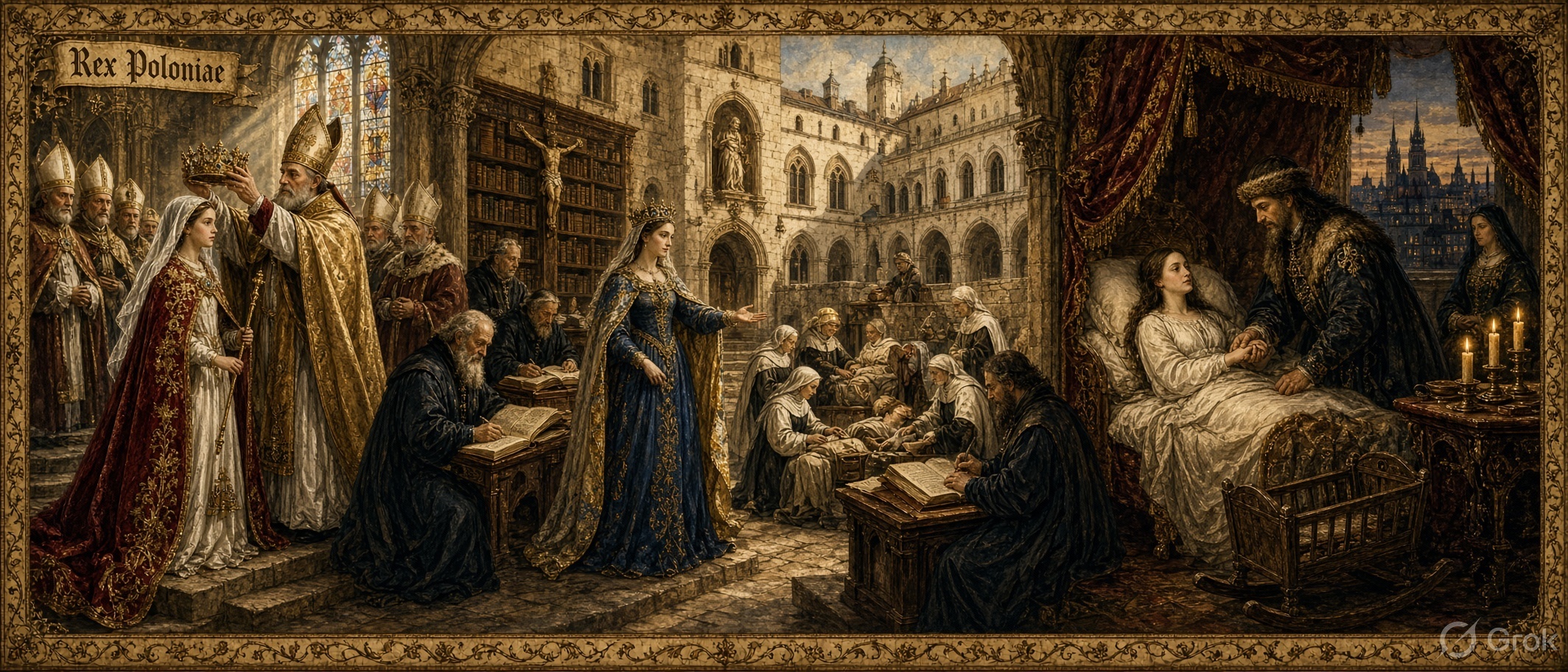
Jadwiga crowned King of Poland
October 16th
October 15, 2026
post photo preview

Jadwiga crowned King of Poland

Jadwiga (Hedwig/Hedvig; born between October 1373 and February 1374 in Buda, died 17 July 1399 in Kraków) was the youngest of the three daughters of Louis I the Great (King of Hungary 1342–1382 and King of Poland 1370–1382) and Elizabeth of Bosnia. Louis had no sons. Through his mother, Elizabeth of Poland (daughter of Władysław I Łokietek), he had a Piast claim to Poland and succeeded his childless maternal uncle Casimir III the Great in 1370 under earlier agreements.

In the Privilege of Koszyce (Košice) of 1374, Louis secured noble recognition of his daughters’ succession rights in exchange for significant privileges (reduced taxes, military obligations limited largely to defending the kingdom). He initially designated his eldest daughter Catherine for Poland and Jadwiga for Hungary. Catherine died in 1378. Mary (engaged to Sigismund of Luxembourg) was then intended for Poland, with Jadwiga for Hungary. Jadwiga was provisionally betrothed in 1375/1378 (ceremony at Hainburg) to William of Habsburg (Duke of Austria); she spent time in Vienna. The match was never fully consummated.

Louis died on the night of 10/11 September 1382. Within days the Hungarian elites crowned the elder daughter Mary as king of Hungary under her mother Elizabeth’s influence, ending the personal union. Polish nobles (especially the powerful lords of Lesser Poland) refused to accept Mary and Sigismund or continued absentee rule from Hungary. They insisted on a resident daughter of Louis. After roughly two years of negotiations, civil unrest (including in Greater Poland), and pressure (including threats of electing someone else), Elizabeth of Bosnia sent the approximately 10-year-old Jadwiga to Poland. She arrived in Kraków around 12–13 October 1384.

Rival candidates had included Siemowit IV of Masovia (a Piast) and Sigismund. Archbishop Bodzanta of Gniezno had at times leaned toward Siemowit.

The Coronation (16 October 1384)

On Sunday, 16 October 1384, in Wawel Cathedral, Kraków, Archbishop Bodzanta of Gniezno crowned Jadwiga. Contemporary and near-contemporary sources (including Jan Długosz) and the traditional scholarly consensus describe her as crowned rex (“king”) rather than regina (“queen”)—in regem Poloniae coronata. This emphasized that she was a sovereign monarch in her own right, not a consort. Polish custom and law treated the ruler as “king”; there was no established form for a queen regnant, and the masculine title helped preserve the crown’s full authority and prevent any future husband from automatically taking the title without noble consent.

A large gathering of clergy, nobles, and burghers welcomed her. No formal regent was appointed; the lords of Lesser Poland (in contact with Elizabeth) effectively guided government while she was a minor. Her main early advisers included Archbishop Bodzanta, Bishop Jan Radlica of Kraków, Bishop Dobrogost of Poznań, and figures such as Duke Władysław of Opole. Her formal style included “Hedvigis Dei gratia rex/regina Poloniae...” along with titles over specific Polish lands.

Significant Figures and Immediate Aftermath

  • Elizabeth of Bosnia: Mother and key negotiator; later involved in Hungarian politics and was murdered in 1387 amid civil strife.
  • Mary of Hungary and Sigismund of Luxembourg: Elder sister and her fiancé/husband; the Polish rejection of them ended the Angevin dual monarchy.
  • William of Habsburg: Childhood betrothed. In 1385 he came to Kraków hoping to consummate and validate the match. Polish nobles expelled him. Jadwiga publicly renounced the childhood betrothal (sources vary on her personal feelings and any attempts to join him). The Church accepted it as unconsummated.
  • Jogaila (Jogaila/Jagiello), Grand Duke of Lithuania: The preferred political match. On 14 August 1385 at Krewo (Kreva), he issued the Act of Krewo promising: baptism of himself, his family, and subjects into Roman Catholicism; marriage to Jadwiga; compensation (traditionally cited around 200,000 florins) to William; recovery of certain Polish lands; and association of Lithuania and its Ruthenian territories with the Polish Crown.
  • He was baptized in Kraków on 15 February 1386 as Władysław, married Jadwiga on 18 February 1386 in Wawel Cathedral, and crowned King of Poland jure uxoris by Bodzanta on 4 March 1386. They ruled jointly while she lived; she remained a leading figure.
  • Other notables: Lesser Poland magnates who drove the policy; later Vytautas the Great (Jogaila’s cousin) in Lithuania; Teutonic Knights as a major external threat that the union helped counter.

Results and Longer-Term Consequences

The marriage and Act of Krewo created a personal union between Poland and Lithuania that lasted, in evolving forms, until the Union of Lublin (1569) and the Polish-Lithuanian Commonwealth. It Christianized the last major pagan realm in Europe (the Lithuanian core), shifted the regional balance of power (especially against the Teutonic Order), and integrated large Orthodox Ruthenian territories. Poland gained a powerful partner and ended the short Angevin personal union with Hungary.

Jadwiga and Jogaila had one child, a daughter Elizabeth Bonifacia (born 22 June 1399). The infant died after about three weeks (c. 13 July); Jadwiga died of postpartum complications on 17 July 1399, aged about 25. They were buried together in Wawel Cathedral. With no surviving heir, she was Poland’s last hereditary ruler; subsequent kings (starting with her husband and the Jagiellonian dynasty) were elective.

While she lived she was an active co-ruler and patron of religion, charity, and learning. She supported the restoration and expansion of the University of Kraków (later the Jagiellonian University), founded or aided hospitals, churches, and a Lithuanian college in Prague, and promoted the Christianization and cultural ties of the united lands. Her early death left succession and governance more fully in Jogaila’s hands (he later married Anna of Cilli as she advised).

She was venerated soon after death, beatified in 1979, and canonized by Pope John Paul II on 8 June 1997 (feast day 17 July or 28 February in some calendars). She remains a major figure in Polish history as the child sovereign whose coronation and marriage launched the Polish-Lithuanian union and the Jagiellonian era.

Primary narrative sources include Jan Długosz’s 15th-century Annales; documentary evidence includes the Privilege of Koszyce, the Act of Krewo, and cathedral calendars. Some details (exact feelings about William, precise legal force of “attachment” of Lithuania, minor date variants) remain debated among historians.

= October 16th

456 – Ricimer defeats Emperor Avitus at Piacenza

Flavius Ricimer (a Germanic general of Suebic/Visigothic descent serving as magister militum) and the comes domesticorum Majorian rebelled against the short-reigning Western Roman Emperor Eparchius Avitus (r. 455–456). After killing Avitus’s magister militum Remistus near Ravenna in September, they faced Avitus’s remaining forces near Placentia (modern Piacenza) in northern Italy. Contemporary and near-contemporary sources place the battle on 17 or 18 October (some later accounts say the 16th). Avitus was defeated, his army shattered, and his commander Messianus killed. Ricimer spared Avitus’s life but forced him to abdicate and become Bishop of Piacenza. Avitus died soon afterward (accounts vary between starvation, execution, or natural causes while fleeing). Ricimer emerged as the dominant power in the West, effectively the “maker of emperors” for the next 16 years, installing a series of short-lived puppet rulers while the Western Empire continued to fragment.

690 – Wu Zetian ascends the throne

Wu Zhao (Wu Zetian), already the de facto ruler of Tang China for decades (first as empress consort to Gaozong, then as empress dowager controlling her sons), formally took the throne. On 16 October 690 she proclaimed the Zhou dynasty (named after the ancient Zhou, from which she claimed descent), changed the imperial surname, and ruled as huangdi (emperor) under titles such as “Sacred and Divine Emperor.” She is the only woman in Chinese imperial history to rule in her own name and right. Her formal enthronement or related ceremonies are sometimes dated a few days later (around 19 October), but 16 October is the conventional date for the proclamation of the dynasty and her accession. She ruled until a palace coup forced her abdication in 705.

955 – Battle on the Raxa (Recknitz)

King Otto I of Germany (later Holy Roman Emperor) defeated a coalition of Slavic tribes, primarily the Obotrites under Nako and his brother Stoigniew (Stoinef/Stoignew), near the Raxa river (most often identified with the Recknitz in present-day Mecklenburg-Vorpommern). The battle followed Otto’s decisive victory over the Magyars at the Lechfeld in August. Otto’s forces (drawn from across the German kingdom, with Bohemian allies) used a feint and secretly built bridges to cross the river, routing the Slavs. Stoigniew was killed (his head displayed the next day), and roughly 700 captives were executed. The victory consolidated Otto’s control of the Billung March and was a high point of his reign.

1384 – Jadwiga crowned King of Poland

Jadwiga (Hedwig) of Anjou, roughly 10–11 years old and the youngest daughter of Louis I of Hungary and Poland, was crowned rex (“king”) rather than regina (“queen”) in Wawel Cathedral, Kraków. The masculine title underscored that she was a sovereign in her own right, not a consort; Polish law had no formal provision for a queen regnant. She reigned until her death in 1399. Her later marriage to the pagan Grand Duke Jogaila of Lithuania (who converted and became Władysław II Jagiełło) created the Polish-Lithuanian union that shaped East-Central European history for centuries. She was later canonized.

1590 – Carlo Gesualdo murders his wife and her lover

Carlo Gesualdo, Prince of Venosa and Count of Conza (and later a renowned composer of chromatic madrigals), caught his wife Donna Maria d’Avalos in bed with her lover Fabrizio Carafa, Duke of Andria, at the Palazzo San Severo in Naples. Accompanied by armed retainers, he murdered both (accounts describe multiple stab wounds, gunshots, and extreme violence; Maria’s throat was cut). The killing was treated as an “honour” crime under contemporary Neapolitan aristocratic norms; Gesualdo faced little legal consequence and retreated to his estates. The episode became inseparable from his later reputation as a tormented, innovative composer.

1780 – Royalton and Tunbridge raids

British Lieutenant Richard Houghton, with about 300 Mohawk (and some Abenaki) warriors from Kahnawake, raided settlements along Vermont’s White River Valley. On 16 October they attacked and burned Royalton, Sharon, and Tunbridge, killing a few settlers, taking roughly 26 prisoners (later marched to Canada), and destroying homes and livestock. Local Vermont militia pursued them but broke off after threats to the captives. It was the last major British-led Indigenous raid in New England during the Revolutionary War.

1793 – Execution of Marie Antoinette and the Battle of Wattignies

  • Marie Antoinette: The former queen of France (widow of Louis XVI, executed in January) was tried by the Revolutionary Tribunal on charges including treason and conspiracy with foreign powers. Found guilty in the early hours of 16 October, she was guillotined that afternoon at the Place de la Révolution (now Place de la Concorde) in Paris, at the height of the Reign of Terror. She was about 37–38 years old.
  • Battle of Wattignies: Fought 15–16 October near Maubeuge during the War of the First Coalition. French forces under Jean-Baptiste Jourdan (with Lazare Carnot of the Committee of Public Safety present) defeated a Coalition (mainly Austrian) covering force under Prince Josias of Saxe-Coburg and Count Clerfayt. The victory raised the siege of Maubeuge and temporarily checked the Allied advance into northern France. The same day as Marie Antoinette’s execution.

These events illustrate the date’s range: late Roman power struggles, the sole female Chinese emperor, medieval German-Slavic warfare, a female sovereign in Poland, a notorious Renaissance murder, the closing phase of the American Revolution in New England, and the radical peak of the French Revolution. Sources sometimes differ by a day or two on the precise dating of the 456 battle and the exact ceremonial timing of Wu Zetian’s proclamation, but 16 October is the conventional anniversary for all of them.


community logo
Join the VoiceDDB Community
To read more articles like this, sign up and join my community today
0
What else you may like…
Videos
Posts
Articles
00:01:07
November 27, 2022
Jingle Bell Rock

Jingle bell, jingle bell, jingle bell rock
Jingle bells swing and jingle bells ring
Snowin' and blowin' up bushels of fun
Now the jingle hop has begun

Jingle bell, jingle bell, jingle bell rock
Jingle bells chime in jingle bell time
Dancin' and prancin' in Jingle Bell Square
In the frosty air

What a bright time, it's the right time
To rock the night away
Jingle bell time is a swell time
To go glidin' in a one-horse sleigh

Giddy-up jingle horse, pick up your feet
Jingle around the clock
Mix and a-mingle in the jinglin' feet
That's the jingle bell rock

Jingle bell, jingle bell, jingle bell rock
Jingle bell chime in jingle bell time
Dancin' and prancin' in Jingle Bell Square
In the frosty air

What a bright time, it's the right time
To rock the night away
Jingle bell time is a swell time
To go glidin' in a one-horse sleigh

Giddy-up jingle horse, pick up your feet
Jingle around the clock
Mix and a-mingle in the jinglin' feet
That's the jingle bell
That's the jingle...

00:02:04
September 01, 2021
Intro to Locals for the Conservative Voice

David Daniel Ball calls himself the Conservative Voice.

I'm a teacher with three decades experience teaching math to high school kids.I also work with first graders and kids in between first grade and high school. I know the legends of why Hypatia's dad is remembered through his contribution to Math theory. And I know the legend of why followers of Godel had thought he had disproved God's existence.

I'm not a preacher, but I am a Christian who has written over 28 books all of which include some reference to my faith. Twelve blog books on world history and current affairs, detailing world events , births and marriages on each day of the year, organised by month. Twelve books on the background to and history of Bible Quotes. One Bible quote per day for a year. An intro to a science fiction series I'm planning, post apocalyptic cyber punk. An autobiography with short story collections.

I'm known in Australia for my failure as a whistleblower over the negligence death of a school boy. ...

00:01:50
September 04, 2026
Should violent criminals be made fat? Grok says 'no'

No. Transferring gut bacteria from an obese person into a violent criminal is not a reliable, ethical, or effective way to make them “fat, sedentary, and less of a physical threat.”

The science does not deliver the outcome you want

Mouse studies in germ-free animals showed that microbiota from obese donors can increase energy harvest and adiposity compared with lean-donor microbiota. That is the origin of the idea. Human evidence is far weaker.

Randomized trials of fecal microbiota transplant (FMT) from lean donors into people with obesity have generally failed to produce meaningful, sustained weight loss. Microbiome composition can change; body weight and metabolic markers often do not, or the effects are small and inconsistent. Diet and the existing gut environment usually dominate. A 2025 Nature paper found diet outperformed microbial transplant for microbiome recovery. Human guts are already colonized, not sterile like lab mice, so engraftment is variable and effects unpredictable.

It is not a ...

post photo preview
August 28, 2026
Pfizer struggles to answer

Some in Australia are brilliant. Malcolm Roberts Investigates Pfizer over Covid vaccine.

Holiday break is over back to work tonight

Tonight I'll start double posting until I've caught up.

post photo preview
JFK tried
November 6th

JFK tried

These two events both occurred on (or were dated to) 6 November in successive years.

1962 – UN General Assembly Resolution 1761 condemning apartheid

On 6 November 1962 the UN General Assembly adopted Resolution 1761 (XVII), “The policies of apartheid of the Government of the Republic of South Africa.”

The resolution:

  • Deplored South Africa’s refusal to abandon its racial policies and its disregard of the UN Charter.
  • Declared that the continuance of apartheid seriously endangered international peace and security.
  • Called on member states, separately or collectively, to take measures including breaking diplomatic relations (or not establishing them), closing ports to vessels flying the South African flag, prohibiting their own ships from entering South African ports, boycotting South African goods, and suspending landing rights for South African aircraft.
  • Established a Special Committee on the Policies of Apartheid to keep the situation under review.

It passed by 67 votes to 16, with 23 abstentions. South Africa itself, along with several Western states (including the United Kingdom, the United States, Australia, Belgium, Canada, and Portugal), voted against or abstained. The resolution was non-binding.

Context and significance. Apartheid had been formalised after the 1948 election victory of the National Party. International condemnation intensified after the 1960 Sharpeville massacre, in which police killed 69 unarmed Black protesters. Resolution 1761 was one of the strongest early UN calls for diplomatic, economic, and military isolation. Western powers and South Africa’s main trading partners largely resisted full sanctions at the time, but the resolution marked a clear shift toward treating apartheid as an international issue. Later UN measures, including an arms embargo and the eventual designation of apartheid as a crime against humanity, built on this foundation. South Africa was suspended from the General Assembly in 1974; apartheid formally ended in the early 1990s.

1963 – General Dương Văn Minh assumes leadership of South Vietnam

On 1–2 November 1963 a group of South Vietnamese generals staged a coup against President Ngô Đình Diệm. Diệm and his influential brother Ngô Đình Nhu were captured and killed (officially reported as suicide, but widely understood to have been executed). In the following days the coup leaders consolidated power; by 6 November, General Dương Văn Minh (“Big Minh”) was recognised as the head of the new Military Revolutionary Committee and effectively the leader of South Vietnam.

Key figures.

  • Dương Văn Minh (1916–2001): Senior army officer, popular with many officers and the Americans. He chaired the Military Revolutionary Committee. Real power rested with the military junta rather than any civilian figurehead.
  • Ngô Đình Diệm: President since 1955; increasingly authoritarian, especially in the suppression of Buddhist protests in 1963. His removal had the tacit awareness (and, according to some accounts, encouragement) of the U.S. Embassy under Ambassador Henry Cabot Lodge.
  • Other junta members included Generals Trần Văn Đôn and Tôn Thất Đính. A civilian, Nguyễn Ngọc Thơ, was named premier, but the military committee held ultimate authority. The constitution was suspended, the National Assembly dissolved, and martial law declared.

Aftermath. Minh’s government was short-lived and ineffective. He was ousted in a bloodless coup led by General Nguyễn Khánh on 30 January 1964. South Vietnam then entered a period of rapid political instability with successive coups and juntas. Minh later served briefly as the last president of South Vietnam in April 1975 and oversaw the formal surrender to North Vietnamese forces.

The 1963 coup is widely regarded as a turning point: it removed a leader the United States had supported for years, deepened U.S. involvement, and contributed to the political chaos that characterised South Vietnam until its collapse in 1975. President Kennedy was reportedly shocked by the assassinations of Diệm and Nhu.

Both events reflected the intensifying Cold War and decolonisation pressures of the early 1960s—one through multilateral diplomatic condemnation of racial policies, the other through a U.S.-influenced military takeover that accelerated the Vietnam War.

= 6th November

These events all took place on 6 November in their respective years. Here is a concise overview of each:

355 – Elevation of Julian to Caesar

Roman Emperor Constantius II promoted his cousin Julian (later known as Julian the Apostate) to the rank of Caesar at Mediolanum (modern Milan). Julian, then about 23–24 and a scholarly, inexperienced figure who had spent much of his life under supervision studying Greek philosophy and Neoplatonism, was given responsibility for the Prefecture of the Gauls (the Western provinces).

The appointment came after Constantius had executed Julian’s half-brother Gallus and faced ongoing Germanic threats and a recent revolt in Gaul. Julian was married to Constantius’s sister Helena and sent west with limited forces and oversight. He proved unexpectedly successful as a military and administrative leader, defeating Alemanni and Franks and restoring order. In 360 his troops proclaimed him Augustus; after Constantius’s death in 361, Julian became sole emperor (361–363).

963 – Synod of Rome and deposition of Pope John XII

Emperor Otto I convened a synod in St. Peter’s Basilica in Rome beginning on 6 November. Pope John XII (who had crowned Otto emperor in 962) faced charges including simony, perjury, murder, adultery, incest, and breaking his oath of loyalty by plotting against Otto. John refused to appear, excommunicated the participants from afar, and fled. The synod deposed him (formally on 4 December) and elected the layman Leo (as Leo VIII) in his place.

This was a significant assertion of imperial authority over the papacy. After Otto left, John returned, overturned the acts, and the situation remained contested until later events.

1217 – Charter of the Forest

The Charter of the Forest was sealed at Old St Paul’s Cathedral in London by the young King Henry III (acting under the regency of William Marshal, 1st Earl of Pembroke). Issued as a companion to the reissued Magna Carta, it restored rights of access for free men to the royal forests that had been heavily restricted and expanded by William the Conqueror and his successors.

Key provisions limited the extent of royal forest, reduced harsh forest-law punishments, and allowed free men to use wood, pasture, and other resources on forest land under certain conditions. It remained influential for centuries (some elements lasted until the 20th century) and is regarded as an important early statement of common rights over land and resources.

1528 – Cabeza de Vaca reaches Texas

Shipwrecked Spanish conquistador Álvar Núñez Cabeza de Vaca (of the failed Narváez expedition) and surviving companions washed ashore on or near what is now Galveston Island (or a nearby Texas barrier island) on 6 November. This is widely regarded as the first known European landing in the area that became Texas.

The expedition had collapsed after landing in Florida; survivors built crude rafts and tried to reach Mexico. Storms separated them; only a handful eventually survived years of hardship, captivity, and travel among Indigenous peoples across the Gulf Coast and interior before reaching Spanish settlements in northern Mexico in 1536. Cabeza de Vaca’s later account is a major early source on the peoples and geography of the region.

1789 – Appointment of the first U.S. Catholic bishop

Pope Pius VI appointed Father John Carroll as the first Catholic bishop in the United States (Bishop of Baltimore, with jurisdiction over the entire country) on 6 November. Carroll, a Maryland Jesuit from a prominent family, had previously served as prefect apostolic and was recommended by the American clergy.

He was consecrated the following year (15 August 1790) in England. As the first American bishop he organised the Church in the new republic, founded institutions including Georgetown College (later University), and worked to establish a native clergy and seminaries while navigating relations with both Rome and the U.S. government.

1792 – Battle of Jemappes

In the French Revolutionary Wars (War of the First Coalition), French forces under General Charles-François Dumouriez defeated an Austrian army commanded by Duke Albert of Saxe-Teschen near Jemappes (in the Austrian Netherlands, modern Belgium) on 6 November. The French, with a large force of volunteers, outnumbered the Austrians and carried a prepared position on a ridge after hard fighting.

It was one of the first major offensive victories for the armies of the young French Republic. The French quickly overran the Austrian Netherlands (including Brussels), though they later lost the territory at the Battle of Neerwinden. The battle demonstrated the effectiveness of the new revolutionary armies against professional European forces.

These events span late antiquity, the medieval period, the Age of Exploration, the American founding era, and the French Revolution, illustrating a range of political, religious, legal, and military developments on the same calendar date.

Read full Article
post photo preview
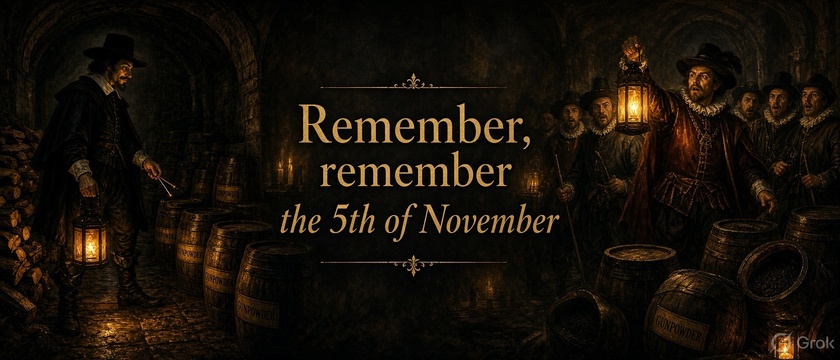
Remember remember
The 5th November

Remember Remember

The Gunpowder Plot of 1605 was a failed attempt by a group of English Catholics to assassinate King James I and the Protestant political leadership by blowing up the House of Lords during the State Opening of Parliament on 5 November. It is the origin of the annual British tradition of Guy Fawkes Night (Bonfire Night).

Context before 1605

Under Elizabeth I (r. 1558–1603), English Catholics faced severe restrictions: recusancy fines for non-attendance at Church of England services, execution of missionary priests as traitors, and the after-effects of the 1570 papal bull excommunicating Elizabeth. Many Catholics hoped for relief when James VI of Scotland (son of the Catholic Mary, Queen of Scots) became James I of England in 1603. James initially signalled moderation and privately suggested he would not harshly persecute those who gave outward obedience. However, hopes faded quickly. In February 1604 he ordered Catholic priests to leave the country and reimposed recusancy fines. The 1604 Treaty of London ended the long war with Spain without securing any religious concessions for English Catholics. By late 1604–1605, persecution had intensified again, creating deep disappointment among some Catholic gentry.

Significant figures

The plot was driven by a small circle of mostly Midlands Catholic gentlemen linked by kinship and shared frustration. The original inner group of five (sworn to secrecy in May 1604 at the Duck and Drake inn in the Strand) were:

  • Robert Catesby (c. 1572–1605): The charismatic leader and originator of the scheme. A tall, athletic Northamptonshire gentleman of old Catholic stock whose father had been imprisoned for recusancy. He had previously been involved in the Earl of Essex’s 1601 rebellion. He conceived the plan to destroy Parliament and the king in one blow.
  • Thomas Wintour (or Winter; c. 1571–1606): Catesby’s cousin; acted as a diplomat and recruiter. He travelled to the Spanish Netherlands seeking support (unsuccessfully) and brought Guy Fawkes into the plot.
  • John (Jack) Wright (c. 1568–1605): A skilled swordsman and long-time associate; brother-in-law of Thomas Percy.
  • Thomas Percy (c. 1560–1605): A kinsman and agent of the Earl of Northumberland. He rented the property near the House of Lords and provided a respectable front. He was also tasked with seizing the young Prince Charles after the explosion.
  • Guy (Guido) Fawkes (1570–1606): A Yorkshire-born soldier who had fought for the Spanish in the Low Countries and had practical experience with mining and explosives. Recruited for his military skills and relative anonymity in England. He used the alias John Johnson while guarding the gunpowder. He was the man found and arrested in the cellar.

Later recruits (bringing the total to 13 main conspirators) included Christopher (Kit) Wright (John’s brother), Robert Wintour (Thomas’s brother), Robert Keyes, Thomas Bates (Catesby’s servant), John Grant, Ambrose Rookwood (who provided money and horses), Sir Everard Digby (who was to organise a Midlands rising and seize Princess Elizabeth), and Francis Tresham (who is widely suspected of sending the anonymous warning letter to Lord Monteagle, his brother-in-law). Jesuit priest Henry Garnet was later implicated for knowledge of the plot (he claimed he was bound by the seal of confession) and was executed.

The plan was to kill James, his eldest son Henry, and the leading ministers, then proclaim the nine-year-old Princess Elizabeth as a puppet queen who could be married to a Catholic prince. A rising in the Midlands was intended to support the coup. They first tried to dig a tunnel under the House of Lords; when that proved impractical they rented a cellar directly beneath it and stocked it with 36 barrels of gunpowder.

The night of 4–5 November 1605 and immediate aftermath

An anonymous letter warning Lord Monteagle not to attend the opening of Parliament was shown to the authorities. After a delay, a search on the night of 4–5 November discovered Fawkes (with matches and fuses) and the gunpowder. He was arrested, taken to the Tower of London, and tortured (on James’s explicit orders, using the rack). He eventually confessed and named his co-conspirators.

Most of the others fled north. On 8 November they made a last stand at Holbeach House in Staffordshire. Catesby, Percy, and both Wright brothers were killed in the fighting; others were wounded and captured. Eight surviving conspirators were tried for high treason in January 1606 and sentenced to be hanged, drawn, and quartered. Executions took place on 30–31 January 1606 (some in St Paul’s Churchyard, Fawkes and others in Old Palace Yard at Westminster). Fawkes famously jumped from the gallows, breaking his neck and dying before the full mutilation. Francis Tresham died in the Tower (possibly of illness); Henry Garnet was also executed.

After 1605

The plot’s failure led to stricter anti-Catholic measures, including the 1606 Popish Recusants Act, which required Catholics to take an Oath of Allegiance denying the Pope’s power to depose monarchs. It reinforced Protestant fears and propaganda that Catholics (especially Jesuits) were disloyal and dangerous. Parliament quickly established 5 November as a day of public thanksgiving. This evolved into Guy Fawkes Night / Bonfire Night, traditionally marked by bonfires, fireworks, and the burning of effigies (“guys”). The custom continues in Britain today, though its original religious edge has largely faded into a more general autumn celebration.

In short, the Gunpowder Plot was born of the gap between Catholic hopes raised by James’s accession and the continued reality of persecution. Its dramatic failure permanently associated Guy Fawkes’s name with the date and cemented anti-Catholic legislation and sentiment for generations.

= The 5th November

These are notable events that occurred on 5 November in various years. Here is a concise overview of each:

1138 – Lý Anh Tông enthroned as emperor of Vietnam

Lý Anh Tông (born Lý Thiên Tộ in 1136) became the sixth emperor of the Lý dynasty of Đại Việt at about two years old after the death of his father, Lý Thần Tông. He reigned until 1175 (roughly 37 years). His mother and court officials (including regents such as Đỗ Anh Vũ) governed during his minority. His reign is generally seen as the last relatively stable period of the Lý dynasty before later turbulence.

1499 – Publication of the Catholicon

Jehan Lagadeuc of Tréguier (Brittany) wrote this trilingual (Breton–French–Latin) dictionary in 1464. Printed in 1499 (often associated with Tréguier or nearby), it is the first printed Breton dictionary and an important early French lexicographical work. It contains roughly 6,000 entries focused on everyday and scholarly vocabulary and was intended to help Breton speakers learn French and Latin. It is regarded as the foundational printed dictionary for Breton.

1605 – Gunpowder Plot: Guy Fawkes is arrested

In the early hours of 5 November 1605, Guy Fawkes (also known as John Johnson) was discovered and arrested in a cellar beneath the House of Lords. He was guarding about 36 barrels of gunpowder intended to blow up King James I and Parliament during the opening of the session. The plot, organised by Robert Catesby and other English Catholics, aimed to kill the Protestant king and leadership and install a Catholic regime (with James’s daughter Elizabeth as a puppet). A warning letter to Lord Monteagle had prompted the search. Fawkes and the other conspirators were later executed; the failure of the plot is still commemorated in Britain as Guy Fawkes Night / Bonfire Night with fireworks and bonfires.

1688 – William III of England lands with a Dutch fleet at Brixham

William of Orange (later William III) landed at Brixham in Torbay, Devon, on 5 November 1688 with a Dutch fleet and roughly 14,000 troops. This was the start of the Glorious Revolution. Invited by English Protestants opposed to the Catholic James II, William’s largely unopposed landing led to James’s flight and William and Mary’s joint accession. It is remembered as a key moment in the establishment of parliamentary sovereignty and the Protestant succession.

1757 – Battle of Rossbach (Seven Years’ War)

Frederick the Great of Prussia, with about 22,000 men, decisively defeated a larger allied force of roughly 41,000 French and Holy Roman Empire (Imperial) troops under the Prince de Soubise and Prince Joseph of Saxe-Hildburghausen near Rossbach in Saxony. The battle lasted about 90 minutes and was a striking example of Prussian tactical superiority (especially cavalry and rapid manoeuvre). Prussian losses were light (around 550); allied losses were heavy (thousands killed, wounded, or captured). The victory restored Frederick’s reputation after earlier setbacks, encouraged British subsidies, and is regarded as a turning point in the war.

1768 – Treaty of Fort Stanwix

Signed on 5 November 1768 at Fort Stanwix (near present-day Rome, New York) between Sir William Johnson (for Britain) and the Haudenosaunee (Iroquois Six Nations), with colonial representatives present. It adjusted the boundary established by the 1763 Royal Proclamation, ceding large areas (including much of what became Kentucky and parts of present-day West Virginia and Pennsylvania) to the Crown. The Haudenosaunee received substantial payments. The treaty opened vast tracts west of the Appalachians to colonial settlement and speculation but was controversial, as some of the land lay outside strict Iroquois control and later contributed to frontier conflicts.

1780 – Defeat of French-American forces under Colonel LaBalme by Miami Chief Little Turtle

In early November 1780 (commonly dated 5 or 6 November), a force of French and Canadien irregulars under Colonel Augustin de La Balme, operating in support of the American side during the Revolutionary War, was ambushed and destroyed near the Eel River (in present-day Indiana) by Miami warriors led by Chief Little Turtle (Mishikinakwa). La Balme had sacked the Miami town of Kekionga (near modern Fort Wayne) while marching toward British-held Detroit. Little Turtle’s victory was decisive, established his reputation as a military leader, and effectively ended the expedition. It foreshadowed his later successes in the Northwest Indian War.

These events span medieval Vietnamese history, early modern European printing and politics, the Seven Years’ War, colonial North American land treaties, and the American Revolutionary frontier. The best-known in the English-speaking world is the Gunpowder Plot and the subsequent Guy Fawkes Night tradition.

Read full Article
November 02, 2026
post photo preview
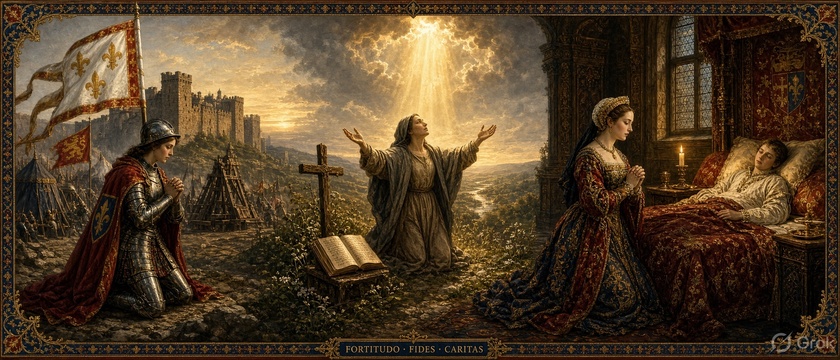
Answered prayer, according to Joan and Catherine
November 4th

Answered prayer, according to Joan and Catherine

1429 – Joan of Arc liberates Saint-Pierre-le-Moûtier

This was a late-1429 French success during the Armagnac–Burgundian phase of the Hundred Years’ War. After the lifting of the siege of Orléans, the Loire campaign, the victory at Patay, and Charles VII’s coronation at Reims (July 1429), Joan of Arc’s influence at court had begun to wane. The failed assault on Paris in September left her sidelined while Charles pursued diplomacy with Burgundy. In October the king’s council decided to clear remaining Burgundian strongholds in the Loire region, starting with Saint-Pierre-le-Moûtier (a small but well-fortified town in the Nièvre, held by the mercenary captain Perrinet Gressard).

Significant figures

  • Joan of Arc (c. 1412–1431): the peasant girl who claimed divine guidance; by this point she was an experienced military leader and inspirational figure, though no longer the primary strategist.
  • Charles d’Albret (also Charles II d’Albret): official commander of the expedition; lieutenant-general in Berry and half-brother to the powerful courtier Georges de La Trémoille.
  • Perrinet Gressard: Burgundian (and later English-aligned) captain who controlled the town and the stronger fortress of La Charité-sur-Loire.
  • Jean d’Aulon: Joan’s bodyguard and steward, whose later testimony is the main eyewitness account.
  • Charles VII: the French king, who authorized the campaign and later rewarded Joan.

Background and course of events
Forces assembled at Bourges. The town was surrounded by a deep moat and strongly defended. An initial assault failed; the French were driven back and a retreat was sounded. Jean d’Aulon (wounded in the heel earlier) found Joan nearly alone near the walls. According to his account, she refused to withdraw, saying she was not alone but had “fifty thousand of my people” with her, and called for faggots and hurdles to bridge the ditch. The troops responded, a second assault went in, and the town fell on 4 November 1429 with relatively little further resistance.

Results
The capture was a clear French victory and one of Joan’s last military successes. Charles VII ennobled Joan, her parents, and her brothers (letters patent issued in late December 1429; the family took the name Du Lys). The army immediately moved on to the larger fortress of La Charité-sur-Loire, which held under Perrinet Gressard. That siege, begun in late November, failed in the face of winter weather, shortages of powder and supplies, and strong defenses; the French withdrew around Christmas without taking the place. Joan’s prestige suffered further. She spent the winter at court, then in 1430 left to aid Compiègne, where she was captured by Burgundians, sold to the English, tried, and burned at Rouen in May 1431.

The episode is remembered mainly through d’Aulon’s testimony at Joan’s later rehabilitation trial and through a statue of Joan erected in the town in 1902.

1501 – Catherine of Aragon meets Arthur Tudor

This was the first personal meeting between the Spanish infanta and the English heir, the culmination of years of dynastic negotiation between Henry VII and Ferdinand and Isabella of Spain.

Significant figures

  • Catherine of Aragon (1485–1536): youngest daughter of Ferdinand II of Aragon and Isabella I of Castile; highly educated (especially in Latin), later Henry VIII’s first wife.
  • Arthur Tudor, Prince of Wales (1486–1502): eldest son of Henry VII and Elizabeth of York; named for the legendary king and raised as the hope of the new Tudor dynasty.
  • Henry VII: the English king, who had secured the Spanish match to strengthen his throne and obtain a large dowry.
  • Spanish diplomats and household officers (including Don Pedro de Ayala and Catherine’s duenna Elvira Manuel), who tried to enforce traditional protocols.

Background
Negotiations dated back to the Treaty of Medina del Campo (1489). A proxy marriage had already taken place, and the couple had exchanged formal Latin letters. Catherine sailed from A Coruña in August 1501; storms forced her to land at Plymouth on 2 October instead of Southampton. She then traveled slowly overland toward London with a large Spanish retinue. Henry VII, impatient to see his future daughter-in-law, left Richmond on 4 November, met Arthur at Easthampstead, and proceeded toward Dogmersfield (Hampshire), a house belonging to the Bishop of Bath and Wells where Catherine had arrived.

The meeting
Spanish custom held that the bride should not meet her future husband until the wedding day. Spanish officials initially tried to prevent the encounter. Henry insisted (according to contemporary accounts he was prepared to enter her chamber if necessary). Catherine, exhausted from travel, eventually received him and then Arthur. They communicated through interpreters (Spanish bishops translating into Latin). Accounts describe Catherine as richly dressed and well accompanied; Henry was reportedly pleased. The couple danced with members of their respective parties. Sources differ on the exact day (popular lists often say 4 November; more detailed contemporary narratives place the actual meeting on 5 or 6 November). A formal renewal of the betrothal took place.

Results
Catherine continued to London and entered the city on or about 12 November. On 14 November 1501 the couple were married in person at Old St Paul’s Cathedral in a lavish ceremony (both dressed in white satin). They later traveled to Ludlow Castle on the Welsh Marches, where Arthur was to preside over the Council of Wales. Arthur died there on 2 April 1502, aged 15, most likely of the sweating sickness (Catherine recovered). The short marriage and the disputed question of whether it had been consummated became central decades later when Catherine married Arthur’s younger brother Henry VIII and Henry sought an annulment—helping trigger the English Reformation. The Spanish alliance, the large dowry, and the prestige of the match had been major diplomatic achievements for Henry VII; Arthur’s early death left the succession dependent on the surviving son and reshaped English–Spanish relations.

= November 4th

These events are standard entries associated with 4 November (not 2 November). Wikipedia’s November 4 page and “on this day” lists include almost the exact sequence you gave (Joan of Arc’s action at Saint-Pierre-le-Moûtier, the Antwerp sack, the William–Mary marriage, the San Carlo inauguration, Túpac Amaru II, Mozart’s Linz Symphony, the Wabash battle, and the start of the Corfu siege). Catherine of Aragon’s meeting with Arthur is also listed under 4 November in many sources, though some detailed accounts place the actual first meeting at Dogmersfield on 5–6 November.

Here is a concise overview of each:

1429 – Joan of Arc liberates Saint-Pierre-le-Moûtier
During the Armagnac–Burgundian phase of the Hundred Years’ War, Joan of Arc (with Charles d’Albret) besieged the fortified Burgundian-held town of Saint-Pierre-le-Moûtier (near the Loire). After an initial failed assault, a second assault on 4 November succeeded; the town fell. Charles VII later ennobled Joan. It was one of her later military successes before the failed siege of La Charité and her eventual capture.

1501 – Catherine of Aragon meets Arthur Tudor
Catherine of Aragon (daughter of Ferdinand and Isabella) arrived in England in October 1501 to marry Arthur, Prince of Wales (Henry VII’s eldest son). They met at Dogmersfield in Hampshire; many popular lists place this on 4 November, while more precise accounts put the meeting on 5 or 6 November after Spanish diplomats tried to enforce the custom of no meeting before the wedding. They married at St Paul’s on 14 November. Arthur died in April 1502; Catherine later married his brother Henry VIII.

1576 – Spanish capture/sack of Antwerp (Spanish Fury)
In the Eighty Years’ War, unpaid mutinous Spanish troops of the Army of Flanders attacked and sacked Antwerp on 4 November. The three-day rampage destroyed much of the city (then the economic and cultural centre of the Low Countries), with estimates of several thousand civilian deaths (some contemporary claims ran much higher). The atrocity helped drive the Pacification of Ghent (signed days later), uniting provinces against Spanish troops.

1677 – Mary II marries William, Prince of Orange
Mary (eldest daughter of the future James II, raised Protestant) married her cousin William III of Orange at St James’s Palace on 4 November 1677. She reportedly wept at the news of the arranged match. They later reigned jointly as William and Mary after the Glorious Revolution of 1688–89 (he overthrew her Catholic father). The marriage was popular in the Dutch Republic as a Protestant alliance against France.

1737 – Inauguration of the Teatro di San Carlo
King Charles VII of Naples commissioned the theatre (near the royal palace) to replace an older venue. It opened on 4 November 1737 (the king’s name day) with Domenico Sarro’s opera Achille in Sciro (libretto by Metastasio). It is the oldest continuously active opera house in Europe, predating La Scala and La Fenice.

1780 – Rebellion of Túpac Amaru II begins
In the Viceroyalty of Peru, José Gabriel Condorcanqui (claiming Inca descent and taking the name Túpac Amaru II) seized and later executed the harsh local corregidor Antonio de Arriaga on or around 4–10 November 1780. This sparked a large indigenous and mestizo uprising against Spanish colonial abuses (repartimiento, forced labour, etc.). It spread widely but was ultimately crushed; Túpac Amaru was captured and executed in 1781. It remains a major symbol of Andean resistance.

1783 – Mozart’s Symphony No. 36 (“Linz”) premieres
While returning from Salzburg to Vienna, Mozart and Constanze stopped in Linz. Count Thun arranged a concert; Mozart, having no symphony with him, composed K. 425 in C major in a few days (roughly 30 October–3 November). It premiered in Linz on 4 November 1783. Scored for pairs of oboes, bassoons, horns, trumpets, timpani and strings, it shows Haydn’s influence (including a slow introduction) and is one of Mozart’s major mature symphonies.

1791 – Battle of the Wabash (St. Clair’s Defeat)
A Western Confederacy of Native American tribes (led by Miami chief Little Turtle, Shawnee chief Blue Jacket and others) attacked and destroyed a U.S. force under Major General Arthur St. Clair near the headwaters of the Wabash River (present-day Ohio) on 4 November. Poor preparation, few sentries and a dawn assault led to one of the worst U.S. Army defeats in history—hundreds of soldiers and camp followers killed (far more American casualties than at the Little Bighorn). It prompted military reforms; the confederacy was later defeated at Fallen Timbers in 1794.

1798 – Beginning of the Russo-Ottoman siege of Corfu
After the French occupation of the Ionian Islands (following the Venetian collapse), a combined Russian–Ottoman naval force under Admiral Fyodor Ushakov began operations against the French garrison on Corfu. A detachment arrived and the siege effectively started around 4 November 1798. The French held out for months; the fortress eventually capitulated in March 1799. It was part of the Second Coalition’s campaign against Revolutionary France in the Mediterranean.

These form a striking cluster of military, dynastic, cultural and colonial turning points on or around the same calendar day across centuries. Let me know if you’d like more detail on any one of them.


Read full Article
See More
Available on mobile and TV devices
google store google store app store app store
google store google store app tv store app tv store amazon store amazon store roku store roku store
Powered by Locals