Zong v Tampa
The Zong massacre is one of the most infamous episodes of the Atlantic slave trade and a pivotal moment in the British abolitionist movement. Here is the fuller context.
Before: the voyage and the system
The Zong was a relatively small Liverpool-registered slave ship (about 110 tons) owned by the Gregson syndicate, a major slave-trading firm. In 1781 it was commanded by Captain Luke Collingwood, a surgeon-turned-captain who had previously worked on slave ships. It left the Gold Coast (present-day Ghana) in early September 1781 with roughly 442–470 enslaved Africans—far more than the vessel could safely carry. Overcrowding was common because human beings were treated as high-value “cargo,” and captains maximised profit by packing as many as possible.
By late November the ship was in the Caribbean. Many captives and several crew members had already died from disease, malnutrition and the conditions below decks. A navigational error (the crew mistook Jamaica for the French colony of Saint-Domingue/Hispaniola) caused the ship to sail past its destination. When the mistake was realised around 29 November, calculations suggested only a few days of fresh water remained, while Jamaica was still 10–14 days away. These figures were later disputed in court; critics argued the water shortage was exaggerated or avoidable.
The massacre (late November–early December 1781)
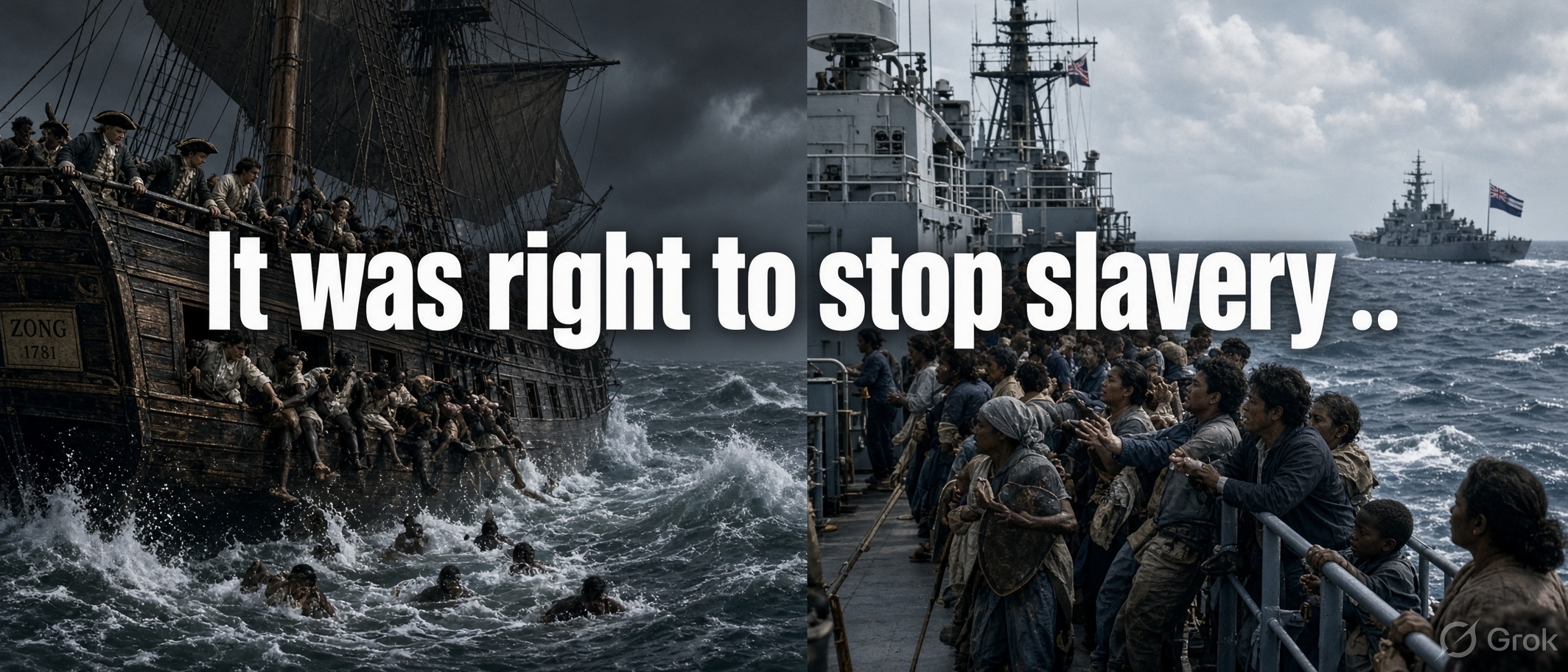
On or about 29 November the crew decided to throw living people overboard so the owners could claim insurance for “jettisoned cargo.” Under contemporary marine insurance, goods lost at sea to save the ship could be claimed; enslaved people were treated as insurable property. Over several days the crew systematically pushed people through cabin windows into the sea:
- About 54 women and children on the first day
- Another group of roughly 42 men the next day
- A further group of around 36–38 in the following days
Approximately 10 more captives jumped overboard themselves rather than be thrown. Contemporary accounts put the total deliberately killed at 132–133. One captive reportedly asked that the remaining people be denied food and water rather than thrown overboard; the request was ignored. The ship reached Jamaica on 22 December with only about 208 survivors, less than half of those originally taken from Africa.
After: the court case and public reaction
In Jamaica the survivors were sold. Back in England the owners (James Gregson and partners) filed an insurance claim for the value of the people thrown overboard. The underwriters refused to pay. The case came to court in London in 1783 as Gregson v. Gilbert—not as a murder trial, but as a commercial dispute over insurance.
The jury initially found for the owners, accepting the argument that the killings were a necessary act to save the ship. On appeal, Lord Chief Justice Mansfield ordered a new trial, but the owners ultimately abandoned the claim. No one was ever prosecuted for murder. The legal principle at stake was simply whether the insurers had to pay for “property” deliberately destroyed.
News of the case reached the abolitionist Granville Sharp, who publicised it vigorously. Pamphlets, newspaper reports and Sharp’s own efforts turned a commercial lawsuit into a moral scandal. The massacre became a powerful symbol of the dehumanising logic of the slave trade: people could be thrown alive into the sea and the only legal question was whether the owners were entitled to compensation.
Significant figures
- Luke Collingwood: Captain of the Zong. He ordered the killings and later claimed the water shortage left no alternative. He died shortly after the voyage.
- James Gregson and the Gregson syndicate: Liverpool owners who filed the insurance claim and treated the dead as lost cargo.
- Robert Stubbs / James Kelsall: Ship’s officers involved in the decisions and later testimony. Kelsall (first mate) gave evidence about the water calculations and the decision-making.
- Granville Sharp: English abolitionist who obtained details of the case, campaigned against it, and used it to argue that the slave trade was inherently criminal.
- Lord Mansfield (William Murray): Chief Justice who ordered the retrial. Although he did not treat the killings as murder, his handling of the case kept the facts in public view.
- The enslaved Africans themselves: Almost entirely nameless in the records. A few individuals are briefly noted in testimony (including the one who asked to be starved rather than thrown overboard), but the great majority remain anonymous.
Longer-term significance
The Zong case did not immediately end the slave trade, but it supplied abolitionists with a stark, documented example of its brutality. It was widely cited in the parliamentary campaigns of the 1780s and 1790s that eventually led to the 1807 Act abolishing the British slave trade. J.M.W. Turner’s 1840 painting The Slave Ship (also known as Slavers Throwing Overboard the Dead and Dying) is widely understood to have been inspired by the Zong massacre, keeping the episode in cultural memory long after the trade itself had ended.
In short, the Zong massacre was the logical outcome of a system that treated human beings as insurable commodities. The subsequent lawsuit failed to punish the perpetrators but succeeded in exposing that logic to a wider public, and it remains one of the most cited episodes in the history of the Atlantic slave trade.
= November 29th
These events are commonly associated with 26 November in various “on this day” compilations (including some Wikipedia lists), though several actually occurred a few days later (often the 28th or 29th). Here is a concise account of each, based on standard historical sources.
561 – Death of Chlothar I and division of the Frankish kingdom
Chlothar I (also Clotaire or Clothar), the last surviving son of Clovis I, died at Compiègne in late 561 (sources place it in late November or December). He had reunited the Frankish realm under a single ruler after the deaths of his brothers. Under Frankish custom of partible inheritance, the kingdom was immediately divided among his four surviving sons:
- Charibert I received the Kingdom of Paris
- Guntram received Burgundy / Orléans
- Sigebert I received Austrasia (Reims)
- Chilperic I received Neustria / Soissons
This restarted the cycle of Merovingian civil wars and fragmentation that characterised the dynasty.
618 – Battle of Qianshuiyuan
In late November 618 (commonly dated 29 November), Tang forces under Li Shimin (the future Emperor Taizong) defeated the army of Xue Rengao, who had proclaimed a short-lived “Qin” state in the northwest after the collapse of the Sui dynasty. After a prolonged standoff on the shallow-water plain northwest of modern Changwu (Shaanxi), Li Shimin exploited the enemy’s supply problems and the difficult terrain to rout Xue’s forces. The victory eliminated a major rival, secured the Guanzhong region, and was an important early step in the Tang consolidation of power.
903 – Battle of Hama
On 29 November 903, an Abbasid army commanded by Muhammad ibn Sulayman al-Katib crushed a Qarmatian (radical Ismaili) force near Hama in Syria. The Qarmatians had been raiding and threatening Abbasid control in the region. The defeat broke their power in northern Syria, allowed the capture and execution of key leaders, and cleared the way for the Abbasids to move against the autonomous Tulunid rulers of Egypt.
1394 – Capital moved to Hanyang (Seoul)
Yi Seong-gye (King Taejo), founder of the Joseon dynasty after overthrowing Goryeo in 1392, moved the capital from Kaesong to Hanyang on the Han River in 1394. The site was chosen for defensive geography, access to the river for transport, central location on the peninsula, and favourable geomantic (feng shui) qualities. Hanyang—today’s Seoul—remained the capital of Korea for the rest of the Joseon period and, with brief interruptions, down to the present.
1549 – Papal conclave of 1549–50 begins
The conclave that followed the death of Pope Paul III opened on 29 November 1549. It lasted until 7 February 1550 and was one of the longest and most politicised of the century, with heavy interference from the French (Henry II) and Imperial (Charles V) factions. Reginald Pole came close to election early on; the eventual compromise choice was Cardinal Giovanni Ciocchi del Monte, who became Pope Julius III. The conclave also concerned the future of the Council of Trent and control of the Duchies of Parma and Piacenza.
1612 – Battle of Swally
On 29–30 November 1612, four English East India Company galleons under Captain Thomas Best defeated a Portuguese squadron (four galleons and numerous smaller vessels) off Suvali (Swally), near Surat in Gujarat. The engagement was modest in scale but significant: it weakened Portuguese naval dominance in the region, impressed the Mughal authorities, and helped the English secure trading privileges. It is often cited as an early milestone in the rise of English power in India and as a remote ancestor of the Indian Navy.
1729 – Natchez massacre at Fort Rosalie
In late November 1729 (28 or 29 November), Natchez warriors attacked the French post of Fort Rosalie and surrounding settlements near present-day Natchez, Mississippi. The immediate trigger was the French commandant Chépart’s demand that the Natchez abandon their sacred White Apple village (containing the bones of their ancestors) so he could plant tobacco there. In a coordinated strike the Natchez killed roughly 230 French colonists (contemporary figures often given as about 138–144 men, 35 women and 56 children) while sparing many women and enslaved Africans, whom they took captive. French retaliation in the following years largely destroyed the Natchez as an independent people; survivors were scattered among other tribes or deported.
1776 – End of the Battle (siege) of Fort Cumberland
During the American Revolutionary War, a mixed force of New Englanders, local Nova Scotian patriots, Acadians and Indigenous allies under Jonathan Eddy besieged Fort Cumberland (formerly Beauséjour) in late October–November 1776. British defenders of the Royal Fencible Americans held out until reinforcements arrived; a sortie on 29 November scattered the besiegers. The failure helped keep Nova Scotia firmly in British hands for the rest of the war.
1777 – Founding of San José, California
On 29 November 1777, Lieutenant José Joaquín Moraga founded the Pueblo de San José de Guadalupe on the Guadalupe River in Alta California. It was the first civilian Spanish settlement (pueblo) in the province, distinct from missions and military presidios, and was intended to supply food to the garrisons at Monterey and San Francisco. The site later became the city of San Jose.
1781 – Zong massacre
Beginning on or about 29 November 1781, the crew of the British slave ship Zong threw approximately 130–133 enslaved Africans overboard into the Atlantic. The ship had been overloaded; after a navigational error and water shortages (the extent of which was later disputed), the crew decided to jettison the “cargo” so the owners could claim insurance. The subsequent London insurance lawsuit publicised the atrocity and became a powerful argument for abolitionists in Britain.
1783 – New Jersey earthquake
On the evening of 29 November 1783 (local time), a magnitude ~5.3 earthquake struck northern New Jersey (estimated epicentre in the Highlands / near the Ramapo Fault). It was felt from New Hampshire to Pennsylvania, toppled chimneys and knocked objects from shelves, but caused relatively limited structural damage. It remains the strongest historically recorded earthquake in New Jersey. George Washington, then in New York City marking the British evacuation, reportedly slept through it at Fraunces Tavern.
These episodes range from dynastic succession and imperial consolidation to colonial violence, early global trade competition, and natural events. Several of the precise calendar dates in secondary lists are approximate or shifted by a day or two relative to primary sources.