



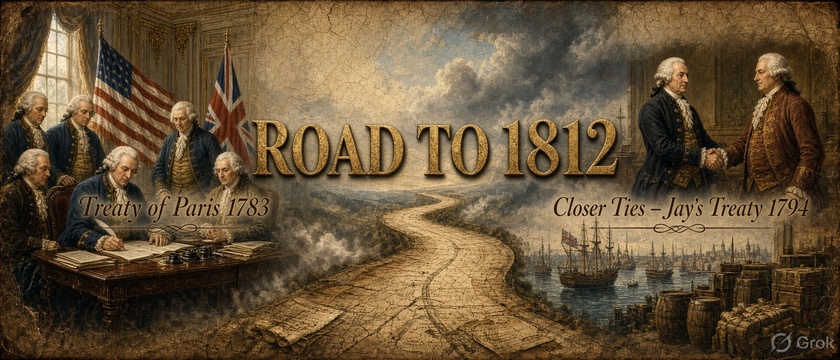
The road to 1812
Jay’s Treaty (officially the Treaty of Amity, Commerce, and Navigation, Between His Britannic Majesty and the United States of America), signed in London on 19 November 1794 by John Jay and Lord Grenville, was a pragmatic and deeply controversial agreement that averted war between the young United States and Great Britain.
Background (before 1794)
The 1783 Treaty of Paris that ended the American Revolutionary War left several issues unresolved or only partially implemented:
- Britain continued to occupy forts in the Northwest Territory (around the Great Lakes), including posts at Detroit, Mackinac, Niagara, Oswego and others, in violation of the peace terms.
- American state courts obstructed British creditors trying to recover pre-war debts.
- Southerners sought compensation for enslaved people who had fled to or been carried off by British forces.
- Trade remained restricted: Britain limited American access to its markets (especially the West Indies) while American ports were open to British goods.
- With Britain at war with Revolutionary France from 1793, the Royal Navy seized American ships trading with France and impressed American sailors into British service. Over 250–300 American vessels were taken in a short period.
These grievances brought the two countries close to war. Federalists (especially Alexander Hamilton) prioritised trade with Britain and peace; Democratic-Republicans (Thomas Jefferson, James Madison and others) were more sympathetic to France and resented British high-handedness. President George Washington, advised by Hamilton, chose diplomacy over confrontation and in 1794 sent Chief Justice John Jay as special envoy to London.
Key figures
- John Jay (1745–1829): Chief Justice of the U.S. Supreme Court, earlier Secretary of Foreign Affairs under the Articles of Confederation, and a negotiator of the 1783 Treaty of Paris. A Federalist Anglophile with strong diplomatic experience.
- Lord William Wyndham Grenville (1759–1834): British Foreign Secretary, the principal British negotiator.
- George Washington: President who selected Jay, supported the treaty despite its flaws, and pushed it through against intense opposition.
- Alexander Hamilton: Treasury Secretary who shaped the American negotiating strategy and strongly favoured closer commercial ties with Britain.
- Thomas Jefferson and James Madison: Leading opponents who viewed the treaty as a betrayal of France and a surrender to British interests. Their resistance helped solidify the emerging Democratic-Republican Party.
- William Pitt the Younger: British Prime Minister during the negotiations.
The treaty itself (19 November 1794)
Jay and Grenville produced a 28-article treaty. Main provisions included:
- Britain agreed to evacuate the Northwest forts by 1 June 1796.
- Mixed commissions were established to arbitrate: pre-war debts owed to British creditors; compensation for British seizures of American ships; and the northeast boundary (the St. Croix River question). This was an early and influential use of international arbitration.
- Limited commercial concessions: the United States received “most favoured nation” trading status in Britain and the British East Indies. Access to the British West Indies was restricted to vessels of 70 tons or less (and even that was later suspended).
- The United States agreed to pay legitimate pre-war debts and to prevent the outfitting of privateers of Britain’s enemies in American ports.
- Freedom of navigation and trade across the boundary (including for Native Americans on either side) was affirmed.
- Notably absent: any real protection against future impressment or a strong American definition of neutral rights at sea. No compensation for enslaved people carried off during the Revolution.
Aftermath and controversy
The treaty reached the United States in 1795 and ignited fierce public and political opposition. Critics called it a humiliating surrender; Jay was burned in effigy in several cities and later remarked that he could find his way across the country by the light of his own burning effigies. The full text was leaked and published, intensifying the uproar.
The Senate, after secret debate, approved it on 24 June 1795 by the bare two-thirds majority of 20–10, but only after conditioning ratification on the suspension of the restrictive West Indies article (Article 12). Britain accepted the change. Washington signed the treaty in August 1795. The House of Representatives later fought over funding the commissions; after heated debate it narrowly approved the necessary appropriations in 1796 (51–48). Washington also set an important precedent by refusing the House’s demand for the negotiation papers, asserting that treaty-making was an executive and Senate power.
Consequences included:
- Avoidance of an immediate war with Britain and roughly a decade of improved commercial relations.
- British withdrawal from the Northwest posts in 1796, which opened the region to American settlement (and contributed to the Treaty of Greenville with Native nations the previous year).
- Deepening of American party divisions: Federalists supported the treaty; Democratic-Republicans opposed it. The controversy permanently strained relations between Washington and both Jefferson and Madison.
- French anger at what they saw as an Anglo-American tilt, which helped produce the Quasi-War (1798–1800).
- Failure to settle impressment and neutral rights, issues that later contributed to the War of 1812. Jefferson did not renew the treaty when it expired in 1805.
Historians generally judge the treaty as imperfect and more favourable to Britain on paper, yet a shrewd bargain for a weak young republic that needed time to consolidate. It bought peace, secured the Northwest, established useful arbitration precedents, and protected the commercial base Hamilton considered essential.
In short, Jay’s Treaty was an unloved but consequential piece of early American diplomacy: it postponed a war the United States was ill-prepared to fight, deepened domestic political factions, and left several maritime grievances for a later generation to confront.
= November 19th
Here are the details on those four events. (I’m taking “yell me about” as “tell me about.”)
461 – Libius Severus declared Western Roman Emperor (real power with Ricimer)
After Ricimer, the magister militum (master of soldiers), had the previous Western emperor Majorian executed in August 461, there was a short interregnum. On 19 November 461 the Senate in Ravenna acclaimed Libius Severus (a Lucanian aristocrat, sometimes called Severus III) as augustus.
He was never recognised by the Eastern emperor Leo I and exercised little real authority. Ricimer remained the dominant figure; some coinage even carried Ricimer’s monogram, and contemporary and later sources treat Severus as a classic “shadow” or puppet emperor. His roughly four-year reign (to November 465) saw ongoing problems with the Vandals under Gaiseric, hostility from the general Aegidius in Gaul, and continued Eastern non-recognition. He died in 465 (natural causes or, as some accounts claim, poisoned by Ricimer), after which Ricimer looked for a candidate more acceptable to the East.
636 – Battle of al-Qādisiyyah
In November 636 (most commonly dated around 16–19 November) the Rashidun army under Saʿd ibn Abī Waqqāṣ defeated a larger Sasanian force commanded by Rostam Farrokhzād near al-Qādisiyyah (on the edge of the desert in what is now southern Iraq).
The battle was decisive. Rostam was killed, the Sasanian lines collapsed, and the royal banner (the Derafš-e Kāviān) was captured. The victory opened the way for the Arab capture of the Sasanian capital Ctesiphon and the subsequent conquest of Mesopotamia and Iran; the Sasanian Empire effectively collapsed by 651. Sources vary on exact army sizes and the precise day, but the outcome is clear: a major turning point in the early Muslim conquests.
1493 – Columbus lands on San Juan Bautista (Puerto Rico)
On his second voyage, Christopher Columbus sighted the island the Taíno called Borikén (or Boriquen) on 18–19 November 1493 and went ashore on the 19th, somewhere on the western coast (likely near the area of modern Aguadilla, Aguada or Añasco). He named it San Juan Bautista (Saint John the Baptist) in honour of the saint.
The island was inhabited by Taíno people. Columbus stayed only briefly to take on water and supplies, then continued west. Permanent Spanish colonisation began later, with Juan Ponce de León founding the first settlement (Caparra) in 1508. Over time the island became known as Puerto Rico (“Rich Port”) while the main city took the name San Juan.
1794 – Jay’s Treaty signed
On 19 November 1794 in London, John Jay (U.S. Chief Justice and special envoy) and British Foreign Secretary Lord Grenville signed the Treaty of Amity, Commerce, and Navigation (Jay’s Treaty). It was an attempt to resolve outstanding issues left over from the 1783 Treaty of Paris that ended the American Revolutionary War.
Key provisions included British agreement to evacuate forts in the Northwest Territory by June 1796, limited commercial concessions (including “most favoured nation” status for American trade), and arbitration for several disputes (pre-war debts, ship seizures, and boundary questions). The treaty was unpopular in the United States—many saw it as too favourable to Britain—and passed the Senate only narrowly in 1795. President Washington still implemented it, viewing it as the price of avoiding war and securing time for the young republic to strengthen.
These four events fall within a few days of each other across different centuries (19 November for three of them; the battle of al-Qādisiyyah is traditionally placed in mid-November 636). Let me know if you’d like more detail on any of them, related context, or images.