



Mismanagement caused Dyke failure
The St. Elizabeth’s Flood of 18–19 November 1421 (Dutch: Sint-Elisabethsvloed) was a major storm-surge disaster in the Low Countries that permanently transformed the landscape of what is now the southwestern Netherlands. It is named for the feast day of St. Elizabeth of Hungary (then observed on 19 November).
Before: The Grote Waard and Vulnerability
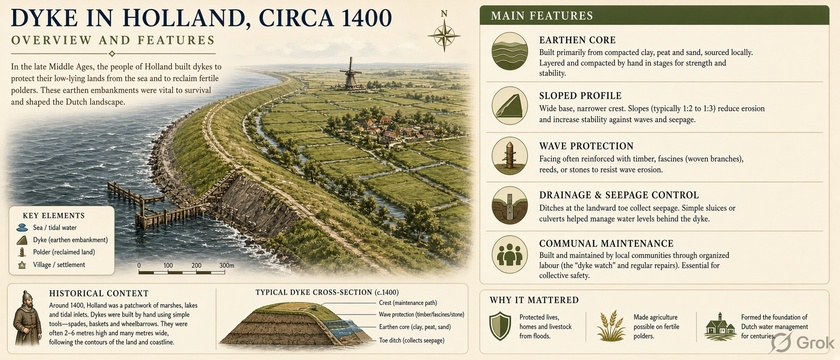
The main area affected was the Grote (or Zuid-Hollandse) Waard, a large, prosperous polder of reclaimed farmland between Dordrecht, Geertruidenberg, and Heusden. It had been protected by dikes since the late 13th century (roughly completed around 1283). By 1421 the land surface had subsided below mean sea level because of drainage for agriculture and extensive peat digging (used for fuel and salt extraction). Deep “salt wells” dug close to the dikes further weakened the defences.
Politically, the County of Holland was convulsed by the Hook and Cod wars (Hoekse en Kabeljauwse twisten), a long series of factional conflicts that ran from the mid-14th century into the late 15th. In the early 15th century the struggle centred on the succession of Countess Jacoba (Jacqueline) of Bavaria. The Hooks generally supported her claims; the Cods backed her uncle John of Bavaria (“John the Pitiless”). Resources that should have gone to dike maintenance were diverted to war. Towns such as Dordrecht (Cod stronghold) and Geertruidenberg (often Hook-aligned) were frequently at odds; Dordrecht forces had attacked Geertruidenberg in 1420. A local dispute over salt extraction involving Jacob van Abcoude (Lord of Putten and Strijen) was only nominally settled weeks before the flood, with a finding that the wells did not endanger the dikes—an assessment soon proved disastrously wrong.
There had already been a major St. Elizabeth’s flood in 1404 that hit Flanders, Zeeland, and parts of Holland.
The Flood Itself
On the night of 18–19 November 1421 a powerful extratropical cyclone drove a storm surge up the rivers from the North Sea. Dikes broke (notably near Broek / Wieldrecht on the southwestern side of the Grote Waard). Water poured into the low-lying polder. Further failures followed in the following weeks and years (including a break on the Merwede side in early 1422 linked to ice jams and high river discharge). The flood separated Dordrecht and Geertruidenberg and inundated large parts of Holland, Zeeland, and Flanders.
Death toll and villages: Contemporary chronicles (notably the Chronicon Tielense) speak of about 2,000 deaths across the wider storm-affected region. Later legend inflated this to 10,000 or even 100,000 and claimed 72 villages were swallowed. Modern historians (including Jan Buisman and later geographers) regard the higher figures as myth-making. The Grote Waard itself contained fewer than 30 villages and a total population of roughly 20,000–22,000. Realistic estimates for the disaster are in the low thousands of deaths at most, with many people able to flee; some analyses suggest the immediate toll in the Waard itself may have been lower still. Roughly two dozen settlements became permanently uninhabitable.
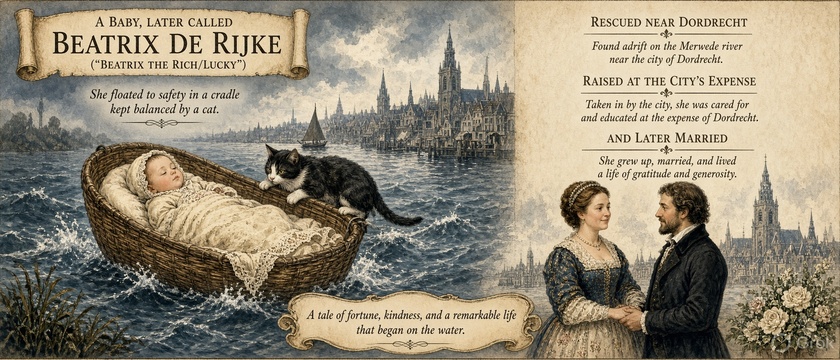
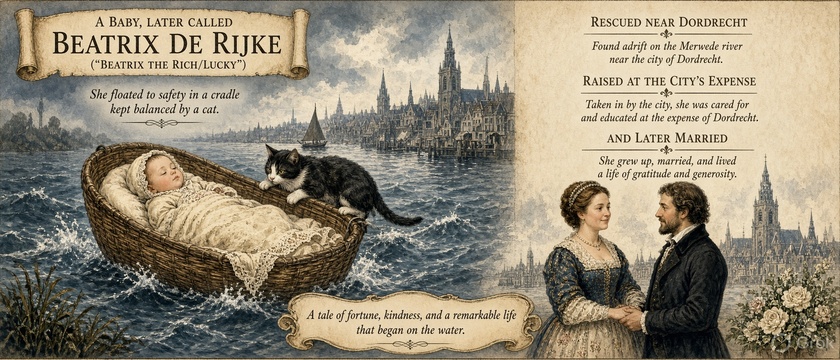
A famous local legend (appearing in art by the 1490s) tells of a baby, later called Beatrix de Rijke (“Beatrix the Rich/Lucky”), who floated to safety in a cradle kept balanced by a cat. She was said to have been rescued near Dordrecht, raised at the city’s expense, and later married. The story is almost certainly folkloric, but the cradle-and-cat motif appears on surviving altar panels of the flood.
Aftermath and Landscape Transformation
Attempts to repair the dikes were half-hearted and repeatedly frustrated by continued political discord. Further breaches in 1424 finished the permanent loss of most of the Grote Waard. Large parts remained under water for decades; some land was never fully reclaimed. The inundated area evolved into a freshwater tidal delta of creeks, islands, and reed beds—the Biesbosch (roughly “forest of rushes”), now a national park. Reclaimed or surviving areas include the island of Dordrecht, the Hoeksche Waard, and parts of northwestern North Brabant around Geertruidenberg.
The flood permanently altered river courses and turned Dordrecht into an island. It also entered Dutch collective memory as one of the great water disasters (alongside the 1953 North Sea flood), inspiring chronicles, maps, altarpieces, and later Romantic paintings. The exaggerated numbers and the Beatrix legend helped turn a serious but not apocalyptic event into a near-biblical catastrophe in popular telling.
Significant Figures and Context
- Jacoba of Bavaria (1401–1436): Countess of Holland, Zeeland, and Hainaut. Her contested succession and the Hook–Cod civil wars created the political instability that contributed to neglected defences. She was in England at the time of the flood.
- John of Bavaria (“John the Pitiless”): Her uncle and rival, supported by the Cod faction; controlled key towns including Dordrecht.
- Local lords and officials (e.g., Jacob van Abcoude) whose decisions on peat/salt extraction and dike upkeep had direct consequences.
- Anonymous chroniclers (especially the Tiel chronicle) who provide the earliest relatively sober casualty figures.
In short, the 1421 flood was not caused by an unprecedented “superstorm” alone, but by the interaction of a severe North Sea storm surge with a landscape already compromised by subsidence, peat digging, and decades of civil war that had starved the dikes of maintenance. Its most lasting legacy is the Biesbosch wetlands and the enduring Dutch awareness of the vulnerability of low-lying land.
= November 18th
These events are associated with November 18.
Here is context on the major ones from your list:
Early Christian and Late Roman Era
326 – Consecration of Old St. Peter’s Basilica: Emperor Constantine ordered a large basilica built over the traditional site of St. Peter’s tomb (and parts of Nero’s Circus) on Vatican Hill. Pope Sylvester I consecrated it on this date. It stood for about 1,200 years as a major pilgrimage site and the site of papal coronations (including Charlemagne’s in 800) before being largely demolished for the current basilica.
401 – Visigoths under Alaric I cross the Alps: Alaric led the Visigoths into northern Italy. This was an early stage in the series of Gothic movements that culminated in the sack of Rome in 410, a symbolic blow to the Western Roman Empire. Roman general Stilicho later defeated him at Pollentia (402), but the pressure continued.
High Middle Ages: Papacy, Crusades, and Power Struggles
1095 – Council of Clermont begins: Called by Pope Urban II, it ran roughly 18–28 November in Clermont (Auvergne). After dealing with reform issues (clerical celibacy, simony, Truce of God, excommunication of King Philip I of France), Urban’s speech on 27 November called for an armed pilgrimage to aid Eastern Christians and recover Jerusalem. This launched the First Crusade. “Deus vult!” (“God wills it!”) became the cry.
1180 – Philip II (Philip Augustus) becomes king of France: He succeeded his father Louis VII (who had already crowned him co-king in 1179). Philip greatly expanded and centralized royal power, reconquering much of the Angevin territories held by the English kings and helping turn the Capetian monarchy into a stronger state.
1302 – Pope Boniface VIII issues the bull Unam sanctam: Issued during his conflict with Philip IV of France, it declared that submission to the Roman pontiff is necessary for salvation and asserted the superiority of spiritual over temporal power (using the “two swords” imagery). It is the strongest medieval statement of papal hierocracy; the original is lost but it entered canon law. The dispute soon led to the outrage at Anagni (1303) and contributed to the move of the papacy to Avignon.
Other papal actions on this date include the election of Antipope Sylvester IV (1105), Innocent III’s excommunication of Emperor Otto IV (1210), and Martin IV’s excommunication of Peter III of Aragon (1282).
Late Middle Ages and Early Modern
1421 – St. Elizabeth’s Flood: On the night of 18–19 November (named for the feast of St. Elizabeth of Hungary, then 19 November), a severe North Sea storm broke dikes in the Grote Waard (Netherlands). Dozens of villages were flooded; traditional accounts cite ~10,000 deaths and 72 villages lost, though modern estimates are often lower (around 2,000 deaths and fewer villages). Much of the land remained flooded for decades and helped shape the Biesbosch wetlands. Poor dike maintenance amid the Hook and Cod wars was a contributing factor.
1493 – Columbus sights Puerto Rico: On his second voyage, the fleet sighted the island (known to the Taíno as Borinquen) around 17–19 November. Columbus named it San Juan Bautista. He made landfall on the northwest coast (near present-day Aguadilla/Añasco area) and stayed briefly before sailing on to Hispaniola.
1626 – Consecration of the present St. Peter’s Basilica: Pope Urban VIII consecrated the rebuilt basilica exactly 1,300 years after the traditional date of the original. Construction had begun in 1506 under Julius II; major architects included Bramante, Raphael, and Michelangelo (who designed the dome). It remains the largest church in Christendom and the symbolic heart of Catholicism.
Later Events
- 1730: The future Frederick II of Prussia (Frederick the Great) was released from confinement after a royal pardon.
- 1760: The rebuilt debtors’ prison at the Castellania in Valletta, Malta, received its first prisoners.
These dates illustrate recurring themes of papal authority, church–state conflict, migration and conquest, and the long continuity of Christian sites in Rome. The two St. Peter’s consecrations (326 and 1626) on the same calendar day are especially striking.