


St Crispin's Day Agincourt
The Battle of Agincourt (25 October 1415) was a decisive English victory in the Hundred Years’ War. An exhausted, outnumbered English army under Henry V defeated a much larger French force on a narrow, muddy field near the village of Agincourt (Azincourt) in northern France.
Lead-up and campaign
Henry V (king since 1413) revived the English claim to the French throne, based on descent from Edward III through the female line. Negotiations with the French court failed in 1414–15. Henry assembled a large expeditionary army (roughly 11,000–12,000 men, including a high proportion of longbowmen) and sailed from Southampton on 11 August 1415.
The primary target was the fortified port of Harfleur at the mouth of the Seine. The siege began in mid-August and lasted until the town surrendered on 22 September. It was costly: dysentery (the “bloody flux”) and other diseases killed or incapacitated a large part of the army—estimates suggest a quarter to a third of the force was lost or invalided home. Henry left a garrison in Harfleur and, with the remaining troops (commonly estimated at 6,000–9,000 fighting men, the majority archers), decided to march overland to the English-held port of Calais rather than risk further campaigning deep in France so late in the season.
The march was difficult. The French blocked river crossings on the Somme, forcing a longer route. By late October the English were tired, short of supplies, and outnumbered when a large French army under the Constable of France intercepted them near Agincourt, blocking the road to Calais.
The battle
The English took up a defensive position on a recently ploughed field between two woods (Agincourt and Tramecourt). The frontage was narrow (roughly 700–1,000 yards at its tightest), which limited the ability of the larger French army to bring its full numbers to bear at once. Heavy rain had turned the ground into deep mud.
Henry organised his force with dismounted men-at-arms in the centre and wedges of longbowmen on the flanks (and sometimes interspersed). The archers drove sharpened stakes into the ground in front of their positions as a defence against cavalry. The French, commanded primarily by Charles d’Albret (Constable of France) and Marshal Boucicaut, had planned a more cautious approach of surrounding and starving the English, but younger nobles insisted on a frontal attack.
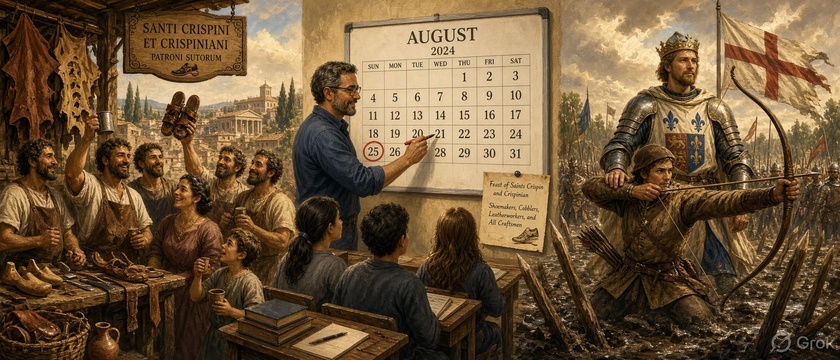
On the morning of 25 October (Saint Crispin’s Day):
- An initial French cavalry charge against the English archers largely failed. The muddy ground slowed the horses, the stakes disrupted the charge, and longbow volleys caused heavy losses.
- The main French force of dismounted men-at-arms advanced across the mud in dense formations. Their heavy plate armour exhausted them; many sank into the mud. As the front ranks were stopped or killed, those behind pressed forward, creating a deadly crush in which men fell and were trampled.
- English longbow fire continued to disrupt the French approach. When the French reached the English line, the lightly armoured archers joined the melee with swords, mallets, and other weapons, attacking the flanks and fallen men.
- Henry himself fought in the hand-to-hand fighting. At one point, fearing a renewed French attack or a breakout by prisoners, he ordered the killing of many captives (a controversial act that violated normal chivalric practice).
The French third line largely did not engage or withdrew. The battle lasted a few hours and ended in a complete English victory.
Result and aftermath
Immediate outcome: English losses were light—commonly estimated at a few hundred (at least 112 named dead in some records, with higher contemporary figures around 400–600). French losses were catastrophic: roughly 6,000–10,000 dead (many of them nobles), plus hundreds to over a thousand high-ranking prisoners. Among the French dead were the Constable Charles d’Albret, the Dukes of Alençon, Bar, and Brabant, and numerous counts and bannerets. Prominent prisoners included Charles, Duke of Orléans (held for 25 years), the Duke of Bourbon, and Marshal Boucicaut.
The English reached Calais a few days later. Henry returned to England in November and was received as a hero. The victory greatly strengthened the legitimacy of the Lancastrian dynasty and Henry’s personal prestige.
Longer-term consequences: The destruction of much of the French military and political leadership (especially the Armagnac faction) left France weakened and divided. It facilitated Henry’s later campaigns, the conquest of Normandy (1417–19), and the Treaty of Troyes (1420), under which Henry married Catherine of Valois and was recognised as heir and regent of France. English dominance in northern France lasted until the appearance of Joan of Arc and the lifting of the Siege of Orléans in 1429. Henry himself died in 1422 during the Siege of Meaux; his infant son became Henry VI.
Significant figures
English
- Henry V: Commander and active participant in the fighting. The battle cemented his reputation.
- Edward, Duke of York: Commanded part of the English centre; killed in the battle.
- Michael de la Pole, Earl of Suffolk: Young earl killed (his father had died of dysentery at Harfleur).
- Humphrey, Duke of Gloucester and Thomas, Duke of Clarence: Henry’s brothers; prominent in the campaign (Clarence at Harfleur).
- Sir Thomas Erpingham: Experienced knight often associated with the archers.
- Dafydd Gam: Welsh captain killed in the fighting.
French
- Charles d’Albret (Constable of France): Senior commander; killed.
- Marshal Boucicaut (Jean II le Meingre): Experienced soldier who favoured a more cautious strategy; captured and died in English captivity.
- Charles, Duke of Orléans: Nephew of King Charles VI; captured and held for decades.
- Dukes of Alençon, Bar, and Brabant: All killed.
- King Charles VI: Absent due to mental illness; did not command.
The battle is most famous in English culture through Shakespeare’s Henry V (“We few, we happy few, we band of brothers…”), which dramatises the Saint Crispin’s Day speech and the victory.
= October 25th
October 25 (traditionally linked to the feast of Saints Crispin and Crispinian, and notably Saint Crispin’s Day) is associated with several significant historical events.
Saints Crispin and Crispinian (285/286)
Saints Crispin and Crispinian were early Christian martyrs (traditionally said to be brothers from a noble Roman family) who worked as shoemakers while preaching in Soissons (Gaul). According to legend, during the Diocletianic Persecution they were tortured under the governor Rictius (or Rictiovarus) Varus—including being stretched on the rack, having strips of flesh cut, and awls driven under their nails—then thrown into the river Aisne with millstones around their necks. They miraculously survived drowning and fire before being beheaded on the orders of co-emperor Maximian (or Diocletian). Their feast day is 25 October. They became the patron saints of shoemakers, cobblers, curriers, tanners, leather workers, and related trades. Their story is largely legendary (with some historians noting inconsistencies with the timeline of persecutions in Gaul), but they were widely venerated in medieval Europe, especially by craft guilds. The date is also famous in English culture because of the Battle of Agincourt.
Emperor Leo I acclaims Leo II as Caesar (473)
On or around this date in 473, Eastern Roman (Byzantine) Emperor Leo I elevated his young grandson Leo II (son of the Isaurian general Zeno and Leo I’s daughter Ariadne) to the rank of Caesar, marking him as heir. Leo II was later promoted to co-emperor (Augustus) in November 473 and briefly ruled as sole emperor after Leo I’s death in January 474 before dying himself later that year (age about 7). Chronological details of his elevation to Caesar vary slightly in sources (some place aspects in 472 or link them to other events), but the traditional association is with October 473.
Second Crusade events (1147)
- Battle of Dorylaeum: In late October 1147 (intensifying around 25 October), the German contingent of the Second Crusade under Conrad III of Germany was defeated by Seljuk Turkish forces under Sultan Mesud I near Dorylaeum (modern Eskişehir, Turkey). After advancing beyond Dorylaeum, the German army faced repeated Turkish attacks during a retreat that turned into a rout. Conrad was wounded by arrows, and the Germans suffered heavy losses (contemporary claims of catastrophic percentages are exaggerated, but the force was badly mauled and largely unable to continue). This was a major early setback for the Second Crusade.
- Siege of Lisbon: After a four-month siege (beginning 1 July), crusader forces from England, Flanders, the Rhineland and elsewhere, allied with King Afonso Henriques of Portugal, forced the surrender of Lisbon from its Almoravid (Muslim) rulers. The city formally fell around 24–25 October 1147. This was one of the few lasting Christian successes of the broader Second Crusade period and a major step in the Portuguese Reconquista, securing the Tagus and helping establish Portugal’s strategic position.
Battle of Agincourt (1415)
On Saint Crispin’s Day, 25 October 1415, during the Hundred Years’ War, the English army under Henry V (roughly 6,000–9,000 men, including a large proportion of longbowmen and relatively lightly armoured infantry) decisively defeated a much larger French force (estimates commonly 12,000–20,000+ men-at-arms and others, with heavy cavalry) near Agincourt (Azincourt) in northern France. The muddy, narrow field, French tactical errors (including a frontal assault by heavily armoured knights), and the effectiveness of the English longbow led to a crushing English victory with relatively light English casualties and very heavy French losses among the nobility. The battle is immortalised in Shakespeare’s Henry V (“We few, we happy few, we band of brothers…”).
Dirk Hartog landfall in Australia (1616)
On 25 October 1616, Dutch East India Company (VOC) captain Dirk Hartog, commanding the ship Eendracht, made landfall on an uninhabited island off the west coast of Australia (now Dirk Hartog Island in Shark Bay, Western Australia). This was the second recorded European landing on the Australian continent (after Willem Janszoon in 1606) and the first on the western coast. Hartog left a flattened pewter plate inscribed with details of the visit nailed to a post at Cape Inscription—the oldest physical European artefact from Australia. He charted part of the western coastline (naming the region Eendrachtsland after his ship) before continuing to Batavia.
Second Battle of Cape Finisterre (1747)
On 25 October 1747 (14 October Old Style / Julian calendar then used in Britain), during the War of the Austrian Succession, a British fleet of 14 ships of the line under Rear-Admiral Edward Hawke intercepted and defeated a French convoy of ~250 merchant ships protected by 8 ships of the line under Henri-François des Herbiers. The British captured six French warships and thousands of seamen (with only a handful of merchant ships taken). The victory severely disrupted French Atlantic commerce and colonial supply for the remainder of the war.
Accession of George III (1760)
On 25 October 1760, George II died suddenly (of aortic dissection) at Kensington Palace. His grandson, George III (George William Frederick, born 1738 in England—the first Hanoverian king born in Britain and whose first language was English), succeeded as King of Great Britain and Ireland and Elector of Hanover. George III reigned until 1820, a period that included the end of the Seven Years’ War, the American Revolution, and the Napoleonic Wars.
These events illustrate how 25 October has been a date of martyrdom, imperial succession, crusading campaigns, decisive battles, early European contact with Australia, naval warfare, and a British royal succession.