


Lest we forget
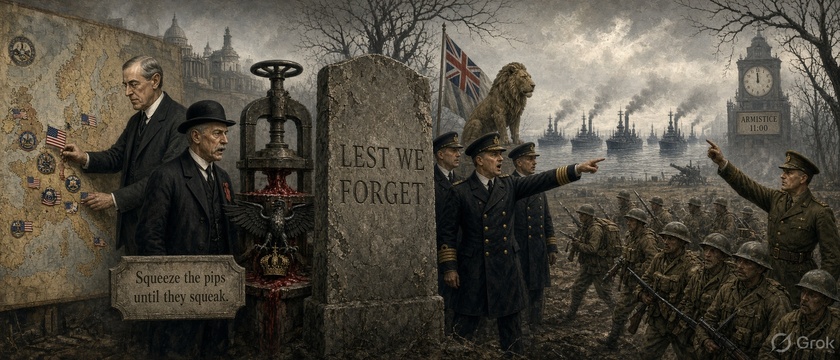
The Armistice of 11 November 1918 (also called the Armistice of Compiègne) ended active fighting in World War I on the Western Front. It was signed in the early morning of 11 November 1918 in railway carriage 2419D (a converted dining car belonging to the Compagnie des Wagons-Lits) in a siding in the Forest of Compiègne near Rethondes, France. The document was signed around 5:00–5:15 a.m.; hostilities ceased at 11:00 a.m. Paris time—the “eleventh hour of the eleventh day of the eleventh month.”
Significant figures
Allied side (military representatives only; no political leaders were present):
- Marshal Ferdinand Foch — Allied Supreme Commander and principal signatory. He dictated the terms and refused substantive negotiation.
- Admiral Sir Rosslyn Wemyss — British First Sea Lord and co-signatory.
- General Maxime Weygand — Foch’s chief of staff.
- Also present: Admiral Sir George Hope, Captain Jack Marriott (British naval aide), and interpreters.
German side (deliberately led by a civilian):
- Matthias Erzberger — Centre Party politician, State Secretary, and head of the German delegation; principal signatory. The German High Command (Paul von Hindenburg and Erich Ludendorff) insisted on a civilian lead so the military could later disclaim responsibility for the defeat.
- Count Alfred von Oberndorff — Foreign Ministry representative.
- Major General Detlof von Winterfeldt — Army representative.
- Captain Ernst Vanselow — Navy representative.
- Two interpreters accompanied them.
Foch’s famous opening exchange set the tone: when Erzberger said the Germans had come to hear Allied proposals, Foch replied that he had none to make—they must request an armistice. The Germans were given little time and essentially presented with terms to accept or reject.
Before the armistice
By late summer 1918 the German Spring Offensive had failed and the Allied Hundred Days Offensive was driving the German army backward. Germany’s allies were collapsing (Bulgaria, the Ottoman Empire, and Austria-Hungary sought or accepted armistices in September–October).
In early October the new German government under Prince Max of Baden asked for an armistice on the basis of U.S. President Woodrow Wilson’s Fourteen Points. Wilson’s replies made clear that the Allies would impose their own military conditions. Naval mutinies began at Kiel on 3 November and spread; revolution broke out in cities across Germany. On 9 November the Kaiser abdicated, the Weimar Republic was proclaimed in Berlin, and the German government authorized Erzberger’s delegation to sign whatever was necessary to stop the fighting. The military leadership had already concluded the war was lost but wanted civilians to bear the political cost.
Terms and immediate aftermath
The armistice was harsh and effectively a military surrender. It required:
- Immediate cessation of hostilities.
- German withdrawal from occupied territories in France, Belgium, Luxembourg, and Alsace-Lorraine within 15 days.
- Evacuation of the left bank of the Rhine and Allied occupation of bridgeheads.
- Surrender of large quantities of artillery, machine guns, aircraft, locomotives, and rolling stock.
- Internment or surrender of the High Seas Fleet and U-boats.
- Annulment of the Treaty of Brest-Litovsk with Russia.
- Continuation of the naval blockade.
Fighting stopped at 11 a.m. on 11 November, ending more than four years of industrial-scale slaughter (roughly 16–20 million dead overall). The armistice was repeatedly extended while the Paris Peace Conference drafted the Treaty of Versailles (signed 28 June 1919), which formalized territorial losses, massive reparations, the “war guilt” clause, and severe limits on the German military.
Longer-term consequences
In Germany the armistice and Versailles fueled the “stab-in-the-back” myth (Dolchstoßlegende): the claim that the undefeated army had been betrayed by civilians, socialists, and Jews at home. Erzberger, as the most visible signatory, became a prime target of right-wing propaganda. He was assassinated by nationalist extremists in the Black Forest on 26 August 1921.
The railway carriage itself became a symbol. After the war it was displayed in Paris, then returned to a specially built memorial building in the Compiègne clearing. In June 1940 Adolf Hitler deliberately used the same carriage, placed on the exact spot of 1918, for the French surrender after the Battle of France—an act of revenge. The original carriage was later taken to Germany and destroyed in 1945; a near-identical carriage of the same series (2439D, renumbered) now stands in the restored Glade of the Armistice (Clairière de l’Armistice).
11 November is observed as Armistice Day, Remembrance Day, or Veterans Day in many countries, commemorating the end of the Great War and those who died in it. The event closed one catastrophic war while planting seeds of the next through humiliation, economic strain, and political mythology.
= November 11th
These events cluster around November 11 (St. Martin’s Day in the traditional calendar), not November 9. The list you provided draws from sources that often group them under or near that date. Here’s a concise overview of each, with the corrected or confirmed dates and key context.Wikipedia
308 – Conference of Carnuntum (November 11)
At Carnuntum (modern Petronell-Carnuntum, Austria, on the Danube in the Roman province of Pannonia Prima), retired Emperor Diocletian, Galerius (Augustus of the East), and Maximian (the recently returned former Western Augustus) met to stabilize the collapsing Tetrarchy amid civil wars.
They forced Maximian to abdicate permanently, declared Maxentius (Maximian’s son, controlling Italy) a usurper, elevated Galerius’s officer Licinius as the new Western Augustus (tasked with dealing with Maxentius), and relegated Constantine (already powerful in Gaul/Britain) back to Caesar. The arrangement was inconclusive; civil wars continued, paving the way for Constantine’s eventual dominance. An altar to Mithras set up by the participants is a noted historical source. The site’s ruins and reconstructed buildings are a major archaeological park today.Wikipedia
1100 – Henry I of England marries Matilda of Scotland (November 11)
Henry I (who had seized the throne after his brother William Rufus’s death in the New Forest in August 1100) married Matilda (born Edith), daughter of Malcolm III of Scotland and St. Margaret, and a direct descendant of the Saxon king Edmund Ironside. The wedding and her coronation took place at Westminster Abbey, performed by Archbishop Anselm of Canterbury.
This union linked the Norman and Anglo-Saxon royal lines, strengthening Henry’s legitimacy among the English population. Matilda (renamed from Edith) was a pious, educated, and influential queen; their daughter became the Empress Matilda, whose struggles shaped the later Plantagenet succession.Wikipedia
1215 – Fourth Lateran Council opens (November 11)
Pope Innocent III convened the council (the twelfth ecumenical council, often called the “Great Council”) at the Lateran Palace in Rome. It opened on St. Martin’s Day after extensive preparation (summoned in 1213) and ran through late November, with major sessions on the 11th, 20th, and 30th.
Key outcomes included the formal definition of transubstantiation (the doctrine that the bread and wine of the Eucharist become the body and blood of Christ), reforms of clergy and Church discipline, rules on heresy, requirements for annual confession and Easter communion, measures affecting Jews and Muslims (including distinctive clothing), and a call for a new Crusade. More than 400 bishops, hundreds of abbots, and royal envoys attended—one of the most influential medieval councils.Wikipedia
1500 – Treaty of Granada (November 11)
Louis XII of France and Ferdinand II of Aragon secretly agreed to divide the Kingdom of Naples between them (Louis taking the north including Naples itself; Ferdinand the south). Louis signed earlier at Chambord (around October 10); Ferdinand ratified it at Granada on November 11. Pope Alexander VI approved the partition.
It was part of the Italian Wars and collapsed into renewed conflict by 1503–1504, after which Spain ultimately secured Naples.Wikipedia
1620 – Mayflower Compact signed (November 11 Old Style / November 21 New Style)
While anchored in what is now Provincetown Harbor near Cape Cod (blown off course from their intended Virginia destination), 41 adult male passengers of the Mayflower—including Separatist “Pilgrims” and others (“Strangers”)—signed an agreement forming a “civil body politic” and pledging to enact just and equal laws for the colony.
It was the first written framework for self-government in the territory that became the United States, based on consent of the governed and majority rule. It remained in effect until Plymouth Colony merged into Massachusetts Bay in 1691.Wikipedia
1634 – Irish Act for the Punishment of the Vice of Buggery (November 11)
Following pressure from Anglican Bishop John Atherton (who realized the English Buggery Act of 1533 did not apply in Ireland), the Irish House of Commons passed “An Act for the Punishment for the Vice of Buggery.” It made the offense a capital felony, mirroring English law.
In a grim irony, Atherton himself was later tried and hanged under this law in 1640 (along with his steward John Childe) on charges of buggery.Historicaltoursireland.wordpress
1673 – Second Battle of Khotyn (November 11)
Polish–Lithuanian Commonwealth forces under Grand Hetman Jan (John) Sobieski defeated an Ottoman army under Hüseyin Pasha near the fortress of Khotyn (in present-day Ukraine). Commonwealth forces numbered roughly 29,000–30,000; the Ottomans about 35,000.
The victory reversed the unfavorable Peace of Buchach from the previous year, boosted Sobieski’s prestige (helping him win the Polish crown in 1674), and foreshadowed his later role at the Battle of Vienna (1683). Contemporary accounts note the successful use of rockets developed by Kazimierz Siemienowicz.Wikipedia
1675 – Leibniz demonstrates integral calculus (November 11)
Gottfried Wilhelm Leibniz, working in Paris, first demonstrated the use of integral calculus to find the area under the curve of y=f(x)y = f(x)y=f(x). In his private notebooks around this period (including late October), he introduced the elongated integral sign ∫\int∫ (from Latin summa) and related differential notation (dxdxdx, dydydy).
He developed calculus independently of (and nearly simultaneously with) Isaac Newton; Leibniz’s notation became the standard one still used today. He published key results in the 1680s.Mathshistory.st-andrews
1724 – Joseph “Blueskin” Blake hanged (November 11)
The London highwayman and housebreaker Joseph Blake (alias Blueskin), known for his dark complexion and for attacking “Thief-Taker General” Jonathan Wild with a knife at the Old Bailey (slashing Wild’s throat during or after his trial), was hanged at Tyburn. He was about 24.
Blake had worked with and then against Wild and was associated with the famous jailbreaker Jack Sheppard (hanged five days later). He stopped for strong drink on the way to the gallows and was reportedly unsteady on the scaffold.Wikipedia
1750 – Lhasa riots (began November 11)
Riots broke out in Lhasa after Qing ambans (imperial representatives) assassinated the expected Tibetan regent Gyurme Namgyal. The mob killed both ambans, dozens of Qing soldiers, and Chinese civilians. The uprising was short-lived; order was restored under the Dalai Lama’s influence within days, and Qing control over Tibet was later tightened.Wikipedia
1750 – Flat Hat Club (F.H.C. Society) formed (November 11)
The F.H.C. Society (later nicknamed the Flat Hat Club) was founded at the College of William & Mary in Williamsburg, Virginia (often linked to meetings at Raleigh Tavern). It is recognized as the first collegiate secret society / fraternity in what became the United States.
Membership was limited (initially to a small number of students); it emphasized friendship, discussion, and fellowship. Notable members included Thomas Jefferson. It faded in the Revolutionary era but inspired later societies (including influences on Phi Beta Kappa, founded at the same college in 1776). A silver membership medal survives in collections.Wikipedia
1778 – Cherry Valley massacre (November 11)
During the American Revolutionary War, a force of Loyalists (Butler’s Rangers), British troops, and Seneca (and other Iroquois) warriors under Walter Butler and Joseph Brant attacked the fort and settlement at Cherry Valley in eastern New York.
Despite warnings, the American commander (Col. Ichabod Alden) was poorly prepared (headquarters outside the fort). More than 40 soldiers and civilians were killed (including Alden); dozens were taken captive. Seneca warriors in particular targeted non-combatants. The raid contributed to the Continental Congress ordering the 1779 Sullivan Expedition against Iroquois villages.Archive
These events span Roman imperial politics, medieval church and monarchy, early modern diplomacy and mathematics, colonial self-government, and frontier warfare. Several are tied to November 11 specifically because of the liturgical calendar or simply coincidence in the historical record. If you’d like deeper detail, primary-source excerpts, maps, or images on any particular one, just say which.