


VoiceDDB
Politics • Culture • News
oDDBall analysis of conservative politics with a libertarian economic conservative twist. Small government, big freedom.
Interested? Want to learn more about the community?
October 09, 2021
On tthis day 9th Oct 2013

Who represents the struggler? Who would give the average person a better deal? Who cares enough to exercise the kind of judgement that benefits the most? What kind of character are they? Obama, a wealthy leftist who identifies with thugs and pardons terrorists for 'peace' wants to spend more money without hiring one doctor to 'secure' the health of ten million desperately poor people. Abbott, a conservative who identifies with families and workers. Who supports people in their hour of need. Who is gracious without being obsequious, kind and generous without being a pushover. That same Mr Abbott is paid too much according to those upset with his expenses claims. Meanwhile Obama cools his heels with a game of Golf while strugglers get nothing.

Obama has failed to negotiate or conciliate with the conservatives on any issue. His community organising seems rusty. Obama leans towards socialism. Abbott leans towards capitalism.

One gets it the press doesn't like Abbott, but even so, it is wrong of the press to lie about Abbott's relationship with Putin. Why should left wing authors get paid government grants denied conservatives? If one believes in balance, the Melbourne Writer's festival is pretty bad. Kuwait is watching you. Egypt is watching her navel. Journalists struggle to explain why Abbott is excelling.

post photo preview
Interested? Want to learn more about the community?
What else you may like…
Videos
Posts
Articles
00:01:07
November 27, 2022
Jingle Bell Rock

Jingle bell, jingle bell, jingle bell rock
Jingle bells swing and jingle bells ring
Snowin' and blowin' up bushels of fun
Now the jingle hop has begun

Jingle bell, jingle bell, jingle bell rock
Jingle bells chime in jingle bell time
Dancin' and prancin' in Jingle Bell Square
In the frosty air

What a bright time, it's the right time
To rock the night away
Jingle bell time is a swell time
To go glidin' in a one-horse sleigh

Giddy-up jingle horse, pick up your feet
Jingle around the clock
Mix and a-mingle in the jinglin' feet
That's the jingle bell rock

Jingle bell, jingle bell, jingle bell rock
Jingle bell chime in jingle bell time
Dancin' and prancin' in Jingle Bell Square
In the frosty air

What a bright time, it's the right time
To rock the night away
Jingle bell time is a swell time
To go glidin' in a one-horse sleigh

Giddy-up jingle horse, pick up your feet
Jingle around the clock
Mix and a-mingle in the jinglin' feet
That's the jingle bell
That's the jingle...

00:02:04
September 01, 2021
Intro to Locals for the Conservative Voice

David Daniel Ball calls himself the Conservative Voice.

I'm a teacher with three decades experience teaching math to high school kids.I also work with first graders and kids in between first grade and high school. I know the legends of why Hypatia's dad is remembered through his contribution to Math theory. And I know the legend of why followers of Godel had thought he had disproved God's existence.

I'm not a preacher, but I am a Christian who has written over 28 books all of which include some reference to my faith. Twelve blog books on world history and current affairs, detailing world events , births and marriages on each day of the year, organised by month. Twelve books on the background to and history of Bible Quotes. One Bible quote per day for a year. An intro to a science fiction series I'm planning, post apocalyptic cyber punk. An autobiography with short story collections.

I'm known in Australia for my failure as a whistleblower over the negligence death of a school boy. ...

00:01:50
September 04, 2026
Should violent criminals be made fat? Grok says 'no'

No. Transferring gut bacteria from an obese person into a violent criminal is not a reliable, ethical, or effective way to make them “fat, sedentary, and less of a physical threat.”

The science does not deliver the outcome you want

Mouse studies in germ-free animals showed that microbiota from obese donors can increase energy harvest and adiposity compared with lean-donor microbiota. That is the origin of the idea. Human evidence is far weaker.

Randomized trials of fecal microbiota transplant (FMT) from lean donors into people with obesity have generally failed to produce meaningful, sustained weight loss. Microbiome composition can change; body weight and metabolic markers often do not, or the effects are small and inconsistent. Diet and the existing gut environment usually dominate. A 2025 Nature paper found diet outperformed microbial transplant for microbiome recovery. Human guts are already colonized, not sterile like lab mice, so engraftment is variable and effects unpredictable.

It is not a ...

post photo preview
August 28, 2026
Pfizer struggles to answer

Some in Australia are brilliant. Malcolm Roberts Investigates Pfizer over Covid vaccine.

Holiday break is over back to work tonight

Tonight I'll start double posting until I've caught up.

post photo preview
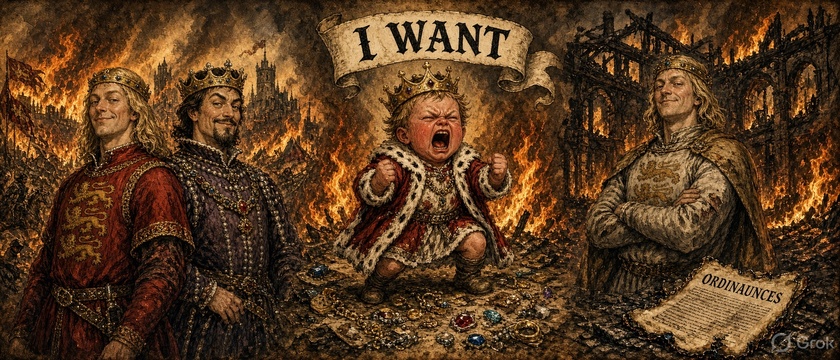
Ordinances of 1311, Edward II
On Oct 11th, a failed king was hobbled

Ordinances of 1311, Edward II 

On Oct 11th, a failed king was hobbled

The Ordinances of 1311 were the barons’ attempt to put Edward II back inside the cage his grandfather and great-uncle had already built: a king who ruled with counsel, spent through the Exchequer, and did not hand the realm to a favourite. Edward signed them because he had no army and no money. He never accepted them, and the fight over them ran until Thomas of Lancaster’s head came off at Pontefract in 1322.

What came before

Edward I died at Burgh-on-Sands on 7 July 1307, still marching against Robert Bruce. His son recalled Piers Gaveston at once. Edward I had already banished the Gascon from England earlier that year, after a quarrel in which Gaveston and the young prince had been too conspicuous. Within weeks of the accession Gaveston was Earl of Cornwall, a title normally kept for royal kin, and married to Margaret de Clare, the king’s niece.

The grievance was older than Gaveston. Edward I had left a kingdom taxed hard for Wales, Gascony and Scotland, with prise and purveyance — the compulsory purchase of food and carts for the household and the army — widely hated. The magnates also had a constitutional memory. The Provisions of Oxford in 1258, and Simon de Montfort’s brief regime, had already tried to put royal appointments and the household under baronial supervision. At the coronation in February 1308 a new clause was added to the oath: the king was to uphold the laws and customs which the community of the realm would choose. The Ordainers later treated that as their warrant.

Gaveston made the abstract complaint personal. He was given the late king’s jewels, dominated tournaments, and nicknamed the earls — Warwick was “the black dog of Arden.” In 1308 the earls forced a second exile. Edward sent him to Ireland as lieutenant, which looked like promotion, and brought him back in 1309. By February 1310 the earls of Lancaster, Warwick, Hereford and Pembroke were accusing the king in parliament of wasting his inheritance and ruining the kingdom. On 16 March 1310 Edward agreed to a commission of twenty-one: eight earls, seven bishops and six barons, to ordain for the reform of realm and household, their work to be finished by Michaelmas 1312. Those were the Lords Ordainers.

Henry de Lacy, Earl of Lincoln, was the senior and the brake. He died in February 1311. His estates and the leadership passed to his son-in-law, Thomas of Lancaster. Lancaster was the king’s first cousin, holder in time of the earldoms of Lancaster, Leicester, Lincoln and Salisbury, and the richest subject in England. He was also rigid, absentee, and convinced the ordinances were a permanent constitution.

The ordinances themselves

Edward spent the winter of 1310–11 on a useless Scottish campaign. He met the Ordainers at Westminster in August 1311. About forty-one articles were presented; he sealed them under pressure in late September and early October. Publication is conventionally dated 11 October. Gaveston was to be out of every land of the king by All Saints, 1 November, on pain of being treated as a public enemy.

The rest was a programme, not a single grudge. Gifts made since the appointment of the Ordainers were revoked. The king was not to leave the realm or make war without baronial assent. Great offices — chancellor, treasurer, chief justices, household steward, keeper of the wardrobe — needed baronial approval, and the holders had to swear to the ordinances. Revenue was to pass through the Exchequer, not the wardrobe. Prise was restricted. Foreign merchants and royal bankers, especially the Italian firms, were targets. Parliament was to meet at least once a year, and a baronial committee was to hear complaints against royal servants. Customs were not to be levied without consent. It looked back to 1258 more than it looked forward.

The people who mattered

Edward II was not a fool, but he was stubborn, loyal to his own household, and bored by the business his father had lived for. He would not sacrifice a friend to keep a council.

Piers Gaveston, a Gascon knight’s son raised in Edward I’s household, was brave, extravagant and unable to stop scoring points. The sexual rumour is medieval as well as modern; what the ordinances actually charge is that he drew royal power to himself, sent treasure out of the realm, and estranged the king from his liege men. He had already been exiled twice.

Thomas of Lancaster became the ordinances’ embodiment. After 1314 he often refused to attend council unless the ordinances were enforced word for word, and he governed badly when he had the chance.

Guy Beauchamp, Earl of Warwick, was the hard edge. He seized Gaveston and saw the execution through.

Aymer de Valence, Earl of Pembroke, was the moderate who broke. He took Gaveston under safe conduct in 1312; Warwick kidnapped the prisoner. Pembroke treated that as an attack on his honour and spent the rest of his life trying to hold a middle line between king and Lancaster.

Humphrey de Bohun, Earl of Hereford, Edward’s brother-in-law, stood with the Ordainers, then died at Boroughbridge fighting the king.

Gilbert de Clare, Earl of Gloucester, the greatest Marcher and Gaveston’s brother-in-law, was killed at Bannockburn in 1314. His death removed the last great earl who might have balanced Lancaster.

Robert Winchelsey, Archbishop of Canterbury, gave the programme its clerical cover until his death in 1313. Walter Langton, Edward I’s treasurer and Edward II’s enemy, was an early victim of the new reign and a symbol of the household the barons wanted back under control.

What followed

Gaveston left, then returned around Christmas 1311. In May 1312 he was besieged in Scarborough and surrendered to Pembroke on terms. Warwick took him at Deddington. On 19 June, on Lancaster’s land at Blacklow Hill, two Welshmen ran him through and cut off his head. A form of trial was staged on the ground that he had broken the ordinances. Edward never forgave it. The body lay embalmed until burial at the Dominican house at Kings Langley in 1315.

Pardons were patched up in 1313. Then Bannockburn, 24 June 1314, destroyed the king’s remaining authority. Lancaster dominated the next four years. Scottish raids reached Yorkshire, the Great Famine bit in 1315–17, and Lancaster’s insistence on the letter of the ordinances produced stalemate rather than government. The Treaty of Leake in 1318, brokered by Pembroke and a group later called the Middle Party, put a standing council around the king and papered over the split.

Edward then acquired a new favourite, Hugh Despenser the Younger, with his father beside him. The Despensers grabbed Marcher lands. In 1321 Lancaster, Hereford and the Marchers forced the pair into exile. Edward struck back that winter, recalled them, and broke the opposition at Boroughbridge on 16 March 1322. Hereford was killed; Lancaster was taken and beheaded at Pontefract on 22 March.

In May 1322 the parliament at York repealed the ordinances by the Statute of York. The statute drew a distinction the Ordainers had refused: things touching the king and the realm needed the assent of king, prelates, earls, barons and the community of the realm in parliament, not a baronial committee appointed over the king’s head. Edward then ruled through the Despensers with executions, confiscations and forced loans. That regime lasted until Isabella and Roger Mortimer landed in 1326. Edward was deposed in January 1327 and killed at Berkeley in September.

The ordinances failed as a constitution. They were imposed, not agreed, and Lancaster could not govern through them. What survived was the claim that custom, parliament and the community could bind a king — the same claim that reappeared, in different language, against Edward’s great-grandson.

= October 11th

These are the events of 11 October, running from a medieval earthquake to a North Sea fleet action.

1138 — Aleppo earthquake. A shock, often rated around magnitude 7.1, struck northern Syria on 11 October, after a foreshock the day before. Contemporary chroniclers, including Ibn al-Qalanisi in Damascus, describe damage across Aleppo, the Crusader citadel at Harem, and country toward Edessa and Antioch. The often-quoted toll of about 230,000 dead comes from the fifteenth-century historian Ibn Taghribirdi and is now treated as a conflation of this quake with events in 1137 and the Ganja earthquake of 1139. Aleppo itself was partly emptied by the foreshock; the countryside and smaller forts took the worst of it. Aftershocks continued into early November.

1142 — Treaty of Shaoxing. During the Jin–Song wars a Jin envoy appeared at the Southern Song court and the peace was formally ratified. The Song emperor accepted vassal status, annual tribute of silver and silk, and a frontier roughly along the Huai River. North China stayed with the Jurchen Jin; the Song kept the south. The arrangement held, with interruptions, for most of the rest of the century.

1311 — Ordinances of 1311. The Lords Ordainers, a committee of peers and clergy forced on Edward II after the baronial crisis of 1310, published a set of regulations that stripped the king of much of his freedom to appoint, spend, and make war. Piers Gaveston was to be exiled again. Edward accepted the ordinances under pressure and spent the next decade trying to undo them. He succeeded in 1322, after Boroughbridge.

1531 — Death of Huldrych Zwingli. At the Second Battle of Kappel the Catholic forest cantons broke the Zurich force. Zwingli, who had gone out with the army as chaplain, was killed, aged 47. His body was quartered and burned. Zurich’s Reformation survived him, but the Swiss confederation stayed split between Catholic and Reformed cantons.

1582 — A day that did not exist. When the Gregorian reform was adopted, Thursday 4 October was followed by Friday 15 October in Italy, Poland, Portugal and Spain. The ten days from 5 to 14 October, including the 11th, were simply omitted. England did not make the change until 1752.

1614 — New Netherland Company. Adriaen Block, just back from charting the coast between the Hudson and Cape Cod (and giving his name to Block Island), joined twelve Amsterdam merchants in petitioning the States General for a monopoly on trade between the 40th and 45th parallels. They were granted three years. The name “New Netherland” on Block’s map is the first known use of it for that coast.

1634 — Burchardi flood. On the night of 11–12 October a North Sea storm tide, the second Grote Mandrenke, overran neglected dikes in North Frisia, Dithmarschen and south-west Jutland. Estimates run from 8,000 to 15,000 dead. The island of Strand was largely destroyed; what remained became Nordstrand, Pellworm and a scatter of halligen. On Strand alone more than 6,000 people and about 50,000 cattle were lost, and 17 of 21 churches were wiped out.

1649 — Sack of Wexford. After a siege from 2 October, Cromwell’s New Model Army stormed Wexford on the 11th when a castle captain opened a gate during talks. Roughly 1,500 to 2,000 soldiers and civilians were killed, several hundred of them drowned trying to cross the Slaney; about 3,000 were taken. Parliamentarian losses were about twenty. Cromwell reported it to London as judgement for 1641 and for the privateers who had used the harbour, and regretted mainly that the town was too wrecked for winter quarters. The port and its ships were lost to the Confederate–Royalist cause.

1727 — Coronation of George II. George II and Caroline of Ansbach were crowned at Westminster Abbey. Handel’s coronation anthems, including Zadok the Priest, were written for the day. George had been Prince of Wales in open feud with his father; Caroline remained the sharper political partner until her death in 1737.

1767 — Mason–Dixon line. Charles Mason and Jeremiah Dixon finished the survey that settled the Maryland–Pennsylvania boundary, begun in 1763 after decades of dispute between the Calvert and Penn proprietors. The line later became the symbolic divide between slave and free states, which is not what the two English surveyors were hired to draw.

1776 — Battle of Valcour Island. On Lake Champlain, Benedict Arnold’s scratch fleet of gunboats and gundalows fought Guy Carleton’s squadron in the narrows west of Valcour Island. The Americans were beaten: most of the vessels were taken or burned, and about 200 men were lost against roughly 40 British. Arnold slipped the survivors past the British that night. The delay kept Carleton from pushing down toward the Hudson before winter, and the 1777 campaign opened instead with Burgoyne — and Saratoga.

1797 — Battle of Camperdown. Admiral Adam Duncan caught the Batavian fleet under Jan Willem de Winter off Kamperduin on the Dutch coast. Duncan broke the line in two divisions. Eleven Dutch ships were taken, none British lost; Dutch casualties were about 540 killed and nearly 3,800 captured, British about 200 killed and 600 wounded. De Winter offered his sword aboard Venerable; Duncan refused it and shook his hand. A sailor, Jack Crawford, nailed the fallen admiral’s flag back to the mast under fire and became “the Hero of Camperdown.” It was the sharpest Anglo-Dutch fleet action since the seventeenth century, and it ended the threat of a Dutch sortie in support of a French invasion.


Read full Article
post photo preview
680 — Karbala.
October 10th

680 — Karbala.

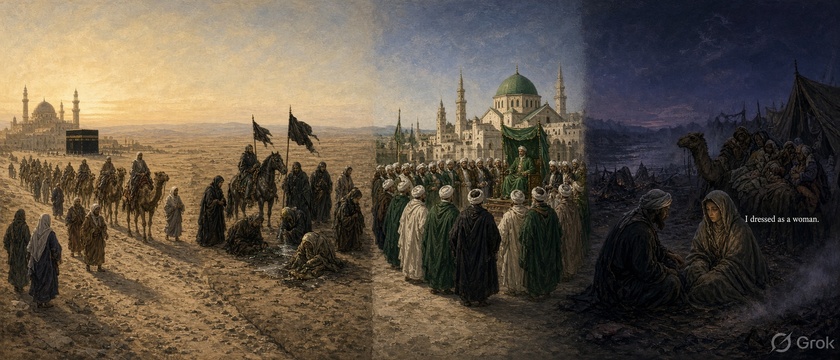
The fight ran in this order. The seventy were with Husayn. They were not the army sent against him.

Husayn had already left Mecca in early September 680, after his envoy Muslim ibn Aqil had been executed in Kufa. On the road a screen of about a thousand horse under al-Hurr ibn Yazid stopped him. Al-Hurr would not let him into Kufa and would not let him turn back to the Hijaz. The two parties moved together until 2 Muharram (2 October), when the column was halted on the open plain of Karbala, west of the Euphrates.

Umar ibn Sa’d arrived with the main force, several thousand, under orders from Ubayd Allah ibn Ziyad: take the oath on the spot, or fight. From 7 Muharram the horse were posted between the tents and the river. One small party got water through. After that the channel was closed.

On 9 Muharram Shimr ibn Dhi al-Jawshan brought Ibn Ziyad’s final order: submission at once, or attack, and Umar ibn Sa’d himself answerable if he delayed. Husayn asked for the night. He told his men they were free to leave under cover of dark. The early report is that none of the fighting men went. That is the seventy or so: relatives, clients, and a few who had joined him, inside his camp, not facing him.

At dawn on 10 Muharram both sides prayed. Al-Hurr, the commander who had first blocked the road, crossed over and was killed on Husayn’s side. Talks ended. Umar ibn Sa’d’s line advanced. Husayn’s men went out in small groups and were cut down. By afternoon the companions were dead, then several of the family, including sons and nephews. Abbas ibn Ali was killed trying to reach the water. Husayn, already wounded, was finished in the open and beheaded. The camp was looted and the tents burned. The women and children were taken, with Ali Zayn al-Abidin, who had been too ill to fight.

Umar ibn Sa’d buried his own dead. Husayn and his men were left until local tribesmen interred them. The heads and the captives went first to Kufa, to Ibn Ziyad, and then to Yazid in Damascus.

=

Karbala was not a battle between two armies that chose a field. It was a small household column stopped on open ground, denied the river, and then killed once it would not give the oath Yazid wanted.

Why they were there

Muawiya died in the spring of 680. He had spent twenty years turning a contested governorship of Syria into a hereditary caliphate, and he named his son Yazid to succeed him. Allegiance was taken in Damascus and pressed in the other garrison cities. Husayn ibn Ali, grandson of Muhammad and son of Ali, refused it in Medina, as did Abd Allah ibn al-Zubayr. Both men left for Mecca, where killing was forbidden and a crowd for the pilgrimage could be addressed.

Kufa was the other pole. It had been Ali’s capital, it was full of men who had fought for him at Siffin, and it resented Syrian rule. Letters reached Husayn promising tens of thousands of supporters if he came. He did not go at once. He sent his cousin Muslim ibn Aqil to test the offer. Muslim was at first received openly, then Ubayd Allah ibn Ziyad, already governor of Basra, was given Kufa as well. Ibn Ziyad entered the city, bought or frightened the notables, and had Muslim and his host Hani ibn Urwa executed. The pledged rising collapsed before Husayn left Mecca.

Husayn set out anyway, around 8–9 Dhu al-Hijja 60 (early September 680), with family, a few dozen fighting men, and camp followers — women, children, and retainers. The early account in al-Tabari, drawing on Abu Mikhnaf, puts the armed men at something like seventy by the end, not an army. On the road he met the poet al-Farazdaq, who told him that Kufan hearts were with him and Kufan swords with Ibn Ziyad. He also received news of Muslim’s death. Companions were released from their oaths. Some left. He continued. Turning back meant either the oath to Yazid or the life of a fugitive. Going on meant a garrison city that had already failed his envoy.

Why the ground looked like that

North of Mecca the road toward Kufa runs up the west side of the Euphrates. Husayn’s column was met by a cavalry screen of about a thousand men under al-Hurr ibn Yazid al-Tamimi, sent to shadow him and keep him off the main roads into the city. Al-Hurr would not let him enter Kufa and would not, at first, force a fight. The two parties moved together until, on 2 Muharram (2 October), they were halted on the bare plain of Karbala, west of the river, with no town and no fort.

That placement was deliberate. Ibn Ziyad’s order to his field commander, Umar ibn Sa’d, was to keep Husayn from Kufa, from the river towns, and from any return to the Hijaz, and to demand the oath. Karbala gave the larger force every advantage: open ground for cavalry, no walls, and the Euphrates within reach but easy to seal. Umar ibn Sa’d arrived with the main body, traditionally numbered in the thousands, and put five hundred horse between the camp and the water. A small party got through once and brought back a few skins. After that the channel was closed. From 7 Muharram the camp was on stored water in early October heat.

Umar ibn Sa’d is the awkward figure in the story. He wanted the governorship of Rayy, and Ibn Ziyad made the command against Husayn the price of it. Negotiations ran for days. Husayn’s reported offers were to withdraw to the frontier, to return the way he had come, or to be taken to Yazid in person. Ibn Ziyad, pushed by Shimr ibn Dhi al-Jawshan, rejected anything short of submission on the spot. Shimr arrived with that order and with a threat against Umar ibn Sa’d if he hesitated. On the eve of the fight al-Hurr crossed over to Husayn’s side, an act the early sources record and later telling makes much of.

What happened

The killing itself was on 10 Muharram, 10 October 680. It was not a pitched battle. Umayyad horse and foot surrounded the tents. Husayn’s men fought in small groups and were cut down. By afternoon the companions were dead, then several of the family, including sons and nephews. Accounts name Abbas ibn Ali trying to reach the water and being killed on the channel. Husayn, wounded, was finished in the open. The man credited with the beheading varies by report; Shimr is the name later tradition fixes on. Heads were taken. The camp was looted, tents burned, and the women and children assembled.

Ali Zayn al-Abidin, Husayn’s eldest surviving son, was ill and had not fought. He was spared, and with him the line continued. The bodies of Husayn and his men were left unburied until local tribesmen interred them a day or more later. Umar ibn Sa’d buried his own dead first.

The captives were walked to Kufa. Ibn Ziyad had the heads set out and questioned the prisoners. Zaynab bint Ali, Husayn’s sister, answered him in the scene the Shia tradition treats as the first public indictment of the killing. The column was then sent to Damascus. Yazid received them, and the sources disagree on his manner: some have him striking Husayn’s mouth with a cane as the head was displayed, others have him distancing himself from Ibn Ziyad and releasing the family. Both can be true of a court managing a scandal. The survivors were sent back toward Medina.

Outcomes

In the short run the Umayyads got what they had forced the issue for. No Alid counter-caliph was proclaimed in Kufa. Yazid’s nomination held. The price showed quickly. In 683 Medina rose and was sacked after the Battle of al-Harra. Ibn al-Zubayr held Mecca. Yazid died that same year. His son Muawiya II lasted months. Ibn Ziyad was killed in 686 by Ibrahim ibn al-Ashtar, fighting for Mukhtar al-Thaqafi, who had taken Kufa in the name of vengeance for Husayn and had many of the Karbala commanders hunted down. The Marwanid branch restored the dynasty, but Karbala remained the charge against it.

The lasting outcome was religious, not territorial. For Shia Muslims the day became the founding martyrdom: Ashura, mourning gatherings, and the passion narrative of the tents, the water, the boy Ali al-Asghar, and Zaynab’s protest in Damascus. Husayn’s refusal is read as the stand of the Prophet’s house against a worldly kingship. Sunni historians, including the early ones, generally call the killing a crime and Yazid’s pressure a disaster, without making 10 Muharram a communal rite or treating Husayn as an imam in the Shia sense. The numbers, the speeches, and the named killers hardened in later retellings. The core that the earliest collectors already have is stable: a refused oath, a Kufan invitation that collapsed, a camp stopped short of the river, and a grandson of Muhammad killed by the caliph’s governor.

= October 10th

680 — Karbala. The usual date is 10 October 680 (10 Muharram, AH 61), on the plain of Karbala west of the Euphrates in present-day Iraq. Husayn ibn Ali, grandson of Muhammad and son of Ali, had refused to recognise Yazid I as caliph after Muawiya’s death. He left Mecca with family and a small retinue, expecting support from Kufa. The governor Ubayd Allah ibn Ziyad intercepted him. Husayn’s fighting men numbered about seventy against several thousand under Umar ibn Sa’d. After water was cut off and terms refused, the camp was overrun. Husayn was killed and beheaded; the head was sent to Yazid in Damascus, the bodies were mutilated, and the women and children were taken captive. His sick son Ali Zayn al-Abidin was spared. The fight secured the Umayyad succession for the moment. For Shia Muslims it became the founding martyrdom: Ashura, the tenth of Muharram, is still a day of mourning, processions, and retelling. Sunni tradition also treats Husayn’s death as a wrong, but does not make the day a communal rite in the same way.

732 — Tours (Poitiers). Fought in October 732, most often given as 10 October, somewhere between Poitiers and Tours. Charles Martel, mayor of the palace and effective ruler of the Franks, met an Umayyad army from al-Andalus under Abd al-Rahman al-Ghafiqi. The Muslim force had raided deep into Aquitaine. Charles held a defensive infantry line; Abd al-Rahman was killed, and the raiders withdrew toward the Pyrenees. Later Christian writers, Gibbon among them, cast it as the battle that saved Europe. Modern historians are cooler: it stopped one campaign and strengthened Charles in the south, but Umayyad pressure on the frontier continued for years, and the deeper limit on expansion was overstretch, not a single field. Numbers are guesses. The battlefield has never been fixed.

1471 — Brunkeberg. Again the standard date is 10 October 1471, on the Brunkeberg ridge just north of Stockholm. Sten Sture the Elder, regent of Sweden, faced King Christian I of Denmark, who was trying to restore the Kalmar Union. Sture’s army was built heavily from farmers and miners of the Bergslagen, plus some regulars. Christian had Danish and German troops. Sture caught the king’s force between attacks from west, east, and the city. Christian was shot in the mouth, lost teeth, and was carried to his ships. The victory broke the unionist party for a generation and left Sture as the effective ruler of Sweden. It was as much a Swedish civil fight, unionists against separatists, as a war with Denmark.

1575 — Dormans. On 10 October 1575, during the French Wars of Religion, Henry I, Duke of Guise, beat a Protestant force at Dormans. It was the only clear Catholic success in a bad campaign. Guise took a facial wound that earned him the name le Balafré, “the scarred,” already carried by his father. Among the prisoners was Philippe de Mornay (Duplessis-Mornay), the Huguenot writer and diplomat later called the “Huguenot pope.” He was ransomed cheaply and soon married Charlotte Arbaleste. The skirmish mattered less for ground gained than for Guise’s reputation in Paris, which fed the Catholic League a few years later.

1580 — Dún an Óir. In autumn 1580 a papal expedition of roughly 600 Italian and Spanish troops under Sebastiano di San Giuseppe landed at Smerwick harbour in County Kerry to support the Second Desmond Rebellion. The fort they occupied was Dún an Óir, the Fort of Gold. The landing itself is usually placed in September; the decisive end came in November, when Lord Grey de Wilton and a naval squadron under William Winter besieged the fort. After surrender, the garrison was massacred. The episode hardened English policy in Munster and became a set piece in Irish memory of the Desmond wars.

1582 — the missing days. Pope Gregory XIII’s reform cut ten days from October so that the calendar would match the solar year and Easter would fall correctly. In the papal states, Spain, Portugal, and the Polish–Lithuanian lands that adopted it at once, 4 October 1582 was followed by 15 October. The 5th through the 14th, including the 8th, did not occur. France, the Protestant states, and Britain waited — Britain until 1752 — which is why letters of the period sometimes carry two dates.

1631 — Prague. After the Swedish–Saxon victory at Breitenfeld on 17 September 1631, John George I of Saxony sent an army under Hans Georg von Arnim into Bohemia. Prague was occupied in November 1631, not on 8 October; the city was entered around the middle of that month. The occupation was short. Imperial forces recovered Bohemia the next year, and the Saxon intervention is remembered more as a raid that looted the palace archives than as a lasting conquest.

1760 — the Ndyuka treaty. On 10 October 1760, at the Dutch camp of Vreedenburg, colonial authorities in Suriname signed a peace with the Ndyuka (Aukaner), Maroons descended from Africans who had escaped plantation slavery and built villages up the Marowijne and Tapanahony. The treaty recognised them as free, confirmed a territory well inland of the plantations, and required them to return later runaways for a bounty. Similar treaties followed with the Saramaka (1762) and Matawai (1767). From the Ndyuka side it is still treated as the charter of freedom and territorial autonomy, older than the modern Surinamese state.

1780 — the Great Hurricane. The deadliest recorded Atlantic hurricane struck the Lesser Antilles between about 10 and 16 October 1780. Barbados, Martinique, and St Eustatius were wrecked. Estimates run from 20,000 to 30,000 dead, many of them on ships of the French and British fleets gathered for the American war. Admiral Rodney’s and de Guichen’s squadrons both lost heavily. Contemporary reports describe stone buildings levelled and harbours choked with wrecks. No storm in the Atlantic basin has a higher accepted death toll.

Read full Article
October 07, 2026
post photo preview
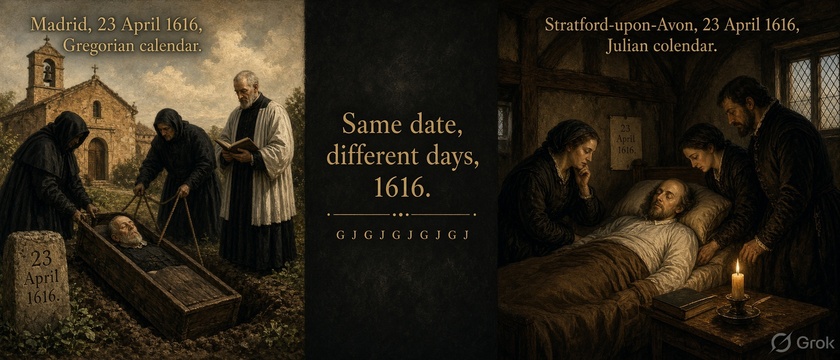
Cervantes and Shakeaspeare Deaths on same date
Ten or eleven days apart

Cervantes and Shakeaspeare Deaths on same date

Ten or eleven days apart

Spain had been on the Gregorian calendar since October 1582. England was still on the Julian calendar, and stayed on it until 1752. In 1616 the gap was ten days.

Miguel de Cervantes died in Madrid on 22 April 1616, Spanish style, and was buried the next day, 23 April. William Shakespeare died in Stratford on 23 April 1616, English style, and was buried on 25 April. When Shakespeare died, it was already 3 May in Madrid. When Cervantes was buried, it was still 13 April in England. Shakespeare outlived him by ten or eleven real days, depending on whether you count Cervantes’s death or his burial.

The famous line swaps the terms. It was the same date-number, not the same day. UNESCO’s World Book Day on 23 April rests on that coincidence, plus the tradition that 23 April is also the feast of St George and, by the old parish register, Shakespeare’s baptismal date in 1564. The registers do not prove he was born that day. They only show he was baptised on 26 April.

=

These are the October 9 entries. Taken together they run from a divided Frankish succession to a missing fortnight on the calendar, a supernova, and a ship whose bell still rings at Lloyd’s.

768 — Carloman I and Charlemagne crowned kings of the Franks. Pepin the Short died on 24 September 768. On 9 October his two surviving sons were raised as kings and the realm was split. Charlemagne (Charles), about 26, took the outer territories: Neustria, western Aquitaine, and the northern coasts. Carloman, about 17, took the inner core: Burgundy, Provence, Septimania, Alsace, and eastern Aquitaine, with a capital at Soissons. Their mother, Bertrada, tried to keep the peace. It did not last. Carloman died on 4 December 771, probably of illness, and Charlemagne took the whole kingdom. From that reunion came the Saxon wars, the destruction of the Lombard kingdom, the Carolingian Renaissance, and the imperial coronation in Rome on Christmas Day 800.

1238 — James I of Aragon takes Valencia. Jaume I, “the Conqueror,” had besieged Valencia since 1237. The city surrendered in late September; he entered on 9 October and founded the Kingdom of Valencia as a realm of the Crown of Aragon, with its own laws (the Furs). The Muslim population was at first allowed to remain under surrender terms. The date is still Valencia’s civic feast, the 9 d’Octubre.

1264 — Castile takes Jerez. Jerez de la Frontera had been in Muslim hands since the conquest of Visigothic Spain after 711. Ferdinand III had brought the lower Guadalquivir under Castilian control in the 1240s and 1250s, but the great Mudéjar revolt of 1264 threw much of it back into open war. Alfonso X retook Jerez on 9 October 1264. The Muslim inhabitants were expelled and the town was resettled with Christians. It became a frontier strongpoint facing the remaining Nasrid kingdom of Granada.

1410 — First known mention of the Prague astronomical clock. A town-hall record of 9 October 1410 names the clockmaker Mikuláš of Kadaň. The astronomical dial is credited to the scholar Jan Šindel. The Orloj on the Old Town Hall is the oldest astronomical clock still running. It was badly damaged in the last days of the Second World War and rebuilt.

1446 — Hangul is published. King Sejong the Great of Joseon had the Korean alphabet set out in Hunminjeongeum (“The Correct Sounds for the Instruction of the People”), promulgated in 1446. The aim was a script ordinary people could learn, instead of depending on classical Chinese. Aristocratic and scholarly opposition kept it marginal for centuries. It is now the national script, and 9 October is Hangul Day in South Korea.

1514 — Louis XII marries Mary Tudor. At Abbeville, Louis XII of France, about 52 and in poor health, married Mary Tudor, 18, sister of Henry VIII. The match sealed a brief Anglo-French peace. Louis died on 1 January 1515. Mary then married Charles Brandon, Duke of Suffolk, for love and against her brother’s wishes. Their granddaughter was Lady Jane Grey.

1582 — This day does not exist in Italy, Spain, Portugal, and Poland. Pope Gregory XIII’s reform corrected the Julian calendar, which had drifted about ten days against the sun and was throwing Easter out. In the states that adopted it at once, Thursday 4 October 1582 was followed by Friday 15 October. The 5th through the 14th, including the 9th, were skipped. Protestant and Orthodox countries refused a papal calendar for generations. Britain and its colonies waited until 1752, by which time eleven days had to be dropped.

1594 — The Campaign of Danture ends. A Portuguese army under Pedro Lopes de Sousa, marching on the Kingdom of Kandy in the highlands of Sri Lanka, was destroyed near Danture. Lopes de Sousa was killed. It closed Portugal’s attempt to break Kandy in that campaign and left the highland kingdom independent for another generation of war.

1604 — Supernova 1604. A new star appeared in Ophiuchus and was studied by Johannes Kepler, whose name it still carries, and by observers across Europe, China, and Korea. It outshone Jupiter and was visible to the naked eye for about eighteen months. It is the most recent supernova observed in the Milky Way. The remnant is still studied as a Type Ia explosion.

1635 — Roger Williams is banished. The Massachusetts General Court banished Williams for denying the colony’s right to punish religious dissent and for rejecting its claim to Native land without purchase. He left in the winter of 1635–36, bought land from the Narragansett, and founded Providence. Rhode Island grew from that settlement as a place of wider religious toleration than the Bay Colony allowed.

1701 — Yale is chartered. The General Court of Connecticut passed “An Act for Liberty to erect a Collegiate School” at Old Saybrook, so that youth might be fitted “for Publick employment both in Church & Civil State.” It was not yet called Yale, and it was not yet in New Haven. The move to New Haven came in 1716. In 1718 it was renamed Yale College after a gift from Elihu Yale, a Boston-born East India Company official. It became Yale University in 1887.

1708 — The Battle of Lesnaya. During the Great Northern War, Peter the Great caught a Swedish supply column under Adam Ludwig Lewenhaupt at Lesnaya (in modern Belarus). The Julian date was 28 September; the Gregorian date was 9 October. The Swedes lost most of their wagons and thousands of men. Charles XII, already deep in Ukraine, was left short of food and powder. Nine months later he was beaten at Poltava.

1740 — The Batavia massacre begins. In the Dutch East India Company capital on Java, panic over a supposed Chinese rising turned into a slaughter. Company troops, colonists, and enslaved and free locals killed ethnic Chinese in the city from 9 October onward. Contemporary and later counts put the dead around 10,000. Survivors fled inland, and the killing spread into a war across Java that lasted until 1743.

1760 — Russians occupy Berlin. In the Seven Years’ War, Russian and Austrian forces under Gottlob Heinrich Totleben and Zakhar Chernyshev entered Berlin around 9 October. They levied a contribution, burned some military stores, and left within a few days as Frederick the Great approached. It was a raid and a humiliation, not a lasting occupation. Frederick still held the field when the war ended.

1790 — The Oran earthquake. A shock struck the western Algerian coast with a maximum intensity of X on the Mercalli scale. Oran and the surrounding towns were badly damaged, and a tsunami ran into the Mediterranean. About 3,000 people were killed. The Spanish still held Oran at the time; they abandoned it to the Bey of Algiers two years later.

1799 — HMS Lutine sinks. The frigate, carrying gold and silver bullion raised by London merchants for Hamburg, was wrecked in a gale off the West Frisian island of Vlieland on 9 October. Of roughly 240 aboard, one man survived. Lloyd’s paid the insurance in full. Later salvage recovered only part of the cargo. The ship’s bell was raised in 1858 and still hangs at Lloyd’s of London, where it is rung for news of an overdue ship.

Read full Article
See More
Available on mobile and TV devices
google store google store app store app store
google store google store app tv store app tv store amazon store amazon store roku store roku store
Powered by Locals