



VoiceDDB
Politics • Culture • News
oDDBall analysis of conservative politics with a libertarian economic conservative twist. Small government, big freedom.
Interested? Want to learn more about the community?
October 26, 2021
Discernable, from Victoria are reporting

Discernable are reporting on what mass media are not

youtu.be/6Lb39c7cQiw also at https://discernable.locals.com/

Interested? Want to learn more about the community?
What else you may like…
Videos
Posts
Articles
00:01:07
November 27, 2022
Jingle Bell Rock

Jingle bell, jingle bell, jingle bell rock
Jingle bells swing and jingle bells ring
Snowin' and blowin' up bushels of fun
Now the jingle hop has begun

Jingle bell, jingle bell, jingle bell rock
Jingle bells chime in jingle bell time
Dancin' and prancin' in Jingle Bell Square
In the frosty air

What a bright time, it's the right time
To rock the night away
Jingle bell time is a swell time
To go glidin' in a one-horse sleigh

Giddy-up jingle horse, pick up your feet
Jingle around the clock
Mix and a-mingle in the jinglin' feet
That's the jingle bell rock

Jingle bell, jingle bell, jingle bell rock
Jingle bell chime in jingle bell time
Dancin' and prancin' in Jingle Bell Square
In the frosty air

What a bright time, it's the right time
To rock the night away
Jingle bell time is a swell time
To go glidin' in a one-horse sleigh

Giddy-up jingle horse, pick up your feet
Jingle around the clock
Mix and a-mingle in the jinglin' feet
That's the jingle bell
That's the jingle...

00:02:04
September 01, 2021
Intro to Locals for the Conservative Voice

David Daniel Ball calls himself the Conservative Voice.

I'm a teacher with three decades experience teaching math to high school kids.I also work with first graders and kids in between first grade and high school. I know the legends of why Hypatia's dad is remembered through his contribution to Math theory. And I know the legend of why followers of Godel had thought he had disproved God's existence.

I'm not a preacher, but I am a Christian who has written over 28 books all of which include some reference to my faith. Twelve blog books on world history and current affairs, detailing world events , births and marriages on each day of the year, organised by month. Twelve books on the background to and history of Bible Quotes. One Bible quote per day for a year. An intro to a science fiction series I'm planning, post apocalyptic cyber punk. An autobiography with short story collections.

I'm known in Australia for my failure as a whistleblower over the negligence death of a school boy. ...

00:01:50
September 04, 2026
Should violent criminals be made fat? Grok says 'no'

No. Transferring gut bacteria from an obese person into a violent criminal is not a reliable, ethical, or effective way to make them “fat, sedentary, and less of a physical threat.”

The science does not deliver the outcome you want

Mouse studies in germ-free animals showed that microbiota from obese donors can increase energy harvest and adiposity compared with lean-donor microbiota. That is the origin of the idea. Human evidence is far weaker.

Randomized trials of fecal microbiota transplant (FMT) from lean donors into people with obesity have generally failed to produce meaningful, sustained weight loss. Microbiome composition can change; body weight and metabolic markers often do not, or the effects are small and inconsistent. Diet and the existing gut environment usually dominate. A 2025 Nature paper found diet outperformed microbial transplant for microbiome recovery. Human guts are already colonized, not sterile like lab mice, so engraftment is variable and effects unpredictable.

It is not a ...

post photo preview
August 28, 2026
Pfizer struggles to answer

Some in Australia are brilliant. Malcolm Roberts Investigates Pfizer over Covid vaccine.

Holiday break is over back to work tonight

Tonight I'll start double posting until I've caught up.

post photo preview
When Spain played Salome for James 1
October 29th

When Spain played Salome for James 1

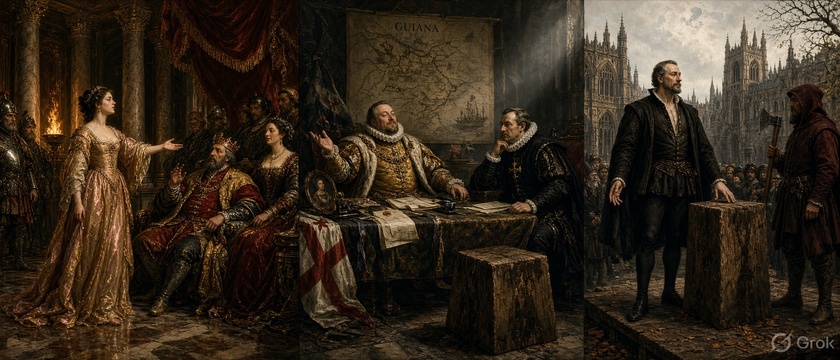
Sir Walter Raleigh was beheaded on 29 October 1618 in the Old Palace Yard at the Palace of Westminster under a revived 1603 treason sentence. The immediate trigger was the failure of his second Guiana expedition and the attack by his men on a Spanish settlement, which clashed with King James I’s policy of peace with Spain.

Background

Raleigh (c. 1552/1554–1618) rose under Elizabeth I as a soldier, courtier, poet, explorer, and promoter of English colonization in North America (including the Roanoke ventures). He fought against the Spanish Armada, served in Ireland, and held offices such as captain of the Queen’s Guard. After Elizabeth’s death in 1603, he was implicated in the Main Plot against the new king, James I. Tried for treason, he was sentenced to death but the sentence was stayed; he spent most of the next thirteen years in the Tower of London, where he wrote The History of the World and pursued scientific and literary interests.

In 1616 James released him to lead an expedition to Guiana (present-day Venezuela/Guyana) in search of gold or El Dorado. Strict orders forbade any attack on Spanish possessions, as James was pursuing a marriage alliance and peace with Spain. The 1617–1618 voyage failed to find the promised mine. Raleigh’s son Wat was killed in a clash when some of the English force, under Lawrence Keymis, attacked the Spanish outpost of San Thomé on the Orinoco. Raleigh returned to England in 1618; the Spanish ambassador, Diego Sarmiento de Acuña (Count of Gondomar), demanded his execution. James reinstated the old 1603 sentence rather than hold a new trial.

The Execution

On the morning of 29 October 1618, Raleigh was brought from the Tower to the scaffold in Old Palace Yard. He showed notable composure: he asked to see the axe, ran his thumb along the blade, and remarked, “This is a sharp medicine, but it is a physician for all diseases.” He delivered a scaffold speech denying the main charges of conspiracy with Spain or France, affirming his loyalty, and admitting personal vanity and a sinful life as soldier, sailor, and courtier. When the executioner hesitated, Raleigh is reported to have said, “What dost thou fear? Strike, man, strike!” His head was severed in two blows.

His wife, Elizabeth (“Bess”) Throckmorton, claimed the head, had it embalmed, and kept it in a red leather bag for the remaining twenty-nine years of her life. His body was buried at St Margaret’s, Westminster.

Significant Figures

  • Sir Walter Raleigh — the condemned man; Elizabethan adventurer, writer, and colonizer whose execution became a symbol of Stuart justice and Spanish influence.
  • King James I — ordered the execution to satisfy Spanish demands and preserve his foreign policy of rapprochement with Spain.
  • Diego Sarmiento de Acuña, Count of Gondomar — Spanish ambassador who pressed for Raleigh’s death after the San Thomé incident.
  • Elizabeth (“Bess”) Throckmorton — Raleigh’s wife; secretly married him in 1591, shared his imprisonment periods, and preserved his head.
  • Lawrence Keymis — Raleigh’s lieutenant who led the attack on San Thomé; he later committed suicide.
  • Wat Raleigh — Raleigh’s eldest son, killed in the fighting at San Thomé.
  • Thomas Hariot — scientist and former associate who was present among the spectators.

Result and Significance

The execution ended Raleigh’s life and the last major Elizabethan adventurer’s career. It demonstrated James I’s willingness to sacrifice an English figure to maintain peace with Spain, reinforced perceptions of Spanish influence at court, and turned Raleigh into a popular martyr. His scaffold conduct and final words entered legend, and his writings and colonial vision continued to shape English expansion in the Americas.

= October 29th 

These events form a classic late-October cluster (mostly 27–29 October, depending on calendar and source). Several are traditionally linked to the 27th or the days immediately around it.

539 BC – Fall of Babylon and the Jewish return
Persian forces under Gobryas (Ugbaru) entered Babylon without a fight on 12 October 539 BC after victories at Opis and Sippar. Cyrus the Great himself entered the city on 29 October. The Cyrus Cylinder and the biblical book of Ezra record his policy of allowing deported peoples, including the Jews of the Babylonian Exile, to return home and rebuild their temple. This ended Neo-Babylonian rule and began the Achaemenid Empire’s control of Mesopotamia, Syria, and the Levant.

312 – Constantine after the Milvian Bridge
The night of 27 October is traditionally associated with Constantine’s vision (Lactantius’s dream of the heavenly sign; Eusebius’s later account of the cross of light and the words In hoc signo vinces). The Battle of the Milvian Bridge itself was fought on 28 October. Constantine then entered Rome in a formal adventus amid popular acclaim. Maxentius drowned in the Tiber; his body was recovered and his head displayed. The victory secured Constantine’s control of the West and is the traditional starting point of his favour toward Christianity.

437 – Marriage of Valentinian III and Licinia Eudoxia
On or about 29 October 437 in Constantinople, the Western emperor Valentinian III married his cousin Licinia Eudoxia, daughter of the Eastern emperor Theodosius II. The wedding formally reunited the two branches of the Theodosian house after years of betrothal and helped stabilise relations between the eastern and western courts, though real power in the West remained with the general Aetius.

969 – Byzantine capture of Antioch
After a prolonged blockade, Byzantine forces under Michael Bourtzes and Petros took Antioch from the Hamdanids on 28 October 969. The city, lost to the Arabs in the 7th century, returned to imperial control. The victory was followed by the Treaty of Safar, which made the Emirate of Aleppo a Byzantine tributary and secured northern Syria for the empire under Nikephoros II Phokas.

1268 – Execution of Conradin
On 29 October 1268 in Naples, the 16-year-old Conradin (last male Hohenstaufen heir, nominal King of Jerusalem and Sicily) and his companion Frederick of Baden were beheaded on the orders of Charles I of Anjou (Charles of Sicily). The execution extinguished the direct Hohenstaufen line and confirmed Angevin rule in southern Italy.

1390 – First documented witchcraft trial in Paris
Around 29 October 1390 the secular court of the Châtelet in Paris began proceedings against Jeanne de Brigue (La Cordière) and others (including Margot de la Barre and Marion la Droiturière). Accused of sorcery, love magic, and diabolism, several were tortured, convicted, and later burned. It is the earliest well-documented Parisian witchcraft case and marks the shift of such prosecutions from ecclesiastical to secular courts.

1467 – Charles the Bold defeats Liège
On 28 October 1467 at the Battle of Brustem, Burgundian forces under Charles the Bold (then Count of Charolais, soon Duke) routed the army of Liège. The victory led to the city’s submission, the demolition of its walls, and the conversion of the Prince-Bishopric into a Burgundian protectorate. It was the second of the Wars of Liège; a third and more destructive rising was crushed the following year.

1591 – Election of Pope Innocent IX
The short conclave of 27–29 October elected Cardinal Giovanni Antonio Facchinetti as Pope Innocent IX on 29 October. A compromise candidate favoured by the Spanish party, he reigned only until 30 December 1591. During his brief pontificate he supported Philip II and the Catholic League in the French Wars of Religion.

1611 – Russian homage to Sigismund III Vasa
On 29 October 1611 in the Senate Hall of the Royal Castle in Warsaw, the deposed Tsar Vasily IV Shuysky, his brothers Ivan and Dmitry, and other captives taken after the Polish capture of Moscow paid formal homage to King Sigismund III Vasa and his son Prince Władysław. The ceremony (the “Shuysky Tribute”) was a high point of Polish-Lithuanian power during the Time of Troubles.

1618 – Execution of Sir Walter Raleigh
On 29 October 1618 in the Old Palace Yard at Westminster, Sir Walter Raleigh was beheaded under the revived 1603 treason sentence. The immediate cause was the failure of his second Guiana expedition and the attack on a Spanish settlement, which angered James I’s desire for peace with Spain. Raleigh’s scaffold speech and composure became legendary.

1658 – Battle of the Sound
On 29 October (Old Style) / 8 November (New Style) 1658, a Dutch fleet under Jacob van Wassenaer Obdam defeated a Swedish fleet under Carl Gustaf Wrangel in the Øresund. The victory broke the Swedish blockade of Copenhagen, relieved the Danish capital, and prevented Sweden from controlling both sides of the Sound and thus the Baltic trade routes.

1665 – Battle of Mbwila
On 29 October 1665 near Mbwila (present-day Angola), a Portuguese force defeated the army of the Kingdom of Kongo. King António I (Nvita a Nkanga) was killed and decapitated; many nobles died or were captured. The defeat shattered Kongo’s political unity, triggered civil war between rival kandas, and accelerated Portuguese influence and the slave trade in the region.

1675 – Leibniz and the integral symbol
On 29 October 1675, in an unpublished manuscript (Analyseos tetragonisticae pars secunda), Gottfried Wilhelm Leibniz first used the elongated “∫” (from the Latin summa) as the symbol for the integral. Two weeks later he combined it with the differential notation dx. The system remains the standard notation of calculus.

1787 – Premiere of Don Giovanni
On 29 October 1787 at the Estates (Nostitz) Theatre in Prague, Mozart conducted the world premiere of his opera Don Giovanni (K. 527), with a libretto by Lorenzo Da Ponte. Delayed by production difficulties, the performance was a triumph and remains one of the greatest works in the operatic repertoire.

1792 – Naming of Mount Hood
On 29 October 1792, while exploring the Columbia River as part of George Vancouver’s expedition, Lieutenant William Broughton sighted the great Cascade volcano (known to local peoples as Wy’east) from near the mouth of the Willamette and named it Mount Hood after Admiral Samuel Hood, 1st Viscount Hood.

Together these episodes illustrate the recurring late-October rhythm of conquest, dynastic marriage, judicial violence, scientific invention, and artistic creation across more than two millennia.
Read full Article
post photo preview
The Siege of La Rochelle
October 28th

The Siege of La Rochelle (1627–1628)

was the climactic episode of the last major Huguenot rebellions against the French crown. It ended the military and political autonomy of French Protestants and marked a decisive step toward the absolute monarchy under Louis XIII and Cardinal Richelieu.

Before the Siege

The French Wars of Religion (1562–1598) had pitted Catholics against Huguenots (French Calvinists). They were settled by Henry IV’s Edict of Nantes (1598), which granted Protestants freedom of worship, civil rights, and a network of fortified “places of safety” (places de sûreté), including the Atlantic port of La Rochelle. La Rochelle became the strongest and wealthiest remaining Huguenot stronghold, with a large Protestant population, commercial power (especially the salt trade), and a semi-autonomous character.

After Henry IV’s assassination in 1610, his young son Louis XIII came under more Catholic influence. Tensions rose in the 1620s as Huguenots resisted royal efforts to curb their independence. Cardinal Richelieu, Louis XIII’s chief minister, viewed the Huguenot “state within a state” as incompatible with centralized royal authority. In 1627, England under Charles I intervened: the Duke of Buckingham landed forces on the nearby Île de Ré to support the Rochelais and encourage a broader rebellion. This prompted the royal siege.

The Siege (September 1627 – 28 October 1628)

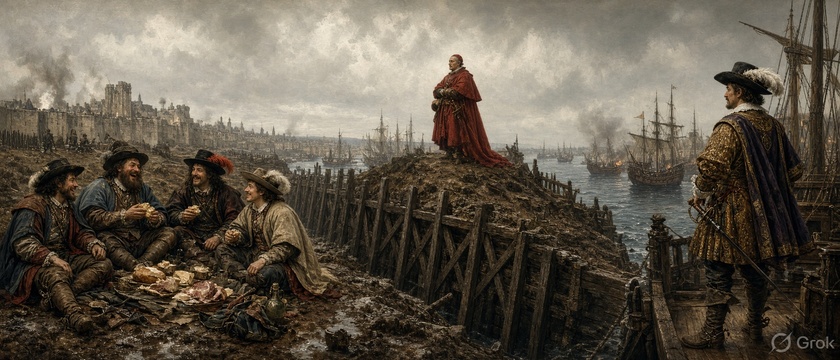
Royal forces under Louis XIII and Richelieu began investing the city in the late summer/early autumn of 1627. Richelieu’s key innovation was the construction of a massive seawall or dyke (digue) across the harbor entrance, sealing La Rochelle off from the sea and blocking English relief.

Three English fleets (including under Buckingham and later the Earl of Lindsey) attempted to break the blockade or relieve the city but failed. Inside the walls, the defenders—led eventually by the energetic mayor and former admiral Jean Guiton—held out through starvation and disease. The population, roughly 27,000–28,000 at the start, fell to about 5,000–5,500 survivors by the end. Guiton is famous for the (possibly legendary) gesture of stabbing a dagger into the council table and declaring he would pierce the heart of anyone who spoke of surrender.

The city surrendered unconditionally on 28 October 1628. Louis XIII and Richelieu entered in triumph shortly afterward. Most inhabitants received clemency, though fortifications were demolished.

After the Siege

The fall of La Rochelle broke the back of organized Huguenot military resistance. The Peace of Alès (also called the Edict of Grace or Edict of Alais), signed on 28 June 1629, confirmed the core religious freedoms of the Edict of Nantes (freedom of conscience and limited worship) but stripped the Huguenots of political assemblies, independent military forces, and all fortified places of safety. They ceased to be a political or military party and became ordinary subjects of the king. This consolidated royal power and advanced Richelieu’s program of strengthening the central state. The long-term vulnerability of French Protestants culminated in Louis XIV’s Revocation of the Edict of Nantes in 1685, which triggered large-scale emigration.

Significant Figures

  • Louis XIII (1601–1643): King of France; present at the siege and the political beneficiary of the victory that strengthened the monarchy.
  • Cardinal Richelieu (Armand Jean du Plessis, 1585–1642): Chief minister and effective commander of the siege. He directed the engineering of the dyke, managed the campaign, and used the victory to advance royal absolutism. His red-caped figure surveying the works became an iconic image.
  • Jean Guiton (1585–1654): Shipowner, Huguenot admiral, and mayor of La Rochelle during the siege. He organized the defense and became a local symbol of resistance (his house and a commemorative statue remain in the city; a table with a dagger mark is displayed at the Hôtel de Ville).
  • George Villiers, 1st Duke of Buckingham (1592–1628): English favorite of Charles I; commanded the initial expedition to Île de Ré and later relief attempts. He was assassinated in England in August 1628.
  • Other notables included the royal commander Toiras (who held Île de Ré), the Huguenot leader Benjamin de Rohan (Soubise), and various marshals under the king.

Significant Fictional Depictions

The siege is most famous as the historical backdrop of Alexandre Dumas père’s The Three Musketeers (1844). In the novel, d’Artagnan, Athos, Porthos, and Aramis serve with the royal army at the siege; Buckingham’s involvement is woven into the romantic and political intrigue involving Queen Anne of Austria and the villainous Milady de Winter. The book (and its countless stage, film, television, comic, and game adaptations) popularized the episode for generations. Recent examples include the French films The Three Musketeers: D’Artagnan and Milady (2023), which depict the siege (filmed in part at Saint-Malo).

Other literary treatments include:

  • Robert Merle’s Fortune de France series (volume 11, La Gloire et les Périls).
  • Lawrence Norfolk’s Lemprière’s Dictionary (1991), which uses the siege as a pivotal, fictionalized origin for later events.
  • Taylor Caldwell’s The Arm and the Darkness (1943).

Visual depictions are also notable, especially Henri-Paul Motte’s 1881 painting Cardinal Richelieu at the Siege of La Rochelle, showing the cardinal in his red cloak on the dyke amid the fortifications and ships.

In short, the siege was both a brutal military operation that devastated a prosperous Protestant city and a political turning point that ended Huguenot independence and advanced the centralized Bourbon state. Its dramatic setting and cast of characters have kept it alive in literature and popular culture, above all through Dumas.

= October 28th 

October 27 (and closely related dates around it) features several notable events across Roman, medieval, early modern, and later history. Many sources list events near this date (sometimes on the 27th or 28th, depending on calendars and exact records). Here is a chronological overview of the ones you listed, with brief context.

Roman and Late Antique Period

  • AD 97: Emperor Nerva, under pressure from a Praetorian Guard mutiny (and lacking a natural heir or strong military backing after Domitian’s assassination), adopted the popular general Marcus Ulpius Trajanus (Trajan) as his son and successor. This occurred publicly in October 97. It stabilized the succession and began the pattern of “adoptive” emperors among the “Five Good Emperors.” Nerva died in January 98; Trajan succeeded smoothly and expanded the empire to its greatest extent.
  • 306: Maxentius (son of the retired emperor Maximian) was proclaimed emperor by the Praetorian Guard and elements of the Roman Senate and people in Rome, on or around 28 October 306. This was part of the breakdown of Diocletian’s Tetrarchy; he controlled Italy and Africa for several years until defeated by Constantine.
  • 312: Constantine I defeated Maxentius at the Battle of the Milvian Bridge (near Rome, over the Tiber) on 28 October 312. Maxentius drowned in the retreat. Constantine became the dominant ruler in the West. The night before (often linked to 27 October), Constantine is traditionally said to have had a vision of a cross or the Chi-Rho symbol with the words “in this sign, conquer.” This event is pivotal in the history of Christianity’s rise within the empire (followed by the Edict of Milan in 313).
  • 456: Visigothic forces under Theodoric II sacked Braga (Bracara Augusta), the capital of the Suebi kingdom in Gallaecia (modern Portugal/northern Spain). Contemporary chronicler Hydatius describes the sacking of churches, desecration of altars, and mistreatment of clergy and civilians (though not a full massacre). It followed a Visigothic victory over the Suebi near the Órbigo River; Suebi king Rechiar was later captured and executed. This weakened Suebi power significantly.

Medieval Period

  • 969: Byzantine general Michael Bourtzes seized a key wall tower of Antioch (held by the Hamdanids) on or around 28 October. He held it for three days against counterattacks until reinforcements under the stratopedarches Peter arrived and secured the city. This was a major reconquest for the Byzantines under Nikephoros II Phokas (though Bourtzes was later sidelined for disobeying orders and joined the conspiracy that assassinated the emperor).
  • 1061: Empress Agnes (regent for the young Henry IV) and an assembly of German/Lombard bishops and notables at Basel elected Bishop Cadalus of Parma as antipope Honorius II (on or around 28 October). This challenged the reformist Pope Alexander II (elected earlier by cardinals under Hildebrand’s influence). The schism lasted into the mid-1060s before Alexander’s position was confirmed.
  • 1344: Crusaders of a papal-led Holy League (including forces linked to the papacy, Venice, the Hospitallers, and others) captured the lower town and harbor of Smyrna (modern İzmir) from the Aydinid Turks under Umur Beg on or around 28 October. This was a response to Turkish piracy in the Aegean; the upper citadel remained in Turkish hands for a time. Smyrna stayed in Latin hands until Timur’s conquest in 1402.
  • 1420: Beijing was formally designated the primary capital of the Ming dynasty (under the Yongle Emperor), coinciding with the completion of the Forbidden City as the imperial seat. The capital had been moved from Nanjing; this consolidated power closer to the northern frontier.
  • 1449: Christian I (of the House of Oldenburg) was crowned King of Denmark in Copenhagen (Church of Our Lady), typically dated 28 October. He was the first Oldenburg king of Denmark (and later Norway and briefly Sweden under the Kalmar Union).
  • 1453: Ladislaus the Posthumous (Habsburg, born after his father’s death) was crowned King of Bohemia in Prague on or around 28 October. Actual power remained largely with regents (notably George of Poděbrady in Bohemia and earlier figures in Hungary); he died young in 1457.
  • 1492: Christopher Columbus’s fleet reached Cuba on his first voyage (sighted/landed around 27–28 October). He named it Juana (after the Spanish prince) and initially believed it related to Asia/Cipango (Japan) or the Asian mainland. This followed his Bahamas landfall on 12 October.

Early Modern Period

  • 1516: At the Battle of Yaunis Khan (near Khan Yunis/Gaza), Ottoman forces under Grand Vizier Hadım Sinan Pasha defeated a Mamluk force under Janbirdi al-Ghazali. This was part of the Ottoman–Mamluk War; it helped clear the way for the Ottoman advance into Egypt after the earlier victory at Marj Dabiq.
  • 1531: At the Battle of Amba Sel, forces of Imam Ahmad ibn Ibrahim al-Ghazi (of the Adal Sultanate) again defeated the army of Ethiopian Emperor Lebna Dengel (Dawit II). This allowed Adal control over southern Ethiopia during the Ethiopian–Adal War.
  • 1538: The Universidad Santo Tomás de Aquino (in Santo Domingo, present-day Dominican Republic) was established by papal bull In Apostolatus Culmine of Pope Paul III (dated 28 October). Run by Dominicans, it is often cited as the first university in the Americas (with later royal recognition). It operated with interruptions until the 19th century.
  • 1628: The long Siege of La Rochelle (a major Huguenot stronghold during the French Wars of Religion) ended with the city’s surrender on 28 October after ~14 months. Cardinal Richelieu’s royal forces (under Louis XIII) had built a blockade/seawall; English relief efforts failed. The Huguenots lost pol


Read full Article
October 26, 2026
post photo preview
Birth of Amsterdam
October 27th

Birth of Amsterdam

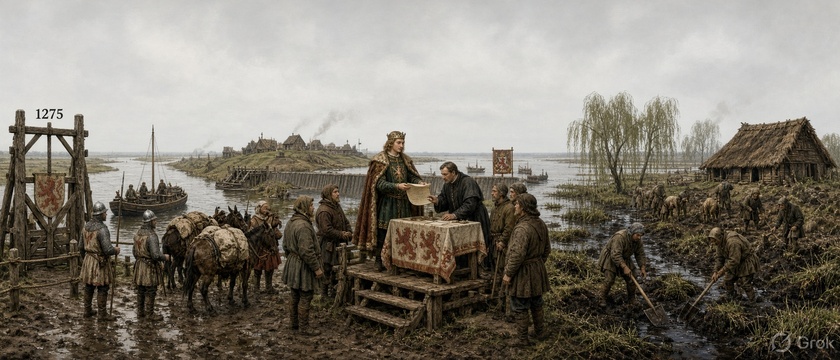
The traditional founding of Amsterdam dates to 27 October 1275, when Count Floris V of Holland issued a toll privilege (the earliest surviving document naming the place) to the people living at the dam in the Amstel River (homines manentes apud Amestelledamme). This granted them exemption from tolls on their own goods throughout his territory. The settlement and dam already existed; the document is the first written reference and is celebrated as the city’s anniversary (Amsterdam marked 750 years in 2025).

Before 1275: From peatland to settlement

The area around the mouth of the Amstel (a river flowing into the IJ estuary, connected to the Zuiderzee) was low-lying peat and marsh, subject to flooding. From roughly the 11th century, people reclaimed land under the authority of the Bishop of Utrecht (the Sticht), building dikes and draining peat. Major storm surges, especially the All Saints’ Flood of 1170, opened the area more fully to the sea and reshaped the landscape, making permanent settlement feasible while also necessitating stronger defenses.

By around 1200, a ribbon-like settlement of farmers, fishermen, craftsmen, and traders had formed along dikes on both banks of the Amstel (roughly the later Nieuwendijk, Warmoesstraat, and Zeedijk areas). A wooden chapel (predecessor of the Oude Kerk) appeared early. Around the 1260s (often dated c. 1260–1270), residents built a dam across the Amstel near its mouth. This was a significant engineering work: a clay-and-earth structure roughly 140 meters long, 25 meters wide, and about 2.5 meters high, with a sluice. It connected the two banks, controlled water (separating fresh river water from tidal/brackish IJ water), created a natural harbor for transferring cargo from larger seagoing ships (koggen) to smaller inland vessels, and provided a central gathering place. The settlement was still small—estimates range from a few hundred to around 500–1,000 people—and fell under the Bishop of Utrecht, administered locally by the Lords of Amstel (a family based around Ouderkerk aan de Amstel). It was not yet a formal city.

The 1275 toll privilege and its context

The document was drawn up in Leiden on Sunday, 27 October 1275 (the Sunday before the feast of Saints Simon and Jude), by Hendrick Allardsz of Middelburg, a clerk in the service of Floris V (likely trained at Egmond Abbey and linked to Middelburg). In Latin, Floris declared that, in compensation for damage done by him and his men to the people living near Amestelledamme, they would henceforth be exempt from his toll when transporting their own goods throughout his lands (roughly modern North and South Holland and parts of Zeeland).

This was not pure generosity or a formal grant of city rights. The area still belonged to the Bishopric of Utrecht, not the County of Holland. Floris was expanding his power against the bishop and local lords such as the Van Amstels. His troops had recently caused damage in the settlement; the privilege was partly compensation and partly a political move to win the loyalty of the inhabitants, encourage trade through Holland, and draw the Amstel area into his sphere of influence. Similar privileges were granted to other places. It gave Amsterdam traders a practical commercial advantage without making the place a free city or transferring sovereignty.

Significant figures

  • Floris V (1254–1296): Count of Holland and Zeeland from 1256 (effectively ruling after reaching majority in 1266). Son of William II (King of the Romans). He expanded Holland significantly (including against the West Frisians), promoted trade, and was known as “der keerlen God” (God of the common people) for his relative popularity with peasants and townsfolk versus some nobles. He issued the 1275 privilege. In 1296 he was kidnapped during a falcon hunt by discontented nobles (including Gijsbrecht IV van Amstel, Herman van Woerden, and Gerard van Velsen), held at Muiderslot, and murdered (stabbed multiple times by van Velsen) near Muiderberg when local people tried to free him. The plot involved international intrigue linked to his shifting alliances between England and France. He is a major figure in Dutch medieval history and literature.
  • The Lords of Amstel (especially Gijsbrecht IV van Amstel, c. 1230/1235–c. 1303): Local rulers of Amstelland under the Bishop of Utrecht. They sought greater independence between Utrecht and Holland. Gijsbrecht IV opposed Floris, participated in the 1296 conspiracy, lost his lands, and went into exile. His family is immortalized in Joost van den Vondel’s 17th-century play Gijsbrecht van Aemstel (set around the 1304 siege of Amsterdam), which became a long-running Amsterdam theatrical tradition.
  • Hendrick Allardsz of Middelburg: The clerk who wrote the privilege document.
  • Later: Guy (Gwijde) of Avesnes: Brother of John II of Holland; Bishop of Utrecht from 1301. He held Amstelland (including the settlement) and is credited with granting or confirming urban rights/charters to Amsterdam around 1300–1306.

After 1275: From settlement to city

The privilege helped trade and gradual growth. By around 1300 the population was roughly 1,000. Formal municipal/city rights (rights to markets, local justice, fortification, etc.) came later, traditionally around 1300 or 1306, associated with Guy of Avesnes (while he controlled the area before or as bishop). Amsterdam remained under shifting authority: after Floris’s murder and the fall of the Van Amstels, it passed more firmly into the Holland orbit. Further privileges followed (e.g., a beer staple right in 1323 that boosted its role as a market). By the mid-14th century it was a recognized poorte (town) with growing trade, especially in Baltic grain and other goods. Major floods (including the St. Lucia’s Flood of 1287, which enlarged the Zuiderzee) continued to shape the landscape and opportunities.

The 1275 document was carefully preserved for centuries (in a charter chest in the Oude Kerk, later in the city archives). It is still displayed briefly each year around 27 October. While not a true “founding charter” in the modern sense—settlement predated it, and full city status came decades later—it is the practical starting point for Amsterdam’s documented history and the basis of its traditional birthday celebration. The dam site is today’s Dam Square; the early harbor is the Damrak area.

= October 27th 

These are events traditionally associated with October 27.

312 – Constantine the Great’s Vision of the Cross

Roman emperor Constantine is said to have received a vision of a cross (or Chi-Rho symbol) in the sky, often accompanied by the words in hoc signo vinces (“in this sign you will conquer”). Sources differ: Lactantius describes a dream instructing him to mark shields with the Christian monogram, while Eusebius (writing later) reports a public midday vision of a cross of light above the sun, followed by a dream of Christ. Popular accounts place this on the eve of the Battle of the Milvian Bridge (October 28, 312), in which Constantine defeated his rival Maxentius near Rome. The victory made him sole Western emperor and is linked to his increasing favor toward Christianity (culminating later in the Edict of Milan). The precise details and timing remain debated among historians, as the main accounts are not fully independent or contemporaneous.

710 – Saracen invasion of Sardinia

Arab/Muslim (often called Saracen in European sources) forces conducted raids on the Byzantine-controlled island of Sardinia around this time, part of broader early Islamic expansion in the western Mediterranean after the conquest of North Africa and coinciding with the invasion of Iberia. Sources record multiple early raids (from roughly 705–711 onward), involving coastal attacks, pillaging, and captives; some mention large numbers of prisoners taken across several islands. These did not result in permanent occupation of Sardinia, which remained outside lasting Muslim control unlike nearby Sicily or parts of the Iberian Peninsula. Exact details for a single 710 invasion are sparse in surviving chronicles.

939 – Death of Æthelstan and succession of Edmund I

Æthelstan (also Athelstan), widely regarded as the first king of a unified England, died on October 27, 939 (probably at Gloucester), at about age 45. He had ruled as king of the Anglo-Saxons from 924 and of the English from 927, after conquering the Viking kingdom of York. His major victory at Brunanburh (937) against a coalition of Scots, Strathclyde Britons, and Dublin Vikings secured his reputation. Childless, he was succeeded by his half-brother Edmund I (then about 18), who faced renewed Viking challenges in the north but eventually recovered control. Æthelstan was buried at Malmesbury Abbey.

1275 – Traditional founding of Amsterdam

On October 27, 1275, Count Floris V of Holland issued a toll privilege (the earliest surviving document naming the place) granting the people living at the dam in the Amstel River (homines manentes apud Amestelledamme) exemption from tolls on their own goods throughout his territory. A settlement and dam already existed by then (the dam itself dated to roughly the 1260s, connecting earlier riverside habitation after floods); the document marks the first written reference and is treated as the traditional founding date of the city that grew into a major trading port. Amsterdam celebrates this anniversary.

1524 – French siege of Pavia begins (Italian Wars)

King Francis I of France led an army (roughly 26,000–40,000 men, including Swiss and other mercenaries) into northern Italy and invested Pavia, then held by an Imperial garrison under Antonio de Leyva for Charles V. The siege began in late October 1524 (accounts vary slightly on the exact day, often given as October 27/28) and lasted through the winter. French assaults and bombardment failed to take the city quickly. An Imperial relief force later attacked, leading to the decisive Battle of Pavia on February 24, 1525, in which Francis was captured. This was a major setback for French ambitions in Italy.

1553 – Michael Servetus burned at the stake

The Spanish physician and theologian Michael Servetus (Miguel Serveto) was executed by burning just outside Geneva at Champel. He had been condemned for heresy, primarily for rejecting the orthodox doctrine of the Trinity and opposing infant baptism in works such as Christianismi Restitutio. After escaping Catholic authorities in Vienne (who burned him in effigy), he was arrested in Geneva. John Calvin played a prominent role in the proceedings and sought a milder execution (beheading), but the council ordered burning; Servetus went to the stake with a copy of his book chained to him. The case became a lasting point of controversy over religious tolerance among Protestants.

1644 – Second Battle of Newbury

During the First English Civil War, Royalist forces under King Charles I fought an indecisive battle against combined Parliamentarian armies (under the Earl of Manchester, Sir William Waller, and others, with the Earl of Essex ill) near Newbury/Speen in Berkshire. Parliament had a substantial numerical advantage (roughly 17,000–19,000 vs. about 8,500–10,000). A planned pincer attack was poorly coordinated; Royalist positions held, and Charles withdrew toward Oxford overnight. The failure to destroy the smaller Royalist army contributed to later Parliamentarian military reforms, including the creation of the New Model Army.

1682 – Philadelphia established

William Penn (English Quaker) founded the city of Philadelphia in the proprietary colony of Pennsylvania, granted to him by Charles II in 1681. Penn’s ship reached the Delaware area around October 27–28, 1682; he had already sent commissioners to lay out a grid-planned “greene country towne” (City of Brotherly Love) between the Delaware and Schuylkill rivers, emphasizing religious tolerance and orderly settlement. It grew rapidly into a major colonial port and later the temporary U.S. capital.

1795 – Treaty of Madrid (Pinckney’s Treaty / Treaty of San Lorenzo)

The United States and Spain signed the Treaty of Friendship, Limits, and Navigation at San Lorenzo el Real. Negotiated for the U.S. by Thomas Pinckney and for Spain by Manuel de Godoy, it fixed the southern U.S. boundary with Spanish Florida at the 31st parallel, recognized the Mississippi River as the western boundary, and granted Americans free navigation of the Mississippi plus the right of deposit at New Orleans. This resolved long-standing disputes and opened western trade routes. It was later ratified by both sides and proclaimed in 1796.

These events span Roman imperial transition and the spread of Christianity, early medieval raids and English state formation, urban foundations, the Italian Wars, Reformation religious conflict, the English Civil War, colonial American settlement, and early U.S. diplomacy. Sources for the earliest entries (especially 312 and 710) are limited or later, so details can vary by account.


Read full Article
See More
Available on mobile and TV devices
google store google store app store app store
google store google store app tv store app tv store amazon store amazon store roku store roku store
Powered by Locals