


Georgetown, founded to be Catholic, with slaves 1791`
Georgetown University’s 1791 opening marked the start of the first Catholic institution of higher learning in the United States, made possible by the American Revolution’s removal of colonial restrictions on Catholic education and public worship.
Before 1791: Background and Planning
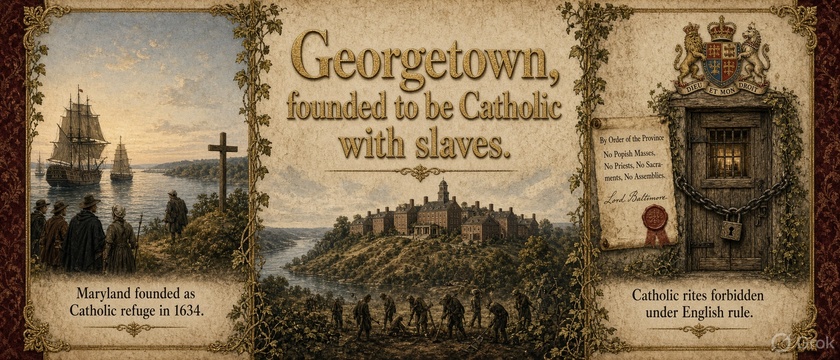
Under English colonial rule, especially after the Glorious Revolution and penal laws, Catholics in Maryland and elsewhere faced severe restrictions: public celebration of Mass was limited or banned, Catholic schools were forbidden, and political rights were curtailed. Maryland had been founded as a Catholic refuge in 1634, but by the 18th century those freedoms had largely eroded. Families seeking a Catholic education often sent sons abroad.
John Carroll (1735–1815) was the central figure. Born in Upper Marlboro, Maryland, into a prominent Catholic family (his cousin Charles Carroll of Carrollton signed the Declaration of Independence; his brother Daniel signed both the Articles of Confederation and the Constitution), he was educated at a small local Jesuit school then at St. Omer in French Flanders. He entered the Society of Jesus in 1753, was ordained in 1761, and taught in Europe. When Pope Clement XIV suppressed the Jesuits in 1773, Carroll returned to Maryland in 1774.
He supported the Revolution (joining a 1776 diplomatic mission to Canada with Benjamin Franklin and others) and, after independence, became the organizational leader of the American Catholic Church. In 1784 Rome appointed him Superior of the American Missions (Apostolic Prefect); in 1790 he was consecrated the first Bishop of Baltimore, with a diocese covering the entire United States. Carroll saw education as essential for the Church’s survival and growth in the new republic. From at least 1783 he planned an academy that would combine classical liberal-arts training in the Jesuit tradition with the values of the American experiment. He wanted it “open to students of every religious profession.”
In 1786–87 clergy meetings at White Marsh appointed directors (including Carroll, Robert Molyneux, and John Ashton). Carroll issued a prospectus, “Proposals for Establishing an Academy at George-Town, Patowmack-River, Maryland.” Construction of the first building (later called Old South or the South Building) began in 1788 on a hilltop overlooking the tobacco port of Georgetown (then in Maryland). On 23 January 1789, Carroll and colleagues secured the deed to the initial land (roughly one to one-and-a-half acres) from William Deakins Jr. and John Threlkeld for £75—the date the university traditionally treats as its founding. The site’s proximity to the emerging federal capital (selected nearby in 1790) was an unexpected advantage.
The 1791 Opening and Early Figures
The academy formally began receiving students in late 1791. William Gaston (1778–1844) of New Bern, North Carolina—then 13—became the first enrolled student on 22 November 1791. His father, a doctor and Revolutionary patriot, had been killed by Tories in 1781; his Catholic mother, Margaret Sharpe, arranged his education. Gaston stayed only briefly (health issues led him to leave by spring 1793), later graduated first in his class from the College of New Jersey (Princeton), became a lawyer, Federalist congressman (1813–1817), and Chief Justice of the North Carolina Supreme Court. As a congressman he helped secure Georgetown’s federal charter. Gaston Hall is named for him. (He was also a large slaveholder—research has identified at least 163 enslaved people in his estate.)
Rev. Robert Plunkett (1752–1815), an English priest educated at St. Omer, Bruges, and Douai who arrived as a missionary in 1790, was persuaded by Carroll to serve as the first president (1791–1793). He oversaw the division into elementary, preparatory, and college levels and the admission of the first students. The first teacher was Jean-Edouard de Mondésir. Classes proper began on campus in January 1792. The second student was Philemon Charles Wederstrandt (enrolled December 1791). Early enrollment reached roughly 40–70 students in the first year or so, including non-Catholics and early international students (e.g., from the West Indies). The first prospectus was issued in English, French, and Spanish. Early faculty included former Jesuits and Sulpician refugees from the French Revolution.
The vision was deliberately ecumenical and republican: a place that would give consistency to Catholic life in America while educating citizens of the new nation.
After 1791: Growth, Challenges, and Transformation
President George Washington visited in August 1797. In 1805, after partial restoration of the Jesuits, the Society assumed fuller direction. On 1 March 1815, President James Madison signed the congressional charter empowering the college to grant degrees (Gaston helped steer it). The first Bachelor of Arts degrees were awarded in 1817. Carroll, elevated to Archbishop of Baltimore in 1808, died in December 1815.
The college relied on enslaved labor from its earliest years. In June 1838, the Maryland Jesuits (under figures including Thomas Mulledy) sold approximately 272 enslaved men, women, and children (the “GU272,” with some counts higher) to Louisiana planters Henry Johnson and Jesse Batey for $115,000 to pay debts and stabilize the college. Families were separated; many were transported south. This episode, and the broader reliance on slavery until the 13th Amendment, has been the subject of extensive modern research, apologies by the university and Jesuits, and efforts involving descendants.
The Civil War nearly emptied the campus (enrollment fell from over 300 to 17); buildings served as a temporary hospital, and more than 1,100 students and alumni served on both sides. In 1876 the school adopted blue and gray as official colors to symbolize post-war reconciliation.
Patrick Francis Healy, S.J. (president 1873–1882), a Jesuit of mixed African and Irish ancestry (legally enslaved at birth in Georgia), was the first African American to earn a Ph.D. and the first to head a major predominantly white U.S. university. He modernized the curriculum (emphasizing history and sciences), expanded facilities, and began construction of the landmark Healy Hall. Medical and law schools had already opened (1851 and 1870). Later expansions included the School of Foreign Service (1919). Women entered the College in 1969. The university became a major research institution with international reach; notable alumni include U.S. Presidents Bill Clinton and Lyndon B. Johnson, Supreme Court Justice Antonin Scalia, and many diplomats, politicians, and scholars.
From a modest academy on a Maryland hillside, open by design to students of every faith and shaped by the revolutionary generation, Georgetown grew into the oldest Catholic and Jesuit university in the United States, still headquartered on the same hilltop in Washington, D.C.
Significant early figures also include early presidents such as Robert Molyneux and Louis William Valentine DuBourg (who helped start the library), and the network of Carroll family members and Maryland clergy who supplied the institutional foundation.
= November 15th
These events cluster around mid-November (primarily 14–15 November in the sources), spanning imperial succession, decisive medieval battles, the Spanish conquest of the Inca Empire, early modern conflicts, institutional openings, and the founding documents of the United States.
565 – Justin II succeeds Justinian I
Justinian I (r. 527–565), the emperor who reconquered much of the western Mediterranean, codified Roman law, and built Hagia Sophia, died childless on the night of 14/15 November 565. His nephew Justin II (son of Justinian’s sister Vigilantia and husband of Sophia, niece of Empress Theodora) was proclaimed emperor. The chamberlain Callinicus claimed a deathbed designation; modern historians note the succession was managed by palace officials amid potential rival claims from another nephew. Justin II’s reign (565–578) faced fiscal strain from Justinian’s wars and building, Persian and Avar pressures, and his own later mental illness; he elevated Tiberius as co-emperor before dying in 578.
655 – Battle of the Winwaed
On 15 November 655, King Oswiu of Bernicia (Northumbria) defeated and killed the powerful pagan Mercian king Penda near a river called the Winwaed (possibly Cock Beck near Leeds). Penda had previously killed Oswald of Northumbria at Maserfield (642) and dominated much of England. Oswiu’s smaller force caught the larger Mercian-led army (including East Anglian allies) as it withdrew; heavy rain flooded the river and drowned many. Bede presents the victory as ending effective Anglo-Saxon pagan political dominance and accelerating Christianisation in Mercia (under Penda’s son Peada and later rulers).
1315 – Battle of Morgarten
On 15 November 1315, infantry from the Swiss forest cantons (especially Schwyz, with Uri and Unterwalden) ambushed a Habsburg army under Leopold I, Duke of Austria, along the shore of Lake Ägeri near the Morgarten Pass. The Swiss used terrain, logs/rocks, and halberds against the constrained Austrian knights and infantry. The result was a decisive rout with heavy Austrian losses. It secured the early Swiss Confederacy (formalised further by the Pact of Brunnen weeks later) and demonstrated the effectiveness of disciplined common infantry against feudal cavalry—an early milestone in Swiss military reputation.
1532 – Pizarro’s forces meet Atahualpa near Cajamarca
In mid-November 1532 (sources place Spanish arrival in Cajamarca on the 15th), Francisco Pizarro’s small force (roughly 160–170 men, including horsemen under Hernando de Soto) made contact with Inca ruler Atahualpa outside Cajamarca. Atahualpa, having just prevailed in a civil war against his half-brother Huáscar, was camped nearby with a large army. The Spaniards arranged a meeting for the following day in the town plaza. On 16 November, in the Battle (or massacre) of Cajamarca, they ambushed Atahualpa’s largely unarmed retinue, killed thousands, and captured the emperor. The ransom of gold and silver that followed, and Atahualpa’s later execution, opened the way for the conquest of the Inca Empire.
1533 – Pizarro arrives in Cuzco
On 15 November 1533—exactly a year after the Cajamarca events—Pizarro entered Cuzco, the Inca capital and religious/political centre. Atahualpa had been executed in July 1533 after the ransom was collected. The Spanish advanced with limited opposition amid the civil-war fallout and local alliances; they installed a puppet ruler (Manco Inca) and began extracting further treasure while consolidating control. Cuzco’s fall symbolised the collapse of central Inca authority, though resistance continued for years.
1705 – Battle of Zsibó
On 15 November 1705 (some traditional accounts give 11 November), during Rákóczi’s War of Independence, Habsburg forces under Marshal Ludwig Herbeville, supported by Danish and Serbian contingents, defeated the Kuruc (Hungarian rebel) army of Francis II Rákóczi near Zsibó (Jibou, in present-day Romania/Transylvania). Forces were roughly equal in number, but superior Habsburg discipline, training, and artillery prevailed. The defeat allowed the Habsburgs to occupy Transylvania and seriously set back the independence movement, which ultimately failed by 1711.
1760 – Inauguration of the Castellania in Valletta
The second (and surviving) Castellania—the Baroque courthouse and prison of the Order of St John in Valletta, Malta—was formally inaugurated around mid-November 1760 (chapel of the Sorrows consecrated 15 November). Built 1757–1760 under Grand Master Manuel Pinto de Fonseca to designs by Francesco Zerafa (completed by Giuseppe Bonici) on the site of an earlier 16th-century building, it served as the island’s main courts until the mid-19th century. It later housed public health offices and remains the Maltese Ministry of Health; the ornate limestone façade, marble details, and allegorical figures of Justice and Truth survive.
1777 – Continental Congress approves the Articles of Confederation
After roughly 16 months of debate, the Continental Congress adopted the Articles of Confederation and Perpetual Union on 15 November 1777 (while meeting in York, Pennsylvania, during the Revolutionary War). The document created a loose “league of friendship” among the thirteen sovereign states, with a unicameral Congress holding limited powers (foreign affairs, war, but no direct taxation or strong executive). Full ratification by all states took until 1 March 1781; the Articles governed until replaced by the 1787 Constitution (effective 1789) because of their weaknesses in finance, commerce, and enforcement.
1791 – Georgetown University opens
The first Catholic institution of higher learning in the United States began operations in 1791 (first student, William Gaston, enrolled 22 November; formal instruction started early 1792). Founded by Bishop John Carroll (later first Archbishop of Baltimore) on land acquired in what was then Maryland (now Washington, D.C.), it was conceived as an academy open to students of all faiths after the Revolution removed colonial restrictions on Catholic education. It later became a Jesuit university and remains the oldest Catholic university in the country.
These moments range from dynastic transitions and the Christianisation of Anglo-Saxon England, through Swiss independence and the dramatic collapse of the Inca state, to institutional foundations in Malta, the early American republic, and Catholic education in the new United States. The two Pizarro entries form a clear sequence in the conquest of Peru; the 1777 and 1791 American events mark early steps in the political and educational life of the independent United States.