


VoiceDDB
Politics • Culture • News
oDDBall analysis of conservative politics with a libertarian economic conservative twist. Small government, big freedom.
Interested? Want to learn more about the community?
November 10, 2021
November 10th Bible Readings

A years plan to read the bible. Each day new text will be read and by the end of the year both the new and old testament will be completed. Some images free sourced from Cathy Ngo and Videoblocks.com. Accidental mistakes will occur
Jeremiah 46-47, Hebrews 6 (NIV)
conservativeweasel.blogspot.com/2011/11/daily-devotional-thursday-10th-november.html
AUAWN1110221
https://rumble.com/vozfzt-november-10th-bible-readings.html

Interested? Want to learn more about the community?
What else you may like…
Videos
Posts
Articles
00:01:07
November 27, 2022
Jingle Bell Rock

Jingle bell, jingle bell, jingle bell rock
Jingle bells swing and jingle bells ring
Snowin' and blowin' up bushels of fun
Now the jingle hop has begun

Jingle bell, jingle bell, jingle bell rock
Jingle bells chime in jingle bell time
Dancin' and prancin' in Jingle Bell Square
In the frosty air

What a bright time, it's the right time
To rock the night away
Jingle bell time is a swell time
To go glidin' in a one-horse sleigh

Giddy-up jingle horse, pick up your feet
Jingle around the clock
Mix and a-mingle in the jinglin' feet
That's the jingle bell rock

Jingle bell, jingle bell, jingle bell rock
Jingle bell chime in jingle bell time
Dancin' and prancin' in Jingle Bell Square
In the frosty air

What a bright time, it's the right time
To rock the night away
Jingle bell time is a swell time
To go glidin' in a one-horse sleigh

Giddy-up jingle horse, pick up your feet
Jingle around the clock
Mix and a-mingle in the jinglin' feet
That's the jingle bell
That's the jingle...

00:02:04
September 01, 2021
Intro to Locals for the Conservative Voice

David Daniel Ball calls himself the Conservative Voice.

I'm a teacher with three decades experience teaching math to high school kids.I also work with first graders and kids in between first grade and high school. I know the legends of why Hypatia's dad is remembered through his contribution to Math theory. And I know the legend of why followers of Godel had thought he had disproved God's existence.

I'm not a preacher, but I am a Christian who has written over 28 books all of which include some reference to my faith. Twelve blog books on world history and current affairs, detailing world events , births and marriages on each day of the year, organised by month. Twelve books on the background to and history of Bible Quotes. One Bible quote per day for a year. An intro to a science fiction series I'm planning, post apocalyptic cyber punk. An autobiography with short story collections.

I'm known in Australia for my failure as a whistleblower over the negligence death of a school boy. ...

00:01:50
September 04, 2026
Should violent criminals be made fat? Grok says 'no'

No. Transferring gut bacteria from an obese person into a violent criminal is not a reliable, ethical, or effective way to make them “fat, sedentary, and less of a physical threat.”

The science does not deliver the outcome you want

Mouse studies in germ-free animals showed that microbiota from obese donors can increase energy harvest and adiposity compared with lean-donor microbiota. That is the origin of the idea. Human evidence is far weaker.

Randomized trials of fecal microbiota transplant (FMT) from lean donors into people with obesity have generally failed to produce meaningful, sustained weight loss. Microbiome composition can change; body weight and metabolic markers often do not, or the effects are small and inconsistent. Diet and the existing gut environment usually dominate. A 2025 Nature paper found diet outperformed microbial transplant for microbiome recovery. Human guts are already colonized, not sterile like lab mice, so engraftment is variable and effects unpredictable.

It is not a ...

post photo preview
August 28, 2026
Pfizer struggles to answer

Some in Australia are brilliant. Malcolm Roberts Investigates Pfizer over Covid vaccine.

Holiday break is over back to work tonight

Tonight I'll start double posting until I've caught up.

post photo preview
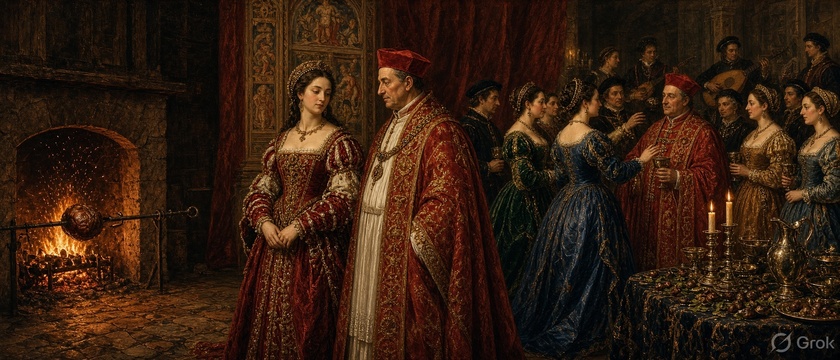
The Party, 1501 Rome.
October 30th

The Party, 1501 Rome. 

The Banquet (or Ballet) of Chestnuts was a notorious supper and entertainment purportedly held in the Apostolic Palace (Vatican) in Rome on the evening of 30/31 October 1501 (All Saints’ Eve), hosted by Cesare Borgia. The primary and most detailed source is the Liber Notarum (also called the Diarium), the official diary of Johann Burchard, the papal master of ceremonies.

Significant Figures

  • Cesare Borgia (c. 1475–1507): Son of Pope Alexander VI. A former cardinal who renounced the purple to become a condottiere and Duke of Valentinois. He was the host and central organizer.
  • Pope Alexander VI (Rodrigo Borgia, 1431–1503): The Spanish-born pope (elected 1492). According to Burchard, he was present and observed the proceedings. He is historically noted for nepotism, multiple illegitimate children, and a reputation for worldliness.
  • Lucrezia Borgia (1480–1519): Daughter of Alexander VI and sister of Cesare. Burchard places her among the spectators. She was a political pawn in dynastic marriages; at this time she was between marriages and later became Duchess of Ferrara.
  • Johann (Johannes) Burchard (c. 1450–1506): Alsatian-born priest, Protonotary Apostolic, and long-serving Master of Ceremonies under several popes. His diary is a key primary source for the Roman court under Alexander VI. He was not especially friendly to the Borgias.

Background

Alexander VI’s papacy (1492–1503) was marked by intense political maneuvering, the elevation of family members, and a court culture that blended Renaissance humanism, luxury, and clerical worldliness. Rome had a large and visible community of courtesans (high-status sex workers who also functioned as entertainers and conversationalists). Cesare, ambitious and military-minded, frequently hosted gatherings in his apartments. The date—All Saints’ Eve—adds a note of liturgical contrast that later writers emphasized.

Burchard’s account states that Cesare arranged a supper in his chambers for about fifty “honest prostitutes” (meretrices honestae), also called courtesans. After the meal they danced with servants and guests, first clothed and then naked. Candelabra with burning candles were placed on the floor; chestnuts were scattered among them. The naked women crawled on hands and knees between the lights to collect the nuts while the Pope, Cesare, and Lucrezia looked on. Prizes (silken tunics, shoes, barrets, and other items) were then offered to the men who “performed the act” most frequently with the women.

Result and Historicity

There was no formal political or institutional “result.” The episode’s lasting impact has been cultural and reputational: it became a cornerstone of the Borgia “black legend,” amplified in later Protestant and anti-papal writing and in modern popular culture (novels, films, and the TV series The Borgias).

Contemporary and modern assessments treat the full account with caution:

  • Two independent contemporary sources confirm that a social gathering involving courtesans occurred around that date, but they give far fewer and milder details. A Florentine envoy (Francesco Pepi) reported dancing and late revelry; a letter associated with Silvio Savelli notes courtesans dining at the palace and offering “a most shocking sight” without mentioning the chestnut ritual or open sexual contest.
  • Critics (including the Vatican researcher Peter de Roo) have argued that the most extreme elements may be a later interpolation, an exaggeration by a hostile diarist, or a conflation of milder events. Some note that the surviving original manuscript of Burchard does not cover 1501, so the passage depends on early copies. Others observe that inviting courtesans to lively private gatherings was not unknown in Renaissance Rome.
  • Defenders point out that Burchard is generally a sober, factual recorder of court protocol, that the passage appears in the oldest copies, and that Alexander VI’s known lifestyle (multiple children, open favoritism) makes a licentious evening plausible. Giles Milton and others have argued the account is consistent with the diary’s overall character.

In short, a banquet with courtesans and dancing in Cesare’s apartments on or about 31 October 1501 is reasonably supported; the precise chestnut-crawling spectacle, the open sexual competition, and the active spectatorship of Alexander VI and Lucrezia rest almost entirely on Burchard’s single diary entry and remain debated. The story has endured far more for its vividness and its fit with the broader Borgia reputation than for unanimous scholarly acceptance of every detail.

= October 30th 

October 30 is the shared date for these events (with minor variations in some records for the exact day of the Stettin negotiations or the Guangzhou raid, which Chinese sources place in late September/the ninth lunar month of 758).

Here is a concise overview of each:

  • 637 – Surrender of Antioch: After the Battle of the Iron Bridge (fought near the Orontes River, with heavy Byzantine losses), the Rashidun army under commanders including Khalid ibn al-Walid and Abu Ubaidah ibn al-Jarrah besieged Antioch. The city, a major Byzantine center in Syria, surrendered on 30 October. Terms typically allowed safe passage for troops or payment of the jizya. This effectively completed Muslim control over most of Roman Syria.
  • 758 – Sack of Guangzhou: During the Tang dynasty (amid the An Lushan Rebellion), Arab and Persian forces (described in Chinese annals as Dashi and Bosi troops or raiders) attacked the major port of Guangzhou (Canton). They looted and burned warehouses and parts of the city; the local governor Wei Lijian fled. Motives are debated—possibly related to trade grievances, mistreatment of foreign merchants, or military opportunism—but it disrupted the city’s role as a Silk Road maritime hub for a period.
  • 1137 – Battle of Rignano: Fought on 30 October near Rignano Garganico in southern Italy during the Norman conquest. Rebel Normans under Ranulf of Alife (recently made Duke of Apulia by Emperor Lothair II and Pope Innocent II, with some German troops) defeated the forces of King Roger II of Sicily (and his son Roger III). Sergius VII of Naples was killed. It was a significant setback for Roger II’s efforts to consolidate control in southern Italy.
  • 1270 – End of the Eighth Crusade / Siege of Tunis: King Louis IX of France had died of illness (likely dysentery) in August during the siege. His brother Charles I of Sicily (Anjou) negotiated an agreement with the Hafsid sultan of Tunis on or around 30 October. The Crusaders gained trade privileges and protections for clergy but no major territorial gains or conversion; the campaign largely collapsed due to disease. Edward of England’s forces arrived shortly afterward for what became the Ninth Crusade.
  • 1340 – Battle of Río Salado (or Tarifa): On 30 October, allied Castilian and Portuguese forces under Alfonso XI of Castile and Afonso IV of Portugal decisively defeated a large Marinid (Moroccan) and Granadan army under Abu al-Hasan and Yusuf I near the Salado River. This halted a major North African invasion of Iberia and was a key late-stage victory in the Reconquista.
  • 1485 – Coronation of Henry VII: Henry Tudor (who had defeated Richard III at Bosworth on 22 August) was crowned King of England at Westminster Abbey on 30 October, founding the Tudor dynasty. The timing helped secure his position before Parliament sat.
  • 1501 – Ballet (or Banquet) of Chestnuts: According to the diary of papal master of ceremonies Johann Burchard, Cesare Borgia hosted a notorious banquet in the Papal Palace on 30/31 October. About fifty courtesans/prostitutes entertained guests (including, by the account, the Pope and Lucrezia Borgia); after dinner they allegedly danced naked while picking up chestnuts from the floor amid candelabra, with sexual prizes offered. Contemporary and modern sources debate the account’s full accuracy or possible later embellishment.
  • 1657 – Battle of Ocho Rios (Las Chorreras): During the Anglo-Spanish War, Spanish forces under former governor Cristóbal Arnaldo Isasi (with reinforcements from Cuba) landed near Ocho Rios, Jamaica, hoping to retake the island seized by the English in 1655. English forces under acting governor Edward D’Oyley defeated them in a short engagement; Isasi fled to the hills while others were captured. This helped secure English control of Jamaica.
  • 1806 – Capitulation of Stettin: In the aftermath of Napoleon’s victories at Jena-Auerstedt, Prussian Lt. Gen. Friedrich von Romberg (with ~5,300 men and many guns) surrendered the fortress of Stettin (Szczecin) on the night of 29–30 October to a much smaller French force (~500–800 light cavalry under Gen. Antoine Lasalle). Romberg was bluffed into believing he faced a far larger army. The garrison was captured with minimal French losses.
  • 1817 – Venezuelan independence efforts under Bolívar: After securing Angostura (Ciudad Bolívar) and dealing with internal challenges (including the execution of rival Manuel Piar earlier in October), Simón Bolívar was consolidating the independent government of the Third Republic of Venezuela in the Orinoco region. Records note administrative and military steps around late October (including a Council of State), marking progress in the independence wars against Spanish rule.
  • 1831 – Capture of Nat Turner: After leading the deadliest U.S. slave rebellion (August 1831 in Southampton County, Virginia, which killed ~55–60 whites), Nat Turner hid for weeks. He was captured on 30 October by Benjamin Phipps near the rebellion’s starting area. He was tried, hanged on 11 November, and his dictated Confessions were published soon after. The revolt led to harsher slave codes across the South.

These events span Muslim expansions, medieval European wars, the Reconquista, Tudor England, Renaissance papal scandals, colonial Caribbean conflict, Napoleonic campaigns, Latin American independence, and U.S. antebellum slavery. Dates for some (especially the 758 Guangzhou raid and precise Stettin timing) can vary slightly by source or calendar.
Read full Article
October 27, 2026
post photo preview
When Spain played Salome for James 1
October 29th

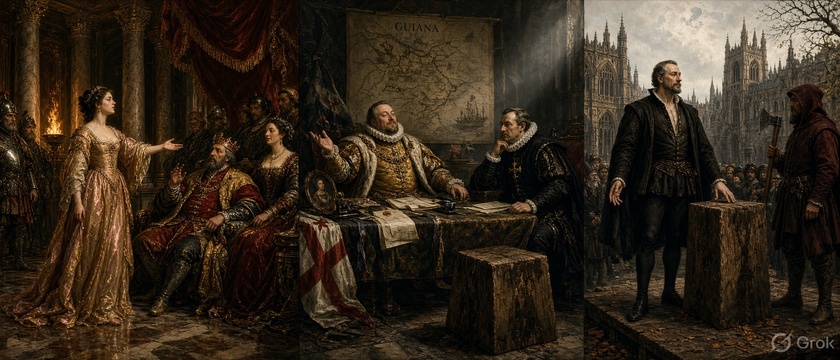
When Spain played Salome for James 1

Sir Walter Raleigh was beheaded on 29 October 1618 in the Old Palace Yard at the Palace of Westminster under a revived 1603 treason sentence. The immediate trigger was the failure of his second Guiana expedition and the attack by his men on a Spanish settlement, which clashed with King James I’s policy of peace with Spain.

Background

Raleigh (c. 1552/1554–1618) rose under Elizabeth I as a soldier, courtier, poet, explorer, and promoter of English colonization in North America (including the Roanoke ventures). He fought against the Spanish Armada, served in Ireland, and held offices such as captain of the Queen’s Guard. After Elizabeth’s death in 1603, he was implicated in the Main Plot against the new king, James I. Tried for treason, he was sentenced to death but the sentence was stayed; he spent most of the next thirteen years in the Tower of London, where he wrote The History of the World and pursued scientific and literary interests.

In 1616 James released him to lead an expedition to Guiana (present-day Venezuela/Guyana) in search of gold or El Dorado. Strict orders forbade any attack on Spanish possessions, as James was pursuing a marriage alliance and peace with Spain. The 1617–1618 voyage failed to find the promised mine. Raleigh’s son Wat was killed in a clash when some of the English force, under Lawrence Keymis, attacked the Spanish outpost of San Thomé on the Orinoco. Raleigh returned to England in 1618; the Spanish ambassador, Diego Sarmiento de Acuña (Count of Gondomar), demanded his execution. James reinstated the old 1603 sentence rather than hold a new trial.

The Execution

On the morning of 29 October 1618, Raleigh was brought from the Tower to the scaffold in Old Palace Yard. He showed notable composure: he asked to see the axe, ran his thumb along the blade, and remarked, “This is a sharp medicine, but it is a physician for all diseases.” He delivered a scaffold speech denying the main charges of conspiracy with Spain or France, affirming his loyalty, and admitting personal vanity and a sinful life as soldier, sailor, and courtier. When the executioner hesitated, Raleigh is reported to have said, “What dost thou fear? Strike, man, strike!” His head was severed in two blows.

His wife, Elizabeth (“Bess”) Throckmorton, claimed the head, had it embalmed, and kept it in a red leather bag for the remaining twenty-nine years of her life. His body was buried at St Margaret’s, Westminster.

Significant Figures

  • Sir Walter Raleigh — the condemned man; Elizabethan adventurer, writer, and colonizer whose execution became a symbol of Stuart justice and Spanish influence.
  • King James I — ordered the execution to satisfy Spanish demands and preserve his foreign policy of rapprochement with Spain.
  • Diego Sarmiento de Acuña, Count of Gondomar — Spanish ambassador who pressed for Raleigh’s death after the San Thomé incident.
  • Elizabeth (“Bess”) Throckmorton — Raleigh’s wife; secretly married him in 1591, shared his imprisonment periods, and preserved his head.
  • Lawrence Keymis — Raleigh’s lieutenant who led the attack on San Thomé; he later committed suicide.
  • Wat Raleigh — Raleigh’s eldest son, killed in the fighting at San Thomé.
  • Thomas Hariot — scientist and former associate who was present among the spectators.

Result and Significance

The execution ended Raleigh’s life and the last major Elizabethan adventurer’s career. It demonstrated James I’s willingness to sacrifice an English figure to maintain peace with Spain, reinforced perceptions of Spanish influence at court, and turned Raleigh into a popular martyr. His scaffold conduct and final words entered legend, and his writings and colonial vision continued to shape English expansion in the Americas.

= October 29th 

These events form a classic late-October cluster (mostly 27–29 October, depending on calendar and source). Several are traditionally linked to the 27th or the days immediately around it.

539 BC – Fall of Babylon and the Jewish return
Persian forces under Gobryas (Ugbaru) entered Babylon without a fight on 12 October 539 BC after victories at Opis and Sippar. Cyrus the Great himself entered the city on 29 October. The Cyrus Cylinder and the biblical book of Ezra record his policy of allowing deported peoples, including the Jews of the Babylonian Exile, to return home and rebuild their temple. This ended Neo-Babylonian rule and began the Achaemenid Empire’s control of Mesopotamia, Syria, and the Levant.

312 – Constantine after the Milvian Bridge
The night of 27 October is traditionally associated with Constantine’s vision (Lactantius’s dream of the heavenly sign; Eusebius’s later account of the cross of light and the words In hoc signo vinces). The Battle of the Milvian Bridge itself was fought on 28 October. Constantine then entered Rome in a formal adventus amid popular acclaim. Maxentius drowned in the Tiber; his body was recovered and his head displayed. The victory secured Constantine’s control of the West and is the traditional starting point of his favour toward Christianity.

437 – Marriage of Valentinian III and Licinia Eudoxia
On or about 29 October 437 in Constantinople, the Western emperor Valentinian III married his cousin Licinia Eudoxia, daughter of the Eastern emperor Theodosius II. The wedding formally reunited the two branches of the Theodosian house after years of betrothal and helped stabilise relations between the eastern and western courts, though real power in the West remained with the general Aetius.

969 – Byzantine capture of Antioch
After a prolonged blockade, Byzantine forces under Michael Bourtzes and Petros took Antioch from the Hamdanids on 28 October 969. The city, lost to the Arabs in the 7th century, returned to imperial control. The victory was followed by the Treaty of Safar, which made the Emirate of Aleppo a Byzantine tributary and secured northern Syria for the empire under Nikephoros II Phokas.

1268 – Execution of Conradin
On 29 October 1268 in Naples, the 16-year-old Conradin (last male Hohenstaufen heir, nominal King of Jerusalem and Sicily) and his companion Frederick of Baden were beheaded on the orders of Charles I of Anjou (Charles of Sicily). The execution extinguished the direct Hohenstaufen line and confirmed Angevin rule in southern Italy.

1390 – First documented witchcraft trial in Paris
Around 29 October 1390 the secular court of the Châtelet in Paris began proceedings against Jeanne de Brigue (La Cordière) and others (including Margot de la Barre and Marion la Droiturière). Accused of sorcery, love magic, and diabolism, several were tortured, convicted, and later burned. It is the earliest well-documented Parisian witchcraft case and marks the shift of such prosecutions from ecclesiastical to secular courts.

1467 – Charles the Bold defeats Liège
On 28 October 1467 at the Battle of Brustem, Burgundian forces under Charles the Bold (then Count of Charolais, soon Duke) routed the army of Liège. The victory led to the city’s submission, the demolition of its walls, and the conversion of the Prince-Bishopric into a Burgundian protectorate. It was the second of the Wars of Liège; a third and more destructive rising was crushed the following year.

1591 – Election of Pope Innocent IX
The short conclave of 27–29 October elected Cardinal Giovanni Antonio Facchinetti as Pope Innocent IX on 29 October. A compromise candidate favoured by the Spanish party, he reigned only until 30 December 1591. During his brief pontificate he supported Philip II and the Catholic League in the French Wars of Religion.

1611 – Russian homage to Sigismund III Vasa
On 29 October 1611 in the Senate Hall of the Royal Castle in Warsaw, the deposed Tsar Vasily IV Shuysky, his brothers Ivan and Dmitry, and other captives taken after the Polish capture of Moscow paid formal homage to King Sigismund III Vasa and his son Prince Władysław. The ceremony (the “Shuysky Tribute”) was a high point of Polish-Lithuanian power during the Time of Troubles.

1618 – Execution of Sir Walter Raleigh
On 29 October 1618 in the Old Palace Yard at Westminster, Sir Walter Raleigh was beheaded under the revived 1603 treason sentence. The immediate cause was the failure of his second Guiana expedition and the attack on a Spanish settlement, which angered James I’s desire for peace with Spain. Raleigh’s scaffold speech and composure became legendary.

1658 – Battle of the Sound
On 29 October (Old Style) / 8 November (New Style) 1658, a Dutch fleet under Jacob van Wassenaer Obdam defeated a Swedish fleet under Carl Gustaf Wrangel in the Øresund. The victory broke the Swedish blockade of Copenhagen, relieved the Danish capital, and prevented Sweden from controlling both sides of the Sound and thus the Baltic trade routes.

1665 – Battle of Mbwila
On 29 October 1665 near Mbwila (present-day Angola), a Portuguese force defeated the army of the Kingdom of Kongo. King António I (Nvita a Nkanga) was killed and decapitated; many nobles died or were captured. The defeat shattered Kongo’s political unity, triggered civil war between rival kandas, and accelerated Portuguese influence and the slave trade in the region.

1675 – Leibniz and the integral symbol
On 29 October 1675, in an unpublished manuscript (Analyseos tetragonisticae pars secunda), Gottfried Wilhelm Leibniz first used the elongated “∫” (from the Latin summa) as the symbol for the integral. Two weeks later he combined it with the differential notation dx. The system remains the standard notation of calculus.

1787 – Premiere of Don Giovanni
On 29 October 1787 at the Estates (Nostitz) Theatre in Prague, Mozart conducted the world premiere of his opera Don Giovanni (K. 527), with a libretto by Lorenzo Da Ponte. Delayed by production difficulties, the performance was a triumph and remains one of the greatest works in the operatic repertoire.

1792 – Naming of Mount Hood
On 29 October 1792, while exploring the Columbia River as part of George Vancouver’s expedition, Lieutenant William Broughton sighted the great Cascade volcano (known to local peoples as Wy’east) from near the mouth of the Willamette and named it Mount Hood after Admiral Samuel Hood, 1st Viscount Hood.

Together these episodes illustrate the recurring late-October rhythm of conquest, dynastic marriage, judicial violence, scientific invention, and artistic creation across more than two millennia.

Read full Article
October 27, 2026
post photo preview
The Siege of La Rochelle
October 28th

The Siege of La Rochelle (1627–1628)

was the climactic episode of the last major Huguenot rebellions against the French crown. It ended the military and political autonomy of French Protestants and marked a decisive step toward the absolute monarchy under Louis XIII and Cardinal Richelieu.

Before the Siege

The French Wars of Religion (1562–1598) had pitted Catholics against Huguenots (French Calvinists). They were settled by Henry IV’s Edict of Nantes (1598), which granted Protestants freedom of worship, civil rights, and a network of fortified “places of safety” (places de sûreté), including the Atlantic port of La Rochelle. La Rochelle became the strongest and wealthiest remaining Huguenot stronghold, with a large Protestant population, commercial power (especially the salt trade), and a semi-autonomous character.

After Henry IV’s assassination in 1610, his young son Louis XIII came under more Catholic influence. Tensions rose in the 1620s as Huguenots resisted royal efforts to curb their independence. Cardinal Richelieu, Louis XIII’s chief minister, viewed the Huguenot “state within a state” as incompatible with centralized royal authority. In 1627, England under Charles I intervened: the Duke of Buckingham landed forces on the nearby Île de Ré to support the Rochelais and encourage a broader rebellion. This prompted the royal siege.

The Siege (September 1627 – 28 October 1628)

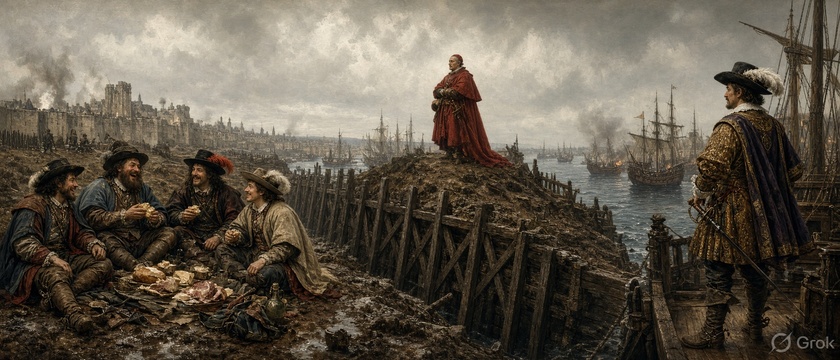
Royal forces under Louis XIII and Richelieu began investing the city in the late summer/early autumn of 1627. Richelieu’s key innovation was the construction of a massive seawall or dyke (digue) across the harbor entrance, sealing La Rochelle off from the sea and blocking English relief.

Three English fleets (including under Buckingham and later the Earl of Lindsey) attempted to break the blockade or relieve the city but failed. Inside the walls, the defenders—led eventually by the energetic mayor and former admiral Jean Guiton—held out through starvation and disease. The population, roughly 27,000–28,000 at the start, fell to about 5,000–5,500 survivors by the end. Guiton is famous for the (possibly legendary) gesture of stabbing a dagger into the council table and declaring he would pierce the heart of anyone who spoke of surrender.

The city surrendered unconditionally on 28 October 1628. Louis XIII and Richelieu entered in triumph shortly afterward. Most inhabitants received clemency, though fortifications were demolished.

After the Siege

The fall of La Rochelle broke the back of organized Huguenot military resistance. The Peace of Alès (also called the Edict of Grace or Edict of Alais), signed on 28 June 1629, confirmed the core religious freedoms of the Edict of Nantes (freedom of conscience and limited worship) but stripped the Huguenots of political assemblies, independent military forces, and all fortified places of safety. They ceased to be a political or military party and became ordinary subjects of the king. This consolidated royal power and advanced Richelieu’s program of strengthening the central state. The long-term vulnerability of French Protestants culminated in Louis XIV’s Revocation of the Edict of Nantes in 1685, which triggered large-scale emigration.

Significant Figures

  • Louis XIII (1601–1643): King of France; present at the siege and the political beneficiary of the victory that strengthened the monarchy.
  • Cardinal Richelieu (Armand Jean du Plessis, 1585–1642): Chief minister and effective commander of the siege. He directed the engineering of the dyke, managed the campaign, and used the victory to advance royal absolutism. His red-caped figure surveying the works became an iconic image.
  • Jean Guiton (1585–1654): Shipowner, Huguenot admiral, and mayor of La Rochelle during the siege. He organized the defense and became a local symbol of resistance (his house and a commemorative statue remain in the city; a table with a dagger mark is displayed at the Hôtel de Ville).
  • George Villiers, 1st Duke of Buckingham (1592–1628): English favorite of Charles I; commanded the initial expedition to Île de Ré and later relief attempts. He was assassinated in England in August 1628.
  • Other notables included the royal commander Toiras (who held Île de Ré), the Huguenot leader Benjamin de Rohan (Soubise), and various marshals under the king.

Significant Fictional Depictions

The siege is most famous as the historical backdrop of Alexandre Dumas père’s The Three Musketeers (1844). In the novel, d’Artagnan, Athos, Porthos, and Aramis serve with the royal army at the siege; Buckingham’s involvement is woven into the romantic and political intrigue involving Queen Anne of Austria and the villainous Milady de Winter. The book (and its countless stage, film, television, comic, and game adaptations) popularized the episode for generations. Recent examples include the French films The Three Musketeers: D’Artagnan and Milady (2023), which depict the siege (filmed in part at Saint-Malo).

Other literary treatments include:

  • Robert Merle’s Fortune de France series (volume 11, La Gloire et les Périls).
  • Lawrence Norfolk’s Lemprière’s Dictionary (1991), which uses the siege as a pivotal, fictionalized origin for later events.
  • Taylor Caldwell’s The Arm and the Darkness (1943).

Visual depictions are also notable, especially Henri-Paul Motte’s 1881 painting Cardinal Richelieu at the Siege of La Rochelle, showing the cardinal in his red cloak on the dyke amid the fortifications and ships.

In short, the siege was both a brutal military operation that devastated a prosperous Protestant city and a political turning point that ended Huguenot independence and advanced the centralized Bourbon state. Its dramatic setting and cast of characters have kept it alive in literature and popular culture, above all through Dumas.

= October 28th 

October 27 (and closely related dates around it) features several notable events across Roman, medieval, early modern, and later history. Many sources list events near this date (sometimes on the 27th or 28th, depending on calendars and exact records). Here is a chronological overview of the ones you listed, with brief context.

Roman and Late Antique Period

  • AD 97: Emperor Nerva, under pressure from a Praetorian Guard mutiny (and lacking a natural heir or strong military backing after Domitian’s assassination), adopted the popular general Marcus Ulpius Trajanus (Trajan) as his son and successor. This occurred publicly in October 97. It stabilized the succession and began the pattern of “adoptive” emperors among the “Five Good Emperors.” Nerva died in January 98; Trajan succeeded smoothly and expanded the empire to its greatest extent.
  • 306: Maxentius (son of the retired emperor Maximian) was proclaimed emperor by the Praetorian Guard and elements of the Roman Senate and people in Rome, on or around 28 October 306. This was part of the breakdown of Diocletian’s Tetrarchy; he controlled Italy and Africa for several years until defeated by Constantine.
  • 312: Constantine I defeated Maxentius at the Battle of the Milvian Bridge (near Rome, over the Tiber) on 28 October 312. Maxentius drowned in the retreat. Constantine became the dominant ruler in the West. The night before (often linked to 27 October), Constantine is traditionally said to have had a vision of a cross or the Chi-Rho symbol with the words “in this sign, conquer.” This event is pivotal in the history of Christianity’s rise within the empire (followed by the Edict of Milan in 313).
  • 456: Visigothic forces under Theodoric II sacked Braga (Bracara Augusta), the capital of the Suebi kingdom in Gallaecia (modern Portugal/northern Spain). Contemporary chronicler Hydatius describes the sacking of churches, desecration of altars, and mistreatment of clergy and civilians (though not a full massacre). It followed a Visigothic victory over the Suebi near the Órbigo River; Suebi king Rechiar was later captured and executed. This weakened Suebi power significantly.

Medieval Period

  • 969: Byzantine general Michael Bourtzes seized a key wall tower of Antioch (held by the Hamdanids) on or around 28 October. He held it for three days against counterattacks until reinforcements under the stratopedarches Peter arrived and secured the city. This was a major reconquest for the Byzantines under Nikephoros II Phokas (though Bourtzes was later sidelined for disobeying orders and joined the conspiracy that assassinated the emperor).
  • 1061: Empress Agnes (regent for the young Henry IV) and an assembly of German/Lombard bishops and notables at Basel elected Bishop Cadalus of Parma as antipope Honorius II (on or around 28 October). This challenged the reformist Pope Alexander II (elected earlier by cardinals under Hildebrand’s influence). The schism lasted into the mid-1060s before Alexander’s position was confirmed.
  • 1344: Crusaders of a papal-led Holy League (including forces linked to the papacy, Venice, the Hospitallers, and others) captured the lower town and harbor of Smyrna (modern İzmir) from the Aydinid Turks under Umur Beg on or around 28 October. This was a response to Turkish piracy in the Aegean; the upper citadel remained in Turkish hands for a time. Smyrna stayed in Latin hands until Timur’s conquest in 1402.
  • 1420: Beijing was formally designated the primary capital of the Ming dynasty (under the Yongle Emperor), coinciding with the completion of the Forbidden City as the imperial seat. The capital had been moved from Nanjing; this consolidated power closer to the northern frontier.
  • 1449: Christian I (of the House of Oldenburg) was crowned King of Denmark in Copenhagen (Church of Our Lady), typically dated 28 October. He was the first Oldenburg king of Denmark (and later Norway and briefly Sweden under the Kalmar Union).
  • 1453: Ladislaus the Posthumous (Habsburg, born after his father’s death) was crowned King of Bohemia in Prague on or around 28 October. Actual power remained largely with regents (notably George of Poděbrady in Bohemia and earlier figures in Hungary); he died young in 1457.
  • 1492: Christopher Columbus’s fleet reached Cuba on his first voyage (sighted/landed around 27–28 October). He named it Juana (after the Spanish prince) and initially believed it related to Asia/Cipango (Japan) or the Asian mainland. This followed his Bahamas landfall on 12 October.

Early Modern Period

  • 1516: At the Battle of Yaunis Khan (near Khan Yunis/Gaza), Ottoman forces under Grand Vizier Hadım Sinan Pasha defeated a Mamluk force under Janbirdi al-Ghazali. This was part of the Ottoman–Mamluk War; it helped clear the way for the Ottoman advance into Egypt after the earlier victory at Marj Dabiq.
  • 1531: At the Battle of Amba Sel, forces of Imam Ahmad ibn Ibrahim al-Ghazi (of the Adal Sultanate) again defeated the army of Ethiopian Emperor Lebna Dengel (Dawit II). This allowed Adal control over southern Ethiopia during the Ethiopian–Adal War.
  • 1538: The Universidad Santo Tomás de Aquino (in Santo Domingo, present-day Dominican Republic) was established by papal bull In Apostolatus Culmine of Pope Paul III (dated 28 October). Run by Dominicans, it is often cited as the first university in the Americas (with later royal recognition). It operated with interruptions until the 19th century.
  • 1628: The long Siege of La Rochelle (a major Huguenot stronghold during the French Wars of Religion) ended with the city’s surrender on 28 October after ~14 months. Cardinal Richelieu’s royal forces (under Louis XIII) had built a blockade/seawall; English relief efforts failed. The Huguenots lost pol


Read full Article
See More
Available on mobile and TV devices
google store google store app store app store
google store google store app tv store app tv store amazon store amazon store roku store roku store
Powered by Locals