


680 — Karbala.
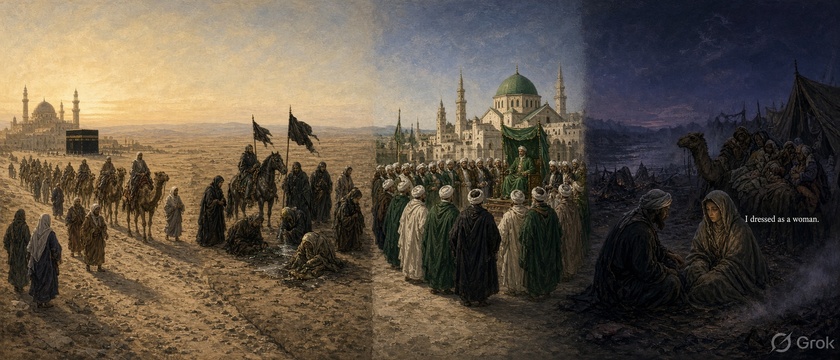
The fight ran in this order. The seventy were with Husayn. They were not the army sent against him.
Husayn had already left Mecca in early September 680, after his envoy Muslim ibn Aqil had been executed in Kufa. On the road a screen of about a thousand horse under al-Hurr ibn Yazid stopped him. Al-Hurr would not let him into Kufa and would not let him turn back to the Hijaz. The two parties moved together until 2 Muharram (2 October), when the column was halted on the open plain of Karbala, west of the Euphrates.
Umar ibn Sa’d arrived with the main force, several thousand, under orders from Ubayd Allah ibn Ziyad: take the oath on the spot, or fight. From 7 Muharram the horse were posted between the tents and the river. One small party got water through. After that the channel was closed.
On 9 Muharram Shimr ibn Dhi al-Jawshan brought Ibn Ziyad’s final order: submission at once, or attack, and Umar ibn Sa’d himself answerable if he delayed. Husayn asked for the night. He told his men they were free to leave under cover of dark. The early report is that none of the fighting men went. That is the seventy or so: relatives, clients, and a few who had joined him, inside his camp, not facing him.
At dawn on 10 Muharram both sides prayed. Al-Hurr, the commander who had first blocked the road, crossed over and was killed on Husayn’s side. Talks ended. Umar ibn Sa’d’s line advanced. Husayn’s men went out in small groups and were cut down. By afternoon the companions were dead, then several of the family, including sons and nephews. Abbas ibn Ali was killed trying to reach the water. Husayn, already wounded, was finished in the open and beheaded. The camp was looted and the tents burned. The women and children were taken, with Ali Zayn al-Abidin, who had been too ill to fight.
Umar ibn Sa’d buried his own dead. Husayn and his men were left until local tribesmen interred them. The heads and the captives went first to Kufa, to Ibn Ziyad, and then to Yazid in Damascus.
=
Karbala was not a battle between two armies that chose a field. It was a small household column stopped on open ground, denied the river, and then killed once it would not give the oath Yazid wanted.
Why they were there
Muawiya died in the spring of 680. He had spent twenty years turning a contested governorship of Syria into a hereditary caliphate, and he named his son Yazid to succeed him. Allegiance was taken in Damascus and pressed in the other garrison cities. Husayn ibn Ali, grandson of Muhammad and son of Ali, refused it in Medina, as did Abd Allah ibn al-Zubayr. Both men left for Mecca, where killing was forbidden and a crowd for the pilgrimage could be addressed.
Kufa was the other pole. It had been Ali’s capital, it was full of men who had fought for him at Siffin, and it resented Syrian rule. Letters reached Husayn promising tens of thousands of supporters if he came. He did not go at once. He sent his cousin Muslim ibn Aqil to test the offer. Muslim was at first received openly, then Ubayd Allah ibn Ziyad, already governor of Basra, was given Kufa as well. Ibn Ziyad entered the city, bought or frightened the notables, and had Muslim and his host Hani ibn Urwa executed. The pledged rising collapsed before Husayn left Mecca.
Husayn set out anyway, around 8–9 Dhu al-Hijja 60 (early September 680), with family, a few dozen fighting men, and camp followers — women, children, and retainers. The early account in al-Tabari, drawing on Abu Mikhnaf, puts the armed men at something like seventy by the end, not an army. On the road he met the poet al-Farazdaq, who told him that Kufan hearts were with him and Kufan swords with Ibn Ziyad. He also received news of Muslim’s death. Companions were released from their oaths. Some left. He continued. Turning back meant either the oath to Yazid or the life of a fugitive. Going on meant a garrison city that had already failed his envoy.
Why the ground looked like that
North of Mecca the road toward Kufa runs up the west side of the Euphrates. Husayn’s column was met by a cavalry screen of about a thousand men under al-Hurr ibn Yazid al-Tamimi, sent to shadow him and keep him off the main roads into the city. Al-Hurr would not let him enter Kufa and would not, at first, force a fight. The two parties moved together until, on 2 Muharram (2 October), they were halted on the bare plain of Karbala, west of the river, with no town and no fort.
That placement was deliberate. Ibn Ziyad’s order to his field commander, Umar ibn Sa’d, was to keep Husayn from Kufa, from the river towns, and from any return to the Hijaz, and to demand the oath. Karbala gave the larger force every advantage: open ground for cavalry, no walls, and the Euphrates within reach but easy to seal. Umar ibn Sa’d arrived with the main body, traditionally numbered in the thousands, and put five hundred horse between the camp and the water. A small party got through once and brought back a few skins. After that the channel was closed. From 7 Muharram the camp was on stored water in early October heat.
Umar ibn Sa’d is the awkward figure in the story. He wanted the governorship of Rayy, and Ibn Ziyad made the command against Husayn the price of it. Negotiations ran for days. Husayn’s reported offers were to withdraw to the frontier, to return the way he had come, or to be taken to Yazid in person. Ibn Ziyad, pushed by Shimr ibn Dhi al-Jawshan, rejected anything short of submission on the spot. Shimr arrived with that order and with a threat against Umar ibn Sa’d if he hesitated. On the eve of the fight al-Hurr crossed over to Husayn’s side, an act the early sources record and later telling makes much of.
What happened
The killing itself was on 10 Muharram, 10 October 680. It was not a pitched battle. Umayyad horse and foot surrounded the tents. Husayn’s men fought in small groups and were cut down. By afternoon the companions were dead, then several of the family, including sons and nephews. Accounts name Abbas ibn Ali trying to reach the water and being killed on the channel. Husayn, wounded, was finished in the open. The man credited with the beheading varies by report; Shimr is the name later tradition fixes on. Heads were taken. The camp was looted, tents burned, and the women and children assembled.
Ali Zayn al-Abidin, Husayn’s eldest surviving son, was ill and had not fought. He was spared, and with him the line continued. The bodies of Husayn and his men were left unburied until local tribesmen interred them a day or more later. Umar ibn Sa’d buried his own dead first.
The captives were walked to Kufa. Ibn Ziyad had the heads set out and questioned the prisoners. Zaynab bint Ali, Husayn’s sister, answered him in the scene the Shia tradition treats as the first public indictment of the killing. The column was then sent to Damascus. Yazid received them, and the sources disagree on his manner: some have him striking Husayn’s mouth with a cane as the head was displayed, others have him distancing himself from Ibn Ziyad and releasing the family. Both can be true of a court managing a scandal. The survivors were sent back toward Medina.
Outcomes
In the short run the Umayyads got what they had forced the issue for. No Alid counter-caliph was proclaimed in Kufa. Yazid’s nomination held. The price showed quickly. In 683 Medina rose and was sacked after the Battle of al-Harra. Ibn al-Zubayr held Mecca. Yazid died that same year. His son Muawiya II lasted months. Ibn Ziyad was killed in 686 by Ibrahim ibn al-Ashtar, fighting for Mukhtar al-Thaqafi, who had taken Kufa in the name of vengeance for Husayn and had many of the Karbala commanders hunted down. The Marwanid branch restored the dynasty, but Karbala remained the charge against it.
The lasting outcome was religious, not territorial. For Shia Muslims the day became the founding martyrdom: Ashura, mourning gatherings, and the passion narrative of the tents, the water, the boy Ali al-Asghar, and Zaynab’s protest in Damascus. Husayn’s refusal is read as the stand of the Prophet’s house against a worldly kingship. Sunni historians, including the early ones, generally call the killing a crime and Yazid’s pressure a disaster, without making 10 Muharram a communal rite or treating Husayn as an imam in the Shia sense. The numbers, the speeches, and the named killers hardened in later retellings. The core that the earliest collectors already have is stable: a refused oath, a Kufan invitation that collapsed, a camp stopped short of the river, and a grandson of Muhammad killed by the caliph’s governor.
= October 10th
680 — Karbala. The usual date is 10 October 680 (10 Muharram, AH 61), on the plain of Karbala west of the Euphrates in present-day Iraq. Husayn ibn Ali, grandson of Muhammad and son of Ali, had refused to recognise Yazid I as caliph after Muawiya’s death. He left Mecca with family and a small retinue, expecting support from Kufa. The governor Ubayd Allah ibn Ziyad intercepted him. Husayn’s fighting men numbered about seventy against several thousand under Umar ibn Sa’d. After water was cut off and terms refused, the camp was overrun. Husayn was killed and beheaded; the head was sent to Yazid in Damascus, the bodies were mutilated, and the women and children were taken captive. His sick son Ali Zayn al-Abidin was spared. The fight secured the Umayyad succession for the moment. For Shia Muslims it became the founding martyrdom: Ashura, the tenth of Muharram, is still a day of mourning, processions, and retelling. Sunni tradition also treats Husayn’s death as a wrong, but does not make the day a communal rite in the same way.
732 — Tours (Poitiers). Fought in October 732, most often given as 10 October, somewhere between Poitiers and Tours. Charles Martel, mayor of the palace and effective ruler of the Franks, met an Umayyad army from al-Andalus under Abd al-Rahman al-Ghafiqi. The Muslim force had raided deep into Aquitaine. Charles held a defensive infantry line; Abd al-Rahman was killed, and the raiders withdrew toward the Pyrenees. Later Christian writers, Gibbon among them, cast it as the battle that saved Europe. Modern historians are cooler: it stopped one campaign and strengthened Charles in the south, but Umayyad pressure on the frontier continued for years, and the deeper limit on expansion was overstretch, not a single field. Numbers are guesses. The battlefield has never been fixed.
1471 — Brunkeberg. Again the standard date is 10 October 1471, on the Brunkeberg ridge just north of Stockholm. Sten Sture the Elder, regent of Sweden, faced King Christian I of Denmark, who was trying to restore the Kalmar Union. Sture’s army was built heavily from farmers and miners of the Bergslagen, plus some regulars. Christian had Danish and German troops. Sture caught the king’s force between attacks from west, east, and the city. Christian was shot in the mouth, lost teeth, and was carried to his ships. The victory broke the unionist party for a generation and left Sture as the effective ruler of Sweden. It was as much a Swedish civil fight, unionists against separatists, as a war with Denmark.
1575 — Dormans. On 10 October 1575, during the French Wars of Religion, Henry I, Duke of Guise, beat a Protestant force at Dormans. It was the only clear Catholic success in a bad campaign. Guise took a facial wound that earned him the name le Balafré, “the scarred,” already carried by his father. Among the prisoners was Philippe de Mornay (Duplessis-Mornay), the Huguenot writer and diplomat later called the “Huguenot pope.” He was ransomed cheaply and soon married Charlotte Arbaleste. The skirmish mattered less for ground gained than for Guise’s reputation in Paris, which fed the Catholic League a few years later.
1580 — Dún an Óir. In autumn 1580 a papal expedition of roughly 600 Italian and Spanish troops under Sebastiano di San Giuseppe landed at Smerwick harbour in County Kerry to support the Second Desmond Rebellion. The fort they occupied was Dún an Óir, the Fort of Gold. The landing itself is usually placed in September; the decisive end came in November, when Lord Grey de Wilton and a naval squadron under William Winter besieged the fort. After surrender, the garrison was massacred. The episode hardened English policy in Munster and became a set piece in Irish memory of the Desmond wars.
1582 — the missing days. Pope Gregory XIII’s reform cut ten days from October so that the calendar would match the solar year and Easter would fall correctly. In the papal states, Spain, Portugal, and the Polish–Lithuanian lands that adopted it at once, 4 October 1582 was followed by 15 October. The 5th through the 14th, including the 8th, did not occur. France, the Protestant states, and Britain waited — Britain until 1752 — which is why letters of the period sometimes carry two dates.
1631 — Prague. After the Swedish–Saxon victory at Breitenfeld on 17 September 1631, John George I of Saxony sent an army under Hans Georg von Arnim into Bohemia. Prague was occupied in November 1631, not on 8 October; the city was entered around the middle of that month. The occupation was short. Imperial forces recovered Bohemia the next year, and the Saxon intervention is remembered more as a raid that looted the palace archives than as a lasting conquest.
1760 — the Ndyuka treaty. On 10 October 1760, at the Dutch camp of Vreedenburg, colonial authorities in Suriname signed a peace with the Ndyuka (Aukaner), Maroons descended from Africans who had escaped plantation slavery and built villages up the Marowijne and Tapanahony. The treaty recognised them as free, confirmed a territory well inland of the plantations, and required them to return later runaways for a bounty. Similar treaties followed with the Saramaka (1762) and Matawai (1767). From the Ndyuka side it is still treated as the charter of freedom and territorial autonomy, older than the modern Surinamese state.
1780 — the Great Hurricane. The deadliest recorded Atlantic hurricane struck the Lesser Antilles between about 10 and 16 October 1780. Barbados, Martinique, and St Eustatius were wrecked. Estimates run from 20,000 to 30,000 dead, many of them on ships of the French and British fleets gathered for the American war. Admiral Rodney’s and de Guichen’s squadrons both lost heavily. Contemporary reports describe stone buildings levelled and harbours choked with wrecks. No storm in the Atlantic basin has a higher accepted death toll.