VoiceDDB
Politics • Culture • News
Is Racism Porn?
Will the Anti-Racism Movement Cave Like the Anti-Porn One Did?
June 13, 2026
post photo preview

Is Racism Porn? Will the Anti-Racism Movement Cave Like the Anti-Porn One Did?

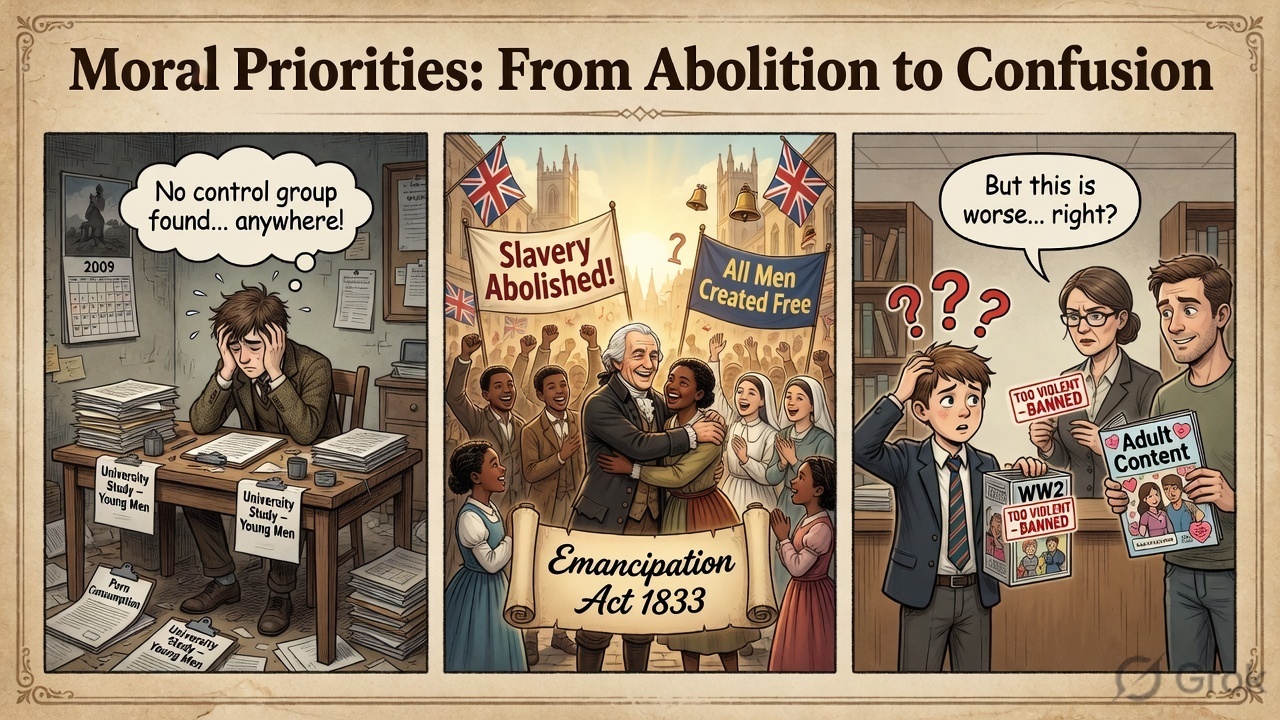
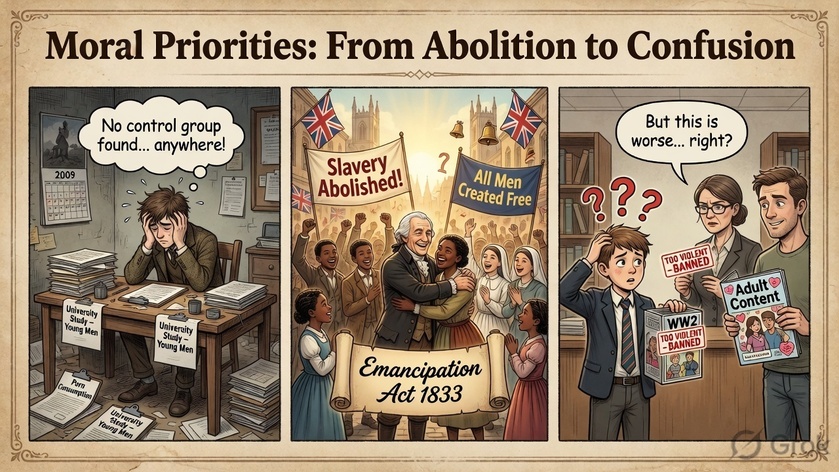
In the 1980s, a potent alliance of radical feminists and social conservatives launched a serious campaign against pornography. Led by figures like Andrea Dworkin and Catharine MacKinnon, they framed much of it as violence against women — graphic subordination that normalized harm. They pushed civil rights ordinances and influenced the Meese Commission under President Reagan. Yet the movement fractured. Sex-positive feminists rebelled against what they saw as censorship and puritanism. Courts struck down key measures on First Amendment grounds. Violent and extreme porn was temporarily sidelined in mainstream discourse, but the deeper politicized strain of feminism splintered. Today, pornography is ubiquitous, with studies (such as one attempted at a Canadian university that couldn't even find a control group of young men who hadn't viewed it) underscoring its normalization.

The anti-racism movement of recent decades invites a parallel. Both issues started outside the core wheelhouse of center-right conservatives, who traditionally emphasized individual responsibility, rule of law, and color-blind opportunity rather than identity-based crusades. Yet both became vehicles for broader cultural and political power plays.

Historical Perspective on Racism

Academic conservative thought has long pointed to the 19th century as a pivotal era when racism, particularly chattel slavery, faced decisive moral and political challenge in the English-speaking world. British evangelicals — William Wilberforce, the Clapham Sect, and allied Quakers and Methodists — drove the abolition of the slave trade (1807) and slavery itself in the Empire (1833). Their campaign rested on Christian universalism: all men created in God's image, endowed with inherent dignity and rights to freedom, not engineered equal outcomes. This was a rights-based, opportunity-focused vision distinct from later 20th-century interpretations emphasizing group equity or systemic determinism.

Slavery and racial prejudice did not vanish overnight, of course. But the moral framework shifted dramatically through persistent, principle-driven activism grounded in transcendent ethics rather than perpetual grievance.

Modern Enlargement and Exploitation

Critics argue that racism as a dominant political narrative enlarged under President Obama. A notable moment came after the 2012 Trayvon Martin case, when Obama remarked that the deceased "could have been my son," injecting personal identity into a contested incident involving a neighborhood watch confrontation. This style of framing amplified racial polarization.

The 2020 death of George Floyd became a headline catalyst for the movement. While Derek Chauvin was convicted, the initial narrative of murder by knee compression alone has been disproved. The Hennepin County medical examiner cited cardiopulmonary arrest complicating restraint, with heart disease, fentanyl, and methamphetamine as significant contributing factors. An independent autopsy differed, but the full context complicated the "police lynching" storyline. Floyd's death was tragic; the broader "defund the police" and systemic racism narrative built around it has frayed as facts emerged.

Recent revelations about the Southern Poverty Law Center (SPLC) — long a flagship of the anti-racism industry — add to the sense of crumbling. In 2026, federal charges alleged the organization funneled millions in donor funds to informants tied to extremist groups it publicly opposed, raising serious questions of fraud and manufacturing the very threats it fundraised against.

Deeper historical questions resurface: Did authorities facilitate or cover elements of past events like the Oklahoma City bombing? Official accounts point to Timothy McVeigh and Terry Nichols, but persistent theories of additional involvement or negligence remain debated and unproven in court. Such inquiries test institutional trust.

The Parallel and the Warning

Racism is wrong. It violates the principle that individuals should be judged by character and conduct, not skin color. Violent pornography harms, especially when accessible to children, and erodes healthy formation of relationships and sexuality. Both deserve principled opposition rooted in truth and human dignity.

Yet the pattern repeats: moral concerns get hijacked for political dominance. The anti-porn effort split feminism and lost momentum as technology and cultural shifts overwhelmed it. The anti-racism juggernaut, fueled by selective narratives, academic capture, and institutional incentives, now faces headwinds — evidentiary cracks, donor skepticism, and a Trump-era political realignment that prioritizes results over rhetoric.

Will it "cave" similarly? Movements that rely on exaggeration, selective enforcement, and identity as currency often do when reality intrudes. The 19th-century abolitionists succeeded by appealing to universal truths and persistent reform, not perpetual victimhood. Today's exploiters of these issues — whether inflating racism for power or earlier anti-porn zealots — risk the same irrelevance when their narratives no longer hold.

The wiser path lies not in denial of real problems, but in rejecting their weaponization. Protect children from porn. Oppose actual racism with color-blind justice. Demand evidence over emotion. Center conservatives, with their emphasis on individual liberty and equal opportunity under law, may yet provide the steadier framework — as their intellectual forebears did against slavery. The question is whether the broader culture will let principle prevail over power.

community logo
Join the VoiceDDB Community
To read more articles like this, sign up and join my community today
0
What else you may like…
Videos
Posts
Articles
00:01:07
November 27, 2022
Jingle Bell Rock

Jingle bell, jingle bell, jingle bell rock
Jingle bells swing and jingle bells ring
Snowin' and blowin' up bushels of fun
Now the jingle hop has begun

Jingle bell, jingle bell, jingle bell rock
Jingle bells chime in jingle bell time
Dancin' and prancin' in Jingle Bell Square
In the frosty air

What a bright time, it's the right time
To rock the night away
Jingle bell time is a swell time
To go glidin' in a one-horse sleigh

Giddy-up jingle horse, pick up your feet
Jingle around the clock
Mix and a-mingle in the jinglin' feet
That's the jingle bell rock

Jingle bell, jingle bell, jingle bell rock
Jingle bell chime in jingle bell time
Dancin' and prancin' in Jingle Bell Square
In the frosty air

What a bright time, it's the right time
To rock the night away
Jingle bell time is a swell time
To go glidin' in a one-horse sleigh

Giddy-up jingle horse, pick up your feet
Jingle around the clock
Mix and a-mingle in the jinglin' feet
That's the jingle bell
That's the jingle...

00:02:04
September 01, 2021
Intro to Locals for the Conservative Voice

David Daniel Ball calls himself the Conservative Voice.

I'm a teacher with three decades experience teaching math to high school kids.I also work with first graders and kids in between first grade and high school. I know the legends of why Hypatia's dad is remembered through his contribution to Math theory. And I know the legend of why followers of Godel had thought he had disproved God's existence.

I'm not a preacher, but I am a Christian who has written over 28 books all of which include some reference to my faith. Twelve blog books on world history and current affairs, detailing world events , births and marriages on each day of the year, organised by month. Twelve books on the background to and history of Bible Quotes. One Bible quote per day for a year. An intro to a science fiction series I'm planning, post apocalyptic cyber punk. An autobiography with short story collections.

I'm known in Australia for my failure as a whistleblower over the negligence death of a school boy. ...

00:01:50
Holiday break is over back to work tonight

Tonight I'll start double posting until I've caught up.

Chinese Space Bio Labs

While Elon Musk is busy landing reusable rockets and building robot swarms on Earth, the CCP has gone full 'Musk but make it bioweapons': they're launching fleets of Starship-inspired rockets crewed by copycat Optimus robots, blasting 'Fau Chi' biolabs straight into Low Earth Orbit.

These gleaming orbital stations, proudly emblazoned with the Chinese characters 福奇 (Fú Qí — sounding suspiciously like 'Fau Chi'), are officially designated as The Science™ Research Facilities. Perfect for safe, ethical gain-of-function experiments on exciting new pathogens like TDS (Trump Derangement Syndrome), 'Last Millennia' nostalgia plagues, and the deadly 'We Are Living in 2026' variant.

The endgame? A billion trusting parents worldwide voluntarily neutering their own children on expert 'Fau Chi' advice from the heavens — because nothing says 'public health' like taking guidance from a floating Chinese biolab with reusable re-entry capabilities.

post photo preview
Editorial from 2018 for June 9th

Don't give up on hope. Western Civilisation is on the nose of universities in Australia. Sydney University collapsed in 1990, and her upper executive got replaced by ALP managerialists as Keating fought a culture war which the Liberal Party have not effectively engaged. Dame Kramer had been made Chancellor, but the Chancellor's position is not executive at Sydney University. Kramer fought effectively for Western Values, but the University, now, is as partisan left as the ABC is now. Kramer had been a powerful presence in charge of the ABC too. 

In 1990, Sydney University lost her Chancellor and Vice Chancellor. The Chancellor, Hermann David Black, died after a long illness. James Anthony Rowland, a former governor of NSW took the chancellor's position for a few years, before passing it to Kramer in 1991. She held on to 2001. From 1981 to 1990, John Manning Ward was the executive head of Sydney University as Vice Chancellor. He had been writing a trilogy on Australian conservative leaders ...

post photo preview
post photo preview
the US Civil War became certain
From personal difficulties in challenging times

From personal difficulties in challenging times, the US Civil War became certain.

Franklin Pierce and James Buchanan, successive Democratic presidents in the 1850s, governed amid rising sectional fury over slavery. Both men carried heavy personal burdens into office. Both operated inside partisan media environments that amplified their worst instincts and muted dissent. Neither proved equal to the crisis. The result was not merely policy failure but the progressive collapse of the Union’s political center.

Pierce arrived as “Young Hickory,” the handsome New Hampshire Democrat who had ridden Andrew Jackson’s coattails from private to brigadier general in the Mexican War. His private life was already marked by grief and frailty. His wife Jane, religious and committed to temperance, disliked the political world. Their three sons all died young; the last, Benjamin, was killed in a train wreck weeks before the inauguration. Pierce himself was often unwell and later died of cirrhosis. These private sorrows did not prevent him from making a decisive public error. By signing the Kansas-Nebraska Act in 1854, he repealed the Missouri Compromise’s prohibition on slavery north of 36°30′ and substituted “popular sovereignty.” The predictable consequence was Bleeding Kansas—armed conflict between pro- and anti-slavery settlers—and the rapid emergence of the Republican Party. For a time the partisan press cheered the move as democratic principle and Western expansion. Only when the violence became undeniable did his own party refuse him renomination.

Buchanan, the only lifelong bachelor president, carried a different private wound: the broken engagement and sudden death of his fiancée Anne Coleman in 1819, long rumored to have been suicide. He spent decades as a skilled politician and diplomat, serving in Congress, as minister to Russia and Britain, and as Polk’s Secretary of State during the era of continental expansion. He entered the White House in 1857 intending to quiet the storm. Instead the Supreme Court’s Dred Scott decision—rendered by a Court shaped in large part by Democratic appointments—declared that Congress lacked power to ban slavery in the territories and that Black people had no rights the white man was bound to respect. Buchanan’s subsequent push to admit Kansas under the pro-slavery Lecompton Constitution further split his party. The doctrine of states’ rights, combined with the formal denial of citizenship to people of color, rendered the Union’s constitutional order increasingly untenable for large parts of the North. When Abraham Lincoln won the 1860 election and offered a careful, limited compromise on the extension of slavery, Southern states seceded. Buchanan denied both the right of secession and the federal power to coerce the seceding states. He left office with the country fracturing. He later supported the Union cause during the war, but the damage of the preceding four years was already irreversible.

Then, as now, partisan media functioned as an echo chamber. Democratic papers defended Pierce’s Kansas-Nebraska Act as fidelity to local self-government and later portrayed Buchanan’s acquiescence in Dred Scott as respect for judicial authority and constitutional restraint. Opposition voices were dismissed as agitators or sectional extremists. The presidents, operating inside that closed information loop, found it easier to continue along the path of least resistance than to confront the moral and political reality that slavery’s expansion was no longer compatible with a durable Union.

Would either man have governed differently if the headlines had been less forgiving? Possibly at the margins. Public pressure can force recalculation. Yet both men’s records suggest deeper limits: personal grief and temperament in Pierce’s case, a lifelong preference for legalistic compromise and Southern constitutional arguments in Buchanan’s. The more fundamental failure was institutional and cultural. A political system that could not produce leaders capable of recognizing when compromise had become capitulation, and a media culture that rewarded tribal affirmation over hard truth, left the country without the resources to negotiate its deepest division.

The Civil War was not inevitable in 1850. By the time Lincoln took the oath in 1861, after eight years of Democratic stewardship under Pierce and Buchanan, it had become nearly certain. Personal misfortune does not excuse public failure. Nor does a partisan press absolve presidents of the duty to see beyond their own side’s applause.

Read full Article
post photo preview
Created by a Blockhead
Minecraft was invented by a blockhead.

Created by a Blockhead

Minecraft was invented by a blockhead.

Not a metaphorical one. A literal, self-made, pixel-pushing blockhead named Markus “Notch” Persson. A Swedish programmer who, in 2009, looked at the world of video games—full of glossy polygons, cinematic cutscenes, and publishers demanding focus-tested perfection—and decided the future belonged to cubes.

He was not entirely wrong.

What began as a weekend experiment called Cave Game on an indie forum became the most commercially successful and culturally inescapable video game of the 21st century. A game that lets children build cathedrals and adults role-play as miners, architects, warlords, and hermits. A game so simple a five-year-old can grasp it and so deep that universities teach coding and urban planning with it. All of it resting on the stubborn vision of one man who thought the height of graphical sophistication was a world made of Lego that bites back.

Persson was not a visionary in the Steve Jobs sense. He was a tinkerer with a short attention span and a talent for iterative chaos. He borrowed heavily—from Infiniminer’s mining, from his own failed RubyDung prototype, from the indie scene’s willingness to ship half-baked ideas and let the players finish them. He released early, charged money while the game was still broken, and updated it in public like a man building a house while living in it. The result was not polished design. It was something rarer: a digital sandbox that felt like it belonged to the people playing it.

That openness was both its genius and its eventual burden. Minecraft did not merely succeed; it metastasised. It escaped the PC and colonised phones, consoles, classrooms, and YouTube. It turned “let’s play” into an industry and “creeper” into a universal punchline. By the time Microsoft paid $2.5 billion for Mojang in 2014, the blockhead had become a billionaire and the game had become too big for its creator.

Persson walked away. He had grown tired of the pressure, the scrutiny, and the realisation that his little cube experiment now carried the weight of a cultural institution. The departure was messy, the subsequent public commentary messier still. Mojang and Microsoft quietly airbrushed him from the official story, which is what corporations do when the founding eccentric becomes inconvenient. The game, meanwhile, kept evolving under other hands—more biomes, more dimensions, more systems—proving that the idea had outgrown the man who first stacked the dirt blocks.

There is a lesson here, and it is not a gentle one. Minecraft’s success was never about perfection. It was about permission. Permission to dig, to build, to fail spectacularly, to grief your friends, to create something beautiful or stupid or both. The blockhead understood, perhaps instinctively, that players did not need a story forced upon them. They needed tools and a world that pushed back just enough to feel real.

Most games try to impress you. Minecraft simply hands you a pickaxe and shrugs. That shrug has sold hundreds of millions of copies and shaped a generation’s idea of what play can be.

Not bad for a blockhead.

Read full Article
post photo preview
On and after the first of August
two commanders faced the reckoning of empires.

On and after the first of August, two commanders faced the reckoning of empires.

Separated by fifteen centuries, Marcus Antonius and Elizabeth Tudor both stood at the hinge of history in the heat of late summer. One ended in blood and silence. The other in fireworks and legend. The fighting they directed shared a recognisable shape—naval pressure, land forces held in reserve, personal resolve under extreme political strain—yet the technology, the tactics, and the final choices diverged so sharply that the same calendar date produces opposite myths.

Antony: a minor victory, then the end

On 31 July 30 BC, outside Alexandria, Antony still possessed enough fight to scatter Octavian’s advancing cavalry. It was a small, sharp success—the last flash of the old soldier. The next morning the structure collapsed. His remaining cavalry defected. What was left of his fleet surrendered. The infantry followed. Alexandria opened its gates.

Months earlier, at Actium, he had already made the hard calculation. When the larger battle turned against him, Antony and Cleopatra broke out with a portion of the fleet and, crucially, the treasure. The rest of the navy was sacrificed; the great land army was left behind to negotiate its own terms. The gold and the queen were preserved. Everything else—reputation, legions, the eastern alliance system—was lost.

On 1 August, believing Cleopatra already dead, Antony fell on his sword. The wound was not immediately fatal. He was carried to her mausoleum and died in her arms. The suicide was not pure despair. It was Roman, calculated, and protective. By dying, he removed himself as a living prize and reduced the incentive for further exemplary punishment of those still linked to him. His eldest son by Fulvia was executed. The younger children by Cleopatra were taken to Rome and raised under Octavia’s care. His two daughters by Octavia—Antonia Major and Antonia Minor—survived and prospered. Through Antonia Minor the blood of Antony entered the Julio-Claudian line. Caligula, Claudius, and Nero all carried it. In the end the man who lost the world became, by a bitter irony, one of the ancestors of the very emperors who ruled it. Revenge of a sort.

Elizabeth: captains, fire, and a speech

Elizabeth’s crisis came in the same season, 1,618 years later. The Spanish Armada of 1588 was intended to clear the Channel, link with Parma’s army in Flanders, and deliver a Catholic invasion force onto English soil. The English response was built on men who understood ships the way Antony had once understood legions.

Charles Howard of Effingham held overall command. Francis Drake, the most famous of the sea dogs, brought aggression and local knowledge. John Hawkins had reformed the navy’s ships and gunnery. Martin Frobisher and others filled out a cadre of captains who knew how to fight under sail with long-range cannon rather than the boarding actions preferred by Mediterranean galley fleets. Their vessels were smaller, faster, and better armed for stand-off combat. They harried the Armada up the Channel, refused close engagement on Spanish terms, and waited for the moment of vulnerability.

That moment came off Calais. On the night of 7–8 August the English sent fireships into the anchored Spanish formation. The Armada cut cables and scattered. The following day’s fighting at Gravelines damaged more ships. Then the wind shifted and drove the Spanish north. The link with Parma was broken. The long, lethal voyage home around Scotland and Ireland finished what English guns had begun. Storms, starvation, disease, and shipwreck did the rest.

Elizabeth herself never commanded a ship. Her decisive act was political and theatrical. On 8 or 9 August she rode to the camp at Tilbury, where the land army waited against the possibility that Parma might still cross. There she delivered the speech that still echoes:

“I know I have the body of a weak and feeble woman; but I have the heart and stomach of a king, and of a king of England too, and think foul scorn that Parma or Spain, or any prince of Europe, should dare to invade the borders of my realm… I myself will take up arms, I myself will be your general, judge, and rewarder of every one of your virtues in the field.”

By the time she spoke, the naval danger had already largely passed. The speech was therefore not a last stand but a consolidation of victory—an assertion of personal courage, Protestant legitimacy, and national solidarity. She celebrated. Medals were struck. “God blew and they were scattered” became the official gloss. The Virgin Queen remained unmarried and childless by deliberate policy, preserving her independence and the fiction that she was wedded only to the realm.

Similarities and the long divergence

Both confrontations turned on the control of narrow waters and the coordination of sea and land forces. Both leaders faced the risk that a single misjudgement would end their political existence. Both used personal presence—Antony among his remaining troops, Elizabeth at Tilbury—to steady morale. Both understood that treasure and political capital mattered as much as ships and soldiers.

The differences were decisive. Antony fought with heavy, oar-powered vessels designed for ramming and boarding; Elizabeth’s captains fought under sail with broadside artillery. Antony’s coalition was brittle and Eastern; Elizabeth’s was national and increasingly professional. Antony, once the army deserted, had no institutional base left. Elizabeth’s captains and her council of war continued to function after the Armada fled.

One chose the sword and left a bloodline that later wore the purple. The other chose the virgin crown and left no direct heir at all. One’s final act was private and fatal. The other’s was public and triumphant.

The calendar brought them into strange proximity. The outcomes could not have been more different.

Read full Article
See More
Available on mobile and TV devices
google store google store app store app store
google store google store app tv store app tv store amazon store amazon store roku store roku store
Powered by Locals