


When Modern Justice arrived
On 30 November 1786, Grand Duke Pietro Leopoldo of Tuscany (later Holy Roman Emperor Leopold II) issued the Riforma della legislazione criminale (known as the Leopoldine Code or Leopoldina). This made the Grand Duchy of Tuscany the first modern state to formally and systematically abolish the death penalty for all crimes, while also ending judicial torture and moderating other punishments.
Before 1786: Context and Preparations
Tuscan criminal law before the reforms was a patchwork of Roman law, medieval statutes, local customs, and severe practices inherited from earlier centuries. It featured frequent use of the death penalty (even for lesser offences), judicial torture to extract confessions, branding, mutilation, confiscation of property, and “civil death.” Pietro Leopoldo (born 1747 in Vienna as Peter Leopold of Habsburg-Lorraine; Grand Duke from 1765 after the death of his father, Francis I) found the system too harsh and ill-suited to the “mild and gentle character” of the Tuscan people.
From the start of his reign he pursued broad Enlightenment-inspired reforms in administration, taxation, agriculture (including land reclamation), the economy, and the Church (suppressing the Inquisition in Tuscany). On criminal justice specifically, he issued earlier edicts and instructions that already moderated or suspended the death penalty and torture in practice while he studied a full overhaul. Key advisers included the Florentine jurists Pompeo Neri (who headed commissions on civil and criminal justice reform and was central to earlier projects under the Lorraine dynasty) and Giulio Rucellai, as well as the influence of Austrian jurist Carlo Antonio Martini.
The intellectual foundation was Cesare Beccaria’s 1764 treatise Dei delitti e delle pene (On Crimes and Punishments), which argued that the death penalty was neither useful nor necessary for deterrence or social order, that punishment should be proportionate, prompt, certain, and public, and that torture was irrational and unjust. Beccaria’s work (briefly placed on the Index) circulated widely and shaped reform thinking across Europe; Pietro Leopoldo explicitly applied its principles.
The Leopoldine Code Itself
Signed in Pisa on 30 November 1786, the reform declared the death penalty abolished “for ever” against any offender (present or contumacious, confessed or convicted) for any previously capital crime. It replaced capital sentences primarily with hard labour or public works for life. It also abolished judicial torture, the use of oaths in certain contexts, treating contumacy as equivalent to confession, confiscation of goods (which often harmed innocent families), civil death, branding, mutilation, and certain rope-based torments. Lèse-majesté offences were narrowed. Procedural changes modernised the inquisitorial system: provisional release was allowed, priority was no longer given to formal legal evidence alone, and witness testing by imprisonment was banned.
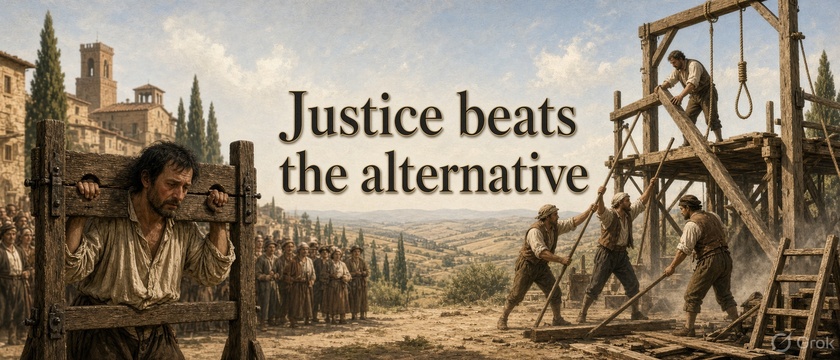
It was not a fully modern codification (it retained a discursive style, did not systematically repeal all prior laws, and left some older punishments such as the pillory). Yet it represented a decisive modernisation of Tuscan practice and was widely noted abroad as a pioneering Enlightenment achievement. Pietro Leopoldo ordered scaffolds removed and instruments of torture destroyed.
Significant Figures
- Pietro Leopoldo (Peter Leopold / Leopold II): The driving force—an unusually hands-on enlightened ruler who personally studied the issues and insisted on leniency combined with prevention and certain enforcement.
- Cesare Beccaria: The Milanese jurist and philosopher whose 1764 treatise supplied the core arguments against capital punishment and torture.
- Pompeo Neri: Leading Tuscan jurist and administrator who helped shape the reform process and earlier legal rationalisation projects.
- Supporting ministers and jurists such as Giulio Rucellai and others in the commissions that prepared the groundwork.
After 1786
The abolition was not permanent in every respect. After Pietro Leopoldo left Tuscany in 1790 to become Holy Roman Emperor (following the death of his brother Joseph II), the death penalty was reintroduced for certain offences—especially political ones—from around 1790 onward under his successor Ferdinand III. It was further altered in the Napoleonic period (when Tuscany became the Kingdom of Etruria and later part of France, introducing elements of the Napoleonic codes). The Leopoldina was reinstated with the restoration of the Grand Duchy in 1814 and remained in force until the new Tuscan Penal Code of 1853. Even when the death penalty existed on the books in later decades, it was applied rarely in Tuscany. It was abolished again by the provisional government in 1859 on the eve of annexation to the Kingdom of Italy; the unified Italian Zanardelli Code of 1889 then abolished it nationwide.
The reform’s longer-term legacy was substantial. It demonstrated that a modern state could function without capital punishment, influenced later European and American penal thinking, and is commemorated in Tuscany as Cities for Life Day / Festa della Toscana on 30 November. Historians such as Franco Venturi have called the Leopoldina one of the most important documents of Beccaria’s and Enlightenment influence on Italian legislation of the eighteenth century.
In short, the 1786 reform was both the culmination of two decades of preparatory moderation under an unusually progressive Habsburg-Lorraine ruler and a landmark practical application of Beccaria’s ideas—the first systematic modern state abolition of the death penalty, even if subsequent political upheavals limited its uninterrupted continuity.
= November 30th
These events cluster in late November (especially around 30 November), spanning sieges, a royal death, a pivotal peace signing, and a legal reform. One date in the list needs correction based on the sources.
978 (not 977): Otto II’s failed siege of Paris and rearguard defeat at the Aisne
In the Franco-German war of 978–980 over Lotharingia and personal honour, King Lothair of West Francia (with allies including Hugh Capet) launched a surprise attack on Aachen in summer 978, nearly capturing Emperor Otto II. Otto retaliated in the autumn, invading West Francia, sacking royal sites, and briefly besieging Paris (camping on Montmartre and having a choir chant the Alleluia). Unable to take the city, he withdrew in November 978. After most of his army had crossed the Aisne, West Frankish forces under Lothair struck the baggage train and rearguard; sources describe heavy losses, with one account claiming the corpses clogged the river.
Peace followed in 980 at Margut-sur-Chiers: Lothair renounced claims to Lotharingia. The campaign highlighted ongoing Carolingian-Ottonian rivalry and helped elevate Hugh Capet, who later founded the Capetian dynasty.
1707: Second Siege of Pensacola ends in British/Creek failure
Part of Queen Anne’s War (North American theatre of the War of the Spanish Succession), this was the second of two 1707 attacks by Carolina traders and Creek (mainly Tallapoosa and Alabama) allies on Spanish Pensacola and Fort San Carlos de Austria. The August siege burned much of the town but failed to take the fort. In late November a smaller force (~20 traders + ~300 Creeks) arrived, demanded surrender (rejected by Governor Don Sebastián de Moscoso, whose garrison was disease-weakened), and launched ineffective night attacks on 27/28, 28/29, and 29/30 November. A leading Creek chief was killed on the final night; the attackers withdrew on the morning of 30 November after significant casualties. French relief from Mobile arrived too late. The fort held; Pensacola was reduced largely to its garrison.
1718: Death of Charles XII of Sweden at the Siege of Fredriksten
During the Great Northern War, Charles XII invaded Norway in autumn 1718 aiming to take the border fortress of Fredriksten (Fredrikshald/Halden) as a stepping-stone. Swedish trenches approached the walls when, on the evening of 30 November (Old Style; 11 December New Style), a projectile (likely a musket ball or grapeshot) struck him through the left temple while he inspected the works. He died instantly. The Swedes abandoned the siege and the invasion; a secondary force under Armfeldt suffered heavy winter losses retreating. Charles’s death ended Sweden’s imperial era (formalised later by the Treaty of Nystad) and opened the Age of Liberty. Circumstances of the shot (enemy or own side) remain debated.
1782: Preliminary articles of the Treaty of Paris signed
On 30 November 1782 in Paris, American commissioners (John Adams, Benjamin Franklin, John Jay, Henry Laurens) and British commissioner Richard Oswald signed preliminary peace articles. Britain acknowledged the United States as free, sovereign, and independent; set boundaries; provided for cessation of hostilities, prisoner exchanges, and British withdrawal (without carrying off American property); and addressed issues such as Loyalists and debts. These were later formalised in the 1783 Treaty of Paris that ended the American Revolutionary War.
1786: Tuscany abolishes the death penalty
On 30 November 1786, Grand Duke Pietro Leopoldo (later Holy Roman Emperor Leopold II) issued the Riforma della legislazione criminale (Leopoldine Code) for the Grand Duchy of Tuscany. It permanently abolished the death penalty for all crimes, ended torture, limited confiscation, and moderated other punishments—the first modern state to do so systematically. Influenced by Enlightenment ideas (especially Cesare Beccaria’s Dei delitti e delle pene), it is commemorated as Cities for Life Day. The abolition was not permanent for every category of offence after Leopoldo left for Austria in 1790.
These episodes range from medieval dynastic warfare and early-modern colonial raids to Enlightenment reform and the diplomatic close of the American Revolution. The late-November timing of the last four is striking; the Otto campaign is securely placed in November 978 by the main narrative sources.